1 530 résultats
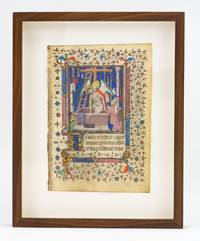
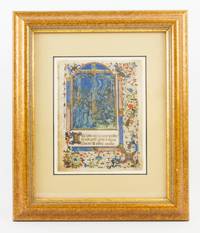
1440réf. ST19540aMetz ca. 1440. Leaf: 162 x 124 mm. 6 3/8 x 4 7/8". Frame: 308 x 258 mm. 12 1/8 x 10 1/8". Single column three lines of text under the miniature obverse with 18 ruled lines five of which contain text in a gothic book hand. Attractively matted and framed. Recto with one three-line initial in gold on pink and blue ground WITH A LARGE MINIATURE OF THE CRUCIFIXION WASHED IN BLUE Christ on a painted gold cross flanked by two thieves on painted gold crosses surrounded by throngs of people including the Virgin St. John Mary Magdalene and numerous soldiers all in an arched gold frame inside a three-sided painted and gilt baguette and a FULL BORDER of colorful vine sprays and flowers inhabited by a peacock. See: "The Jeanne Miles Blacburn Collection of Manuscript Illuminations" nos. 29-38; Avril & Reynaud pp. 182 & 190. Minor soiling/browning right at inner edge away from border and image otherwise IN VERY FINE CONDITION THE MINIATURE REMARKABLY WELL PRESERVED WITHOUT ANY LOSS OF PAINT. This stunning miniature with its memorable nocturnal scene comes from a very fine Book of Hours probably executed by Henri d'Orquevaulz or d'Orquevaulx or a member of his workshop. D'Oquevaulz was active during the second quarter of the 15th century in Metz the cultural and commercial capital of Lorraine during the period and the center of a growing book trade. According to the catalogue of the Jeanne Miles Blackburn Collection in the Cleveland Museum of Art which owns 10 leaves from the original manuscript the parent Book of Hours can be localized based on the Lorraine dialect found in the French text on some of the leaves including the present example and because the calendar singled out two bishop-saints of Metz Clement and Arnoul. Although little is known about d'Orquevaulz his dated signature in the colophon of a Livy manuscript that he illuminated for an alderman of Metz indicates that he was active in that city in 1440. Artistic affinities with northern European styles make it possible that d'Orquevaulz had emigrated from the Netherlands or Germany to Lorraine; another possibility one that Avril and Renaud suggest is that the master himself was from Metz but that he had German associates perhaps from the Rhineland area. According to these two scholars the painter's use of large flat areas of colors is more typical of the Rhineland the Netherlands or Bohemia than of France; in any case they praise his "exquisite color harmonies." The artist has outdone himself in the present miniature rising to the height of pathos and making it one of the most extraordinary leaves we have ever offered for sale. In contrast to the bright colors used in Books of Hours even to depict the most serious scenes the present leaf presents a remarkable visual nocturne with the figures and buildings painted in the same shades of blue as the sky suggesting that heaven itself is darkening at the death of Christ. Mary Magdalen kneels at the foot of the cross while St. John supports the devastated Virgin as a soldier pierces the Savior's side with a lance. The miniature is crowded with figures we see well-defined faces of no fewer than 18 persons and two horses but the artist has not lost his dramatic focus as Christ on his cross of brushed gold dominates the scene. In choosing to make this a darkened composition the artist has risked obscuring detail but his skill has been equal to his concept here as he has used a diluted blue paint that allows for a very successful delineation in various shades almost like grisaille this technique not incidentally has prevented the cracking and erosion so commonly seen with the normal thick applications of typical cobalt blue. The result of the decision to show the world in eclipse at Christ's death is to heighten and universalize the drama here to such an extent that the scene leaves a powerful and lasting impression. The text on this leaf is entirely in French in rhyming verse. Roughly it translates as: "Jesus on the cross did hang / And took upon himself our sins / Gave to humankind redemption / Rendered up his soul to God. / The sunshine lost its glowing light / The earth did tremble and did crack / Grieving for the bitter death / Suffered by the son of God." Although the original Book of Hours was dismembered some time in the 20th century extant leaves suggest that its visual program was much bigger than usual and probably the result of an important commission by a wealthy patron--something likely to be painted by one of the chief artists in the workshop. Illuminated manuscripts from Metz--let alone examples of this quality--are uncommonly seen on the market. unknown
1415réf. ST17763Paris ca. 1415-20. Leaf: 160 x 110 mm. 6 1/4 x 3/8"; Frame: 232 x 185 mm. 9 1/8 x 7 1/4". Recto with three lines single column in a gothic book hand verso not inspected due to frame. Mounted in a wooden frame. Recto with a three-line initial in blue on gold ground embellished with ivy leaves A HALF-PAGE MINIATURE DEPICTING THE MASS OF ST. GREGORY the recently crucified Christ depicted emerging from a tomb supported by an angel and surrounded by the Arma Christi St. Gregory kneeling at the corner of the image the text and miniature framed by thick bar borders of pink blue and gold on three sides all SURROUNDED BY A FULL BORDER of hairline vines gilt ivy leaves and bezants and a few colorful flowers and acanthus. A little faint smudging in top and bottom borders very small scarcely noticeable area of blue background retouched not affecting the figures but A BEAUTIFUL LEAF the colors bright and the detail in the miniature very well preserved. Featuring carefully realized detail intriguing iconography and artistry that shows a very high degree of skill this is an important and early example of the work of the Master of the Harvard Hannibal. The subject of the present work is a well-known story about the sixth century Pope Gregory ca. 540-604 commonly known as St. Gregory the Great. According to legend Gregory was saying Mass when one of his deacons expressed a doubt in the doctrine of Transubstantiation whereby the communion bread actually becomes the body of Christ. Gregory prayed to God for a verifying sign whereupon Christ appeared in the guise of the Man of Sorrows clad in a loincloth and displaying the bloody wounds he incurred during the Crucifixion. Most Medieval miniatures depict Gregory kneeling before an altar as he says Mass accompanied by one or more deacons or assistants who bear witness to the miraculous event. In a notable departure from this norm the present miniature depicts the saint alone at the edge of the picture plane; in place of the chalice host and altar that would normally occupy the center of the scene is a considerable open tomb from which a larger-than-life-size Christ emerges. With blood still rushing from his wounds he places one hand on the edge of the tomb to steady himself while an angel supports him from behind. Christ's expression conveys both physical and mental pain as he struggles to support his own bodyweight; the angel who assists him spreads his wings protectively around the body of Christ while looking down at Gregory with a sorrowful expression knitted into his brow. The fine detail work seen in the figures' faces the angel's wings and the careful delineation of each slender finger is also carried over into more than a dozen objects crammed into the spaces in and around the tomb the rope is especially remarkable in the representation of its detail. Known as the "Arma Christi" or "Instruments of the Passion" these objects are meant to symbolize Christ's suffering. Seen here are: the cross nails and hammer that were used to crucify Christ the ladder used in the Deposition the disembodied hand symbolizing the one which slapped Christ's face the dice used by soldiers to see who would claim his seamless robe a lantern used by the soldiers who arrested Christ the 30 pieces of silver from Judas' betrayal a purple robe used in the mockery of Christ and other items that appear as part of the Passion narrative. It is also interesting to note that although a St. Gregory miniature usually appears at the beginning of the Hours of the Cross the Penitential Psalms or before the Seven Prayers of St. Gregory here rather unusually it opens a reading from John chapter 19 beginning "In illo tempore adprehendit Pilatus Iesum et flagellavit" describing the events of the Passion. This miniature can be attributed to an artist known as the Master of the Harvard Hannibal so-named for a splendid miniature painting of the "Coronation of Hannibal" prefacing a Livy in the Harvard College Library. Active from about 1415-30 in Paris and later possibly Rouen it is believed that our illuminator was a pupil of the Boucicaut Master with whom he is thought to have collaborated on several manuscripts both secular and religious. The present miniature would probably have been executed early in his career and while it certainly shows the influence of his teacher it also reveals certain stylistic tendencies that would become staples of the Master of the Harvard Hannibal's more mature work such as his preference for rich colors heavy molding of the faces and interest in decorative details. With its clever composition meticulous detail work and emotive figures that engage the viewer the present miniature is not only a beautiful work of art it also documents the precocious talent of an emerging master early in his professional career. unknown books
1415réf. ST17763Paris ca. 1415-20. Leaf: 160 x 110 mm. 6 1/4 x 3/8"; Frame: 232 x 185 mm. 9 1/8 x 7 1/4". Recto with three lines single column in a gothic book hand verso not inspected due to frame. Mounted in a wooden frame. Recto with a three-line initial in blue on gold ground embellished with ivy leaves A HALF-PAGE MINIATURE DEPICTING THE MASS OF ST. GREGORY the recently crucified Christ depicted emerging from a tomb supported by an angel and surrounded by the Arma Christi St. Gregory kneeling at the corner of the image the text and miniature framed by thick bar borders of pink blue and gold on three sides all SURROUNDED BY A FULL BORDER of hairline vines gilt ivy leaves and bezants and a few colorful flowers and acanthus. A little faint smudging in top and bottom borders very small scarcely noticeable area of blue background retouched not affecting the figures but A BEAUTIFUL LEAF the colors bright and the detail in the miniature very well preserved. Featuring carefully realized detail intriguing iconography and artistry that shows a very high degree of skill this is an important and early example of the work of the Master of the Harvard Hannibal. The subject of the present work is a well-known story about the sixth century Pope Gregory ca. 540-604 commonly known as St. Gregory the Great. According to legend Gregory was saying Mass when one of his deacons expressed a doubt in the doctrine of Transubstantiation whereby the communion bread actually becomes the body of Christ. Gregory prayed to God for a verifying sign whereupon Christ appeared in the guise of the Man of Sorrows clad in a loincloth and displaying the bloody wounds he incurred during the Crucifixion. Most Medieval miniatures depict Gregory kneeling before an altar as he says Mass accompanied by one or more deacons or assistants who bear witness to the miraculous event. In a notable departure from this norm the present miniature depicts the saint alone at the edge of the picture plane; in place of the chalice host and altar that would normally occupy the center of the scene is a considerable open tomb from which a larger-than-life-size Christ emerges. With blood still rushing from his wounds he places one hand on the edge of the tomb to steady himself while an angel supports him from behind. Christ's expression conveys both physical and mental pain as he struggles to support his own bodyweight; the angel who assists him spreads his wings protectively around the body of Christ while looking down at Gregory with a sorrowful expression knitted into his brow. The fine detail work seen in the figures' faces the angel's wings and the careful delineation of each slender finger is also carried over into more than a dozen objects crammed into the spaces in and around the tomb the rope is especially remarkable in the representation of its detail. Known as the "Arma Christi" or "Instruments of the Passion" these objects are meant to symbolize Christ's suffering. Seen here are: the cross nails and hammer that were used to crucify Christ the ladder used in the Deposition the disembodied hand symbolizing the one which slapped Christ's face the dice used by soldiers to see who would claim his seamless robe a lantern used by the soldiers who arrested Christ the 30 pieces of silver from Judas' betrayal a purple robe used in the mockery of Christ and other items that appear as part of the Passion narrative. It is also interesting to note that although a St. Gregory miniature usually appears at the beginning of the Hours of the Cross the Penitential Psalms or before the Seven Prayers of St. Gregory here rather unusually it opens a reading from John chapter 19 beginning "In illo tempore adprehendit Pilatus Iesum et flagellavit" describing the events of the Passion. This miniature can be attributed to an artist known as the Master of the Harvard Hannibal so-named for a splendid miniature painting of the "Coronation of Hannibal" prefacing a Livy in the Harvard College Library. Active from about 1415-30 in Paris and later possibly Rouen it is believed that our illuminator was a pupil of the Boucicaut Master with whom he is thought to have collaborated on several manuscripts both secular and religious. The present miniature would probably have been executed early in his career and while it certainly shows the influence of his teacher it also reveals certain stylistic tendencies that would become staples of the Master of the Harvard Hannibal's more mature work such as his preference for rich colors heavy molding of the faces and interest in decorative details. With its clever composition meticulous detail work and emotive figures that engage the viewer the present miniature is not only a beautiful work of art it also documents the precocious talent of an emerging master early in his professional career. unknown
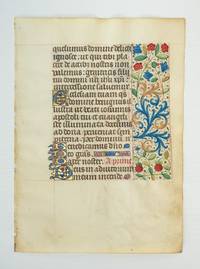
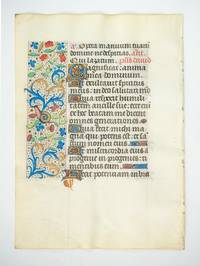
1500réf. ST20810BParis ca. 1500. 165 x 115 mm. 6 1/2 x 4 1/2". Single column 18 lines in a gothic book hand. Rubrics in red line fillers in pink and blue with gilt bezants and white embellishment most leaves with one or more one-line initials in burnished gold on pink and blue ground with white embellishments many leaves with one or more two-line initials in blue or pink with white embellishments enclosing leaves or flowers on burnished gold ground each side with panel border of acanthus flowers and/or fruit and gilt bezants one leaf with a small bird perched in the border sold at this price level due to an ink smear. The odd smudge of small stain but generally quite clean fresh and well preserved. Featuring high-quality illuminated initials a fine border on every page and the liberal use of painted and burnished gold these leaves clearly come from a luxurious Book of Hours produced by an accomplished workshop. Although a common element is the appearance of prominent blue acanthus every panel border shows a slightly different design with varying flower combinations a fact that may make selecting a single favorite quite difficult!. unknown books
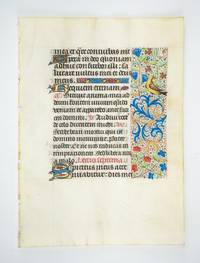
1500réf. ST20810GParis ca. 1500. 165 x 115 mm. 6 1/2 x 4 1/2". Single column 18 lines in a gothic book hand. Rubrics in red line fillers in pink and blue with gilt bezants and white embellishment each leaf with one or more one-line initials in burnished gold on pink and blue ground with white embellishments and one two-line initial in blue or pink with white embellishments enclosing leaves or flowers on burnished gold ground EACH SIDE WITH A PANEL BORDER INCORPORATING AN ANIMAL OR HYBRID CREATURE and filled with acanthus flowers and/or fruit and gilt bezants. Light soiling or thumbing to some leaves but in uniformly excellent condition almost entirely clean fresh and bright. Whether you prefer your marginalia in the form of beautiful peacocks murderous-looking bunnies or fantastic hybrids these leaves feature pleasing creatures fanciful and charming. Featuring high-quality illuminated initials a fine border on every page and the liberal use of painted and burnished gold the leaves clearly come from a luxurious Book of Hours produced by an accomplished workshop. The marginal creatures are prominent executed with considerable skill and exhibit a great deal of personality. unknown books
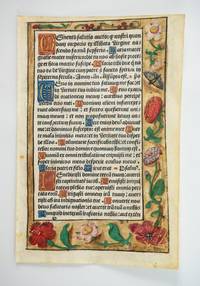
réf. ST20972dParis: Nicolas Vivien early 16th century. 197 x 130 mm. 7 3/4 x 5 1/8". Single column 28 lines gothic typeface. Ruled in red each leaf with several one- to three-line initials painted gold on red or blue ground and A LOVELY ANIMATED FULL BORDER DONE IN MANUSCRIPT with trompe-l'oeil flowers a moth a fly and a bird on painted gold ground. Light soiling and a couple small stains to vellum one initial a bit smudged but in excellent condition overall. This beautifully embellished leaf from a printed Book of Hours demonstrates the enduring demand for manuscript illumination in the incunabular period and beyond. While the text here was completed on a printing press the initials and border were done entirely by hand adding luxury and luster to an otherwise unadorned page. Although this leaf likely belonged to a Book of Hours printed in Paris possibly an edition printed for Nicolas Vivien in or around 1503 the trompe-l'oeil style seen in the border was particularly popular among Flemish and Netherlandish illuminators of the period. The large blossoms and acanthus here seem to pop off the page because of the artist's use of subtle shading to indicate shadows and there is additional pleasure to be found in the small creatures--a bird carrying a small flower a moth and a housefly--that share the space. Nicolas Vivien(?) unknown books
réf. ST20972b-cParis: Nicolas Vivien early 16th century. 197 x 130 mm. 7 3/4 x 5 1/8". Single column 28 lines gothic typeface. Ruled in red two one-line initials and two three-line initials painted in gold on red or blue ground and A LOVELY ANIMATED FULL PAINTED BORDER done by hand with trompe-l'oeil flowers one leaf also with a moth on painted gold ground. Top margin a little small light soiling to vellum borders with a couple superficial scratches and tiny smudges but in excellent condition overall. These beautifully embellished leaves from a printed Book of Hours demonstrate the enduring demand for manuscript illumination in the incunabular period and beyond. While the text here was completed on a printing press the initials and borders were done entirely by hand adding luxury and luster to otherwise unadorned pages. Although these leaves likely belonged to a Book of Hours printed in Paris possibly an edition printed for Nicolas Viven in or around 1503 the trompe-l'oeil style seen in the borders was particularly popular among Flemish and Netherlandish illuminators of the period. Because of the artist's use of subtle shading to indicate shadows the large blossoms here seem to pop off the page and one of the leaves contains a delicate little moth--attracted perhaps by the gleaming painted gold ground. Nicolas Vivien(?) unknown books
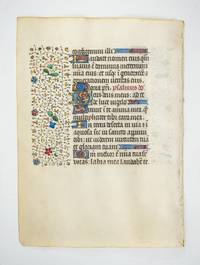
1475réf. ST19653LNorthern France ca. 1475. 155 x 110 mm. 6 x 4 1/4". Single column 16 lines in a gothic book hand. Rubrics in red line fillers in pink and blue with gilt bezants and white embellishment most leaves with one or more one-line initials in burnished gold on pink and blue ground with white embellishments and some with one or more two-line initials in blue or pink with white embellishments enclosing leaves or flowers on burnished gold ground each side with panel border of acanthus sprays of flowers and/or fruit and gilt bezants five with a well-realized bird or insect in the borders two with small mounds of fruit or flowers emerging from a golden vase. In fine fresh condition very clean and with wide margins. Undoubtedly the work of a top atelier these lovely manuscript leaves have been written and decorated with a high degree of skill. Each leaf features multiple glittering initials and the delicate panel borders add a bit of extra sparkle to the page. The price is meant to be as attractive as the decoration. unknown books
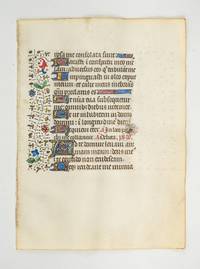
1475réf. ST19653GNorthern France ca. 1475. 155 x 110 mm. 6 x 4 1/4". Single column 16 lines in a gothic book hand. Rubrics in dark pink some leaves with line fillers in pink and blue with white embellishment and gilt bezants each leaf with at least one and some with many one- to three-line initial either in gilt on a pink and blue ground with white embellishment or painted blue with white embellishment filled with flowers or ivy on a gilt ground most leaves with one panel border of hairline vines gilt ivy and bezants and painted flowers. Occasional light soiling wrinkling and other very minor imperfections but in fine fresh condition overall very clean and with wide margins. Undoubtedly the work of a top atelier these lovely manuscript leaves have been written and decorated with a high degree of skill. Many of the leaves feature numerous glittering initials and the delicate panel borders add a bit of extra sparkle to the page. unknown books
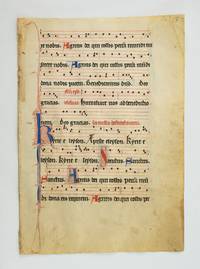
réf. ST21065CNortheastern France or Rhineland early 14th century. 345 x 239 mm. 13 1/2 x 9 3/8". Single column nine lines of music and text in a gothic hand. Rubrics and staves in red calligraphic initials in black. Later ink foliation in upper right corners. See: de Hamel Christopher. "Medieval and Renaissance Manuscripts from the Library of Sir Sydney Cockerell" British Library Journal 13 1987. Vellum with light soiling and a little light creasing mostly marginal a few negligible marks but very clean and in excellent condition. From a manuscript fragment that once passed through the hands of Sir Sydney Cockerell the leaves in this group appear to come from a rarely seen liturgical text called a Sequentiary. Consisting of sung hymns called "sequences" performed between the Alleluia and Gospel readings during Mass a Sequentiary could be either a standalone volume or part of a longer work such as a Gradual or Missal. The script here is a neat and legible gothic book hand with some interesting calligraphic initials in black--some with little spikes or other flourishes--that might warrant further study. These leaves were previously bound into a later perhaps 18th century limp vellum binding the pastedown of which contained a tipped-on handwritten note from Cockerell 1867-1962 who was William Morris' private secretary and the director of the Fitzwilliam Museum for nearly 30 years. Cockerell attributed this manuscript to Northern France and suggested a date of ca. 1280 we believe it dates a little later noting that it was probably made for Dominican use based on the presence of the sequences for St. Peter Martyr and St. Dominic. It is unclear whether Cockerell actually owned this manuscript at one point or served as a consultant for a dealer or a private collector as he was known to do: in the words of de Hamel Cockerell became "the arbiter of quality before whom generations of collectors and scholars brought their acquisitions and attributions for judgement. . . . Dyson Perrins Yates Thompson Chester Beatty Pierpont Morgan St John Hornby Lord Kennet Francis Wormald Eric Millar J. R. Abbey and many others never felt that a manuscript acquisition was truly made until Sydney Cockerell had seen and approved it." De Hamel also notes that Cockerell "gave away sold or exchanged manuscripts on many occasions during his life of collecting" making it difficult to know exactly how this manuscript may have crossed his path or for how long it was in his possession. His appraisal does however suggest that this manuscript was in a defective state from at least the 1920s and probably a good deal earlier than that. Most of the choir book leaves that we offer for sale come from 15th and early 16th century manuscripts typically Italian or Spanish in origin; the present leaves offer an uncommon opportunity to purchase earlier specimens of musical notation from an unusual liturgical text with distinguished if uncertain ownership history and at an attainable price. The price given here is for a single leaf; for additional leaves from this same manuscript please see our website. unknown books
réf. ST21065DNortheastern France or Rhineland early 14th century. 345 x 239 mm. 13 1/2 x 9 3/8". Single column nine lines of music and text in a gothic hand. Rubrics and staves in red calligraphic initials in black one-line initials in red or blue some with contrasting penwork each leaf with one or more large initials measuring a line of text plus a full stave in blue or red with blue and red penwork often extending several lines above or below. Later ink foliation in upper right corners; some leaves with marginal notations in later hand; one specimen with older manuscript fragment enforcing the gutter. See: de Hamel Christopher. "Medieval and Renaissance Manuscripts from the Library of Sir Sydney Cockerell" British Library Journal 13 1987. Trimmed a little close at the top occasionally cutting into penwork decoration moderate soiling to vellum with noticeable mostly marginal condition issues including wormholes large repairs to margins and stains. From a manuscript fragment that once passed through the hands of Sir Sydney Cockerell the leaves in this group appear to come from a rarely seen liturgical text called a Sequentiary. Consisting of sung hymns called "sequences" performed between the Alleluia and Gospel readings during Mass a Sequentiary could be either a standalone volume or part of a longer work such as a Gradual or Missal. The script here is a neat and legible gothic book hand with simple but attractive lettering in blue and red with contrasting penwork; there are also some interesting calligraphic initials in black--some with little spikes or other flourishes--that might warrant further study. These leaves were previously bound into a later perhaps 18th century limp vellum binding the pastedown of which contained a tipped-on handwritten note from Cockerell 1867-1962 who was William Morris' private secretary and the director of the Fitzwilliam Museum for nearly 30 years. Cockerell attributed this manuscript to Northern France and suggested a date of ca. 1280 we believe it dates a little later noting that it was probably made for Dominican use based on the presence of the sequences for St. Peter Martyr and St. Dominic. It is unclear whether Cockerell actually owned this manuscript at one point or served as a consultant for a dealer or a private collector as he was known to do: in the words of de Hamel Cockerell became "the arbiter of quality before whom generations of collectors and scholars brought their acquisitions and attributions for judgement. . . . Dyson Perrins Yates Thompson Chester Beatty Pierpont Morgan St John Hornby Lord Kennet Francis Wormald Eric Millar J. R. Abbey and many others never felt that a manuscript acquisition was truly made until Sydney Cockerell had seen and approved it." De Hamel also notes that Cockerell "gave away sold or exchanged manuscripts on many occasions during his life of collecting" making it difficult to know exactly how this manuscript may have crossed his path or for how long it was in his possession. His appraisal does however suggest that this manuscript was in a defective state from at least the 1920s and probably a good deal earlier than that. Most of the choir book leaves that we offer for sale come from 15th and early 16th century manuscripts typically Italian or Spanish in origin; the present leaves offer an uncommon opportunity to purchase earlier specimens of musical notation from an unusual liturgical text with distinguished if uncertain ownership history and at an attainable price. The price given here is for a single leaf; for additional leaves from this same manuscript please see our website. unknown books
réf. ST21065BNortheastern France or Rhineland early 14th century. 345 x 239 mm. 13 1/2 x 9 3/8". Single column nine lines of music and text in a gothic hand. Rubrics and staves in red calligraphic initials in black one-line initials in red or blue some with contrasting penwork each leaf with at least one large initial measuring a line of text plus a full stave in blue or red with blue and red penwork often extending several lines above or below. Later ink foliation in upper right corners; a couple leaves with remnants of older manuscript leaves enforcing the gutter. See: de Hamel Christopher. "Medieval and Renaissance Manuscripts from the Library of Sir Sydney Cockerell" British Library Journal 13 1987. Trimmed a little close at the top occasionally cutting into penwork decoration light to moderate soiling to vellum some leaves with light creasing small stains and/or wormholes a few leaves with more noticeable flaws but still in very good presentable condition. From a manuscript fragment that once passed through the hands of Sir Sydney Cockerell the leaves in this group appear to come from a rarely seen liturgical text called a Sequentiary. Consisting of sung hymns called "sequences" performed between the Alleluia and Gospel readings during Mass a Sequentiary could be either a standalone volume or part of a longer work such as a Gradual or Missal. The script here is a neat and legible gothic book hand with simple but attractive lettering in blue and red with contrasting penwork; there are also some interesting calligraphic initials in black--some with little spikes or other flourishes--that might warrant further study. These leaves were previously bound into a later perhaps 18th century limp vellum binding the pastedown of which contained a tipped-on handwritten note from Cockerell 1867-1962 who was William Morris' private secretary and the director of the Fitzwilliam Museum for nearly 30 years. Cockerell attributed this manuscript to Northern France and suggested a date of ca. 1280 we believe it dates a little later noting that it was probably made for Dominican use based on the presence of the sequences for St. Peter Martyr and St. Dominic. It is unclear whether Cockerell actually owned this manuscript at one point or served as a consultant for a dealer or a private collector as he was known to do: in the words of de Hamel Cockerell became "the arbiter of quality before whom generations of collectors and scholars brought their acquisitions and attributions for judgement. . . . Dyson Perrins Yates Thompson Chester Beatty Pierpont Morgan St John Hornby Lord Kennet Francis Wormald Eric Millar J. R. Abbey and many others never felt that a manuscript acquisition was truly made until Sydney Cockerell had seen and approved it." De Hamel also notes that Cockerell "gave away sold or exchanged manuscripts on many occasions during his life of collecting" making it difficult to know exactly how this manuscript may have crossed his path or for how long it was in his possession. His appraisal does however suggest that this manuscript was in a defective state from at least the 1920s and probably a good deal earlier than that. Most of the choir book leaves that we offer for sale come from 15th and early 16th century manuscripts typically Italian or Spanish in origin; the present leaves offer an uncommon opportunity to purchase earlier specimens of musical notation from an unusual liturgical text with distinguished if uncertain ownership history and at an attainable price. The price given here is for a single leaf; for additional leaves from this same manuscript please see our website. unknown books
réf. ST21065ANortheastern France or Rhineland early 14th century. 345 x 239 mm. 13 1/2 x 9 3/8". Single column nine lines of music and text in a gothic hand. Rubrics and staves in red calligraphic initials in black some leaves with one-line initials in red or blue some with contrasting penwork each leaf with two or more large initials measuring a line of text plus a full stave in blue or red with blue and red penwork often extending several lines above or below. Later ink foliation in upper right corners; one leaf with marginal notations in later hands. See: de Hamel Christopher. "Medieval and Renaissance Manuscripts from the Library of Sir Sydney Cockerell" British Library Journal 13 1987. Trimmed a little close at the top occasionally cutting into penwork decoration light to moderate soiling to vellum some leaves with light creasing small stains and/or wormholes but still in very good presentable condition. From a manuscript fragment that once passed through the hands of Sir Sydney Cockerell the leaves in this group appear to come from a rarely seen liturgical text called a Sequentiary. Consisting of sung hymns called "sequences" performed between the Alleluia and Gospel readings during Mass a Sequentiary could be either a standalone volume or part of a longer work such as a Gradual or Missal. The script here is a neat and legible gothic book hand with simple but attractive lettering in blue and red with contrasting penwork; there are also some interesting calligraphic initials in black--some with little spikes or other flourishes--that might warrant further study. These leaves were previously bound into a later perhaps 18th century limp vellum binding the pastedown of which contained a tipped-on handwritten note from Cockerell 1867-1962 who was William Morris' private secretary and the director of the Fitzwilliam Museum for nearly 30 years. Cockerell attributed this manuscript to Northern France and suggested a date of ca. 1280 we believe it dates a little later noting that it was probably made for Dominican use based on the presence of the sequences for St. Peter Martyr and St. Dominic. It is unclear whether Cockerell actually owned this manuscript at one point or served as a consultant for a dealer or a private collector as he was known to do: in the words of de Hamel Cockerell became "the arbiter of quality before whom generations of collectors and scholars brought their acquisitions and attributions for judgement. . . . Dyson Perrins Yates Thompson Chester Beatty Pierpont Morgan St John Hornby Lord Kennet Francis Wormald Eric Millar J. R. Abbey and many others never felt that a manuscript acquisition was truly made until Sydney Cockerell had seen and approved it." De Hamel also notes that Cockerell "gave away sold or exchanged manuscripts on many occasions during his life of collecting" making it difficult to know exactly how this manuscript may have crossed his path or for how long it was in his possession. His appraisal does however suggest that this manuscript was in a defective state from at least the 1920s and probably a good deal earlier than that. Most of the choir book leaves that we've offered for sale over the years have come from 15th and early 16th century manuscripts typically Italian or Spanish in origin; the present leaves offer an uncommon opportunity to purchase earlier specimens of musical notation--and they are leaves from an unusual liturgical text with distinguished if uncertain ownership history and at an attainable price. The price given here is for a single leaf; for additional leaves from this same manuscript at various prices please see our website. unknown books
1500réf. ST20810FParis ca. 1500. 165 x 115 mm. 6 1/2 x 4 1/2". Single column 18 lines in a gothic book hand. Rubrics in red line fillers in pink and blue with gilt bezants and white embellishment most leaves with one or more one-line initials in burnished gold on pink and blue ground with white embellishments and some with one or more two-line initials in blue or pink with white embellishments enclosing leaves or flowers on burnished gold ground each side with panel border of acanthus sprays of flowers and/or fruit and gilt bezants five with a well-realized bird or insect in the borders two with with small mounds of fruit or flowers emerging from a golden vase. Some leaves with small marks smudges or other minor imperfections but generally in excellent condition being quite clean fresh and altogether attractive. Featuring high-quality illuminated initials a fine border on every page and the liberal use of painted and burnished gold these leaves clearly come from a luxurious Book of Hours produced by an accomplished workshop. Although a common element is the appearance of prominent blue acanthus every panel border shows a slightly different design including those with flowers emanating from golden chalices mounds of grape vines or charming well-realized birds or bees. These leaves are especially delightful carefully painted and very well preserved. unknown books
réf. ST19578Northern Italy last quarter of 15th century. Each leaf measuring 250 x 164 mm. 9 7/8 x 6 3/8". Single column 24 lines in a handsome humanist hand. Each leaf with three to four large initials one measuring two lines all others three lines in burnished gold in-filled with pink and green paint with white embellishment on blue ground with white embellishments. Insignificant wrinkling and a couple faint creases to vellum tiny snag along top edge of each leaf but IN VERY FINE CONDITION the vellum especially clean and bright the paint and ink fresh and the margins generous. Written in a beautiful humanistic script enclosed by wide margins and adorned with tasteful gilt initials these leaves come from what must have been a particularly fine manuscript made for a person of means. The text comes from the "Rhetorica ad Herennium" which was long attributed to Cicero but is now believed to have been written ca. 80 B.C. by an unknown scholar. This guide to rhetoric remained influential through the Renaissance in large part because of its thorough treatment of rhetorical devices. The style of the initials--elegant burnished gold on a ground of pale pink green and sapphire blue with whisps of white embellishments--suggest that the manuscript was executed in Northern Italy perhaps Milan Bologna or Florence by a craftsman of great technical skill. Fine examples of humanistic script are becoming increasingly difficult to find on the market and the present examples are among the loveliest we have ever acquired. unknown books
réf. ST20972dParis: Nicolas Vivien early 16th century. 197 x 130 mm. 7 3/4 x 5 1/8". Single column 28 lines gothic typeface. Ruled in red each leaf with several one- to three-line initials painted gold on red or blue ground and A LOVELY ANIMATED FULL BORDER DONE IN MANUSCRIPT with trompe-l'oeil flowers a moth a fly and a bird on painted gold ground. Light soiling and a couple small stains to vellum one initial a bit smudged but in excellent condition overall. This beautifully embellished leaf from a printed Book of Hours demonstrates the enduring demand for manuscript illumination in the incunabular period and beyond. While the text here was completed on a printing press the initials and border were done entirely by hand adding luxury and luster to an otherwise unadorned page. Although this leaf likely belonged to a Book of Hours printed in Paris possibly an edition printed for Nicolas Vivien in or around 1503 the trompe-l'oeil style seen in the border was particularly popular among Flemish and Netherlandish illuminators of the period. The large blossoms and acanthus here seem to pop off the page because of the artist's use of subtle shading to indicate shadows and there is additional pleasure to be found in the small creatures--a bird carrying a small flower a moth and a housefly--that share the space. Nicolas Vivien(?) unknown
réf. ST20972b-cParis: Nicolas Vivien early 16th century. 197 x 130 mm. 7 3/4 x 5 1/8". Single column 28 lines gothic typeface. Ruled in red two one-line initials and two three-line initials painted in gold on red or blue ground and A LOVELY ANIMATED FULL PAINTED BORDER done by hand with trompe-l'oeil flowers one leaf also with a moth on painted gold ground. Top margin a little small light soiling to vellum borders with a couple superficial scratches and tiny smudges but in excellent condition overall. These beautifully embellished leaves from a printed Book of Hours demonstrate the enduring demand for manuscript illumination in the incunabular period and beyond. While the text here was completed on a printing press the initials and borders were done entirely by hand adding luxury and luster to otherwise unadorned pages. Although these leaves likely belonged to a Book of Hours printed in Paris possibly an edition printed for Nicolas Viven in or around 1503 the trompe-l'oeil style seen in the borders was particularly popular among Flemish and Netherlandish illuminators of the period. Because of the artist's use of subtle shading to indicate shadows the large blossoms here seem to pop off the page and one of the leaves contains a delicate little moth--attracted perhaps by the gleaming painted gold ground. Nicolas Vivien(?) unknown
réf. ST21065ANortheastern France or Rhineland early 14th century. 345 x 239 mm. 13 1/2 x 9 3/8". Single column nine lines of music and text in a gothic hand. Rubrics and staves in red calligraphic initials in black some leaves with one-line initials in red or blue some with contrasting penwork each leaf with two or more large initials measuring a line of text plus a full stave in blue or red with blue and red penwork often extending several lines above or below. Later ink foliation in upper right corners; one leaf with marginal notations in later hands. See: de Hamel Christopher. "Medieval and Renaissance Manuscripts from the Library of Sir Sydney Cockerell" British Library Journal 13 1987. Trimmed a little close at the top occasionally cutting into penwork decoration light to moderate soiling to vellum some leaves with light creasing small stains and/or wormholes but still in very good presentable condition. From a manuscript fragment that once passed through the hands of Sir Sydney Cockerell the leaves in this group appear to come from a rarely seen liturgical text called a Sequentiary. Consisting of sung hymns called "sequences" performed between the Alleluia and Gospel readings during Mass a Sequentiary could be either a standalone volume or part of a longer work such as a Gradual or Missal. The script here is a neat and legible gothic book hand with simple but attractive lettering in blue and red with contrasting penwork; there are also some interesting calligraphic initials in black--some with little spikes or other flourishes--that might warrant further study. These leaves were previously bound into a later perhaps 18th century limp vellum binding the pastedown of which contained a tipped-on handwritten note from Cockerell 1867-1962 who was William Morris' private secretary and the director of the Fitzwilliam Museum for nearly 30 years. Cockerell attributed this manuscript to Northern France and suggested a date of ca. 1280 we believe it dates a little later noting that it was probably made for Dominican use based on the presence of the sequences for St. Peter Martyr and St. Dominic. It is unclear whether Cockerell actually owned this manuscript at one point or served as a consultant for a dealer or a private collector as he was known to do: in the words of de Hamel Cockerell became "the arbiter of quality before whom generations of collectors and scholars brought their acquisitions and attributions for judgement. . . . Dyson Perrins Yates Thompson Chester Beatty Pierpont Morgan St John Hornby Lord Kennet Francis Wormald Eric Millar J. R. Abbey and many others never felt that a manuscript acquisition was truly made until Sydney Cockerell had seen and approved it." De Hamel also notes that Cockerell "gave away sold or exchanged manuscripts on many occasions during his life of collecting" making it difficult to know exactly how this manuscript may have crossed his path or for how long it was in his possession. His appraisal does however suggest that this manuscript was in a defective state from at least the 1920s and probably a good deal earlier than that. Most of the choir book leaves that we've offered for sale over the years have come from 15th and early 16th century manuscripts typically Italian or Spanish in origin; the present leaves offer an uncommon opportunity to purchase earlier specimens of musical notation--and they are leaves from an unusual liturgical text with distinguished if uncertain ownership history and at an attainable price. The price given here is for a single leaf; for additional leaves from this same manuscript at various prices please see our website. unknown
réf. ST21065CNortheastern France or Rhineland early 14th century. 345 x 239 mm. 13 1/2 x 9 3/8". Single column nine lines of music and text in a gothic hand. Rubrics and staves in red calligraphic initials in black. Later ink foliation in upper right corners. See: de Hamel Christopher. "Medieval and Renaissance Manuscripts from the Library of Sir Sydney Cockerell" British Library Journal 13 1987. Vellum with light soiling and a little light creasing mostly marginal a few negligible marks but very clean and in excellent condition. From a manuscript fragment that once passed through the hands of Sir Sydney Cockerell the leaves in this group appear to come from a rarely seen liturgical text called a Sequentiary. Consisting of sung hymns called "sequences" performed between the Alleluia and Gospel readings during Mass a Sequentiary could be either a standalone volume or part of a longer work such as a Gradual or Missal. The script here is a neat and legible gothic book hand with some interesting calligraphic initials in black--some with little spikes or other flourishes--that might warrant further study. These leaves were previously bound into a later perhaps 18th century limp vellum binding the pastedown of which contained a tipped-on handwritten note from Cockerell 1867-1962 who was William Morris' private secretary and the director of the Fitzwilliam Museum for nearly 30 years. Cockerell attributed this manuscript to Northern France and suggested a date of ca. 1280 we believe it dates a little later noting that it was probably made for Dominican use based on the presence of the sequences for St. Peter Martyr and St. Dominic. It is unclear whether Cockerell actually owned this manuscript at one point or served as a consultant for a dealer or a private collector as he was known to do: in the words of de Hamel Cockerell became "the arbiter of quality before whom generations of collectors and scholars brought their acquisitions and attributions for judgement. . . . Dyson Perrins Yates Thompson Chester Beatty Pierpont Morgan St John Hornby Lord Kennet Francis Wormald Eric Millar J. R. Abbey and many others never felt that a manuscript acquisition was truly made until Sydney Cockerell had seen and approved it." De Hamel also notes that Cockerell "gave away sold or exchanged manuscripts on many occasions during his life of collecting" making it difficult to know exactly how this manuscript may have crossed his path or for how long it was in his possession. His appraisal does however suggest that this manuscript was in a defective state from at least the 1920s and probably a good deal earlier than that. Most of the choir book leaves that we offer for sale come from 15th and early 16th century manuscripts typically Italian or Spanish in origin; the present leaves offer an uncommon opportunity to purchase earlier specimens of musical notation from an unusual liturgical text with distinguished if uncertain ownership history and at an attainable price. The price given here is for a single leaf; for additional leaves from this same manuscript please see our website. unknown
réf. ST21065DNortheastern France or Rhineland early 14th century. 345 x 239 mm. 13 1/2 x 9 3/8". Single column nine lines of music and text in a gothic hand. Rubrics and staves in red calligraphic initials in black one-line initials in red or blue some with contrasting penwork each leaf with one or more large initials measuring a line of text plus a full stave in blue or red with blue and red penwork often extending several lines above or below. Later ink foliation in upper right corners; some leaves with marginal notations in later hand; one specimen with older manuscript fragment enforcing the gutter. See: de Hamel Christopher. "Medieval and Renaissance Manuscripts from the Library of Sir Sydney Cockerell" British Library Journal 13 1987. Trimmed a little close at the top occasionally cutting into penwork decoration moderate soiling to vellum with noticeable mostly marginal condition issues including wormholes large repairs to margins and stains. From a manuscript fragment that once passed through the hands of Sir Sydney Cockerell the leaves in this group appear to come from a rarely seen liturgical text called a Sequentiary. Consisting of sung hymns called "sequences" performed between the Alleluia and Gospel readings during Mass a Sequentiary could be either a standalone volume or part of a longer work such as a Gradual or Missal. The script here is a neat and legible gothic book hand with simple but attractive lettering in blue and red with contrasting penwork; there are also some interesting calligraphic initials in black--some with little spikes or other flourishes--that might warrant further study. These leaves were previously bound into a later perhaps 18th century limp vellum binding the pastedown of which contained a tipped-on handwritten note from Cockerell 1867-1962 who was William Morris' private secretary and the director of the Fitzwilliam Museum for nearly 30 years. Cockerell attributed this manuscript to Northern France and suggested a date of ca. 1280 we believe it dates a little later noting that it was probably made for Dominican use based on the presence of the sequences for St. Peter Martyr and St. Dominic. It is unclear whether Cockerell actually owned this manuscript at one point or served as a consultant for a dealer or a private collector as he was known to do: in the words of de Hamel Cockerell became "the arbiter of quality before whom generations of collectors and scholars brought their acquisitions and attributions for judgement. . . . Dyson Perrins Yates Thompson Chester Beatty Pierpont Morgan St John Hornby Lord Kennet Francis Wormald Eric Millar J. R. Abbey and many others never felt that a manuscript acquisition was truly made until Sydney Cockerell had seen and approved it." De Hamel also notes that Cockerell "gave away sold or exchanged manuscripts on many occasions during his life of collecting" making it difficult to know exactly how this manuscript may have crossed his path or for how long it was in his possession. His appraisal does however suggest that this manuscript was in a defective state from at least the 1920s and probably a good deal earlier than that. Most of the choir book leaves that we offer for sale come from 15th and early 16th century manuscripts typically Italian or Spanish in origin; the present leaves offer an uncommon opportunity to purchase earlier specimens of musical notation from an unusual liturgical text with distinguished if uncertain ownership history and at an attainable price. The price given here is for a single leaf; for additional leaves from this same manuscript please see our website. unknown
réf. ST21065BNortheastern France or Rhineland early 14th century. 345 x 239 mm. 13 1/2 x 9 3/8". Single column nine lines of music and text in a gothic hand. Rubrics and staves in red calligraphic initials in black one-line initials in red or blue some with contrasting penwork each leaf with at least one large initial measuring a line of text plus a full stave in blue or red with blue and red penwork often extending several lines above or below. Later ink foliation in upper right corners; a couple leaves with remnants of older manuscript leaves enforcing the gutter. See: de Hamel Christopher. "Medieval and Renaissance Manuscripts from the Library of Sir Sydney Cockerell" British Library Journal 13 1987. Trimmed a little close at the top occasionally cutting into penwork decoration light to moderate soiling to vellum some leaves with light creasing small stains and/or wormholes a few leaves with more noticeable flaws but still in very good presentable condition. From a manuscript fragment that once passed through the hands of Sir Sydney Cockerell the leaves in this group appear to come from a rarely seen liturgical text called a Sequentiary. Consisting of sung hymns called "sequences" performed between the Alleluia and Gospel readings during Mass a Sequentiary could be either a standalone volume or part of a longer work such as a Gradual or Missal. The script here is a neat and legible gothic book hand with simple but attractive lettering in blue and red with contrasting penwork; there are also some interesting calligraphic initials in black--some with little spikes or other flourishes--that might warrant further study. These leaves were previously bound into a later perhaps 18th century limp vellum binding the pastedown of which contained a tipped-on handwritten note from Cockerell 1867-1962 who was William Morris' private secretary and the director of the Fitzwilliam Museum for nearly 30 years. Cockerell attributed this manuscript to Northern France and suggested a date of ca. 1280 we believe it dates a little later noting that it was probably made for Dominican use based on the presence of the sequences for St. Peter Martyr and St. Dominic. It is unclear whether Cockerell actually owned this manuscript at one point or served as a consultant for a dealer or a private collector as he was known to do: in the words of de Hamel Cockerell became "the arbiter of quality before whom generations of collectors and scholars brought their acquisitions and attributions for judgement. . . . Dyson Perrins Yates Thompson Chester Beatty Pierpont Morgan St John Hornby Lord Kennet Francis Wormald Eric Millar J. R. Abbey and many others never felt that a manuscript acquisition was truly made until Sydney Cockerell had seen and approved it." De Hamel also notes that Cockerell "gave away sold or exchanged manuscripts on many occasions during his life of collecting" making it difficult to know exactly how this manuscript may have crossed his path or for how long it was in his possession. His appraisal does however suggest that this manuscript was in a defective state from at least the 1920s and probably a good deal earlier than that. Most of the choir book leaves that we offer for sale come from 15th and early 16th century manuscripts typically Italian or Spanish in origin; the present leaves offer an uncommon opportunity to purchase earlier specimens of musical notation from an unusual liturgical text with distinguished if uncertain ownership history and at an attainable price. The price given here is for a single leaf; for additional leaves from this same manuscript please see our website. unknown
1475réf. ST19653LNorthern France ca. 1475. 155 x 110 mm. 6 x 4 1/4". Single column 16 lines in a gothic book hand. Rubrics in red line fillers in pink and blue with gilt bezants and white embellishment most leaves with one or more one-line initials in burnished gold on pink and blue ground with white embellishments and some with one or more two-line initials in blue or pink with white embellishments enclosing leaves or flowers on burnished gold ground each side with panel border of acanthus sprays of flowers and/or fruit and gilt bezants five with a well-realized bird or insect in the borders two with small mounds of fruit or flowers emerging from a golden vase. In fine fresh condition very clean and with wide margins. Undoubtedly the work of a top atelier these lovely manuscript leaves have been written and decorated with a high degree of skill. Each leaf features multiple glittering initials and the delicate panel borders add a bit of extra sparkle to the page. The price is meant to be as attractive as the decoration. unknown
1475réf. ST19653GNorthern France ca. 1475. 155 x 110 mm. 6 x 4 1/4". Single column 16 lines in a gothic book hand. Rubrics in dark pink some leaves with line fillers in pink and blue with white embellishment and gilt bezants each leaf with at least one and some with many one- to three-line initial either in gilt on a pink and blue ground with white embellishment or painted blue with white embellishment filled with flowers or ivy on a gilt ground most leaves with one panel border of hairline vines gilt ivy and bezants and painted flowers. Occasional light soiling wrinkling and other very minor imperfections but in fine fresh condition overall very clean and with wide margins. Undoubtedly the work of a top atelier these lovely manuscript leaves have been written and decorated with a high degree of skill. Many of the leaves feature numerous glittering initials and the delicate panel borders add a bit of extra sparkle to the page. unknown
1500réf. ST20810BParis ca. 1500. 165 x 115 mm. 6 1/2 x 4 1/2". Single column 18 lines in a gothic book hand. Rubrics in red line fillers in pink and blue with gilt bezants and white embellishment most leaves with one or more one-line initials in burnished gold on pink and blue ground with white embellishments many leaves with one or more two-line initials in blue or pink with white embellishments enclosing leaves or flowers on burnished gold ground each side with panel border of acanthus flowers and/or fruit and gilt bezants one leaf with a small bird perched in the border sold at this price level due to an ink smear. The odd smudge of small stain but generally quite clean fresh and well preserved. Featuring high-quality illuminated initials a fine border on every page and the liberal use of painted and burnished gold these leaves clearly come from a luxurious Book of Hours produced by an accomplished workshop. Although a common element is the appearance of prominent blue acanthus every panel border shows a slightly different design with varying flower combinations a fact that may make selecting a single favorite quite difficult!. unknown
1500réf. ST20810GParis ca. 1500. 165 x 115 mm. 6 1/2 x 4 1/2". Single column 18 lines in a gothic book hand. Rubrics in red line fillers in pink and blue with gilt bezants and white embellishment each leaf with one or more one-line initials in burnished gold on pink and blue ground with white embellishments and one two-line initial in blue or pink with white embellishments enclosing leaves or flowers on burnished gold ground EACH SIDE WITH A PANEL BORDER INCORPORATING AN ANIMAL OR HYBRID CREATURE and filled with acanthus flowers and/or fruit and gilt bezants. Light soiling or thumbing to some leaves but in uniformly excellent condition almost entirely clean fresh and bright. Whether you prefer your marginalia in the form of beautiful peacocks murderous-looking bunnies or fantastic hybrids these leaves feature pleasing creatures fanciful and charming. Featuring high-quality illuminated initials a fine border on every page and the liberal use of painted and burnished gold the leaves clearly come from a luxurious Book of Hours produced by an accomplished workshop. The marginal creatures are prominent executed with considerable skill and exhibit a great deal of personality. unknown