Story, KateBiblio.com
Antilia: Seer and Sacrifice
ref. 1771484888.Gpaperback. Good. Access codes and supplements are not guaranteed with used items. May be an ex-library book. paperback

Bonita · Estados Unidos155,15 US$≈ 138,61 €
12.531 resultados
ref. DADAX0977795357New unknown
ref. SONG1580630405Used: Good unknown
ref. 1771484888.Gpaperback. Good. Access codes and supplements are not guaranteed with used items. May be an ex-library book. paperback
ref. DADAX0060921455New unknown
ref. DADAX1847672957New unknown
ref. DADAX0313322295New unknown
ref. DADAX0313227357New unknown
ref. DADAX0313235767New unknown
ref. DADAX0313245665New unknown
ref. DADAX0275970507New unknown
ref. DADAX0313266948New unknown
ref. DADAX0275932168New unknown
ref. DADAX0313234922New unknown
ref. DADAX0313315922New unknown
ref. DADAX0415812062New unknown
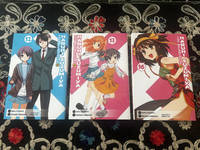
2013ref. 584Very Good paperback manga lot. Yen Press 2013. English-language editions of The Melancholy of Haruhi Suzumiya volumes 8-10 12 13 and 16. Story by Nagaru Tanigawa art by Gaku Tsugano characters by Noizi Ito. Slight shelf wear from handling/storage. Pages clean bindings solid. Incomplete manga lot. Yen Press paperback
ref. DADAX0064403548New unknown
1970Very Good Turkish Original autograph letter sent to Arslan Kaynardag, (1923-2008) who was a Turkish rare book dealer and philosopher. 26x14 cm. In Turkish (Modern). 1 p. Erhat requests several books in behalf of Güzin Dino, (1910-2013) was in Paris. Typescript letter with autograph note and signature.
1990Very Good Turkish Paperback. Cr. 8vo. (20 x 14 cm). In Crimean Turkish (Cyrillic script). 222, [2] p., color ills. ISBN: 582501247. Akilli kirpinen ayneci tilki. Krimtatar halk masallari. Toplagan, islegen ve tertib etgen: Ablüziz Veliev. A rare fairytale book compiled and printed by Crimean intellectuals during their exile in Uzbekistan.
1923Very Good Turkish, Ottoman (1500-1928) In modern very aesthetic full leather bdg. Demy 8vo. (22 x 14 cm). In Ottoman script. 197, [2], [1] p. Altin isik. Ziya Gökalp, whose real name is Mehmet Ziya was born on March 23,1876 in Diyarbair. Ziya Gökalp started his education in Diyarbakir, and moved to Istanbul in 1895 to attend the school for veterinary medicine. During this stage of his life, he met important political figures of the era such as Ibrahim Temo and Ishak Sukûti. He was much influenced by the Young Turks movement and joined the political reform movement Ittihat ve Terakki (Committee of Union and Progress). He was arrested in 1898 because of his dissident activities and spent a year in prison. After his release, he was sent to exile to Diyarbakir where he worked on a minor governmental assignments. After the declaration of the second constitutional monarchy, he established a branch of Ittihat ve Terakki in Diyarbakir, and became its representative. He published the Peyman newspaper. In 1909, he attended the Ittihat ve Terakki Congress held in Thessalonica as the Diyarbakir delegate. The next year, he was elected member to the central administrative council of this organization in Thessalonica. He taught sociology courses in Ittihat Terakki's school, which he had helped establish in 1910. In the mean time, he also published the Genç Kalemler periodical. In 1912, he was elected as a representative of Ergani Maden to the Meclis-i Mebusan (Parliament), and he moved to Istanbul. He was also one of the founders of the association Türk Ocagi (The Turkish Hearth). He wrote about nationalism and Turkish nationalism in the publication of this association Turk Yurdu, and in many other publications such as Halka Dogru, Islam Mecmuasi, Milli Tetebbular Mecmuasi, Iktisadiyat Mecmuasi, Içtimaiyat Mecmuasi and Yeni Mecmua. In the mean time, he taught sociology at the Darülfünun-u Osmani (Istanbul University). During the collapse of the Ottoman Empire, Ziya Gökalp sought to fashion a new national identity. In essence, his philosophy consisted of the effort of synthesizing the ethical and cultural values native to Turkish society, and certain values borrowed from the west. He summarized this approach as 'becoming Turkish, Muslim, and modern', and he took the cultural component from Turkish nationalism, and the ethical component from Islam. Gokalp defended that the constructive element of international culture were national cultures and he gave priority to folk literature over court literature. He believed in the importance of positive sciences, which had made the technological and scientific development of the West possible and considered religion as an auxiliary element on the way to reach religious and social unity. His social model was influenced by Emile Durkheim's theoretical concept of 'solidarism'. He opted for this model because unlike liberalism, which was based on the individual, and Marxism, which was based on class struggle, solidarism considered vocational organizations as the essential social unit. He wrote countless articles explaining his social and political views, and he systematized the concept of Turkish nationalism. He played an important role in the establishment and the development of Turkish national literature. In spite of the verse works and the poetry that he wrote in defense of Turkish nationalism, recent history Turkish cultural tends to acknowledge him more as a figure of political struggle. Ziya Gökalp earned great respect on the basis of his life of political activism. Leaving an indelible mark on the development of Turkish national identity, Gokalp died on October 25, 1924 as a citizen of the newly founded Republic of Turkey. Hegira: 1342 = Roumi: 1339 = Gregorian: 1923. First and Only Edition. Extremely rare. Özege 550.; Just five copies in OCLC: 880485512 (x3).; 163023661 (x2). Altin isik (The Golden light) includes the collection of Turkish tales in verse and prosaical which reflected Ziya Gökalp's thoughts. When he was a small child, Z
ref. DADAX027595823XNew unknown
ref. DADAX0313276374New unknown
1990ref. 1-0446710164Grand Central Publishing 1990. Hardcover. New. 236 pages. 9.25x6.25x0.50 inches. Grand Central Publishing hardcover
ref. SONG1554580447Used: Good unknown
ref. DADAX0415117593New unknown