1975190p. Numerous color drawings. Inked scribbling. Small 4to. Original color pictorial glossy binding. Display Copy. Arthur Stanley Maxwell (1896-1970), also known as Uncle Arthur, was a well-known author, editor, and church administrator. His books are still extremely popular. Hardbound. Very good. RELIGION BOX 5
1934ref. 460668New York: Blue Ribbon Books 1934. Hardcover. Near Fine/Good. First edition. Quarto. Papercovered illustrated boards. A little rubbing along the bottom of the boards and very faint spotting along the edge of the front board else near fine in good dustwrapper with erosion along the edge of the front flap fold and internal tape repairs. Blue Ribbon Books hardcover
1934ref. 460668New York: Blue Ribbon Books 1934. Hardcover. Near Fine/Good. First edition. Quarto. Papercovered illustrated boards. A little rubbing along the bottom of the boards and very faint spotting along the edge of the front board else near fine in good dustwrapper with erosion along the edge of the front flap fold and internal tape repairs. Blue Ribbon Books hardcover books
ref. 080918010script format reprint. Like New. / 207 PAGES /1957 FINAL DRAFT / THE SCRIPT IS PRINTED ON THREE-HOLE PUNCHED PAPER AND BOUND WITH 2 BRASS BRADS/. unknown
2000243 pages including index and black and white photos. Hockey fans who saw Frank Mahovlich play will never forget the combination of power and grace that defined the on-ice presence of a hockey superstar. He was a Toronto Maple Leaf by age nineteen. In his first year in the NHL he beat out Bobby Hull for the Calder Trophy as rookie of the year. And so began a Hall of Fame career, spanning twenty-one years in the NHL and WHA, that saw six Stanley Cups, the end of the six team era, and a Senate appointment. Relies upon 30 interviews with the Big M's peers. An insightful portrayal of a hockey legend, father and mentor. A very attractively illustrated and unmarked volume with very light wear. Book
1977ref. 308395NY: BLACK SPARROW PRESS. Fine with no dust jacket. 1977. First Edition; First Printing. Hardcover. 0876853696 . SIGNED Limited Edition. Copy #52 of 200 numbered copies. Fine in quarter cloth & decorated boards in a clear acetate protective wrapper as issued. Signed by Paul Bowles & Mohammed Mrabet. . BLACK SPARROW PRESS. hardcover
1981283 pages. Index. Dozens of wonderful black and white photos. "The UNITED STATES represents the fulfillment of a lifetime dream. Her design, her financing, her construction, her trials, her capturing the world's speed supremacy - all these were the crowning achievements of an amazingly successful life - the life of William Francis Gibbs... Tells the story of The Big Ship, as she was known at 21 West Street, the offices of Gibbs & Cox, where she was designed... She was drydocked in 1980 and passed with flying colours... So here's to the safest liner ever built, the fastest big ship ever and one of the world's masterpieces!" - from dust jacket. Prior owner's ink stamp inside front board else book clean and unmarked with light wear. Average wear and some spine sunning to dust jacket which is now preserved in archival-grade Brodart. A quality copy. Book
ref. 081018001Script Format reprint. Like New. A FILM BY WIM WENDERS /1998 DRAFT / THE SCRIPT IS PRINTED ON THREE-HOLE PUNCHED PAPER AND BOUND WITH 2 BRASS BRADS/. unknown
ref. 132794Universal City CA: Universal Pictures 1986. Archive of three title card maquettes hand lettered by Harold Adler for the 1963 film. Also included are two fascinating autograph letters both elaborately designed and executed in a calligraphic style from Adler to author illustrator and editor Fridolf Johnson relating to Adler's work with Hitchcock. Harold Adler was a calligrapher who created hand lettered titles on over 100 films worked frequently with Alfred Hitchcock and was a favorite of legendary title sequence designers Saul Bass and Pablo Ferro. In addition to "The Birds" 1963 his credits include "Comanche!" 1956 "The Man with the Golden Arm" 1955 "The Seven Year Itch" 1955 "Carmen Jones" 1954 "Psycho" 1960 "In the Heat of the Night" 1967 and "Justine" 1969. In 2012 an exhibition of Adler's work was organized by noted typographer and design historian Jill Bell at the American Advertising Federation Kansas City. In the first letter dated May 16 1986 Adler describes after touching on other topics meeting Hitchcock and then presenting him with layout ideas for the titles. He then goes into detail regarding his answer to a question about the techniques of artist Eric Gill stating that Hitchcock "was amazed" by this answer and after that would "request 'to be sure to bring that nice young man along" meaning Adler whenever he had a job for Adler's firm. The second letter dated June 10th 1986 focuses almost exclusively on Adler's work on "The Birds" going into some detail regarding both the creative and technical processes of producing hand lettered titles for films. He also describes Hitchcock as "an unusual person to work with. He was a master at what he did knew what he wanted and smoked the finest cigars." He then concludes the letter with some brief remarks on how his approach to title lettering evolved over the course of his career. The letters themselves are works of art executed in a variety of inks in Adler's detailed penmanship with Johnson's name on each in particular receiving full calligraphic treatment. Also included are draft title cards for the film stylistically similar to each other but much different from the titles used in the finished film. Two of the cards are marked as "camera ready" in manuscript colored pencil with titles executed in white paint on black board. The third card photo stat on black paper which accompanied the June 10th letter has been annotated by Adler on both the recto and verso explaining the in more detail the technical process of putting the lettering on film. Overall a significant collection of material illuminating a little explored aspect of film design with a direct and significant connection to a seminal work by a director known for personally overseeing all aspects of production. Each letter 19 x 24 inches single leaf rectos only. May 16th letter folded twice for mailing June 10th letter folded. Two long diagonal creases to the May 16th letter else both are Fine. Original mailing envelope for the May 16th letter included. "Camera ready" title cards 22 x 14 inches. Lightly rubbed and about Near Fine. Third card 18 x 4 inches. Near Fine. National Film Registry. Clover Men Women and Chainsaws. Godard Histoires du cinema. Universal Pictures unknown
ref. 132794Universal City CA: Universal Pictures 1986. Archive of three title card maquettes hand lettered by Harold Adler for the 1963 film. Also included are two fascinating autograph letters both elaborately designed and executed in a calligraphic style from Adler to author illustrator and editor Fridolf Johnson relating to Adler's work with Hitchcock. Harold Adler was a calligrapher who created hand lettered titles on over 100 films worked frequently with Alfred Hitchcock and was a favorite of legendary title sequence designers Saul Bass and Pablo Ferro. In addition to "The Birds" 1963 his credits include "Comanche!" 1956 "The Man with the Golden Arm" 1955 "The Seven Year Itch" 1955 "Carmen Jones" 1954 "Psycho" 1960 "In the Heat of the Night" 1967 and "Justine" 1969. In 2012 an exhibition of Adler's work was organized by noted typographer and design historian Jill Bell at the American Advertising Federation Kansas City. In the first letter dated May 16 1986 Adler describes after touching on other topics meeting Hitchcock and then presenting him with layout ideas for the titles. He then goes into detail regarding his answer to a question about the techniques of artist Eric Gill stating that Hitchcock "was amazed" by this answer and after that would "request 'to be sure to bring that nice young man along" meaning Adler whenever he had a job for Adler's firm. The second letter dated June 10th 1986 focuses almost exclusively on Adler's work on "The Birds" going into some detail regarding both the creative and technical processes of producing hand lettered titles for films. He also describes Hitchcock as "an unusual person to work with. He was a master at what he did knew what he wanted and smoked the finest cigars." He then concludes the letter with some brief remarks on how his approach to title lettering evolved over the course of his career. The letters themselves are works of art executed in a variety of inks in Adler's detailed penmanship with Johnson's name on each in particular receiving full calligraphic treatment. Also included are draft title cards for the film stylistically similar to each other but much different from the titles used in the finished film. Two of the cards are marked as "camera ready" in manuscript colored pencil with titles executed in white paint on black board. The third card photo stat on black paper which accompanied the June 10th letter has been annotated by Adler on both the recto and verso explaining the in more detail the technical process of putting the lettering on film. Overall a significant collection of material illuminating a little explored aspect of film design with a direct and significant connection to a seminal work by a director known for personally overseeing all aspects of production. Each letter 19 x 24 inches single leaf rectos only. May 16th letter folded twice for mailing June 10th letter folded. Two long diagonal creases to the May 16th letter else both are Fine. Original mailing envelope for the May 16th letter included. "Camera ready" title cards 22 x 14 inches. Lightly rubbed and about Near Fine. Third card 18 x 4 inches. Near Fine. National Film Registry. Clover Men Women and Chainsaws. Godard Histoires du cinema. Universal Pictures unknown books
1985ref. 10553Woodbridge Suffolk & Dover New Hampshire: Boydell Press 1985. Limited Facsimile Edition. One of 500 sets this set unnumbered. Tan cloth with titling and pictorial elements stamped in gilt on the spine and covers. Gilt lightly rubbed on front board of Volume 1 and rear board of Volume 2 due to their being in the slipcase. Publisher's original black paper-covered slipcase lighly rubbed. Profusely embellished with black and white illustrations in Beardsley's beautiful art nouveau style. Fine in a Near Fine slipcase. A handsome facsimile edition of Malory's 1893 work. Boydell Press unknown
190751p. Title page printed in red and black. Printed on Japan vellum. Bookplate of Albert David Hutzler and Gretchen Hochschild Hutzler, of the powerful Baltimore department store families. Small 24mo. Original stiff printed Japan vellum wraps with large red initial on front cover. Original floral pattern slip case, loss at top and bottom. Limited Edition of only 425 copies. Second Edition. Nice example. Oscar Fingal O'Flahertie Wills Wilde (1854-1900) was an Irish writer and poet. After writing in different forms throughout the 1880s, he became one of London's most popular playwrights in the early 1890s. Today he is remembered for his epigrams, his novel The Picture of Dorian Gray, his plays, and the circumstances of his imprisonment and early death. PRESS/W39. **PRICE JUST REDUCED!
1941ref. 137043Universal City CA: Universal Pictures 1941. Draft script for the 1941 film. Copy belonging to studio secretary Marion Pecht with her name in manuscript pencil at the top right corner of the front wrapper. File copy rubber-stamped on the front wrapper. Housed in a custom black cloth clamshell box. From the Richard Manney collection of horror film scripts. The 1941 version of "The Black Cat" is neither a remake of Edgar G. Ulmer's 1934 Karloff-Lugosi film of the same name nor does it bear much relation to the Edgar Allan Poe story though in fairness neither did the 1934 version. It is more of a horror-comedy affair than its predecessor with Broderick Crawford and Hugh Herbert in the lead Bela Lugosi reappearing now in the more minor role of "Eduardo" and Basil Rathbone ably handling the part of the shady Mr. Hartley. Shot by the legendary Stanley Cortez of "Magnificent Ambersons" fame. Hal Erickson Rovi Gray titled wrappers rubber-stamped copy No. 6856 dated February 15 1941. 117 leaves with last page of text numbered 117. Mimeograph duplication. Pages Near Fine wrapper Very Good plus bound with three gold brads. Weaver Universal Horrors. Universal Pictures unknown
1969ref. 61786Baltimore MD: Enoch Pratt Free Library 1969. Presumed first edition/first printing. Wraps. Good. No dust jacket as issued. Signed by previous owner. Ink notation on last page. COver has some wear and soiling. Unpaginaged 16 pages or 20 counting the cover. This work was compiled byt three Young Adult Librarians at the Enoch Pratt Free Library and was prepared for Maryland Public Libraries. Staplebound pamphlet of African-American booklists on topics including Growing Up Black Black Power Black Magic Black Beauty Black Rage. This represents an early attempt to bring the emerging field of black studies a youth oriented reference tool. Enoch Pratt Free Library paperback
1941ref. 137043Universal City CA: Universal Pictures 1941. Draft script for the 1941 film. Copy belonging to studio secretary Marion Pecht with her name in manuscript pencil at the top right corner of the front wrapper. File copy rubber-stamped on the front wrapper. Housed in a custom black cloth clamshell box. From the Richard Manney collection of horror film scripts. The 1941 version of "The Black Cat" is neither a remake of Edgar G. Ulmer's 1934 Karloff-Lugosi film of the same name nor does it bear much relation to the Edgar Allan Poe story though in fairness neither did the 1934 version. It is more of a horror-comedy affair than its predecessor with Broderick Crawford and Hugh Herbert in the lead Bela Lugosi reappearing now in the more minor role of "Eduardo" and Basil Rathbone ably handling the part of the shady Mr. Hartley. Shot by the legendary Stanley Cortez of "Magnificent Ambersons" fame. Hal Erickson Rovi Gray titled wrappers rubber-stamped copy No. 6856 dated February 15 1941. 117 leaves with last page of text numbered 117. Mimeograph duplication. Pages Near Fine wrapper Very Good plus bound with three gold brads. Weaver Universal Horrors. Universal Pictures unknown books
1951ref. 161406Los Angeles: RKO Studios Inc 1951. Revised Final Draft script for the 1951 film. Specially bound copy belonging to producer Jerry Wald with his name in gilt on the spine. Eight reference photographs from the film bound in variously among the script pages each with an RKO stamp on the versos and four with a mimeo snipe on the versos. Original wrapper bound in with the manuscript ink annotation of Wald's name on the top right as well as six pink revision pages of an "Optional Ending" following the script. Jerry Wald is best remembered for his long and successful association with Warner Brothers as both a screenwriter and producer of a number of notable films including "Mildred Pierce" 1945 "Humoresque" 1946 "Key Largo" 1948 and "Flamingo Road" 1949. In the 1950s he moved to Twentieth Century-Fox and was the producer there for "An Affair to Remember" 1957 "Peyton Place" 1957 and "Sons and Lovers" 1960. Remake of the 1942 French film "Le volle bleu" direced by Jean Stelli and starring Gaby Morlay and Elvire Popesco. Jane Wyman stars as a WWI war widow who after loosing her only child spends her life as a children's nurse. Bound in light green cloth with dark green quarter leather binding with five raised bands and gilt titles on the spine. Distribution page integral with title page with receipt removed dated April 9 1951 noted as REVISED FINAL SCRIPT with credits for screenwriter Norman Corwin and story credit for Francois Campaux. 163 leaves with last page of text numbered "143-146." Mimeograph duplication rectos only with blue revision pages throughout dated variously between 4/23/51 and 5/25/51. Pages Near Fine binding Very Good plus with light rubbing and edgewear. RKO Studios, Inc unknown
1951ref. 161406Los Angeles: RKO Studios Inc 1951. Revised Final Draft script for the 1951 film. Specially bound copy belonging to producer Jerry Wald with his name in gilt on the spine. Eight reference photographs from the film bound in variously among the script pages each with an RKO stamp on the versos and four with a mimeo snipe on the versos. Original wrapper bound in with the manuscript ink annotation of Wald's name on the top right as well as six pink revision pages of an "Optional Ending" following the script. Jerry Wald is best remembered for his long and successful association with Warner Brothers as both a screenwriter and producer of a number of notable films including "Mildred Pierce" 1945 "Humoresque" 1946 "Key Largo" 1948 and "Flamingo Road" 1949. In the 1950s he moved to Twentieth Century-Fox and was the producer there for "An Affair to Remember" 1957 "Peyton Place" 1957 and "Sons and Lovers" 1960. Remake of the 1942 French film "Le volle bleu" direced by Jean Stelli and starring Gaby Morlay and Elvire Popesco. Jane Wyman stars as a WWI war widow who after loosing her only child spends her life as a children's nurse. Bound in light green cloth with dark green quarter leather binding with five raised bands and gilt titles on the spine. Distribution page integral with title page with receipt removed dated April 9 1951 noted as REVISED FINAL SCRIPT with credits for screenwriter Norman Corwin and story credit for Francois Campaux. 163 leaves with last page of text numbered "143-146." Mimeograph duplication rectos only with blue revision pages throughout dated variously between 4/23/51 and 5/25/51. Pages Near Fine binding Very Good plus with light rubbing and edgewear. RKO Studios, Inc unknown books
1985364 pages including index. Tells the fascinating story of our bioelectric selves. Challenges the established mechanistic understanding of the body. Explores new pathways in our understanding of evolution, acupuncture, psychic phenomena, and cancer, all within the framework of Dr. Becker's colorful and controversial career. Unmarked. Light to moderate wear. Nice copy. Book
ref. 0243933312.Gpaperback. Good. Access codes and supplements are not guaranteed with used items. May be an ex-library book. paperback
2023About The Book : The Booklover is distinguished from the reader as such by loving his books, and from the collector as such by reading them. He prizes not only the soul of the book, but also its body, which he would make a house beautiful, meet for the indwelling of the spirit given by its author. Love is not too strong a word to apply to his regard, which demands, in the language of Dorothy Wordsworth, “a beautiful book, a book to caress — peculiar, distinctive, individual: a book that hath first caught your eye and then pleased your fancy," The truth is that the book on its physical side is a highly organized art object. About The Author : Harry Lyman Koopman (1860-1937), librarian from 1893 to 1930, was born in Freeport, Maine, on July 1, 1860. He graduated from Colby College in 1880. In 1881, after a brief teaching experience, he went to work at the Astor Library. In 1883 he became a cataloger at Cornell University, a job he subsequently held at Columbia, Rutgers and the University of Vermont. In 1893 he received a master of arts degree from Harvard and was appointed Librarian of Brown University, a position from which he retired thirty-seven years later. During his tenure, the size of the library grew from 80,000 to 400,000, and the John Hay Library was built in 1910. He said that he had two of the greatest satisfactions that a librarian can enjoy, a new library and the opportunity to launch some of his “disciples,” or student assistants, on a library career. Well known in the library world, Koopman was elected president of the American Library Association in 1928. He was opposed to censorship, and, in 1929, delivered an outspoken commentary on the policy of the Customs Department in barring works by such authors as Rousseau, Balzac and Bocaccio: “Every college in the country will have to ‘shut up shop’ if this continues. ... If these books are going to be banned, they ought to go through with it and bar the Old Testament.” Koopman was also a poet. He wrote his first published poem in 1875, and later contributed prose and poetry to the college monthly at Columbia. His first book, an ode to Farragut entitled The Great Admiral, was published in 1883. His other books of poetry included Morrow Songs in 1898, At the Gates of the Century in 1905, The Librarian and the Desert in 1908, and Hesperia, an American National Poem in two volumes, 1919-1924. His service to Brown went far beyond the library. In 1895 he published the Historical Catalogue of Brown University. He was associate editor of the Brown Alumni Monthly from 1906 to 1917. He taught a course on “Books and Libraries.” He was named professor of bibliography in 1908. In October 1930 he began to write a regular column, “Planets and Stars,” for the Providence Journal. He died on December 28, 1937. His last “Planets and Stars” column was published posthumously on January 1, 1938. In his plans for the column in the new year, he had written, “During the present year, we shall devote our space to stars that we cannot see unless, in Horace’s phrase, we ‘change our skies.”
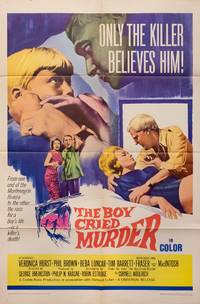
1966ref. 149248Universal City: Universal Pictures 1966. Vintage one sheet poster for the US release of the 1966 British film. Based on the 1947 short story by Cornell Woolrich. Previously filmed in 1949 as "The Window" directed by Ted Tetzlaff and starring Barbara Hale and Arthur Kennedy and remade in 1984 as "Cloak and Dagger" directed by Richard Franklin and starring Henry Thomas and Dabney Coleman. Twelve year old Jonathan has a penchant for making up stories and when he witnesses a murder which the killer is aware of his family doesn't believe him. Set in and shot on location in Montenegro and Yugoslavia. 27 x 41 inches. Folded as issued. Very Good plus with splitting and closed tears at the folds. Universal Pictures unknown books
190496 pages. Illustrated front board. Undated. Gift greetings upon front free endpaper dated 1904. Above-average wear. Binding tender and open at title page. Still a worthy copy. Book
ref. 1023405679.Ghardcover. Good. Access codes and supplements are not guaranteed with used items. May be an ex-library book. hardcover
1934Pages 449-512. Features: In Peril Among the Riffs - How Sir Malcolm Campbell and Flight-Lieut. Don nearly lost their lives in North Africa - article with photos; With the Seal Hunters - photo-illustrated article on the heroic and arduous labours of the gallant fishermen for seals amongst the ice-floes of the coast of Labrador; Famous Figures in Football - G. (Geoffrey) N. Foster and Dr. R. Cove-Smith - article with photo; Sixty Years of Soccer - article with photos of William McCracken, Fanny Walden, G.O. Smith, Victor Watson, and Clifford Bastin; The Secret of Druid's Cross (mystery story); Why Keep a Log Book?; Field Hockey Tactics - article with photos; Making Morris Motors - photo-illustrated article on the manufacture of Morris cars; The Poacher's Wirelss (fiction); The Reversed Watermark (fiction); The Hooghly River - the World's Worst (article); The Story of Stamp Collecting. No table of contents. Covers loose but present. Average wear. A worthy vintage copy. Magazine