1997ref. 2090502124600456Nakasu old book publishing company 1997. Soft Cover. Fine. Number of pages: 587P882P Number of books: 2 Nakasu old book publishing company paperback
ref. 1528450922.Gpaperback. Good. Access codes and supplements are not guaranteed with used items. May be an ex-library book. paperback
ref. 144687imitation_leather. Very Good. 0x0x0. hardcover
1930ref. 2110502150307225Osaka-do 1930. Soft Cover. Fine. Volume: 1 Osaka-do paperback
ref. 022120001Script Format reprint. Like New. / 1969 FINAL SHOOTING DRAFT / I HAVE MORE TITLES LET ME KNOW IF YOU ARE LOOKING FOR OTHER TITLES / THE SCRIPT IS PRINTED ON THREE-HOLE PUNCHED PAPER AND BOUND WITH 2 BRASS BRADS /. unknown
ref. 022720007Script Format reprint. Like New. / 1964 REVISED FINAL DRAFT / I HAVE MORE TITLES LET ME KNOW IF YOU ARE LOOKING FOR OTHER TITLES / THE SCRIPT IS PRINTED ON THREE-HOLE PUNCHED PAPER AND BOUND WITH 2 BRASS BRADS /. unknown
1973ref. 2081402109801239Aoshio-sha 1973. Soft Cover. Fine. Number of books: 2 Aoshio-sha paperback
ref. 152777290X.Gpaperback. Good. Access codes and supplements are not guaranteed with used items. May be an ex-library book. paperback
1960ref. 148058N.p.: British Lion Film Corporation 1960. Vintage studio still photograph of Maurice Denham and Lionel Jeffries with Peter Sellers David Lodge and Bernard Cribbins behind from the 1960 film. Dodger Lane Peter Sellers and two of his prison mates plan to break out of prison the day before their release steal a fortune in diamonds and break back in before anyone notices. Set in and shot on location in West Sussex Surrey Berkshire and London. 8 x 10 inches. Near Fine light edgewear. Dayrl Lee "The Heist Film. British Lion Film Corporation unknown books
1975Very Good Turkish Original TLS by Onat Kutlar sent to Cihan Akerson, (1946-2019). 29x23cm. In Turkish. 1 p. Folded in its envelope. Document on Venice Biennial, Turkish cinema, Yilmaz Güney, etc. Onat Kutlar was born in Alanya, Turkey in 1936. He was the grandson of Arif Pasha, an Ottoman governor of the Taif district and the son of Ali Riza Bey, a penal judge of the young Turkish Republic and later a farmer, and Meliha Hanim. He grew up in the city of Gaziantep. He studied law at Istanbul University and philosophy in Paris. His book, Ishak (1959), composed of nine short stories, most of which are written from the point of view of a child and are often surrealistic and mystical was the recipient of the 1960 "Turkish Language Association Short Story Award". According to the literary critic Fethi Naci, these represent a very early example of the magical realism genre. In 1985, he was a member of the jury at the 35th Berlin International Film Festival. In 1994, he was awarded L'Ordre des Arts et des Lettres and in 1975 Cultural Medal of Poland for his work in the Turkish Sinematek. He died on 11 January 1995 in Istanbul resulting from injuries sustained in a bomb attack (carried out by the terror organization PKK) which occurred on 30 December 1994 at The Marmara Hotel's cafeteria in Taksim. He was laid to rest at the Asiyan Asri Cemetery. Currently, the International Federation of Film Critics (FIPRESCI) Prize in the National Competition of the Istanbul International Film Festival is named after him to commemorate his contributions to the Turkish cinema. (Wikipedia).
1939ref. 147709Los Angeles: Paramount Pictures 1939. Draft script for the 1940 film with the name of uncredited screenwriter Leonard Lee in manuscript pencil over date on lower left. Paramount "File Copy" and "Master File" stamps and manuscript annotation in pencil on front wrapper. Script divided into sequences as was customary for the period. Paramount's 1940 Technicolor south seas adventure. Dea Dorothy Lamour is marooned on an isolated island since childhood with only the company of Koko the chimp when Skipper Joe Lynne Overman and Johnny Potter Robert Preston are marooned on the island by a mutinous crew. The three must battle angry natives and survive tidal waves a forest fire and the titular typhoon to survive. Nominated for an Academy Award. Set on a South Sea island and shot on location in Santa Catalina Island Los Angeles County Arboretum and Botanic Garden and Baldwin Dry Lake California. Self wrappers with front wrapper dated July 8 1939 rubber-stamped production No. 1908. 122 leaves with last page of text numbered E-31. Mimeograph duplication rectos only. Pages Near Fine bound with three gold brads. Paramount Pictures unknown
1939ref. 147709Los Angeles: Paramount Pictures 1939. Draft script for the 1940 film with the name of uncredited screenwriter Leonard Lee in manuscript pencil over date on lower left. Paramount "File Copy" and "Master File" stamps and manuscript annotation in pencil on front wrapper. Script divided into sequences as was customary for the period. Paramount's 1940 Technicolor south seas adventure. Dea Dorothy Lamour is marooned on an isolated island since childhood with only the company of Koko the chimp when Skipper Joe Lynne Overman and Johnny Potter Robert Preston are marooned on the island by a mutinous crew. The three must battle angry natives and survive tidal waves a forest fire and the titular typhoon to survive. Nominated for an Academy Award. Set on a South Sea island and shot on location in Santa Catalina Island Los Angeles County Arboretum and Botanic Garden and Baldwin Dry Lake California. Self wrappers with front wrapper dated July 8 1939 rubber-stamped production No. 1908. 122 leaves with last page of text numbered E-31. Mimeograph duplication rectos only. Pages Near Fine bound with three gold brads. Paramount Pictures unknown books
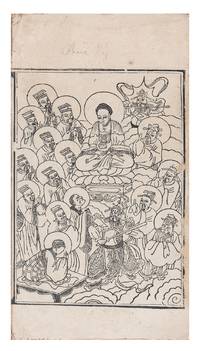
ref. 10902Two full-page frontis. woodcuts printed on each side of first leaf of Vol. I & one full-page woodcut on final leaf of Vol. II. 61.5; 107 folding leaves. Three parts in two vols. 8vo 287 x 171 mm. orig. wrappers Vol. I & modern wrappers Vol. II stitched orig. stitching in Vol. I. Quần phương hạ xã: Anh quang tự 1928. First edition of this very rare Vietnamese edition of the story of MaudgalyÄyana. The journey of MaudgalyÄyana rendered in Chinese as mulian 目連 one of the Buddha’s earliest disciples into the most abysmal and gruesome of Buddhist hells in his quest to rescue the soul of his mother was perhaps the single most important story in Chinese popular Buddhism since medieval times. The detailed depictions of tortures inflicted upon sinners relayed in MaudgalyÄyana’s story made Buddhist cosmology and morality vividly graspable to the laity and since the 12th century at the latest staged performances of his underworld travel have accompanied the Ghost Festival held at the full moon of the seventh month attended by masses of people across social strata. These theatrical retellings of MaudgalyÄyana’s travels remained highly popular until the early 20th century and are still sometimes staged today. The tale’s popularity and influence since medieval times had been so immense that David Johnson a historian of Chinese popular culture writes that “among the tens of thousands of Chinese operas none had deeper religious significance or was watched with greater excitement or was integrated into a more complex ritual matrix than MaudgalyÄyana” “Actions Speak Louder than Words: The Cultural Significance of Chinese Ritual Opera” in Ritual Opera Operatic Ritual IEAS Publications: 1989 p. 2. Unsurprisingly then there was wide dissemination of MaudgalyÄyana narratives and rituals not only in China but throughout East Asia in local and vernacular retellings of his story in a large range of religious and literary genres. Our copy of Penitence at the Compassionate Ritual Grounds of MaudgalyÄyana printed in northern Vietnam in 1928 is one such example. It opens with two illustrations from the canonical narrative of MaudgalyÄyana: the assembly of disciples attentively surrounding the Buddha and MaudgalyÄyana entering Avīci Hell riding a cloud holding the Buddha’s magical staff. The book itself is simultaneously a narrative account of MaudgalyÄyana’s travels and a Buddhist ritual of penitence opening as it does with prayers of refuge and devotion to “Shakyamuni the benevolent father” Thích-ca từ phụ 釋迦慈父 an interesting appellation. The prayer sections also make use of the placeholding name giáp mỗ ç”²æŸ which during ritual readings of the text was probably to be replaced with one’s own name. Despite sharing the same title as a canonical Buddhist scripture T. 1909 composed in the Liang dynasty a comparison of contents suggests that ours is a related but substantially different text. The first Preface makes it clear that this text is indeed based on an original in the “northern country” — i.e. China — and an earlier domestic edition was made possible by the secular and ritual offerings of the monk Trí Giác 智覺. For some time the woodblocks had been stored in the Trác điá»n temple å“田寺 in Bình Lục 平陸 Hà Nam province and did not circulate widely. As a result a reprint was made in Tự Äức 9 1856 by a monk named Thanh Tuyá»n Bhikṣu 清泉比丘. His Preface also dated 1856 is found in the first volume. By the 1920s however there was another problem: there were too many variants of the text in circulation which became a source of confusion. The monk Thanh Hưởng 清亨 using the earlier woodblocks stored at the Anh quang temple 英光寺 Quần phương hạ 羣芳下 commune Nam Äịnh province and with the guidance of Phổ Tụ æ™®èš collated various editions in circulation and created a new edition. This editorial history might explain why our copy does not correspond to known Chinese versions of the text as it probably has incorporated local Vietnamese elements. The woodblocks were carved by two craftsmen named Phó Dung 付瑢 and Phó Huênh 付轟 from the Liễu choàng xã 柳幢社 with monetary offerings from monks and laypeople across many temples and communes listed towards the end of the second volume. The carving began in Bảo Äại 1 1926 and concluded two years later in 1928; the completed woodblocks were kept at the Anh quang temple. Despite the country’s long history of Buddhist and Confucian learning woodblock-printed books published within Vietnam itself are far fewer in number today than their Chinese or Japanese counterparts. This scarcity of extant Vietnamese books is due to a variety of factors including the cost of local printing a humid climate that makes preservation difficult as well as the country’s recent war-torn past. Outside of Buddhist texts kept by individual temples in Vietnam whose collections are difficult to access the bulk of these books are now kept at a handful of institutions such as the Institute of Sino-Nôm Studies in Hanoi and l’École française d’Extrême-Orient in Paris. The catalogue of these collections shows two items with the same title as ours Viện nghiên cứu Hán nôm AC.607 and AC.647 but there is insufficient detail to determine their editions. We find no Vietnamese woodblock-printed copy by this title on WorldCat. Very good set. Final three leaves of the second volume are carefully repaired. The full-page woodcut on the final leaf is partially defective at the borders but the main image is completely intact. â§ Rostislav Berezkin Many Faces of Mulian: The Precious Scrolls of Late Imperial China Univ. of Washington: 2017; Beata Grant and Wilt Idema Escape from Blood Pond Hell: The Tales of Mulian and Woman Huang Univ. of Washington: 2011; David Johnson ed. Ritual Opera Operatic Ritual IEAS Publications: 1989; Stephen F. Teiser The Ghost Festival in Medieval China Princeton: 1988; Yuenan Hannan wenxian ziliaoku è¶Šå—æ¼¢å–ƒæ–‡ç»è³‡æ–™åº« Academia Sinica. unknown
ref. 10902Two full-page frontis. woodcuts printed on each side of first leaf of Vol. I & one full-page woodcut on final leaf of Vol. II. 61.5; 107 folding leaves. Three parts in two vols. 8vo 287 x 171 mm. orig. wrappers Vol. I & modern wrappers Vol. II stitched orig. stitching in Vol. I. Quần phương hạ xã: Anh quang tự 1928. First edition of this very rare Vietnamese edition of the story of MaudgalyÄyana. The journey of MaudgalyÄyana rendered in Chinese as mulian 目連 one of the Buddha’s earliest disciples into the most abysmal and gruesome of Buddhist hells in his quest to rescue the soul of his mother was perhaps the single most important story in Chinese popular Buddhism since medieval times. The detailed depictions of tortures inflicted upon sinners relayed in MaudgalyÄyana’s story made Buddhist cosmology and morality vividly graspable to the laity and since the 12th century at the latest staged performances of his underworld travel have accompanied the Ghost Festival held at the full moon of the seventh month attended by masses of people across social strata. These theatrical retellings of MaudgalyÄyana’s travels remained highly popular until the early 20th century and are still sometimes staged today. The tale’s popularity and influence since medieval times had been so immense that David Johnson a historian of Chinese popular culture writes that “among the tens of thousands of Chinese operas none had deeper religious significance or was watched with greater excitement or was integrated into a more complex ritual matrix than MaudgalyÄyana” “Actions Speak Louder than Words: The Cultural Significance of Chinese Ritual Opera” in Ritual Opera Operatic Ritual IEAS Publications: 1989 p. 2. Unsurprisingly then there was wide dissemination of MaudgalyÄyana narratives and rituals not only in China but throughout East Asia in local and vernacular retellings of his story in a large range of religious and literary genres. Our copy of Penitence at the Compassionate Ritual Grounds of MaudgalyÄyana printed in northern Vietnam in 1928 is one such example. It opens with two illustrations from the canonical narrative of MaudgalyÄyana: the assembly of disciples attentively surrounding the Buddha and MaudgalyÄyana entering Avīci Hell riding a cloud holding the Buddha’s magical staff. The book itself is simultaneously a narrative account of MaudgalyÄyana’s travels and a Buddhist ritual of penitence opening as it does with prayers of refuge and devotion to “Shakyamuni the benevolent father” Thích-ca từ phụ 釋迦慈父 an interesting appellation. The prayer sections also make use of the placeholding name giáp mỗ ç”²æŸ which during ritual readings of the text was probably to be replaced with one’s own name. Despite sharing the same title as a canonical Buddhist scripture T. 1909 composed in the Liang dynasty a comparison of contents suggests that ours is a related but substantially different text. The first Preface makes it clear that this text is indeed based on an original in the “northern country” — i.e. China — and an earlier domestic edition was made possible by the secular and ritual offerings of the monk Trí Giác 智覺. For some time the woodblocks had been stored in the Trác điá»n temple å“田寺 in Bình Lục 平陸 Hà Nam province and did not circulate widely. As a result a reprint was made in Tự Äức 9 1856 by a monk named Thanh Tuyá»n Bhikṣu 清泉比丘. His Preface also dated 1856 is found in the first volume. By the 1920s however there was another problem: there were too many variants of the text in circulation which became a source of confusion. The monk Thanh Hưởng 清亨 using the earlier woodblocks stored at the Anh quang temple 英光寺 Quần phương hạ 羣芳下 commune Nam Äịnh province and with the guidance of Phổ Tụ æ™®èš collated various editions in circulation and created a new edition. This editorial history might explain why our copy does not correspond to known Chinese versions of the text as it probably has incorporated local Vietnamese elements. The woodblocks were carved by two craftsmen named Phó Dung 付瑢 and Phó Huênh 付轟 from the Liễu choàng xã 柳幢社 with monetary offerings from monks and laypeople across many temples and communes listed towards the end of the second volume. The carving began in Bảo Äại 1 1926 and concluded two years later in 1928; the completed woodblocks were kept at the Anh quang temple. Despite the country’s long history of Buddhist and Confucian learning woodblock-printed books published within Vietnam itself are far fewer in number today than their Chinese or Japanese counterparts. This scarcity of extant Vietnamese books is due to a variety of factors including the cost of local printing a humid climate that makes preservation difficult as well as the country’s recent war-torn past. Outside of Buddhist texts kept by individual temples in Vietnam whose collections are difficult to access the bulk of these books are now kept at a handful of institutions such as the Institute of Sino-Nôm Studies in Hanoi and l’École française d’Extrême-Orient in Paris. The catalogue of these collections shows two items with the same title as ours Viện nghiên cứu Hán nôm AC.607 and AC.647 but there is insufficient detail to determine their editions. We find no Vietnamese woodblock-printed copy by this title on WorldCat. Very good set. Final three leaves of the second volume are carefully repaired. The full-page woodcut on the final leaf is partially defective at the borders but the main image is completely intact. â§ Rostislav Berezkin Many Faces of Mulian: The Precious Scrolls of Late Imperial China Univ. of Washington: 2017; Beata Grant and Wilt Idema Escape from Blood Pond Hell: The Tales of Mulian and Woman Huang Univ. of Washington: 2011; David Johnson ed. Ritual Opera Operatic Ritual IEAS Publications: 1989; Stephen F. Teiser The Ghost Festival in Medieval China Princeton: 1988; Yuenan Hannan wenxian ziliaoku è¶Šå—æ¼¢å–ƒæ–‡ç»è³‡æ–™åº« Academia Sinica. unknown books
2003ref. 6462003 - broché - Editions l'Harmattan - Collection Questions contemporaines - 2003 - In-8 (21,5 x 13,5 cm) broché - 480 pages - ISBN : 9782747543545 - Ouvrage collectif sous la direction de Jean-François CHIANTARETTO et Régine ROBIN
2011New English Paperback. Pbo. Cr. 8vo. (19.5 x 13.5 cm). In Turkish. 132, [12] p. Women authors in Turkish literature. Türk edebiyatinda kadin yazarlar. (Kötücüllük - cinsellik - erotizm).
2016New English Paperback. Pbo. Demy 8vo. (21 x 14 cm). In Turkish. 219 p. Türk edebiyatinda manzum hikaye. Servet-i Fünûn'dan Cumhuriyet'e. Story in verse in Turkish literature from Servet-i Fünun to Republican period.
2003New Turkish Paperback. 4to. (28 x 20 cm). In Turkish. 91, [4] p., color and b/w ills. Türk Sinemasi'nda IETT'nin serüveni: Yesilçam'in "Yol"culugu - "Yol"culugun "Yesilçam"i.
1930Very Good English In modern cloth bdg. Cr. 8vo. (20 x 14 cm). In Turkish. 151 p., 2 color plates, b/w plates. A study on Turkish shadow theater. Rare. First Edition. Türk temasasi. Meddah - Karagöz - Orta Oyunu.
1942Very Good English In modern cloth bdg. Cr. 8vo. (20 x 14 cm). In Turkish. 159 p., 2 color plates, b/w plates. A study on Turkish shadow theater. Rare. Second Edition. Türk temasasi. Meddah - Karagöz - Orta Oyunu.
2003As New Turkish Paperback. Demy 8vo. (22 x 15 cm). In Swedish. 58 p. B/w ills. Türk çocuk edebiyatinda engellilik, 1969-2009.
ref. 0450048179.Gpaperback. Good. Access codes and supplements are not guaranteed with used items. May be an ex-library book. paperback
ref. 0688001440.Ghardcover. Good. Access codes and supplements are not guaranteed with used items. May be an ex-library book. hardcover
1953ref. 2110502150410539Popurasha 1953. Soft Cover. Fine. Volume: 1 Popurasha paperback
2008As New English Paperback. Pbo. Mint. Cr. 8vo. (20 x 14 cm). In Turkish. 79 p. B/w ills. An illustrated horror fiction for children. Ugursuz kösk. Öykü-masal.