Charlotte VaudevilleBiblio.com

325 Ergebnisse
Best.-Nr. BIBRR111230005Paperback. USED. THIS RARE/ANTIQUE BOOK PUBLISHED IN THE YEAR 1965 BY Institut francais d'indologie HAVING 100 PGS AND SIZE 6.509.50 WRITTEN IN English. THE BOOK IS IN READABLE CONDITION Originally in Unbound with some issues like PB damage and some Pin Holes. THE IMAGE OF THIS BOOK IS GIVEN FOR YOUR REFERENCE. WE CAN REBIND THE SAME IN LEATHER BINDING FOR EXTRA $ 25. paperback
190910 pages plus 2 pages of advertisements. Heavily worn. Few markings. Sheet music
Best.-Nr. 6073Ne semble pas avoir été édité.Très bel état. Plein papier, pièce de titre sur le plat supérieur. Reliure moderne dans le style de l'époque. Très bon XIXè siècle 1 volume in-4°
Best.-Nr. 18981comédie-vaudeville improvisée en un acte, composée en cinq heures, dans la grande salle de l'hôtel de ville de Toulon, sur un sujet fourni par le public. Toulon. Aurel. 1829. In-8 (22x13). 24 pages. Demi-basane modeste de l'époque.
1845Best.-Nr. 37390[Paris] Typographie Vinchon s.d. [1845] prospectus in-8 en feuille
1846Best.-Nr. 37394S.l. [Paris] s.d. [1846] prospectus in-8 en feuille
1857Best.-Nr. 37444Auxerre Imprimerie, librairie et lithographie Ch. Gallot s.d. [1857] prospectus in-8 en feuille
Best.-Nr. AMA-654Belle affiche imprimée Belle affiche imprimée en noir sur papier saumon dans un encadrement de feuilles d’acanthe. Orléans, Imprimerie Ve Huet-Perdoux. 600 x 435 mm.
Best.-Nr. AMA-655Affiche imprimée en noir sur papier blanc, [Orléans],Imprimerie de Danicourt-Huet rue Royale n° 94, 1825. Petite mouillure avec menu manque au coin supérieur gauche.
Best.-Nr. 654In 8 broché,190 pages,24 illustrations hors-texte en couleurs et 19 dans le texte de DUBOUT.Edition du livre Monte-Carlo.1944.édition numérotée sur grand velin Crèvecoeur. emboîtage avec titre doré pour le premier et bordure toilée bleu pour le second.très bon état.
1924Best.-Nr. 39161Vaudeville Managers Protective Association 1924. vg-. Vaudeville Managers Protective Association unknown
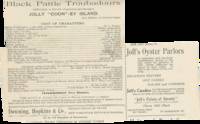
1899Best.-Nr. List2923Portland Oregon 1899. Two double-sided clippings measuring approximately 7 ½ x 4 ¾ inches both put together with tape. Slightly wrinkled and toned; excellent. Matilda Sissieretta Jones 1869–1933 was an African-American opera singer from Portsmouth Virginia. She studied at the Providence Academy of Music and the New England Conservatory in Boston. At the start of her career Jones sang solo or in small groups touring North and South America the Caribbean and Europe. Jones’ talent was renowned; she was the first Black artist to sing at Carnegie Hall and she performed for multiple US presidents and the English royal family among many other accomplishments.1 In 1896 she formed Black Patti’s Troubadours—Jones was given the nickname “Black Patti” by a critic after famed Spanish opera singer Adelina Patti. The Troubadours would perform comical vaudeville and minstrel skits without Jones followed by Jones performing her “operatic kaleidoscope” of musical excerpts. Offered here are two magazine clippings—based on the advertisements these were printed in Portland Oregon—promoting two Black Patti’s shows: “A Rag Time Frolic at Ras-Bury Park” and “Jolly ‘Coon’-ey Island”. The latter was written by Ernest Hogan a musician widely credited with creating the ragtime genre; he would become the first African-American performer to produce and star in a Broadway show 1907’s The Oyster Man. Jones’ kaleidoscope pieces include excerpts from Faust Pirates of Penzance and others; both shows also feature an audience-judged cakewalk. Of interest to scholars of M. Sissieretta Jones and African-American entertainers at the turn of the century. 1 “Jones M. Sissieretta ‘Black Patti’” in Africana: The Encyclopedia of the African and African American Experience ed. Anthony Appiah and Henry Louis Gates Basic Civitas Books 1999 1064. unknown
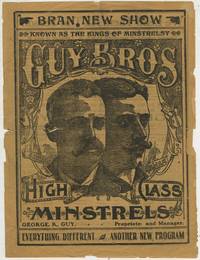
1900Best.-Nr. BK0117Cincinnati Ohio: Hennegan & Co 1900. Illustrated advertising circular 4 pp. measuring 10 ½ x 14 inches on a single folded sheet. Printed in black with large paired portrait illustration on the front and an interior illustration of the company onstage. Local performance overprint announcing an appearance at the Opera House Brookville Saturday January 8; year not stated. Toning extensive marginal chipping and tears and separations along folds several extending into the text and illustrations; fair condition with the printing substantially preserved. An illustrated circular advertising the Guy Brothers' touring minstrel company with blackface comedy vaudeville specialties electrical stage effects and a dissolving-picture attraction. The company originated in a family entertainment enterprise that included George Guy his wife daughter and six sons. Edward Le Roy Rice's Monarchs of Minstrelsy dates its permanent organization to about 1874 and records its subsequent continuation under George R. Guy identified on the present circular as proprietor and manager.1 The interior provides an extensive roster of performers and musicians including Albert Guy as interlocutor the Mantell Brothers as "A Pair of German Athletes" Harvey Dunn performing a gymnasium specialty with bag punching musical entertainers Adams & Mutt and Louis LeBrun an "Expert Electrician and His Wonderful Machine." One announcement advertises George R. Guy's return to his former position as an end man after an absence of ten years. The orchestra and silver band are separately listed with an invitation to attend the company's street parade and daytime concerts: "Everybody be on the Main Street and See the Parade and Hear Our Band." A large interior illustration depicts the company arranged beneath an elaborate shell-shaped backdrop for its opening production The Palace of Enchantment. The accompanying description emphasizes the combination of electrical spectacle music and racial caricature: "Another Grand Spectacular First Part Produced by GEO. R. GUY with Elegant Special Scenery and Electrical Effects Entitled THE PALACE OF ENCHANTMENT. Illuminated with hundreds of different colored electric lights etc. This part of the Entertainment will be participated in by the Entire Company in elegant costumes who will introduce the Latest Ballads Songs and Beautiful Music of the day. The Six Funny Black Men will make you crack your face laughing at their Antics and Funny Remarks." The rear page gives particular prominence to "Schaefer's Dissolvicanna" advertised as "the Finest Dissolving Picture Machine on Earth" with the assurance that "This is Worth the Admission Alone." The circular does not describe the apparatus further. Other attractions include the one-act comedy School Days billed as "The Funniest Negro Comedy" an old log cabin with "Phantom Doors and Windows" a Zouave drill and ten vaudeville acts. 1 Edw. Le Roy Rice Monarchs of Minstrelsy from "Daddy" Rice to Date Kenny Publishing Company 1911 digitized by Project Gutenberg accessed October 5 2026 https://www.gutenberg.org/cache/epub/69826/pg69826-images.html. . Hennegan & Co unknown
Insieme di 2 manoscritti. a) Quaderno cm. 20,5x16 composto da 2cnn. b) Quaderno cm. 20,5x16 composto da 12 cc (di cui 6 bianche). I due quaderni sono composti da molti distici ('Couplet'), Romanze ('Romance') di argomento amoroso. Il vaudeville è un genere teatrale nato in Francia a fine Settecento (primo teatro di gran successo in cui venivano rappresentate i vaudevilles, risale al 1792) . Il termine "vaudeville" stava a indicare le commedie leggere in cui alla prosa vengono alternate strofe cantate su arie conosciute (vaudevilles).
Best.-Nr. 4749petit in 4 broché,couverture rempliée illustrée en couleurs.Faux-titre,titre,348 pages,lithographies en couleurs dans le texte de Ferdinand FARGEOT,Les éditions d’Art H.Piazza 1929 exemplaire n° 90 sur japon impérial avec une suite des illustrations,dans un portefeuille cartonné,l’ensemble sous emboitage,très bon état
Best.-Nr. 83893A Paris, rue Saint-Jean de Beauvais, 1714, Tome I vendu seul, 1 volume de 95x160 mm environ, (1) f., (3) ff. ( titre, avertissement), 276 pages, (6) ff. ( tables, privilège) (1) f., plein veau marbré fauve, dos à 5 nerfs portant titres et tomaisons dorés sur pièces de titre et de tomaison brodeaux, orné de caissons à motifs dorés, coupes dorées, gardes finement mouchetées de rouge. Manque de papier sur un coin de la dernière garde, quelques rousseurs et pages brunies, traces brunes sur les gardes, petites épidermures, coiffe supérieure ébréchée, coins frottés, bon état pour le reste.
1859Best.-Nr. 37638Auxerre Typographie Ch. Gallot s.d. [1859] prospectus in-8 en feuille
1901Best.-Nr. 8816351, rue des Ecoles, Paris, Charles Schmid 1901 In-folio demi basane bleue, légèrement insolée revues illustrées de 44 planches hors-texte 308 pages. pales rousseurs. Bon état d’occasion.
1903Best.-Nr. 8816151, rue des Ecoles, Paris, Charles Schmid 1903 In-folio demi basane bleue, dos à à nerfs encadrés de double filets dorés. Illustrations de 33 planches Hors-texte gravures et caricatures contrecollées.212+ Supplément à l’art du théâtre CXIIpp.. Bon état d’occasion.
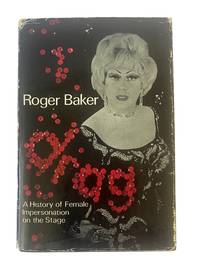
1968Best.-Nr. 207741968. LGBTQ Baker Roger. Drag: A History of Female Impersonation on the Stage. London: Triton Books 1968. First edition. 256 pages. Original brown cloth binding with author title and publisher stamped on spine. Original dustjacket with black and white image of English drag performer Chris Shaw in a black sequined dress and full glam makeup and title spelled out in red sequins. Includes 92 black and white photographs and illustrations of cross-dressing performers artists and stage productions. This book by British scholar Roger Baker examines the history of drag performance dating back to ancient China Japan and Greece through the punk scene of the 1960s. Baker touches on the difference between drag as a performance art and transvestism a personal practice before delving in to the historical uses of drag by actors and impersonators. Chapters touch on famous cross-dressers including the Chevalier D'Eon Vesta Tilley Marlene Dietrichand Julian Eltinge and cross-dressing traditions on the Elizabethan stage in pantomime Kabuki vaudeville and opera among others. Wear to edges of dustjacket price clipped. Overall very good condition. A detailed history on the uses of drag in performance and entertainment across the world. unknown
1944Best.-Nr. 1062661944 A Paris, Compagnie Française des Arts Graphiques - 1944 - In-quarto (25 x 30 cm), feuillets libres sous jaquette papier rempliée + chemise et emboîtage cartonnés neutres - Illustrations (eaux-fortes) en N&B hors-texte de Michel Ciry sous serpentes - 268 pages - Tirage limité à 315 exemplaires. L'un des 50 exemplaires sur Auvergne pur chiffon à la main avec une suite sur Berzélius des gravures - Numéroté N° 59
Best.-Nr. 14493Chansonnier historique du XVIIIème siècle. Recueil CLAIRAMBAULT-MAUREPAS publié avec introduction, commentaires, notes et inde par Emile RAUNIE archiviste paléologue. 10 tomes en 10 volumes in 12 brochés, grand papier non justifié. 190x1255mm, Paris Quantin imprimeur éditeur 1879-1884. Recueil de chansons, vaudeville, sonnets, épigrammes, épitaphe et autres vers satiriques et historiques formé avec la collection de Clairambault de Maurepas et autres manuscrits inédits. Pour chaque volume, faux titre, titre. Tome 1 : CX, 156 pages, 5 portraits hors texte, gravés par ROUSSELLE, sous serpente plus table des portraits ; Tome 2 :4 portraits hors texte sous serpente ; 328 pages, plus table des portraits.1879 Tome 3 : portraits hors texte gravés par ROUSSELLE, sous serpente ; 328 pages, plus table des portraits1880. Tome 4 : 5 portraits hors texte gravés par ROUSSELLE, sous serpente ; 302 pages, plus table des portraits 1880. Tome 5 : XXX, 5 portraits hors texte gravés par ROUSSELLE, sous serpente ; 305 pages, plus table des portraits 1881. Tome 6 : 5 portraits hors texte gravés par ROUSSELLE, sous serpente ; 368 pages, plus table des portraits 1882. Tome 7 : XX, 5 portraits hors texte gravés par ROUSSELLE, sous serpente ; 373 pages, plus table des portraits 1882. Tome 8 :XXV 5 portraits hors texte gravés par ROUSSELLE, sous serpente ; 339 pages, plus table des portraits 1883.Tome 9 :XXXIX, 5 portraits hors texte gravés par ROUSSELLE, sous serpente ; 268 pages, plus table des portraits 1884. Tome X : 5 portraits hors texte gravés par ROUSSELLE, sous serpente ; 328 pages, plus table des portraits 1884. Bel ensemble.
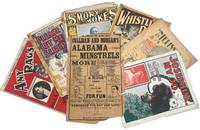
1902Best.-Nr. 220121902. Minstrelsy Archive of minstrel sheet music and ephemera documenting the role of blackface performance and racial caricature in American popular music during the late 19th and early 20th centuries. Josephine My Jo. Words by R.C. McPherson; music by Jas. T. Brymn 1902 appears alongside a group of minstrel and ragtime-era compositions and a touring advertisement for Culligan and Morgan's Alabama Minstrels establishing a concentrated record of how African American identity was constructed marketed and circulated as commercial entertainment. These materials are tied to vaudeville circuits Tin Pan Alley publishing and traveling minstrel troupes including works associated with Lew Dockstader's Minstrels. Brymn an African American composer who later led the 350th Field Artillery Regiment Band during World War I represents the constrained presence of Black musicians working within a white-dominated industry reliant on the mass acceptance of racist tropes and widely disseminated caricatured imagery and dialect performance. Archive consists of 9 items: 8 pieces of large-format sheet music and 1 minstrel tour poster dating from 1897 to approximately 1900-1915. Sheet music titles include Josephine My Jo 1902; Melissy: A Melody of Dark Town Admiration by Joseph B. Carey 1897 issued as a supplement to the San Francisco Examiner; and additional titles including Any Rags by Thos. S. Allen Smoky Mokes Bunch O' Blackberries By the Watermelon Vine Lindy Lou Whistling Rufus by Kerry Mills and Your Dad Gave His Life for His Country as performed by Lew Dockstader's Minstrels. Sheet music measures approximately 11" x 14" and retains staple-bound or disbound formats with illustrated covers. The poster for Culligan and Morgan's Alabama Minstrels printed in Ohio with illustrations by the National Press and Engraving Company of Chicago measures approximately 10.5" x 27" and survives in multiple separated sections. Across the archive cover imagery employs exaggerated racial caricatures "Darktown" themes and blackface performance conventions reflecting the visual and commercial strategies through which minstrel entertainment was promoted to national audiences. General toning edge wear and chipping present across the sheet music with occasional fragility to bindings; poster is brittle with losses and separation along folds and margins. The advert poster is separated into three pieces with text largely preserved but overall in poor form. Archive in overall good condition. The grouping provides direct primary source evidence of how blackface and minstrelsy operated as a popular form of entertainment and music production while also documenting the limited participation of African American composers within that structure and the broader transition from minstrel traditions into ragtime-era popular music. unknown