2 011 résultats
1937réf. 082059The St. Catherine Press 1937. First Edition. Hardback. Very Good. 336 pages. Black leather HB Small pocket book. Scarce. A very good copy with a neat previous owner's name on the f.e.p. Lacks dust jacket. Leather is a little rubbed. Gilt titles on the spine still vivid. The St. Catherine Press hardcover
réf. BN371162De Gruyter. Leiden lesen: Bedeutungen von 'compassio' um 1200 und die Poetik des Mit-Leidens im 'Parzival' Wolframs von Eschenbach Scrinium Friburgense 21 Leiden lesen: Bedeutungen von 'compassio' um 1200 und die Poetik des Mit-Leidens im 'Parzival' Wolframs von Eschenbach Scrinium Friburgense 21 Mertens Fleury Katharina De Gruyter unknown
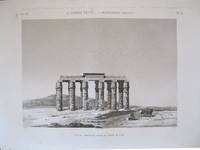
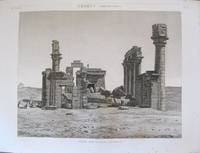
réf. 1983Middle East: Paris Impremerie de C.L.F.Pancoucke 1820-1829. Copper engraved view of the temple of Hermopolis Magna Achmouneyn. from the fourth volume of the "Antiquities "of the "Description de l'Egypte" 2nd Edition; black & white; verso blank. Blind stamp of the publisher Panckoucke to margin. The view shows the ruins of the temple of Hermopolis which was dedicated to the Ibis-headed god. The emblems the Ibis and the Cynocephalus or ape are the most conspicuous among the sculptures upon the great portico of the temple. Good dark impression; generally clean; some spotting to margins; remains of glue and tissue guard to upper margin. "Description de l'Egypte ou Recueil des observations et des recherches qui ont été faites en Egypte pendant l'expédition de l'armée française." When Napoleon Bonaparte invaded Egypt in 1798 he brought with him an entourage of more than 160 scholars and scientists. Known as the French Commission on the Sciences and Arts of Egypt these experts undertook an extensive survey of the country's archeology topography and natural history. . For four years more than 150 artists engineers linguists and scientists traveled throughout the country examining almost every aspect of ancient and contemporary Egypt. They recorded and measured in meticulous detail Egypt's topography flora and fauna and its ancient and contemporary architecture. A soldier who was part of the expedition found the famous Rosetta Stone which the French linguist and scholar Jean-François Champollion 1790-1832 later used to unlock many of the mysteries that long had surrounded the language of ancient Egypt. The Egyptian expedition ended with a total military failure. The French left Egypt in 1801 with the honors of war but defeated; yet military failure remains a significant event in the history of knowledge because it is the first time a military expedition was accompanied by a scientific expedition. In 1802 Napoleon authorized the publication of the commission's findings in a monumental multi-volume work that included plates maps scholarly essays and a detailed index. Publication of the original Imperial edition began in 1809 and continued to 1822 sold by subscription. It proved so popular that a second edition was published under the post-Napoleonic Bourbon Restoration. The "Royal edition" published in Paris by C.L.F. Panckoucke from 1820-1830. The Second edition consists of 11 or 12 volumes of plates in folio and 24 of text bound as 26 8vo. Brunet:II 617; Blackmer/Navari: 476 1st edition Middle East Egypt Hermopolis Magna Achmouneyn Paris Impremerie de C.L.F.Pancoucke 1820-1829 unknown
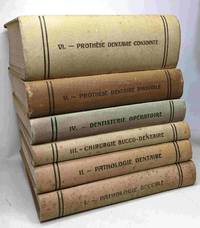
réf. 100073662Masson et cie. couvertures défraîchies ternissures frottements rousseurs intérieurs propres. in8. Sans date. Cartonné. 7 volumes. La pratique stomatologique - TOME 1 à 6 de 1939 à 1941 : Pathologie buccale Pathologie dentaire Technique chirurgicale bucco-dentaire Dentisterie opératoire Prothèse dentaire amovible Prothèse dentaire conjointe abondante iconographie Masson et cie unknown
2014réf. Agrosciences-978149390445SPRINGER 2014. New. SPRINGER unknown
2018réf. x-331991216XSpringer 2018. Hardcover. New. 588 pages. 9.25x6.10x1.50 inches. Springer hardcover
1870réf. 38498Paris: L. Lesort. Very Good with no dust jacket. 1870. Hardcover. Half vellum Or leather with marbled boards red spine label/gilt. Backstrip splitting bumped at head corners lightly bumped edges worn light soil. Foxing more concentrated at prelims. Frontis plates. Firm binding. The panels show views of the Holy Cross and materials and tools used for the crucifixion. ; Folio 13" - 23" tall; 416 pages . L. Lesort hardcover
1688réf. CAT000838Amsterdam: Pierre Savouret 1688. Early Edition. Hardcover Full Leather. Near Fine Condition. Later but old full calf spine guilt in compartments. Scattered minor foxing endpapers browned - a bright attractive copy of Fleury's manual on house keeping and the relations between master and servants. Amsterdam edition published the same year as the 1st. 198pp. Cagle 146 Paris ed. Size: 16mo. Quantity Available: 1. Shipped Weight: Under 1 kilo. Category: Cooking Wine & Dining; Inventory No: CAT000838. Pierre Savouret hardcover
1681réf. 100420Paris: Chez la veuve Gervais Clouzier 1681. First edition. 12mo. Engraved head-piece and intial. 8 343 5 pp. Nineteenth-century half red morocco marbled boards spine richly gilt; fine First edition of this account of Jewish religion and customs by the French Jesuit historian and teacher Claude Fleury 1640-1723 "one of the most impressive of the anciens" New Oxford Companion to Literature in French. His Moeurs des chrétiens followed in 1682.PROVENANCE: J.A.M. Gritton du Plessis arms in gilt at foot of spine cf. d'Olivier plate 510; P. de la Morandière book-plate Chez la veuve Gervais Clouzier hardcover
1761réf. 5653BB1761. Avignon Duchesne 1761. Klein-8°. 6 XX 400 3 S. Lederbd. d. Zt. mit floraler Rückenverzierung u. Stehkantenvergoldung berieben u. bestossen. Barbier 477. - Quérard 46 f les supercheries littéraires devoilées. - Anonym erschienene erste Ausgabe die 1769 unter dem Titel "Poésies diverses de M. Fleury ." wiederaufgelegt wurde. - Mit Widmung auf dem Schmutztitel. Fest. Vorsatz mit grösserem Abrieb durch eliminiertes Schild od. Exlibris. Durchgehend gebräunt. - Vord. Einbandgelenk am Kopf über 1 cm geplatzt. unknown
réf. 160257Brugge Franciscus van Eeck. 1787. Contemporary brown paper-spine hardback hand-marbled covers 1787-1789 12mo: in 16 volumes complete about 5700 pages With endex volume. Fine complete set. . Brugge, Franciscus van Eeck. 1787 hardcover
réf. 1964Middle East: Paris Impremerie de C.L.F.Pancoucke 1820-1829. Copper engraved view of one of the gateways to Cairo from the first volume of the "Etat Modene "of the "Description de l'Egypte" 2nd Edition; 1822; black & white; verso blank. Blind stamp of the publisher Panckoucke to margin. Good dark impression; a few some spotting mainly to margins but also a few in image. "Description de l'Egypte ou Recueil des observations et des recherches qui ont été faites en Egypte pendant l'expédition de l'armée française." When Napoleon Bonaparte invaded Egypt in 1798 he brought with him an entourage of more than 160 scholars and scientists. Known as the French Commission on the Sciences and Arts of Egypt these experts undertook an extensive survey of the country's archeology topography and natural history. . For four years more than 150 artists engineers linguists and scientists traveled throughout the country examining almost every aspect of ancient and contemporary Egypt. They recorded and measured in meticulous detail Egypt's topography flora and fauna and its ancient and contemporary architecture. A soldier who was part of the expedition found the famous Rosetta Stone which the French linguist and scholar Jean-François Champollion 1790-1832 later used to unlock many of the mysteries that long had surrounded the language of ancient Egypt. The Egyptian expedition ended with a total military failure. The French left Egypt in 1801 with the honors of war but defeated; yet military failure remains a significant event in the history of knowledge because it is the first time a military expedition was accompanied by a scientific expedition. In 1802 Napoleon authorized the publication of the commission's findings in a monumental multi-volume work that included plates maps scholarly essays and a detailed index. Publication of the original Imperial edition began in 1809 and continued to 1822 sold by subscription. It proved so popular that a second edition was published under the post-Napoleonic Bourbon Restoration. The "Royal edition" published in Paris by C.L.F. Panckoucke from 1820-1830. The Second edition consists of 11 or 12 volumes of plates in folio and 24 of text bound as 26 8vo. Brunet:II 617; Blackmer/Navari: 476 1st edition Middle East Egypt Cairo Paris Impremerie de C.L.F.Pancoucke 1820-1829 unknown
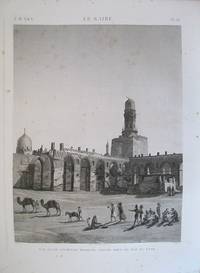
réf. 1969Middle East: Paris Impremerie de C.L.F.Pancoucke 1820-1829. Copper engraved view of an old mosque Cairo from the first volume of the "Etat Modene "of the "Description de l'Egypte" 2nd Edition; 1822; black & white; verso blank. Blind stamp of the publisher Panckoucke to margin. The view shows the mosque close to the gate of Bab el Nasr and the city walls. In the foreground are travelers arriving in the city by camel and donkey. Two French soldiers seem to be moving on a group of musicians and healers. Good dark impression; foxing to sky and blank margins. "Description de l'Egypte ou Recueil des observations et des recherches qui ont été faites en Egypte pendant l'expédition de l'armée française." When Napoleon Bonaparte invaded Egypt in 1798 he brought with him an entourage of more than 160 scholars and scientists. Known as the French Commission on the Sciences and Arts of Egypt these experts undertook an extensive survey of the country's archeology topography and natural history. . For four years more than 150 artists engineers linguists and scientists traveled throughout the country examining almost every aspect of ancient and contemporary Egypt. They recorded and measured in meticulous detail Egypt's topography flora and fauna and its ancient and contemporary architecture. A soldier who was part of the expedition found the famous Rosetta Stone which the French linguist and scholar Jean-François Champollion 1790-1832 later used to unlock many of the mysteries that long had surrounded the language of ancient Egypt. The Egyptian expedition ended with a total military failure. The French left Egypt in 1801 with the honors of war but defeated; yet military failure remains a significant event in the history of knowledge because it is the first time a military expedition was accompanied by a scientific expedition. In 1802 Napoleon authorized the publication of the commission's findings in a monumental multi-volume work that included plates maps scholarly essays and a detailed index. Publication of the original Imperial edition began in 1809 and continued to 1822 sold by subscription. It proved so popular that a second edition was published under the post-Napoleonic Bourbon Restoration. The "Royal edition" published in Paris by C.L.F. Panckoucke from 1820-1830. The Second edition consists of 11 or 12 volumes of plates in folio and 24 of text bound as 26 8vo. Brunet:II 617; Blackmer/Navari: 476 1st edition Middle East Egypt Cairo Bab el Nasr Paris Impremerie de C.L.F.Pancoucke 1820-1829 unknown
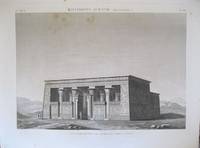
réf. 1984Middle East: Paris Impremerie de C.L.F.Pancoucke 1820-1829. Copper engraved view of the temple of Hermonthis. from the first volume of the "Antiquities "of the "Description de l'Egypte" 2nd Edition; black & white; verso blank. Blind stamp of the publisher Panckoucke to margin. The view shows the ruins of the temple of Hermonthis. The temple was dedicated to Menthu a god whose name means "nomad". Menthu was associated with raging bulls strength and war. He was also said to manifest himself in a white bull with a black face which was referred to as the Bakha. Egypt's greatest general-kings called themselves Mighty Bulls the sons of Menthu. Good dark impression; generally clean; some spotting to margins; remains of glue and tissue guard to upper margin. "Description de l'Egypte ou Recueil des observations et des recherches qui ont été faites en Egypte pendant l'expédition de l'armée française." When Napoleon Bonaparte invaded Egypt in 1798 he brought with him an entourage of more than 160 scholars and scientists. Known as the French Commission on the Sciences and Arts of Egypt these experts undertook an extensive survey of the country's archeology topography and natural history. . For four years more than 150 artists engineers linguists and scientists traveled throughout the country examining almost every aspect of ancient and contemporary Egypt. They recorded and measured in meticulous detail Egypt's topography flora and fauna and its ancient and contemporary architecture. A soldier who was part of the expedition found the famous Rosetta Stone which the French linguist and scholar Jean-François Champollion 1790-1832 later used to unlock many of the mysteries that long had surrounded the language of ancient Egypt. The Egyptian expedition ended with a total military failure. The French left Egypt in 1801 with the honors of war but defeated; yet military failure remains a significant event in the history of knowledge because it is the first time a military expedition was accompanied by a scientific expedition. In 1802 Napoleon authorized the publication of the commission's findings in a monumental multi-volume work that included plates maps scholarly essays and a detailed index. Publication of the original Imperial edition began in 1809 and continued to 1822 sold by subscription. It proved so popular that a second edition was published under the post-Napoleonic Bourbon Restoration. The "Royal edition" published in Paris by C.L.F. Panckoucke from 1820-1830. The Second edition consists of 11 or 12 volumes of plates in folio and 24 of text bound as 26 8vo. Brunet:II 617; Blackmer/Navari: 476 1st edition Middle East Egypt Hermonthis Erment Paris Impremerie de C.L.F.Pancoucke 1820-1829 unknown
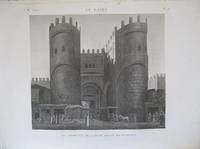
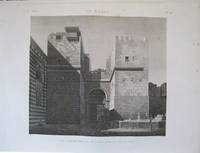
réf. 1963Middle East: Paris Impremerie de C.L.F.Pancoucke 1820-1829. Copper engraved view of one of the gateways to Cairo from the first volume of the "Etat Modene "of the "Description de l'Egypte" 2nd Edition; 1822; black & white; verso blank. Blind stamp of the publisher Panckoucke to margin. The view shows the massive gateway to the city with some small workshops & shops built against the walls. Good dark impression; a few some spotting mainly to margins but also a few in image. "Description de l'Egypte ou Recueil des observations et des recherches qui ont été faites en Egypte pendant l'expédition de l'armée française." When Napoleon Bonaparte invaded Egypt in 1798 he brought with him an entourage of more than 160 scholars and scientists. Known as the French Commission on the Sciences and Arts of Egypt these experts undertook an extensive survey of the country's archeology topography and natural history. . For four years more than 150 artists engineers linguists and scientists traveled throughout the country examining almost every aspect of ancient and contemporary Egypt. They recorded and measured in meticulous detail Egypt's topography flora and fauna and its ancient and contemporary architecture. A soldier who was part of the expedition found the famous Rosetta Stone which the French linguist and scholar Jean-François Champollion 1790-1832 later used to unlock many of the mysteries that long had surrounded the language of ancient Egypt. The Egyptian expedition ended with a total military failure. The French left Egypt in 1801 with the honors of war but defeated; yet military failure remains a significant event in the history of knowledge because it is the first time a military expedition was accompanied by a scientific expedition. In 1802 Napoleon authorized the publication of the commission's findings in a monumental multi-volume work that included plates maps scholarly essays and a detailed index. Publication of the original Imperial edition began in 1809 and continued to 1822 sold by subscription. It proved so popular that a second edition was published under the post-Napoleonic Bourbon Restoration. The "Royal edition" published in Paris by C.L.F. Panckoucke from 1820-1830. The Second edition consists of 11 or 12 volumes of plates in folio and 24 of text bound as 26 8vo. Brunet:II 617; Blackmer/Navari: 476 1st edition Middle East Egypt Cairo Paris Impremerie de C.L.F.Pancoucke 1820-1829 unknown
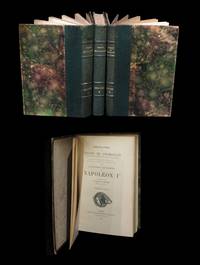
1901réf. 289961901. Paris Edouard Rouveyre 1901. 3 vol. au format in-8 218 x 143 mm de li pp. 1 f. n.fol. 8 pp. 330 pp. 2 ff. de catalogue diteur in fine n.fol. et 2 ff. bl. ; 2 ff. bl. 2 ff. n.fol. 334 pp. et 2 ff. bl. 1 volume pagination erratique. Reliures uniformes de l'poque de demi-cuir meraude l'imitation de maroquin dos nerfs orns de filets froid titre dor tomaison dore tranches mouchetes. Edition en grande partie originale ; complÂte des trois volumes la constituant. Le dernier - imprim sur papier vert d'eau - est constitu de la reproduction des ''Notes marginales crites par Napolon Ier Sainte-HlÂne sur un exemplaire des Mmoires . de Fleury de Chaboulon''. ''Source importante pour le retour de l'le d'Elbe et les Cent Jours nottamment en ce qui concerne les intrigues de Fouch Les notes de Napolon sur la premiÂre dition de l'ouvrage de Fleury n'ont pas t reproduites dans l'dition officielle de la Correspondance. Elles permettent de rectifier dans la prsente publication de nombreuses inexactitudes et d'liminer les ''bruits d'antichambre'' selon l'expression de Napolon rapports par Fleury''. in Tulard. Tulard Bibliographie critique des Mmoires sur le Consulat et l'Empire p. 63. Angles et coupes lgÂrement lims. Infimes altrations superficielles affectant par ailleurs les reliures. Du reste trÂs belle condition. b42961 unknown
1842réf. 010976Oxford: John Henry Parker 1842 1843 1844. 3 vols. ccxx 400; vii 468; viii 471 pp. Full leather with raised bands. Chipping at head of Vol. 1 1 of two spine slips missing on Vol. 2 minor chipping of two other spine slips some leather scuffing foxed bookplates some notations in pencil on the blank endpapers tight. Contains Newman's 205-page "Essay on the Miracles Recorded in Ecclesiastical History" and his introductory advertisements to each volume. . Good. Hardcover. First Edition. 1842. John Henry Parker, 1842, 1843, 1844. hardcover
2015réf. mon0003558099Easton Press 2015. Hardcover. Very Good. . oversized volumes bound in full leather with gilt decoration all edges gilt. lovely copies. Easton Press hardcover
réf. 150227John Murray 1819. 2 vols. 8vo 8½ x 5½ ins. Contemporary half calf on marbled paper-laid boards spines blind-tooled in with monograms in top compartments gilt lettered labels and red sprinkled edges spines lightly faded and marked - otherwise a VG set. Pp. xvi 415 1 blank & ii 419 1 prelims rather toned; previous owner's armorial bookplate on front paste-downs; no inscriptions. John Murray, 1819 unknown
1842réf. 9032517London: John Henry Parker 1842. Hardcover. Very Good. Ex-library. Translated by Newman. Bound in brown cloth with spines stamped in gilt covers blind-stamped. Text blocks are in very good condition clean and bright with library bookplates stamps and very minor foxing to endpapers. Minor wear to corners heads and heels sunning to spines. 5 1/2 x 8 1/2 inches. John Henry Parker hardcover
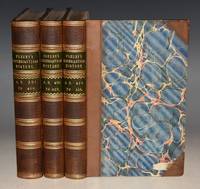
réf. 101536Oxford John Henry Parker Rivingtons 1842-44 1st 1842-44 1st. Three Volumes. Hardback 8.75 x 5.5 inches. Quarterbound calf leather to spine and corners and marbled papered boards. Raised and gilt banding to spines with blind embossed decoration and twin dark green leather spine labels lettered in gilt. Speckled page edges. Overall very good conditions. Some handling marks to boards a couple of thin surface chips to leather on spine edge of vol.1 and corners of vols. 2 & 3. Some dark foxing spots to blank prelims lighter foxing to title pages neat inscription to top of title page in vol.1. One or two occasional minor foxing spots to inside pages else pages all very clean bright and tight throughout. Else a very good clean and tight set. 3 vols: ccxx 400 463 & 471pp. A highly regarded English translation by John Henry Newman later Cardinal Newman of the foundational work by French historian Claude Fleury. Details the growth of the early Christian Church the rise of major heresies such as Nestorianism and the political dynamics between the priesthood and imperial power. Oxford, John Henry Parker, Rivingtons, 1842-44 1st 1842-44 1st hardcover
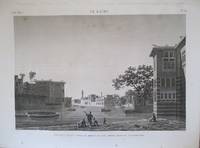
réf. 1965Middle East: Paris Impremerie de C.L.F.Pancoucke 1820-1829. Copper engraved view of the grand square of Birket-el-Fyl Cairo from the first volume of the "Etat Modene "of the "Description de l'Egypte" 2nd Edition; 1822; black & white; verso blank. Blind stamp of the publisher Panckoucke to margin. The view shows the square in a state of flood with boats upon the water. Good dark impression; some foxing to plate darker spots to lower margin; in the upper margin remains of glue from tissue guard outside the platemark. "Description de l'Egypte ou Recueil des observations et des recherches qui ont été faites en Egypte pendant l'expédition de l'armée française." When Napoleon Bonaparte invaded Egypt in 1798 he brought with him an entourage of more than 160 scholars and scientists. Known as the French Commission on the Sciences and Arts of Egypt these experts undertook an extensive survey of the country's archeology topography and natural history. . For four years more than 150 artists engineers linguists and scientists traveled throughout the country examining almost every aspect of ancient and contemporary Egypt. They recorded and measured in meticulous detail Egypt's topography flora and fauna and its ancient and contemporary architecture. A soldier who was part of the expedition found the famous Rosetta Stone which the French linguist and scholar Jean-François Champollion 1790-1832 later used to unlock many of the mysteries that long had surrounded the language of ancient Egypt. The Egyptian expedition ended with a total military failure. The French left Egypt in 1801 with the honors of war but defeated; yet military failure remains a significant event in the history of knowledge because it is the first time a military expedition was accompanied by a scientific expedition. In 1802 Napoleon authorized the publication of the commission's findings in a monumental multi-volume work that included plates maps scholarly essays and a detailed index. Publication of the original Imperial edition began in 1809 and continued to 1822 sold by subscription. It proved so popular that a second edition was published under the post-Napoleonic Bourbon Restoration. The "Royal edition" published in Paris by C.L.F. Panckoucke from 1820-1830. The Second edition consists of 11 or 12 volumes of plates in folio and 24 of text bound as 26 8vo. Brunet:II 617; Blackmer/Navari: 476 1st edition Middle East Egypt Cairo Birket-el-Fyl Paris Impremerie de C.L.F.Pancoucke 1820-1829 unknown
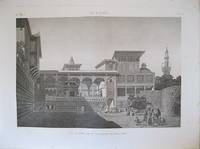
réf. 1967Middle East: Paris Impremerie de C.L.F.Pancoucke 1820-1829. Copper engraved view of the interior of a noble Egyptian house Cairo from the first volume of the "Etat Modene "of the "Description de l'Egypte" 2nd Edition; 1822; black & white; verso blank. Blind stamp of the publisher Panckoucke to margin. The view shows the courtyard of the house belonging to Osman Bey Visitors arrive on horse and camel and are ushered up to an audience with the Bey. The view shows the ornate decoration of the house with a minaret in the background. Good dark impression; some foxing mainly to blank margins. "Description de l'Egypte ou Recueil des observations et des recherches qui ont été faites en Egypte pendant l'expédition de l'armée française." When Napoleon Bonaparte invaded Egypt in 1798 he brought with him an entourage of more than 160 scholars and scientists. Known as the French Commission on the Sciences and Arts of Egypt these experts undertook an extensive survey of the country's archeology topography and natural history. . For four years more than 150 artists engineers linguists and scientists traveled throughout the country examining almost every aspect of ancient and contemporary Egypt. They recorded and measured in meticulous detail Egypt's topography flora and fauna and its ancient and contemporary architecture. A soldier who was part of the expedition found the famous Rosetta Stone which the French linguist and scholar Jean-François Champollion 1790-1832 later used to unlock many of the mysteries that long had surrounded the language of ancient Egypt. The Egyptian expedition ended with a total military failure. The French left Egypt in 1801 with the honors of war but defeated; yet military failure remains a significant event in the history of knowledge because it is the first time a military expedition was accompanied by a scientific expedition. In 1802 Napoleon authorized the publication of the commission's findings in a monumental multi-volume work that included plates maps scholarly essays and a detailed index. Publication of the original Imperial edition began in 1809 and continued to 1822 sold by subscription. It proved so popular that a second edition was published under the post-Napoleonic Bourbon Restoration. The "Royal edition" published in Paris by C.L.F. Panckoucke from 1820-1830. The Second edition consists of 11 or 12 volumes of plates in folio and 24 of text bound as 26 8vo. Brunet:II 617; Blackmer/Navari: 476 1st edition Middle East Egypt Cairo House of Osman Bey Paris Impremerie de C.L.F.Pancoucke 1820-1829 unknown
réf. 1981Middle East: Paris Impremerie de C.L.F.Pancoucke 1820-1829. Copper engraved view of the temple of Esna from the first volume of the "Antiquities "of the "Description de l'Egypte" 2nd Edition; black & white; verso blank. Blind stamp of the publisher Panckoucke to margin. The view shows a reconstruction of the temple of Khnum. at Esné The tutelary deities of Latopolis seem to have been the triad – Khnum and Neith and Heka their offspring. The temple of Esna dedicated to this triad was remarkable for the beauty of its site and the magnificence of its architecture. It was built of red sandstone and its portico consisted of six rows of four columns each with lotus-leaf capitals all of which however differ from each other Good dark impression; some foxing to sky and spotting to margins. "Description de l'Egypte ou Recueil des observations et des recherches qui ont été faites en Egypte pendant l'expédition de l'armée française." When Napoleon Bonaparte invaded Egypt in 1798 he brought with him an entourage of more than 160 scholars and scientists. Known as the French Commission on the Sciences and Arts of Egypt these experts undertook an extensive survey of the country's archeology topography and natural history. . For four years more than 150 artists engineers linguists and scientists traveled throughout the country examining almost every aspect of ancient and contemporary Egypt. They recorded and measured in meticulous detail Egypt's topography flora and fauna and its ancient and contemporary architecture. A soldier who was part of the expedition found the famous Rosetta Stone which the French linguist and scholar Jean-François Champollion 1790-1832 later used to unlock many of the mysteries that long had surrounded the language of ancient Egypt. The Egyptian expedition ended with a total military failure. The French left Egypt in 1801 with the honors of war but defeated; yet military failure remains a significant event in the history of knowledge because it is the first time a military expedition was accompanied by a scientific expedition. In 1802 Napoleon authorized the publication of the commission's findings in a monumental multi-volume work that included plates maps scholarly essays and a detailed index. Publication of the original Imperial edition began in 1809 and continued to 1822 sold by subscription. It proved so popular that a second edition was published under the post-Napoleonic Bourbon Restoration. The "Royal edition" published in Paris by C.L.F. Panckoucke from 1820-1830. The Second edition consists of 11 or 12 volumes of plates in folio and 24 of text bound as 26 8vo. Brunet:II 617; Blackmer/Navari: 476 1st edition Middle East Egypt Esne Esna Latopolis Paris Impremerie de C.L.F.Pancoucke 1820-1829 unknown