3 717 résultats
1999réf. 038473Arléa broché Bristol 1999 117 pages en format 13 - 19 cm Exemplaire de bibliothèque 2-86959-441-0
2003réf. 039783Arléa broché Bristol 2003 104 pages en format 13 - 19 cm 2-86959-635-9
1932réf. 14918In Annales de Géographie n°234 du 15 novembre 1932 ; in-8, broché ; pp. 561 à 582 et 3 planches hors-texte soit 6 photographies aériennes du capitaine Seive (Fleury).
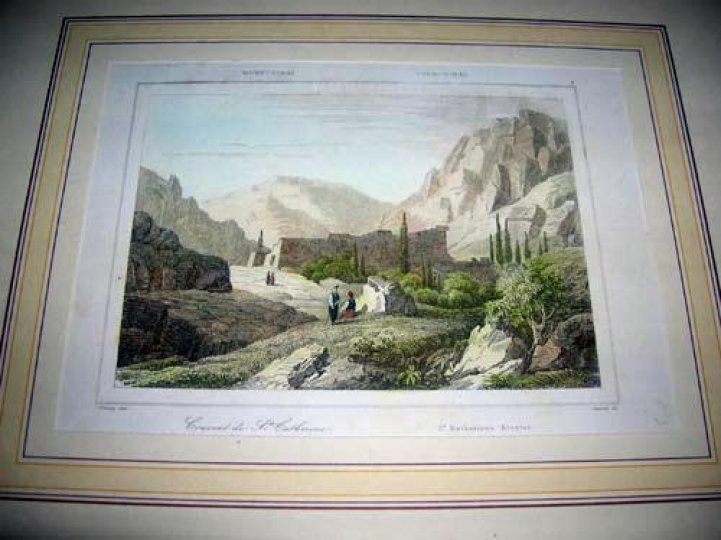
1850réf. 9091Gravure en couleurs. Mont-Sinaï - Couvent de Ste. Catherine. Vers 1850.Très bon état. Format in-8°(20x13) pour la gravure. Format in-4°(30x24) pour le passe-partout. Livré sans le passe-partout pour des raisons techniques.
1956réf. 76261Partitions sur les États-Unis Hortensia 1956
réf. 6871Paris, Lacroix, s.d. (1875). In-12 à grandes marges, non rogné, 323-(1) p., reliure demi-maroquin vert à coins, dos orné, vignettes dans le texte (Fleury), 7 planches hors-texte (dos insolé).
2026réf. LRB1015999Paris: Editions Recreasoft 2026 Langue : Français. Environ 614 pages. Français : Réimpression à la demande. Édition originale : 1838. Ouvrage consacré au dessin de fabrique et aux ressources documentaires utiles au manufacturier réunissant des cahiers de modèles de procédés et de matériaux destinés à l'industrie et aux arts appliqués. Cette publication périodique du XIXe siècle intéressera les chercheurs en histoire des techniques des manufactures du dessin industriel et des usages décoratifs. Images du livre non contractuelles English : Print-on-demand reprint. Original edition : 1838. Work devoted to factory drawing and to the documentary resources useful to the manufacturer bringing together notebooks of models processes and materials intended for industry and the applied arts. This nineteenth-century periodical publication will appeal to researchers in the history of technology manufacture industrial design and decorative practice. Book images are non-contractual. Editions Recreasoft. Softcover. New. Editions Recreasoft paperback
1901réf. 68453Paris, J.B. Baillière et fils, 1901, in-8, VIII-320 pp, Broché, couverture imprimée de l'éditeur, non coupé, EDITION ORIGINALE de cette thèse sur l'hystérie auriculaire du Dr Fleury Chavanne, disciple de Lannois à qui il dédie cette étude. A travers cet ouvrage, Fleury Chavanne entend déterminer l'histoire des rapports entre l'oreille et l'hystérie, et regrouper les diverses manifestations auriculaires de la névrose. Découverte en premier lieu par Fabricius Hidanus en 1595, l'hystérie auriculaire fit l'objet de plusieurs études par la suite. Elle peut se manifester sous deux aspects : soit à l'état d'épiphénomènes, soit à l'état d'hystérie auriculaire monosymptomatique. Ainsi, ce trouble auditif engendre des cas d'anesthésie provoquant plusieurs formes de surdité, d'hyperesthésie (hypercousie douloureuse, zones hystérogènes, otalgie ou algie mastoïdienne), ainsi que des otorrhagies. Cette étude est agrémentée de 84 diagrammes dans le texte. Agréable exemplaire, deux légers manques restaurés au plat inférieur. Envoi signé de l'auteur à l'attention du docteur Carrier en tête d'ouvrage. Cachet ex-libris du docteur Carrier sur le plat supérieur et la page de titre. Couverture rigide
réf. 2012980171.Gpaperback. Good. Access codes and supplements are not guaranteed with used items. May be an ex-library book. paperback
réf. 1385961090.Ghardcover. Good. Access codes and supplements are not guaranteed with used items. May be an ex-library book. hardcover
réf. 0364829605.Gpaperback. Good. Access codes and supplements are not guaranteed with used items. May be an ex-library book. paperback
réf. 0364794070.Ghardcover. Good. Access codes and supplements are not guaranteed with used items. May be an ex-library book. hardcover
réf. 0364829729.Ghardcover. Good. Access codes and supplements are not guaranteed with used items. May be an ex-library book. hardcover
réf. 0259803014.Gpaperback. Good. Access codes and supplements are not guaranteed with used items. May be an ex-library book. paperback
réf. 0484153358.Ghardcover. Good. Access codes and supplements are not guaranteed with used items. May be an ex-library book. hardcover
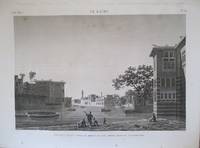
réf. 1965Middle East: Paris Impremerie de C.L.F.Pancoucke 1820-1829. Copper engraved view of the grand square of Birket-el-Fyl Cairo from the first volume of the "Etat Modene "of the "Description de l'Egypte" 2nd Edition; 1822; black & white; verso blank. Blind stamp of the publisher Panckoucke to margin. The view shows the square in a state of flood with boats upon the water. Good dark impression; some foxing to plate darker spots to lower margin; in the upper margin remains of glue from tissue guard outside the platemark. "Description de l'Egypte ou Recueil des observations et des recherches qui ont été faites en Egypte pendant l'expédition de l'armée française." When Napoleon Bonaparte invaded Egypt in 1798 he brought with him an entourage of more than 160 scholars and scientists. Known as the French Commission on the Sciences and Arts of Egypt these experts undertook an extensive survey of the country's archeology topography and natural history. . For four years more than 150 artists engineers linguists and scientists traveled throughout the country examining almost every aspect of ancient and contemporary Egypt. They recorded and measured in meticulous detail Egypt's topography flora and fauna and its ancient and contemporary architecture. A soldier who was part of the expedition found the famous Rosetta Stone which the French linguist and scholar Jean-François Champollion 1790-1832 later used to unlock many of the mysteries that long had surrounded the language of ancient Egypt. The Egyptian expedition ended with a total military failure. The French left Egypt in 1801 with the honors of war but defeated; yet military failure remains a significant event in the history of knowledge because it is the first time a military expedition was accompanied by a scientific expedition. In 1802 Napoleon authorized the publication of the commission's findings in a monumental multi-volume work that included plates maps scholarly essays and a detailed index. Publication of the original Imperial edition began in 1809 and continued to 1822 sold by subscription. It proved so popular that a second edition was published under the post-Napoleonic Bourbon Restoration. The "Royal edition" published in Paris by C.L.F. Panckoucke from 1820-1830. The Second edition consists of 11 or 12 volumes of plates in folio and 24 of text bound as 26 8vo. Brunet:II 617; Blackmer/Navari: 476 1st edition Middle East Egypt Cairo Birket-el-Fyl Paris Impremerie de C.L.F.Pancoucke 1820-1829 unknown
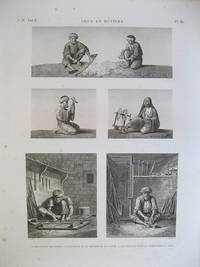
réf. 1997Trades Professions & the Arts: Paris Impremerie de C.L.F.Pancoucke 1820-1829. Copper engravings 5 on 1 plate showing a variety of trades from the second volume of "Etat Moderne" of the "Description de l'Egypte" 2nd Edition; black & white; verso blank. Blind stamp of the publisher Panckoucke to margin. The images show cotton being sorted and spun; the spinning of woolen thread; A wood turner using his foot to shape the wood on the lathe and the "serrurier" planing a block of wood. Good dark impression; some light spotting to margins; remains of glue and tissue guard to right margin. "Description de l'Egypte ou Recueil des observations et des recherches qui ont été faites en Egypte pendant l'expédition de l'armée française." When Napoleon Bonaparte invaded Egypt in 1798 he brought with him an entourage of more than 160 scholars and scientists. Known as the French Commission on the Sciences and Arts of Egypt these experts undertook an extensive survey of the country's archeology topography and natural history. . For four years more than 150 artists engineers linguists and scientists traveled throughout the country examining almost every aspect of ancient and contemporary Egypt. They recorded and measured in meticulous detail Egypt's topography flora and fauna and its ancient and contemporary architecture. A soldier who was part of the expedition found the famous Rosetta Stone which the French linguist and scholar Jean-François Champollion 1790-1832 later used to unlock many of the mysteries that long had surrounded the language of ancient Egypt. The Egyptian expedition ended with a total military failure. The French left Egypt in 1801 with the honors of war but defeated; yet military failure remains a significant event in the history of knowledge because it is the first time a military expedition was accompanied by a scientific expedition. In 1802 Napoleon authorized the publication of the commission's findings in a monumental multi-volume work that included plates maps scholarly essays and a detailed index. Publication of the original Imperial edition began in 1809 and continued to 1822 sold by subscription. It proved so popular that a second edition was published under the post-Napoleonic Bourbon Restoration. The "Royal edition" published in Paris by C.L.F. Panckoucke from 1820-1830. The Second edition consists of 11 or 12 volumes of plates in folio and 24 of text bound as 26 8vo. Brunet:II 617; Blackmer/Navari: 476 1st edition Trades Professions & the Arts Egypt Spinning Wood workers Paris Impremerie de C.L.F.Pancoucke 1820-1829 unknown
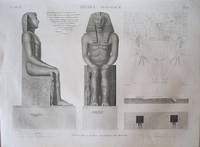
réf. 1977Middle East: Paris Impremerie de C.L.F.Pancoucke 1820-1829. Copper engraving showing one of the Colossi of Mnemnon Thebes from the second volume of the "Antiquities "of the "Description de l'Egypte" 2nd Edition; black & white; verso blank. Blind stamp of the publisher Panckoucke to margin. The image shows the statue reconstructed from the front and side sides showing the Greek graffiti carved on the massive legs of the statue and on the sides of the pedestal; with a detail of the carving of the Nile god Hapy from the side of his throne. The statue depicts Amenhotep III fl. 14th century BC in a seated position his hands resting on his knees and his gaze facing eastwards towards the river. Two shorter figures are carved into the front throne alongside his legs: these are his wife Tiy and mother Mutemwiya. Good dark impression; generally clean a few very minor spots. "Description de l'Egypte ou Recueil des observations et des recherches qui ont été faites en Egypte pendant l'expédition de l'armée française." When Napoleon Bonaparte invaded Egypt in 1798 he brought with him an entourage of more than 160 scholars and scientists. Known as the French Commission on the Sciences and Arts of Egypt these experts undertook an extensive survey of the country's archeology topography and natural history. . For four years more than 150 artists engineers linguists and scientists traveled throughout the country examining almost every aspect of ancient and contemporary Egypt. They recorded and measured in meticulous detail Egypt's topography flora and fauna and its ancient and contemporary architecture. A soldier who was part of the expedition found the famous Rosetta Stone which the French linguist and scholar Jean-François Champollion 1790-1832 later used to unlock many of the mysteries that long had surrounded the language of ancient Egypt. The Egyptian expedition ended with a total military failure. The French left Egypt in 1801 with the honors of war but defeated; yet military failure remains a significant event in the history of knowledge because it is the first time a military expedition was accompanied by a scientific expedition. In 1802 Napoleon authorized the publication of the commission's findings in a monumental multi-volume work that included plates maps scholarly essays and a detailed index. Publication of the original Imperial edition began in 1809 and continued to 1822 sold by subscription. It proved so popular that a second edition was published under the post-Napoleonic Bourbon Restoration. The "Royal edition" published in Paris by C.L.F. Panckoucke from 1820-1830. The Second edition consists of 11 or 12 volumes of plates in folio and 24 of text bound as 26 8vo. Brunet:II 617; Blackmer/Navari: 476 1st edition Middle East Antiquities Colossi of Memnon Paris Impremerie de C.L.F.Pancoucke 1820-1829 unknown
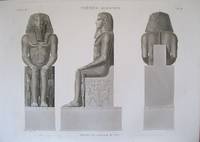
réf. 1976Middle East: Paris Impremerie de C.L.F.Pancoucke 1820-1829. Copper engraving showing one of the Colossi of Mnemnon Thebes from the second volume of the "Antiquities "of the "Description de l'Egypte" 2nd Edition; black & white; verso blank. Blind stamp of the publisher Panckoucke to margin. The image shows the statue from three sides and in a reconstructed condition The statue depicts Amenhotep III fl. 14th century BC in a seated position his hands resting on his knees and his gaze facing eastwards towards the river. Two shorter figures are carved into the front throne alongside his legs: these are his wife Tiy and mother Mutemwiya. The side panels depict the Nile god Hapy. Good dark impression; generally clean a few very minor spots. "Description de l'Egypte ou Recueil des observations et des recherches qui ont été faites en Egypte pendant l'expédition de l'armée française." When Napoleon Bonaparte invaded Egypt in 1798 he brought with him an entourage of more than 160 scholars and scientists. Known as the French Commission on the Sciences and Arts of Egypt these experts undertook an extensive survey of the country's archeology topography and natural history. . For four years more than 150 artists engineers linguists and scientists traveled throughout the country examining almost every aspect of ancient and contemporary Egypt. They recorded and measured in meticulous detail Egypt's topography flora and fauna and its ancient and contemporary architecture. A soldier who was part of the expedition found the famous Rosetta Stone which the French linguist and scholar Jean-François Champollion 1790-1832 later used to unlock many of the mysteries that long had surrounded the language of ancient Egypt. The Egyptian expedition ended with a total military failure. The French left Egypt in 1801 with the honors of war but defeated; yet military failure remains a significant event in the history of knowledge because it is the first time a military expedition was accompanied by a scientific expedition. In 1802 Napoleon authorized the publication of the commission's findings in a monumental multi-volume work that included plates maps scholarly essays and a detailed index. Publication of the original Imperial edition began in 1809 and continued to 1822 sold by subscription. It proved so popular that a second edition was published under the post-Napoleonic Bourbon Restoration. The "Royal edition" published in Paris by C.L.F. Panckoucke from 1820-1830. The Second edition consists of 11 or 12 volumes of plates in folio and 24 of text bound as 26 8vo. Brunet:II 617; Blackmer/Navari: 476 1st edition Middle East Antiquities Colossi of Memnon Paris Impremerie de C.L.F.Pancoucke 1820-1829 unknown
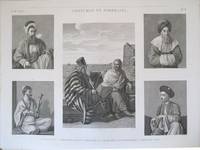
réf. 1998Middle East: Paris Impremerie de C.L.F.Pancoucke 1820-1829. Copper engravings 5 on 1 plate showing portraits and costumes from the second volume of "Etat Moderne" of the "Description de l'Egypte" 2nd Edition; black & white; verso blank. Blind stamp of the publisher Panckoucke to margin. The central image of two men by the seashore is surrounded by 4 smaller portaits Good dark impression; some light spotting to margins; remains of glue and tissue guard to right margin. The print is black and white. "Description de l'Egypte ou Recueil des observations et des recherches qui ont été faites en Egypte pendant l'expédition de l'armée française." When Napoleon Bonaparte invaded Egypt in 1798 he brought with him an entourage of more than 160 scholars and scientists. Known as the French Commission on the Sciences and Arts of Egypt these experts undertook an extensive survey of the country's archeology topography and natural history. . For four years more than 150 artists engineers linguists and scientists traveled throughout the country examining almost every aspect of ancient and contemporary Egypt. They recorded and measured in meticulous detail Egypt's topography flora and fauna and its ancient and contemporary architecture. A soldier who was part of the expedition found the famous Rosetta Stone which the French linguist and scholar Jean-François Champollion 1790-1832 later used to unlock many of the mysteries that long had surrounded the language of ancient Egypt. The Egyptian expedition ended with a total military failure. The French left Egypt in 1801 with the honors of war but defeated; yet military failure remains a significant event in the history of knowledge because it is the first time a military expedition was accompanied by a scientific expedition. In 1802 Napoleon authorized the publication of the commission's findings in a monumental multi-volume work that included plates maps scholarly essays and a detailed index. Publication of the original Imperial edition began in 1809 and continued to 1822 sold by subscription. It proved so popular that a second edition was published under the post-Napoleonic Bourbon Restoration. The "Royal edition" published in Paris by C.L.F. Panckoucke from 1820-1830. The Second edition consists of 11 or 12 volumes of plates in folio and 24 of text bound as 26 8vo. Brunet:II 617; Blackmer/Navari: 476 1st edition Middle East Egypt Costumes Paris Impremerie de C.L.F.Pancoucke 1820-1829 unknown
réf. 0267163932.Ghardcover. Good. Access codes and supplements are not guaranteed with used items. May be an ex-library book. hardcover
réf. 0259120987.Gpaperback. Good. Access codes and supplements are not guaranteed with used items. May be an ex-library book. paperback
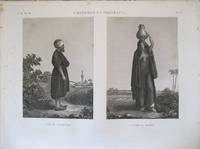
réf. 1999Middle East: Paris Impremerie de C.L.F.Pancoucke 1820-1829. Copper engravings 2 on 1 plate showing costumes from the second volume of "Etat Moderne" of the "Description de l'Egypte" 2nd Edition; black & white; verso blank. Blind stamp of the publisher Panckoucke to margin. The images show the grooms tanding in the countryside; the woman with a water jar on her head stands on the edge of the desert with the Pyramids in the background. Good dark impression; some light spotting to margins; remains of glue and tissue guard to right margin. "Description de l'Egypte ou Recueil des observations et des recherches qui ont été faites en Egypte pendant l'expédition de l'armée française." When Napoleon Bonaparte invaded Egypt in 1798 he brought with him an entourage of more than 160 scholars and scientists. Known as the French Commission on the Sciences and Arts of Egypt these experts undertook an extensive survey of the country's archeology topography and natural history. . For four years more than 150 artists engineers linguists and scientists traveled throughout the country examining almost every aspect of ancient and contemporary Egypt. They recorded and measured in meticulous detail Egypt's topography flora and fauna and its ancient and contemporary architecture. A soldier who was part of the expedition found the famous Rosetta Stone which the French linguist and scholar Jean-François Champollion 1790-1832 later used to unlock many of the mysteries that long had surrounded the language of ancient Egypt. The Egyptian expedition ended with a total military failure. The French left Egypt in 1801 with the honors of war but defeated; yet military failure remains a significant event in the history of knowledge because it is the first time a military expedition was accompanied by a scientific expedition. In 1802 Napoleon authorized the publication of the commission's findings in a monumental multi-volume work that included plates maps scholarly essays and a detailed index. Publication of the original Imperial edition began in 1809 and continued to 1822 sold by subscription. It proved so popular that a second edition was published under the post-Napoleonic Bourbon Restoration. The "Royal edition" published in Paris by C.L.F. Panckoucke from 1820-1830. The Second edition consists of 11 or 12 volumes of plates in folio and 24 of text bound as 26 8vo. Brunet:II 617; Blackmer/Navari: 476 1st edition Middle East Egypt Costumes Paris Impremerie de C.L.F.Pancoucke 1820-1829 unknown
réf. 0282521909.Gpaperback. Good. Access codes and supplements are not guaranteed with used items. May be an ex-library book. paperback