3629 resultados
1972Top corners lightly bumped. Else fine. DJ spine a little discolored. Light edgewear with 1 small tear (1 cm). DJ is price-clipped. ; 280 pages; Professor Dover's book is designed for those who are interested in the history of comedy as an art form but who are not necessarily familiar with the Greek language. The eleven surviving plays of Aristophanes are treated as representative of a genre. Old Attic Comedy, which was artistically and intellectually homogeneous and gave expression to the spirit of Athenian society in the late fifth and early fourth centuries B. C. Aristophanes is regarded primarily not as a reformer or propagandist but as a dramatist who sought, in competition with his rivals, to win the esteem both of the general public and of the cultivated and critical minority. He succeeded in this effort by making people laugh, and the book pays more attention than has generally been paid to the technical means, whether of language or of situation, on which Aristophanes' humor depends. Particular emphasis is laid on his indifference-positively assisted by the physical limitations of the Greek theatre and the conditions of the Athenian dramatic festivals-to the maintenance of continuous "dramatic illusion" or to the provision of a dramatic event with the antecedents and consequences which might logically be expected. More importance is attached to Aristophanes' adoption of popular attitudes and beliefs, to his creation of uninhibited characters with which the spectators could identify themselves, and to his acceptance of the comic poet's traditional role as a mordant but jocular critic of morals, than to any identifiable and consistent elements in his political standpoint.
1972light foxing to top of textblock. Scholar's name to ffep (Philippa Goold née Forder). Minor shelfwear to DJ. ; 280 pages; Professor Dover's book is designed for those who are interested in the history of comedy as an art form but who are not necessarily familiar with the Greek language. The eleven surviving plays of Aristophanes are treated as representative of a genre. Old Attic Comedy, which was artistically and intellectually homogeneous and gave expression to the spirit of Athenian society in the late fifth and early fourth centuries B. C. Aristophanes is regarded primarily not as a reformer or propagandist but as a dramatist who sought, in competition with his rivals, to win the esteem both of the general public and of the cultivated and critical minority. He succeeded in this effort by making people laugh, and the book pays more attention than has generally been paid to the technical means, whether of language or of situation, on which Aristophanes' humor depends. Particular emphasis is laid on his indifference-positively assisted by the physical limitations of the Greek theatre and the conditions of the Athenian dramatic festivals-to the maintenance of continuous "dramatic illusion" or to the provision of a dramatic event with the antecedents and consequences which might logically be expected. More importance is attached to Aristophanes' adoption of popular attitudes and beliefs, to his creation of uninhibited characters with which the spectators could identify themselves, and to his acceptance of the comic poet's traditional role as a mordant but jocular critic of morals, than to any identifiable and consistent elements in his political standpoint.
19652 corners bumped. Small tear to cloth at head of spine (1 cm). Minor rubbing. ; The study of roman Comedy is a study of the work of two comic poets, Titus Maccius Plautus and Publius Terentius Afer. Looks at the twenty extant plays of Plautus and the six by Terence. Also looks at Greek Comedy and Roman Comedy's influence on later authors. ; 501 pages
1965Corners and spine ends are worn and slightly fraying. Moderate edgewear. Slight Discoloration to front board. ; The study of roman Comedy is a study of the work of two comic poets, Titus Maccius Plautus and Publius Terentius Afer. Looks at the twenty extant plays of Plautus and the six by Terence. Also looks at Greek Comedy and Roman Comedy's influence on later authors. ; 501 pages
1952Book has minor shelfwear and rubbing. Rubbing to extremities; The study of roman Comedy is a study of the work of two comic poets, Titus Maccius Plautus and Publius Terentius Afer. Looks at the twenty extant plays of Plautus and the six by Terence. Also looks at Greek Comedy and Roman Comedy's influence on later authors. ; 501 pages
1972Very light shelfwear to book. Else fine. ; Analyses the conservative imagery of Terence and of Cicero's letters, contrasting this naturalistic language with the fantasies of Plautus and the formalization of Cicero's speeches. Numerous illustrative passages from Greek New Comedy, Terence, Plautus, and Cicero are reproduced in the text. ; Phoenix supplementary volume, 10; 222 pages
1972Very light shelfwear to book else fine. Endpapers lightly tanned. Some chipping and tears to DJ. Some tear to upper edge of back panel with some loss of DJ. Shelfwear and rubbing to DJ. ; Analyses the conservative imagery of Terence and of Cicero's letters, contrasting this naturalistic language with the fantasies of Plautus and the formalization of Cicero's speeches. Numerous illustrative passages from Greek New Comedy, Terence, Plautus, and Cicero are reproduced in the text. ; Phoenix supplementary volume, 10; 222 pages
1972Faint spotting to spine. 2 tiny pen markings to base of textblock. Minor shelfwear. ; Analyses the conservative imagery of Terence and of Cicero's letters, contrasting this naturalistic language with the fantasies of Plautus and the formalization of Cicero's speeches. Numerous illustrative passages from Greek New Comedy, Terence, Plautus, and Cicero are reproduced in the text. ; Phoenix Supplementary Volume, 10; 222 pages
1972Very light shelfwear to book. DJ has chipping and a few small tears. ; Analyses the conservative imagery of Terence and of Cicero's letters, contrasting this naturalistic language with the fantasies of Plautus and the formalization of Cicero's speeches. Numerous illustrative passages from Greek New Comedy, Terence, Plautus, and Cicero are reproduced in the text. ; Phoenix Supplementary Volume, 10; 222 pages
1972Book has sticker stain on inner fly-page. Light chipping to top of dustjacket spine. A few closed tears to back panel. Shelfwear and rubbing to DJ. ; Analyses the conservative imagery of Terence and of Cicero's letters, contrasting this naturalistic language with the fantasies of Plautus and the formalization of Cicero's speeches. Numerous illustrative passages from Greek New Comedy, Terence, Plautus, and Cicero are reproduced in the text. ; Phoenix supplementary volume, 10; 222 pages
1972Former owner's name stamped on ffep. ; Analyses the conservative imagery of Terence and of Cicero's letters, contrasting this naturalistic language with the fantasies of Plautus and the formalization of Cicero's speeches. Numerous illustrative passages from Greek New Comedy, Terence, Plautus, and Cicero are reproduced in the text. ; Phoenix supplementary volume, 10; 222 pages
1972Foxing/dustsoiling to top of textblock. Scholar's bookplate to inner cover (G. P. Goold). DJ has small tears (a couple repaired with cellotape) and some rubbing. ; Analyses the conservative imagery of Terence and of Cicero's letters, contrasting this naturalistic language with the fantasies of Plautus and the formalization of Cicero's speeches. Numerous illustrative passages from Greek New Comedy, Terence, Plautus, and Cicero are reproduced in the text. ; Phoenix Supplementary Volume, 10; 222 pages
1972Very minor shelfwear to book. DJ has some tears and chipping. DJ is price-clipped. ; Analyses the conservative imagery of Terence and of Cicero's letters, contrasting this naturalistic language with the fantasies of Plautus and the formalization of Cicero's speeches. Numerous illustrative passages from Greek New Comedy, Terence, Plautus, and Cicero are reproduced in the text. ; Phoenix Supplementary Volume, 10; 222 pages
1962Extensively revised and updated, this human rights study presents new material on the legal protection of rights in Canada's post-Charter era. 327p. bibliography . index Crisp ight copy, but has previous owners name and s few paragraphs highlighted, Excellent readyiog vopy Book
1927Endpapers browned. Small tears to spine ends. Spotting to boards. Minor spine slant. ; Xxxvi, 182pp. ; 182 pages
2008ref. 46645Ariola, 2008. CD CD
1998ref. 30633Wolverine Records, 1998. WRR 057 1 CD CD
1957ref. 50261957 Paris, Fayard, 1957, in 8, broché, 283 pages ; illustrations.
ref. 106.793Paris, Librairie Plon, Plon-Nourrit, 1923. 14 x 23, 405 pp., broché, bon état.
1985ref. 97583The Bodley Head 1985 In-8 à l’italienne broché. Livre en anglais. 127 pages. Bon état d’occasion.
2009ref. 11665Finix Comics 2009 48 pages 22 2x0 8x29 4cm. 2009. Reliure editeur cartonnée. 48 pages. Tatiana K. est une série de bande dessinée réunie en intégrale comprenant trois tomes. Elle raconte les aventures de Tatiana une espionne venue des pays de l'Est au charme ravageur impliquée dans des missions mêlant clonage manipulation génétique et guerre des services secrets le tout sur un ton mêlant action et comédie

ref. 47899Paris, Jacques Vautrain, 1949. 18 x 22, 205 pp., très nombreux dessins, broché, très bon état.
1952ref. 3526Les éditions magnard 1952 402 pages in8. 1952. Reliure Editeur avec jaquette. 402 pages.
1878ref. 7806Garnier Frères Libraires-Éditeurs 1878 462 pages in8. 1878. reliure editeur demi toile. 462 pages. Le Philosophe marié est une comédie en cinq actes et en vers de Destouches représentée pour la première fois à Paris en 1727. Cette pièce considérée comme l'un des plus grands succès du XVIIIe siècle est souvent publiée dans des recueils contenant d'autres œuvres de l'auteur comme Le Glorieux et Le Dissipateur. L'édition analysée est une publication de 1878 par Garnier frères accompagnée d'une introduction de Louis Moland
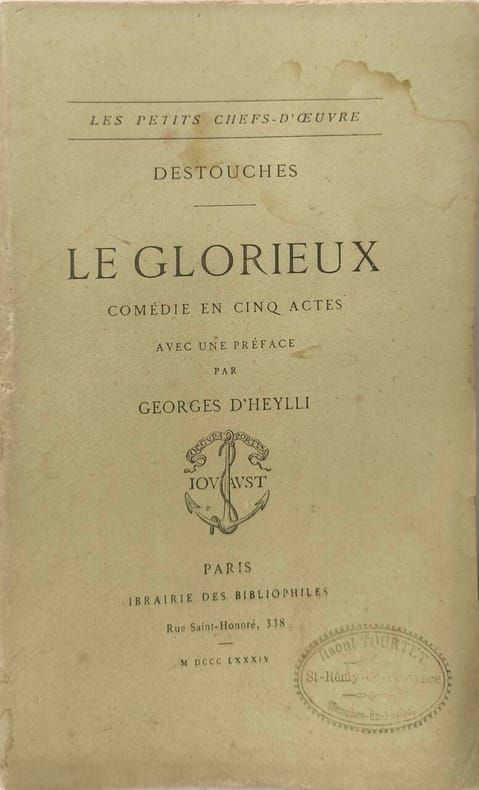
1884ref. 4567Librairie des bibliophiles 1884 142 pages in12. 1884. broché. 142 pages.