8 327 résultats
19244 vols., roy. 8vo., First Edition thus, on laid paper, free endpapers lightly browned as usual; tan boards, brown buckram backs with printed paper labels, uncut, a very good, bright, crisp, clean set. EDITION LIMITED TO 900 NUMBERED SETS (THIS SET NO. 156). This remains the only complete collection of Wycherley's works. The set comprises Vol. I: Introduction, Love in a Wood, The Gentleman Dancing-Master; Vol. II: The Country Wife, The Plain Dealer, Letters; Vol. III: Miscellany Poems; Vol. IV: Miscellaneous Poems, Hero and Leander, Posthumous Works. A lovely set.
Prices and buyers' names in a cont. hand, orig. printed wrappers, 368 lots.
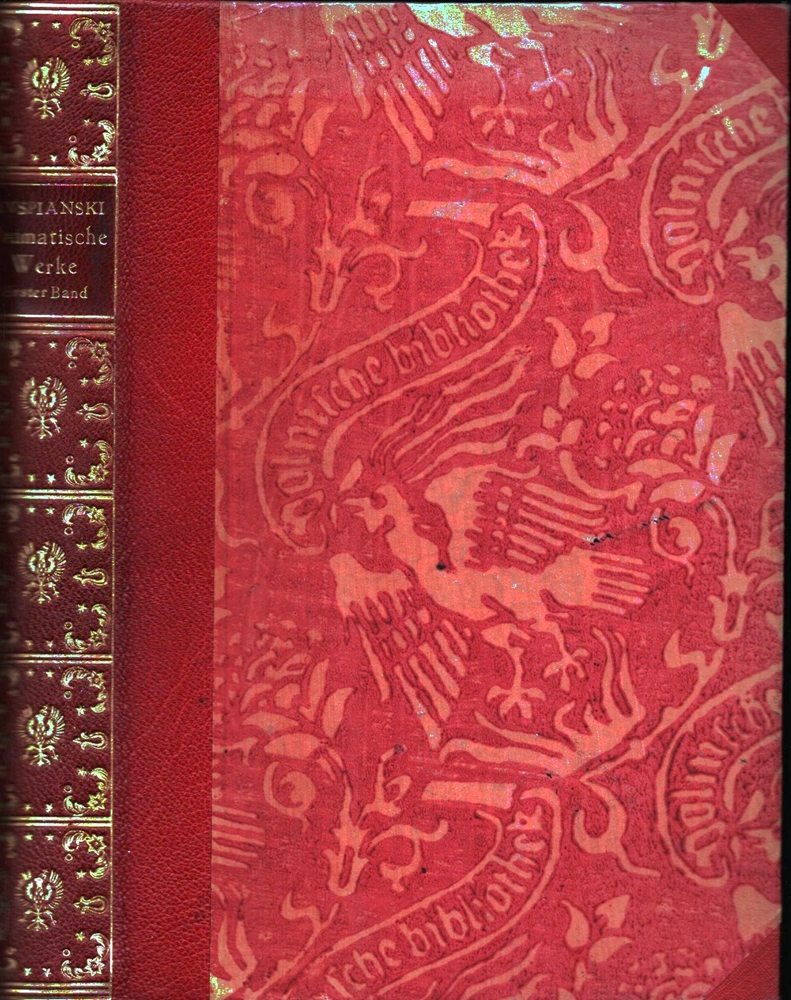
1918réf. 95892München, Georg Müller, 1918. LXIV, 301 S. Mit 1 Portrait-Tafel (= Dramatische Werke, 1) / Polnische Bibliothek, Abt. 3, Bd. 2). 19 cm. Rotes OHLdr. mit reicher ornamentaler Rückenvergoldung u. figürlich-dekorat. Walzenpapierbezug.
réf. 19303Lighthouse Home Entertainment, 2017. Blu-ray Blu-ray
réf. 5843Librairie Saint Joseph Tolra 190 pages in8. Sans date. reliure éditeur demi toile à coins. 190 pages. Pièce de théâtre en deux actes et deux tableaux adaptée de l'ouvrage 'L'Abbé Jean' mettant en scène un drame véridique centré sur la figure de l'abbé Jean de Vayrac (1664-1734)
1978réf. 80168Stuttgart, Klett-Cotta, 1978. 250 S. 8° Oktav, Softcover/Paperback
1986réf. 10430France Loisirs 1986 274 pages 14x20x3cm. 1986. Reliure Editeur avec jaquette. 274 pages. Les Noces barbares de Yann Queffélec publié en 1985 et lauréat du prix Goncourt raconte l'histoire de Nicole une adolescente trop crédule séduite puis violée par un militaire américain. De cette union barbare naît Ludovic un enfant haï par sa mère trop jeune dans un récit qui explore les thèmes de la honte de l'exclusion et de la quête d'amour à travers une narration sombre et puissante
London, Chatto & Windus 1945, 95pp., bit of rust, 1e ed., linen cover with dustwrapper, VG
1971réf. 20076Indianapolis, The Bobbs-Merill Company, 1971. (Edited with an introduction by Robin Skelton) 382 S. (24,5 cm) Leinen mit Umschlag / gebundene Ausgabe
1939réf. 053785Dublin: The Cuala Press 1939. 1st Edition 2nd Printing. Soft cover. Near Fine. 46 Pp. Large Format Soft Cover. Second Printing All But A Few Copies Of The First Having Been Destroyed. Near Fine Slight Bumping To Yapped Edges No Tears Or Chips Or Marks Or Browning. The Cuala Press paperback
190333 p. Hardcover Very good condition, back strip chipped at top and detached at bottom 950 copies printed.
1909réf. 001417Portland Maine: Thomas B. Mosher 1909. Hardcover. Near Fine. 6 31 3 p.; 19 cm. Off-white stiffened covers with overlapping fore-edges. Spine and cover titles and front cover decoration printed in light green. Original light green slipcase with title in black at foot of front section. Title page and colophon in red and black. Pages are unopened. "Five hundred copies of this book printed on Japan vellum small quarto and the type distributed in the month of July MDCCCCIX." -- colophon. First American edition thus. Book is in Near Fine Condition: slight discoloration on back cover; slight darkening along edges of covers; otherwise clean and bright. Slipcase is in Poor Condition: separated into two sections; lacking upper and spine sections; lacking small amount of green paper from front section. Thomas B. Mosher hardcover
1917Publishers cloth. 8vo. 217; 205; 230 pages. 20 cm. First edition. In Yiddish. Cover illustrated by S. Raskin. From New York to Rehovot and Back, the travel narrative and memoir of Yehoash in three volumes. YEHOASH (pseudonym of Yehoash Solomon Bloomgarden; 18721927) , Yiddish poet and translator. Yehoash was born in Virbalen, Lithuania, and as a boy he read maskilic literature as well as studying Torah with his father, briefly attending the yeshivah of Volozhin, only to begin a career as a Hebrew poet. At the age of 17 he took his first Hebrew poems to Warsaw, where I. L. Peretz encouraged him to continue writing Hebrew and Yiddish lyrics. The following year Yehoash immigrated to the U. S. He made no headway either as a Hebrew poet or in various callings bookkeeping, tailoring, peddling, and Hebrew teaching. For a decade he faced severe privations until he contracted tuberculosis and went to the Denver Sanatorium for Consumptives in 1900 to recuperate. There he remained for almost ten years, maturing as a Yiddish poet, publishing his poems, ballads, fables, and translations in leading dailies, periodicals, and literary almanacs. In his early 30s, he undertook to translate the Bible into a modern Yiddish which would combine scholarly precision with simple idiomatic language, a task to which he devoted the rest of his life. While at work on this translation, he prepared, together with Charles D. Spivak, his physician and the co-founder of the sanatorium, a Yiddish dictionary, first published in 1911, which defined about 4, 000 Hebrew and Aramaic words used in Yiddish and which went through many editions as a basic reference work. Returning to New York in 1909, Yehoash had to struggle to make a living, even though his fame was worldwide and Yiddish periodicals in many lands gladly published his contributions. In January 1914, he left for Erez Israel and settled in Rehovot. He mastered classical Arabic and translated portions of the Koran and Arabian tales into Yiddish. When the Ottoman Empire entered World War I, he returned to New York and published the story of his experiences in three volumes of travel sketches, Fun New York biz Rekhovot un Tsurik (From New York to Rehovot and Back, 191718; Eng. The Feet of the Messenger, 1923) . His sojourn in Erez Israel as well as his knowledge of Arabic proved useful to him in his work on the translation of the Bible. Although he had published a Yiddish rendering of several biblical books including Isaiah and Job in 1910, he realized the inadequacy of this initial attempt and began anew. His more adequate rendering, starting with Genesis, appeared in installments in the New York daily Der Tog from 1922. At the time of his death only the Pentateuch translation had been published, but the rest of the biblical books were printed from his manuscripts. His version was hailed as a contribution of national significance. The translator drew upon idiomatic treasures of various Yiddish dialects, upon the Khumesh-Taytsh (the Old Yiddish, word-for-word translation of Pentateuch) , vocabulary used by melammedim in Ashkenazi schools for many generations, and expressions of the Ze'enah u-Re'enah (Tsene-Rene) , with its archaic patina. Yehoash was thus able to retain the rhythm and flavor of the Hebrew to a larger extent than preceding Bible translators. The two-volume edition, with parallel Hebrew and Yiddish texts, distributed in tens of thousands of copies, became a standard work for Yiddish-speaking homes throughout the world. In 1949, Mordecai Kosover edited Yehoash's notes to the Bible, which afforded an insight into the translator's many years of wrestling with the sacred text. Yehoash, who also translated Longfellow's Hiawatha and the Rubáiyát of Omar Khayyam into Yiddish, was far ahead of his time in terms of his own poetry. When the first edition of his Gezamelte Lider (Collected Poems) appeared in 1907, he was widely hailed as a first-rank artist. His lyrics were reprinted in anthologies and school texts, and were translated into many languages. An English translation, Poems of Yehoash, by Isidore Goldstick, appeared in 1952, and a Hebrew version (1957) was a cooperative venture by a number of significant Hebrew writers, including Jacob Fichmann and Dov Sadan. Yehoash's two later lyric volumes (1919 and 1921) linked him with Inzikhism, the modernist trend of introspection in post-World War I Yiddish poetry, the leaders of which acclaimed him as their forerunner. Yehoash gave expression in his lyrics to his awareness of a divine force permeating the universe. He re-imagined in verse biblical and post-biblical legends, tales from medieval Jewish chronicles, and hasidic lore, versified fables from the Talmud, Aesop, La Fontaine, and Lessing, and created new fables of his own. He wrote romantic, ghostly ballads, but he also felt the spell of Peretz, his lifelong friend, and strove for classical purity and perfection in rhythm and rhyme. Yehoash also influenced American Jewish poetry in English, notably the modernist work of Louis Zukofsky. (EJ 2007) Subjects: Yiddish literature - Palestine. Palestine -Description and travel. Authors, Yiddish - New York (State) - Biography. Authors, Yiddish - Israel - Biography. Light wear to cloth, light soiling to outer edges, endpapers starting on volume 3, otherwise fresh. Good + condition. (YID-16-10)
1917Publishers cloth. 8vo. 217; 205; 230 pages. 20 cm. First edition. In Yiddish. Cover illustrated by S. Raskin. From New York to Rehovot and Back, the travel narrative and memoir of Yehoash in three volumes. YEHOASH (pseudonym of Yehoash Solomon Bloomgarden; 18721927) , Yiddish poet and translator. Yehoash was born in Virbalen, Lithuania, and as a boy he read maskilic literature as well as studying Torah with his father, briefly attending the yeshivah of Volozhin, only to begin a career as a Hebrew poet. At the age of 17 he took his first Hebrew poems to Warsaw, where I. L. Peretz encouraged him to continue writing Hebrew and Yiddish lyrics. The following year Yehoash immigrated to the U. S. He made no headway either as a Hebrew poet or in various callings bookkeeping, tailoring, peddling, and Hebrew teaching. For a decade he faced severe privations until he contracted tuberculosis and went to the Denver Sanatorium for Consumptives in 1900 to recuperate. There he remained for almost ten years, maturing as a Yiddish poet, publishing his poems, ballads, fables, and translations in leading dailies, periodicals, and literary almanacs. In his early 30s, he undertook to translate the Bible into a modern Yiddish which would combine scholarly precision with simple idiomatic language, a task to which he devoted the rest of his life. While at work on this translation, he prepared, together with Charles D. Spivak, his physician and the co-founder of the sanatorium, a Yiddish dictionary, first published in 1911, which defined about 4, 000 Hebrew and Aramaic words used in Yiddish and which went through many editions as a basic reference work. Returning to New York in 1909, Yehoash had to struggle to make a living, even though his fame was worldwide and Yiddish periodicals in many lands gladly published his contributions. In January 1914, he left for Erez Israel and settled in Rehovot. He mastered classical Arabic and translated portions of the Koran and Arabian tales into Yiddish. When the Ottoman Empire entered World War I, he returned to New York and published the story of his experiences in three volumes of travel sketches, Fun New York biz Rekhovot un Tsurik (From New York to Rehovot and Back, 191718; Eng. The Feet of the Messenger, 1923) . His sojourn in Erez Israel as well as his knowledge of Arabic proved useful to him in his work on the translation of the Bible. Although he had published a Yiddish rendering of several biblical books including Isaiah and Job in 1910, he realized the inadequacy of this initial attempt and began anew. His more adequate rendering, starting with Genesis, appeared in installments in the New York daily Der Tog from 1922. At the time of his death only the Pentateuch translation had been published, but the rest of the biblical books were printed from his manuscripts. His version was hailed as a contribution of national significance. The translator drew upon idiomatic treasures of various Yiddish dialects, upon the Khumesh-Taytsh (the Old Yiddish, word-for-word translation of Pentateuch) , vocabulary used by melammedim in Ashkenazi schools for many generations, and expressions of the Ze'enah u-Re'enah (Tsene-Rene) , with its archaic patina. Yehoash was thus able to retain the rhythm and flavor of the Hebrew to a larger extent than preceding Bible translators. The two-volume edition, with parallel Hebrew and Yiddish texts, distributed in tens of thousands of copies, became a standard work for Yiddish-speaking homes throughout the world. In 1949, Mordecai Kosover edited Yehoash's notes to the Bible, which afforded an insight into the translator's many years of wrestling with the sacred text. Yehoash, who also translated Longfellow's Hiawatha and the Rubáiyát of Omar Khayyam into Yiddish, was far ahead of his time in terms of his own poetry. When the first edition of his Gezamelte Lider (Collected Poems) appeared in 1907, he was widely hailed as a first-rank artist. His lyrics were reprinted in anthologies and school texts, and were translated into many languages. An English translation, Poems of Yehoash, by Isidore Goldstick, appeared in 1952, and a Hebrew version (1957) was a cooperative venture by a number of significant Hebrew writers, including Jacob Fichmann and Dov Sadan. Yehoash's two later lyric volumes (1919 and 1921) linked him with Inzikhism, the modernist trend of introspection in post-World War I Yiddish poetry, the leaders of which acclaimed him as their forerunner. Yehoash gave expression in his lyrics to his awareness of a divine force permeating the universe. He re-imagined in verse biblical and post-biblical legends, tales from medieval Jewish chronicles, and hasidic lore, versified fables from the Talmud, Aesop, La Fontaine, and Lessing, and created new fables of his own. He wrote romantic, ghostly ballads, but he also felt the spell of Peretz, his lifelong friend, and strove for classical purity and perfection in rhythm and rhyme. Yehoash also influenced American Jewish poetry in English, notably the modernist work of Louis Zukofsky. (EJ 2007) Subjects: Yiddish literature - Palestine. Palestine -Description and travel. Authors, Yiddish - New York (State) - Biography. Authors, Yiddish - Israel - Biography. Light wear to cloth, light soiling to outer edges. Very Good Condition. (YID-16-10A)
réf. 94563aafBulle, Les enfants de Joseph Yerly du Mont, 1993, in-8vo, 408 p., reliure ill. de l’éditeur (cartonnage).
réf. 123459aafEdition du ‘Paysan fribourgeois’, 1937, pt. in-8vo, 64 p., brochure originale. (ill. d’un dessin de L. Vonlanthen).
réf. DADAX0313290636New unknown
1982réf. 2081502111703261Not Available 1982. Soft Cover. Fine. The book is in fine condition. Not Available paperback
2009réf. 55083Indigo, 2009. DVD DVD
19622 vols., 8vo., Second Edition; original black buckram, gilt backs, a very good, bright, clean set. Sold from an institution with its stamps and labels on endpapers and title versos. Much-needed reissue of the original edition of 1933. VERY SCARCE, ESPECIALLY IN THIS CONDITION
2026réf. x-1009466461Cambridge University Press 2026. Hardcover. New. 75 pages. 6.00x0.25x9.00 inches. Cambridge University Press hardcover
1927réf. 1958Weimann, Leipzig, 1927. Band 1-3, ca. 1800 S. m. zahlr. Skizzen u. Tfln., OHldr., Goldprägung auf Rücken, Frab. Kopfschnitt, Ecken etwas bestossen, Leinen sauber, sonst sehr gut
2014Very light pencilling to a couple of pages by R. E. Fantham else book is fine. Card of Dr. Martin Hose taped to ffep. ; 9.3 X 6.4 X 0.9 inches; 296 pages
1860réf. 96667Stuttgart, J. G. Cotta, 1860. 98;192; 230; 164 S. Kl.-8vo. 15 cm. Dekorativ goldgeprägtes OLn. mit marmor. Schnitt.
1969réf. 972Velber bei Hannover : Friedrich, 1969. 154 S. Mehrere Bühnenbilder. Kl. 8°. 2. Aufl. OPb. m. SU. (Friedrichs Dramatiker des Welttheaters ; 8)