7 180 résultats
1957Endpapers tanned. Spine a little faded. Corners somewhat edgeworn. Pen marginalia and underlining to some pages. ; Greek Text with Latin introduction and apparatus. V1 (1957) Lxviii, 152 pp; ; Bibliotheca Scriptorum Graecorum Et Romanorum Teubneriana TEUBNER; Vol. 1; 260 pages
1957Scholar's bookplate to inner cover (G. P. Goold). Corners edgeworn. Pages lightly tanned. Else VG. ; Greek Text with Latin introduction and apparatus. V1 (1957) Lxviii, 152 pp; ; Bibliotheca Scriptorum Graecorum Et Romanorum Teubneriana TEUBNER; Vol. 1; 260 pages
1940Publishers cloth. 8vo. 188 pages. 24 cm. First edition. In Yiddish. Bibliotek fun Yivo. Added english title page: A Centenary of Abraham Goldfaden. Contains writings by various authors on Goldfaden and the Yiddish Theatre in Lemberg, his activities in Paris, Goldfadens unpublished letters, poems, etc. Avrom Goldfaden (18401908) , playwright, theater director, poet, and impresario; considered the Father of Yiddish Theater. Avrom Goldfadns productions emerged during the period of the Haskalah movement in Russia and the cultural-nationalistic activities of East European minorities. The first director to create a viable Jewish national theater, Goldfadn built up an audience and initiated its members into Western aesthetics, secularism, and a modern Jewish consciousness. (YIVO Encyclopedia) Subjects: Goldfaden, Abraham, 1840-1908. Yiddish Theatre. Bibliography. OCLC lists 27 copies worldwide. Outer edges of cloth rubbed, otherwise fresh. Very good condition. (YID-16-32)
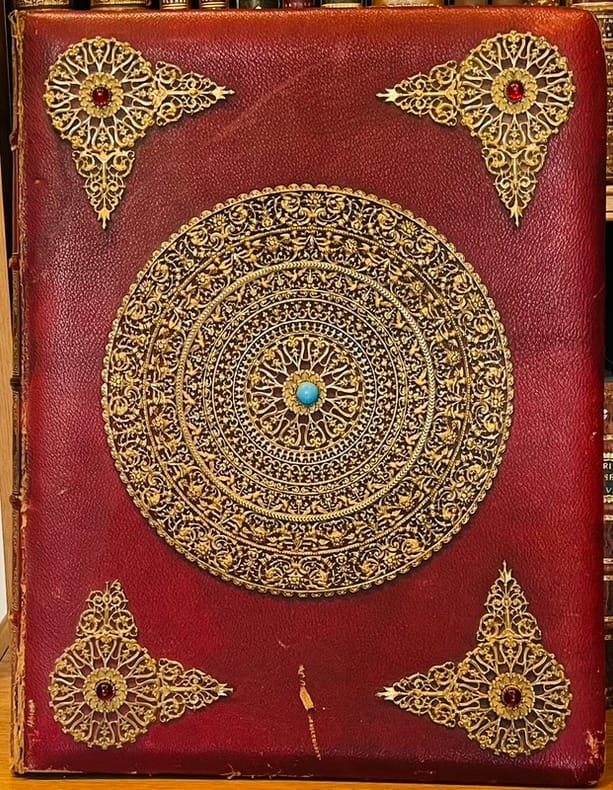
1880réf. 44443, , (Vers 1870-1880). Grand in-folio manuscrit (54 x 41 cm) de 52, 50 ff. enluminés sur peau de vélin à l'encre et aquarelle rouge, vert, bleu et or, chagrin rouge, dos orné à nerfs, décor sur le plat supérieur d'écoinçons et d'une grande plaque circulaire ajourés en laiton avec incrustations de cabochons de pierres, sur le second plat quatre plaques d'angles circulaires ajourés en laiton avec incrustations de cabochons de pierres, dentelle intérieure, gardes de papier dominoté (reliure de l'époque).
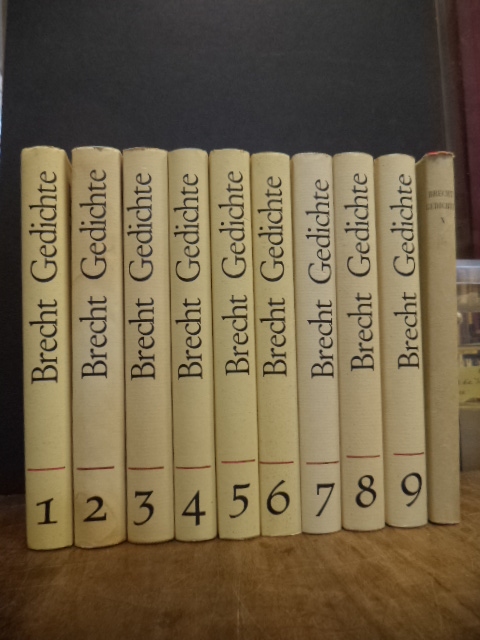
1960réf. 39318ABFfm. bzw. [Ost]-Berlin/Weimar, Suhrkamp (Bände I-IX) / Aufbau (Band X), 1960-1965 (Bände I-IX) bzw.1978 (Band X). 8°, insg. 2.247 S., die 9 Suhrkamp-Bände jeweils mit einem ganzs. s/w-Porträt und Kopfrotschnitt, original Leineneinbände mit Rückenschildern und den original Schutzumschlägen (die Bände1, 4, 5 und 6 sind original Pappbände mit Rückenschild), DDR), alle Bände in Erstausgabe (nur der Band 10 als ung wenige Umschlag minimal fleckig, auch der Schnitt bei zwei Bände zart fleckig, die meisten Bände mit einem schönen Exlibris auf den vorderen Innendeckeln, leichte papier- und altersbedingte Nachdunklung innen, sonst schön und textsauber
1909Very Good Turkish, Ottoman (1500-1928) In modern, handsome full brown morocco. Foolscap 8vo. (18 x 12.5 cm). In Ottoman script (Old Turkish with Arabic letters). 159 p. Extremely rare first Turkish translation of Macbeth, printed in Ottoman Cairo. Macbeth reflected Abdullah Cevdet's reaction against Hamidian despotism and his love and advocacy of liberty. One must also remember him as one of the founding members of the Party of Union and Progress - a secret organization that conspired to overthrow Abdülhamid's absolutist regime. The argument that Abdullah Cevdet's translation of Hamlet, Julius Caesar and Macbeth reflected his opposition to Abdülhamid II's absolute monarchy could be justified with the fact that the themes of the translated plays were perceived by the political authorities as threatening since they were about the murder of kings and heads of state. In Abdullah Cevdet's view, Macbeth is famous as a drama of "ambition for status" (hirs-i cah). Abdullah Cevdet was an Ottoman-born Turkish intellectual and physician of Kurdish ethnic descent, and one of the founders of the Committee of Union and Progress (CUP). In 1908, he joined the Democratic Party that later on merged with the Freedom and Accord Party in 1911. He was also a translator, radical free-thinker, and ideologist of the Young Turks until 1908. The son of a physician, and himself a graduate from the Military College in Constantinople as an ophthalmologist, Cevdet, initially a pious Muslim, was influenced by Western materialistic philosophies and came to oppose institutionalized religion but thought that "although the Muslim God was of no use in the modern era, the Islamic society must preserve Islamic principles." He published the periodical Içtihat from 1904 to 1932, of which articles he used to promote his modernist thoughts. He was arrested and expelled from his country several times due to his political activities and lived in European cities including Vienna, Geneva and Paris. His poetry was linked with the Symbolist movement in France and he received accolades from leading French authors like Gustave Kahn. (Source: DR. ABDULLAH CEVDET'S TRANSLATIONS (1908-1910): THE MAKING OF A WESTERNIST AND MATERIALIST "CULTURE REPERTOIRE" IN A "RESISTANT" OTTOMAN CONTEXT; Ayluçtarhan, Sevda). "Between 1908 and 1910, Abdullah Cevdet produced a large oeuvre of translations, including four translations of Shakespeare's tragedies: The translations of Hamlet and Julius Caesar (translated by Cevdet as Jül Sezar) were published in 1908, the same year as the declaration of the Second Constitution. Macbeth, translated by Cevdet as Makbes, was published in the following year. [.] Nonetheless, Abdülhamid II seemed to be even less tolerant of the dissemination of Hamlet, Macbeth, and Julius Caesar, since they were all about unjust rulers who were executed in the end. It is not surprising that the performances of these plays became subject to strict censorship in the Ottoman lands and banned (Paker 1986: 91). This could be shown as a reason why Abdullah Cevdet was able to publish the translations of these plays only after 1908, though he had finished translating Hamlet in 1902, Julius Caesar and Macbeth in 1904, and Romeo and Juliet in 1905 (Süssheim 1987). As Abdullah Cevdet was a planner of culture, his literary translations cannot merely be judged on an "aesthetic" level. It will be discussed in this chapter that Abdullah Cevdet's translations of Hamlet, Julius Caesar and Macbeth could be read as critical texts directed against Abdülhamid II's absolutist regime. [.] Due to the fact that the selection of source language and culture is an important factor in accounting for any kind of "translation policy", Abdullah Cevdet's selection of both these instruments needs to be taken into account (Toury 2000: 202). Özege 12009. Only one copy in OCLC: 949612474 (Bogaziçi University Library of Turkey).
1824Bound in brown marbled boards. Black spine label with gilt lettering to spine. Corners and spine ends edgeworn. Rubbing to boards. Colour flecking off in places of boards. Cracks along joints of spine cover. Pages age-toned. Foxing passim. Former owner's name with note in ink to ffep. ; Vol I: (1824) XVIII, 489 pp + vol. II: (1824) 370 pp Text in Greek and Latin. ; 2 Vols in 1; Vol. 1/2/2022; 8vo 8" - 9" tall; 744 pages
1823Bound in brown marbled boards. Black spine label with gilt lettering to spine. Corners and spine ends edgeworn. Rubbing to boards. Colour flecking off in places of boards. Pages age-toned. Foxing passim. Former owner's name with note in ink to ffep. ; Hippolytus: (1823) Xxxii, 416 pp + Diatribe (1824) viii, 328 pp Text in Greek, notes and commentary in Latin. ; 744 pages
1990Book is fine. Minor shelfwear to DJ. Very tiny chip to DJ. ; Greek Text with Latin apparatus and introduction. ; Oxford Classical Texts Oct (Scriptorum Classicorum Bibliotheca Oxoniensis); Vol. 3; 402 pages
1969Former owner's name stamped to ffep (J. D. Fitton). ; Greek Text with Latin apparatus and introduction. ; Oxford Classical Texts Oct (Scriptorum Classicorum Bibliotheca Oxoniensis); Vol. 3; 402 pages
1957Endpapers browned. Former owner's name to ffep covered with white label. Light shelfwear. ; Greek Text with Latin apparatus and introduction. ; Oxford Classical Texts Oct (Scriptorum Classicorum Bibliotheca Oxoniensis); Vol. 2
1955Scholar's name to ffep (Philippa Goold née Forder). Endpapers browned. Some pencil notes. Light bump to 1 corner. ; Greek Text with Latin apparatus and introduction. ; Oxford Classical Texts Oct (Scriptorum Classicorum Bibliotheca Oxoniensis); Vol. 2
1966Former owner's name stamped to ffep (J. D. Fitton). Crease to front board. A couple of pages have not been corner trimmed. ; Greek Text with Latin apparatus and introduction. ; Oxford Classical Texts Oct (Scriptorum Classicorum Bibliotheca Oxoniensis); Vol. 2
1958Scholar's name stamped to ffep with small label affixed over another name. Minor shelfwear. Endpapers lightly browned. ; Greek Text with Latin apparatus and introduction. ; Oxford Classical Texts Oct (Scriptorum Classicorum Bibliotheca Oxoniensis); Vol. 1
1966Former owner's name to ffep. Some rubbing to boards. Very light bump to head of spine. Minor shelfwear. ; Greek Text with Latin apparatus and introduction. ; Oxford Classical Texts Oct (Scriptorum Classicorum Bibliotheca Oxoniensis); Vol. 1
1974Light browning to wraps. Minor shelfwear. Very Light bump to base of spine; Greek Text with Italian commentary. XXXVI, 51 pp. ; Testi E Documenti Per Lo Studio Dell'antichità XLVII; 51 pages
1974Light browning to wraps. Minor shelfwear. Very Light bump to bottom corner. Tiny chip to base of spine. ; Greek Text with Italian commentary. XXXVI, 51 pp. ; Testi E Documenti Per Lo Studio Dell'antichità XLVII; 51 pages
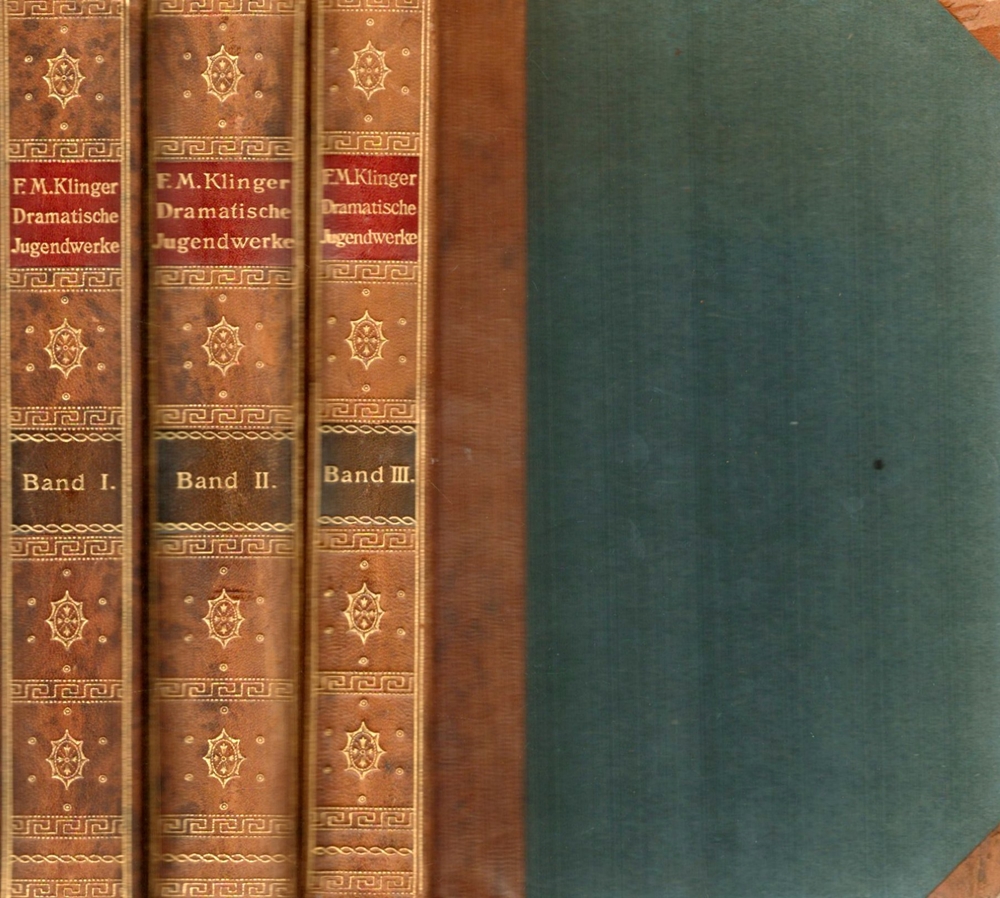
1913réf. 86355(Leipzig, Ernst Rowohlt, 1912/1913). LXIII, 371; 469; 353 S. Mit 1 mont. Porträt nach der Zeichnung Goethes von 1775 u. 2 gefalt. Faks. in Bd. 1. 8vo. 21 cm. Bde. 1 u. 3 marmor. HLdr. mit RVergold. u. je 2 RSchildern, Bd. 2 unaufgeschnittene OBrosch.
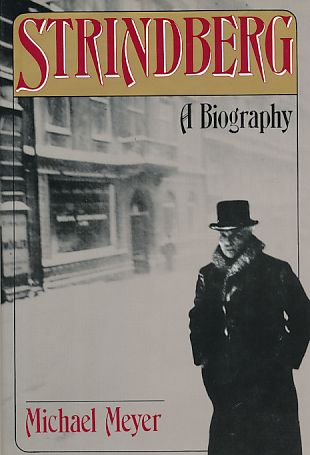
1985réf. 965715London: Secker & Warburg, 1985. XVI; 651 S., Abb. Originalhalbleinen mit Schutzumschlag.
1904Spine and part of wraps have been crudely reinforced with masking tape while inner hinges have been reinforced with cellotape. Some creasing to wraps. Wraps are browned. Internally VG. ; Greek text with Latin Commentary; 156 pages
1888Heavy marginalia and underlining to greek text. Wraps are very chipped, torn and tattered. Front wrap is detached but has been taped on--Spine has been crudely repaired with brown tape. Former owner's name to titlepage. ; [163]-248 p. Greek Text with German commentary. ; 85 pages
1960Light bumping to two corners. Minor edgewear to corners. Fraying to spine ends. Spine is rubbed and a little faded. Former owner's name to ffep. Pencil marginalia and underlining on some pages. ; Greek Text with Latin apparatus and introduction. ; Oxford Classical Texts Oct (Scriptorum Classicorum Bibliotheca Oxoniensis); 376 pages
1964Minor edgewear to corners. Small tears to cloth at base of spine. Former owner's name with 1 line written in pen to ffep. Very light marginalia and underlining on about 6 pages. ; Greek Text with Latin apparatus and introduction. ; Oxford Classical Texts Oct (Scriptorum Classicorum Bibliotheca Oxoniensis); 376 pages
1966Former owner's name to ffep. Else book is fine. DJ spine is browned. Light creasing to edges of wraps. ; Greek Text with Latin apparatus and introduction. ; Oxford Classical Texts Oct (Scriptorum Classicorum Bibliotheca Oxoniensis); 376 pages
1966Scholar's name to inner cover (Brad Inwood). Else book is fine. DJ spine is browned. DJ is price-clipped. Light chipping and small tears to DJ. ; Greek Text with Latin apparatus and introduction. ; Oxford Classical Texts Oct (Scriptorum Classicorum Bibliotheca Oxoniensis); 376 pages