367 résultats
In-8 (cm. 28.50), brossura, sovracoperta editoriale illustrata, pp. 63, (1), con illustrazioni in bianco e nero e a colori nel testo. Conferenza tenuta nell’Aula Magna dell’Ateneo Veneto il 3 Dicembre 1981. Data d’appartenenza. In ottimo stato (nice copy).
In-16 (cm. 18.90), custodia bivalve in mezza tela verde e cartonato, contenente pp. 8, ed ai risguardi due illustrazioni che riproducono la targa posta a Pavia il XIII Dicembre 1914 “A Casimiro Mondino innovatore sapiente nel giorno solenne e gloriosa celebrazione dell’Autonomia della Clinica di Malattie nervose e Mentali gli Assistenti e gli Allievi ammirati offrono”. Al risguardo posteriore la medesima dedica, seguita da innumerevoli firme, posta su un documento istoriato. Mancanze alla carta che ricopriva il dorso e macchie ai piatti. Le carte, con fioriture, presentano un’allocuzione di Mario Gandini al Professore ed un messaggio agli Studenti del medesimo Casimiro Mondino. Testo in buono stato (text in good condition).
Centro per la storia dell'Università di Padova; 440 pagg in perfetto stato Brossura
2 Voll. In-8 (Cm 23,7 x 13,5), pp. 153-168, brossura editoriale. Illustrazioni bianco nero nel testo. Ex libris alla prima carta. COME NUOVO
1 Vol. In-4 gr t. editoriale pag. 78 decine di tavv. a p. pagina PROG 43323 CATT_ATT 57
Gli Incunabili della Biblioteca Queriniana di Brescia Ugo Baroncelli Ateneo di Brescia Rilegatura brossura Ottime condizioni
Supplemento ai "commentari dell'ateneo di Brescia" per l'anno 1933. Volume in buone condizioni. Copertina flessibile di cartone grigio con segni del tempo. Pagine ingiallite, in particolare sui bordi, ma perfettamente leggibili. Molte illustrazioni.
Volume in discrete condizioni. Copertina flessibile di cartone giallo molto rovinata (vedasi immagini). Paine leggibili, ma rovinate sui bordi.
Volume in buone condizioni. Copertina flessibile di cartone giallo . Pagine ingiallite dal tempo, soprattutto sui bordi, ma perfettamente leggibili.
Volume in discrete condizioni. Copertina flessibile di cartone giallo . Pagine ingiallite dal tempo, soprattutto sui bordi, ma perfettamente leggibili.
Volume in ottimo stato. Pagine lievemente ingiallite a causa del tempo. Copertina cartacea flessibile di colore scuro.
Volume in buone condizioni. Pagine ingiallite dal tempo, soprattutto sui bordi. Copertina flessibile cartacea.
(Parma, 1941) stralcio con copertina posticcia muta, pp. 55/89. - !! ATTENZIONE !!: Con il termine estratto (o stralcio) intendiamo riferirci ad un fascicolo contenente un articolo di rivista, sia che esso sia stato stampato a parte utilizzando la stessa composizione sia che provenga direttamente da una rivista. Le pagine sono indicate come "da/a", ad esempio: 229/231 significa che il testo è composto da tre pagine. Quando la rivista di provenienza non viene indicata é perchè ci è sconosciuta. - !! ATTENTION !!: : NOT A BOOK : “estratto” or “stralcio” means simply a few pages, original nonetheless, printed in a magazine. Pages are indicated as in "from” “to", for example: 229/231 means the text comprises three pages (229, 230 and 231). If the magazine that contained the pages is not mentioned, it is because it is unknown to us.
(Parma, 1977) stralcio con copertina posticcia muta, pp. 307/336. - !! ATTENZIONE !!: Con il termine estratto (o stralcio) intendiamo riferirci ad un fascicolo contenente un articolo di rivista, sia che esso sia stato stampato a parte utilizzando la stessa composizione sia che provenga direttamente da una rivista. Le pagine sono indicate come "da/a", ad esempio: 229/231 significa che il testo è composto da tre pagine. Quando la rivista di provenienza non viene indicata é perchè ci è sconosciuta. - !! ATTENTION !!: : NOT A BOOK : “estratto” or “stralcio” means simply a few pages, original nonetheless, printed in a magazine. Pages are indicated as in "from” “to", for example: 229/231 means the text comprises three pages (229, 230 and 231). If the magazine that contained the pages is not mentioned, it is because it is unknown to us.
(Parma, 1977) stralcio con copertina posticcia muta, pp. 383/396. - !! ATTENZIONE !!: Con il termine estratto (o stralcio) intendiamo riferirci ad un fascicolo contenente un articolo di rivista, sia che esso sia stato stampato a parte utilizzando la stessa composizione sia che provenga direttamente da una rivista. Le pagine sono indicate come "da/a", ad esempio: 229/231 significa che il testo è composto da tre pagine. Quando la rivista di provenienza non viene indicata é perchè ci è sconosciuta. - !! ATTENTION !!: : NOT A BOOK : “estratto” or “stralcio” means simply a few pages, original nonetheless, printed in a magazine. Pages are indicated as in "from” “to", for example: 229/231 means the text comprises three pages (229, 230 and 231). If the magazine that contained the pages is not mentioned, it is because it is unknown to us.
Gute, stabile Exemplare / 3 BÄNDE; Einbände berieben u. stw. beschabt; innen Vorsätze mit kl. Besitzvermerk; Seitenstw. geringfügig fleckig. - (Bücher 1 - 14; in 3 Bänden). // Griechisch; Latein. - Athenaios (Athenaios Naukrátios, lateinisch Athenaeus Naucratita, selten Naucratitus) war ein griechischer Poikilograph aus Naukratis in Ägypten. Athenaios wirkte während der Herrschaft der severischen Kaiser (193 bis 235) und lebte anfangs in Alexandria, später in der Hauptstadt Rom. Nach dem literarischen Vorbild von Platons Symposion berichtet Athenaios seinem Freund Timokrates über die Teilnahme an einem mehrtägigen Gastmahl in Rom. Der Gastgeber Publius Livius Larensis und seine insgesamt 29 Gäste behandeln in Form von Tischgesprächen die altgriechischen Sitten und Gebräuche, das Alltagsleben, die politische Geschichte, zeitgenössische Kunst (unter anderem die attische Komödie) und Wissenschaft, weniger jedoch die Philosophie, der Athenaios nicht sehr zugeneigt war. Dabei werden über 700 antike Autoren zitiert, wobei die meisten davon ohne die Zitierung bei Athenaios sonst unbekannt wären. Es ist allerdings nicht immer klar, ob Athenaios die entsprechenden Werke selbst gelesen hat oder ob er teilweise aus Zwischenquellen geschöpft hat. Die Sammlung von Zitaten ist jedenfalls gerade aufgrund des Verlusts zahlreicher dieser Werke von großem Wert. Die Teilnehmer des Gastmahls sind teilweise an reale Persönlichkeiten angelehnt, wie der Gastgeber. Bei anderen Personen spielen fiktive Elemente mit hinein. Die im Werk geäußerte Kritik an Kaiser Commodus (180 bis 192) lässt vermuten, dass das Werk bald nach 193 entstanden ist. Die Überlieferung stützt sich in erster Linie auf einen 1423 aus Konstantinopel nach Italien gebrachten Codex. … (wiki) // Karl Wilhelm Dindorf, latinisiert Guilielmus Dindorfus (* 2. Januar 1802 in Leipzig; † 1. August 1883 ebenda) war ein Klassischer Philologe. Von 1828 bis 1833 war Dindorf als außerordentlicher Professor für Literaturgeschichte an der Philosophischen Fakultät der Leipziger Universität tätig. Als sich seine Hoffnungen zerschlugen, als Nachfolger Christian Daniel Becks den Lehrstuhl für griechische und lateinische Literatur zu übernehmen, trat er von diesem Posten zurück. Danach wirkte er als Schriftsteller und Privatgelehrter. Er gab zahlreiche Editionen antiker griechischer Texte heraus, die oft mehrere Auflagen erlebten und zum Teil noch im 20. Jahrhundert nachgedruckt wurden. 1846 wurde Dindorf zum korrespondierenden Mitglied der Preußischen Akademie der Wissenschaften gewählt. ... (wiki) // ... Epitomes codices Casaubonus liabuit duo, alterum membranaceum Ioannis Levinii, canonici Antwerpiensis, obiter ab nescio quo inspectiim , alterum Davidis Hoeschelii, Leviniano siinilliinuin, de quo ab Casaubono dictum est in initio Animad-versionum et in epistola XXVI. p. 15. ed. Almelov. annb 1593 scripta. Dono Hoeschelium Casaubono codiceih dedisse eo probabile fit quod post Casauboni mortem ex eius bibliotheca in Museum Britannicum illatus est, ubi hodie numeratur 16 D. X. Est chartaceus, ab initio mancus. ... Habet in fine dissertationem de Nili incremento ab Schweighaeusero et nobis Jibro secundo subiectam. Panyasidis fragmentum (II. p. 36 d) et alia ex codice suo ipse ediderat Hoeschelius anno 1588 ad Ioannis Damasceni orationem in transfigurationein domini, Augustac Vindelico-rum emissam: quo libro ab Schweighaeusero p. XXXIX. cornmemorato ego carui. Praeterea Casaubonus aliis quibusdam priorum editionum exemplaribus non accuratius descriptis usus est, quo-rum marginibus et codicum lectiones et virorum doctorum coniecturae ab illis non satis distinctae allitae fuenmt. Quamobrem cavendum est ne vel codici tribuatur quod ex coniectura profectum est vel coniecturae pro codicum lectionibus babeantur: quomm errorum culpam et Casaubohus et Schweighaeuserus contraxerunt. … (Vorwort; Band I; XI)
Grande foto ricordo in b/n, cm. 64x46, applicata su cartone. Ritratti dei laureandi e collegio Docenti a mezzo busto in ovale, 23 del Collegio Docenti presieduto dal Prof. Livini, e 96 dei laureandi. Buona conservaz. Un foro al marg. superiore. Qualche minima fiorit. ai margini biancho.
réf. 26786Leuven/ Louvain, Koninklijk Atheneum/ Athenee Royal, 1943 Programma over 2 pagina's, blauwe druk op wit papier, 130 x 220mm.
réf. 46236 programmes du théatre de l' athénée format 18X14cm et 21X14cm pour knock
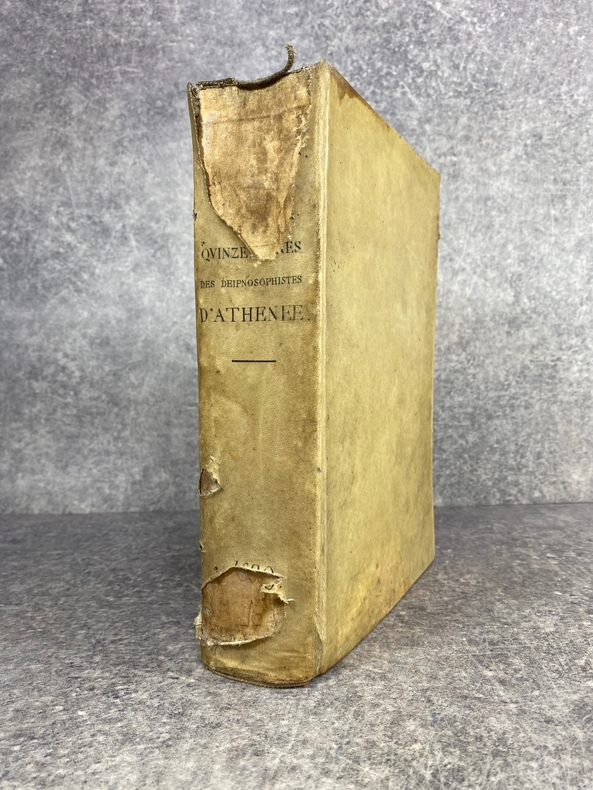
réf. LCS-14600Première édition de la traduction française de J.-B. Le Febvre de Villebrune de l’œuvre principale d’Athénée « Le livre des Deipnosophistes » ou le Banquet des Savants. Paris, Lamy (de l’imprimerie de Didot jeune), 1789-1791. 5 volumes grand in-4 de: I/ (3) ff., 504 pp., (2) ff.; II/ (2) ff., 537 pp. (chiffrée par erreur 503), (3) pp; III/ (1) f.bl., (2) ff., 565 pp. (mal chiffrées), (4) pp., (1) f.bl.; IV/ (1) f.bl., (2) ff., 561 pp., (4) pp.; V/ (2) ff., 562 pp. Plein maroquin rouge de l’époque, grecque dorée autour des plats, dos à nerfs ornés, coupes décorées, roulette intérieure dorée, tranches dorées. Reliures de l’époque. 307 x 227 mm.
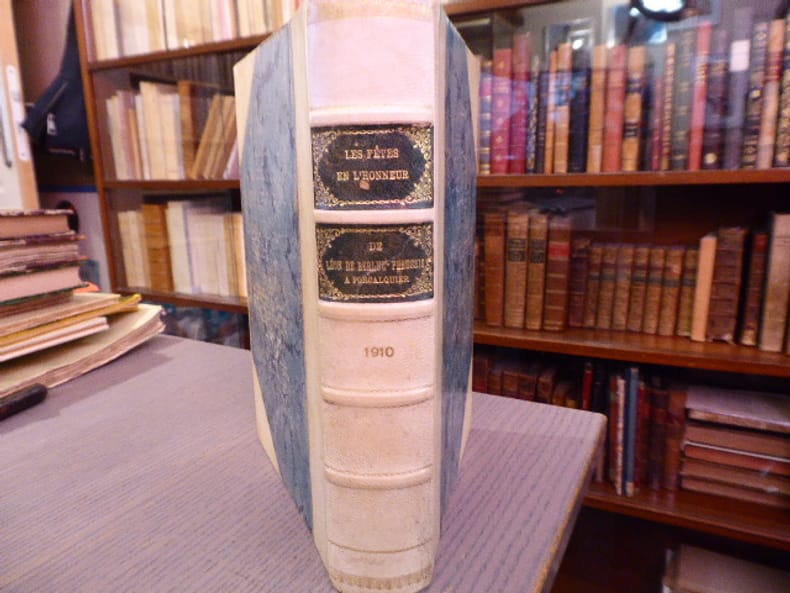
réf. 910738Imprimerie Paul Bernard Forcalquier 1910 In-8 ( 215 X 145 mm ) de 368 pages, demi vélin crème à coins, dos à nerfs janséniste, pièces de titre de maroquin aubergine. Illustrations hors-texte. EDITION ORIGINALE. Bel exemplaire.
1680réf. 3825A PARIS. CHEZ JACQUES LANGLOIS, IMPRIMEUR ORDINAIRE DU ROY. 1680. FORT IN-4 (18 X 25 X 6,5 CENTIMETRES ENVIRON) DE LXXII + 1090 PAGES, RELIURE D'EPOQUE PLEIN VELIN IVOIRE, TITRE EN NOIR SUR DOS LISSE, TRANCHES ROUGES. ILLUSTRE D’UN PORTRAIT DE MICHEL DE MAROLLES GRAVE SUR CUIVRE PAR NANTEUIL (PAGE LXII) ET DE 2 FIGURES GRAVEES SUR BOIS DANS LE TEXTE (PAGE 737 « LA COUPE DE NESTOR » ET PAGE 986 « LE COTTABE ». ERREUR DE PAGINATION D’ORIGINE, CELLE-CI PASSANT DIRECTEMENT DE LA PAGE 360 A LA PAGE 391, LES PAGES 361 A 390 N’EXISTANT PAS (COLLATION IDENTIQUE A L’EXEMPLAIRE DE LA B. N.). PREMIERE ET UNIQUE EDITION DE LA TRADUCTION FRANCAISE PAR MICHEL DE MAROLLES, DE CE TRESOR D’ERUDITION SUR LA GASTRONOMIE ANTIQUE (BRUNET. I. 536 - VICAIRE. 51). « CETTE MINE D’ERUDITION CONTIENT DES EXTRAITS DE 800 PIECES, DES CITATIONS DE 1500 OUVRAGES PERDUS ET LES NOMS DE 700 AUTEURS DONT LA PLUPART NOUS SERAIENT INCONNUS SANS LUI » (OBERLE. FASTES, PAGE 21). TRES RARE, « TIRE A PETIT NOMBRE » SELON BRUNET. OUVRAGE COLLATIONNE, COMPLET. MANQUES DE VELIN AU DOS, AUREOLES D’HUMIDITE ANCIENNE SUR DE NOMBREUSES PAGES, PETIT MANQUE DE PAPIER PAGES 453-454, AVEC INFIME MANQUE DE CARACTERES N’AFFECTANT AUCUNEMENT LA LECTURE. PRIX ETABLI EN FONCTION DES DEFAUTS SIGNALES.
1730réf. 119603honoré 1730 1 A Amsterdam, Chez François l'Honoré, 1730, 1 volume in-12 de 90x155 mm environ, (10) ff. (Page de titre, Épître, Préface), 473 pages (pagination continue : 296 pages - (7) ff. ( Remarques, table) - 473 pages), (15) ff. (Table, Remarques sur la traduction de Frontin). Plein cuir tacheté, dos à nerfs portant titres dorés sur pièce de cuir havane, caissons ornés, tranches mouchetées de rouge, gardes blanches. Coiffe de queue en partie manquante, coins légèrement frottés, épidermures au second plat, mouillures marginales sur 12 feuillets, petit trou p.365, sinon bon état général.
réf. 229181 volume in-8° demi-chagrin rouge à coins, dos à nerfs, titre doré, fleurons dorés (nénuphars) en décor. 62 p. + illustrations dans le texte, portraits des défunts. Joint une carte postale d'époque représentant Gaston de Ruyter. Très bon état. Très peu courant.
1556réf. 40664ABBasel, (Henri Petri,August 1556) 8°. 26 n.n. Bl., 1122 S. Pappband um 1820 mit rotem goldgeprägtem Rückentitel.