La Rochefoucauld, FrancoisBiblio.com

458 risultati
rif. 1017129525.Ghardcover. Good. Access codes and supplements are not guaranteed with used items. May be an ex-library book. hardcover
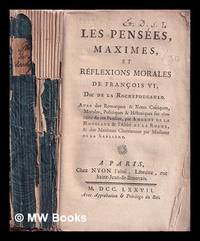
1777rif. 366766Paris : Chez Nyon l'aine librarie 1777. First Edition. Softcover. Poor copy in the original stiff-card wrappers; wear and tear as with age. Front wrapper missing with parts of the spine band missing. Text remains in fine condition and without blemish. Physical description; lxx 447 pages. Subjects; Maxims. Paris : Chez Nyon l'aine, librarie paperback
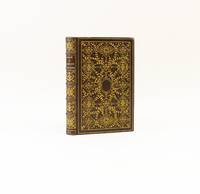
1892rif. ST17001Paris: Imprimé par D. Jouaust Librairie Des Bibliophiles E. Flammarion Successeur 1892. 188 x 104 pp. 6 3/4 x 4 1/4". XL 290 pp. 1 leaf.Preface and notes by J.-F. Thénard. With the autobiographical essay "Self-Portrait by Himself" from the 1665 first edition the introductions to the 1665 and the 1678 fifth editions maxims removed from earlier editions and the posthumously published essays "Reflections." EXQUISITE DARK BROWN MOROCCO EXUBERANTLY GILT IN THE FANFARE STYLE BY ZAEHNSDORF stamp-signed in gilt on front turn-in blind Exhibition stamp on rear doublure covers with fillet border enclosing a panel with central oval strapwork medallion surrounded by rows of geometric ornaments with sprays of leafy fronds connecting them and filling the space between raised bands spine compartments with central geometric ornament with leafy cornerpieces gilt lettering turn-ins with gilt fillets accented with leaf sprigs crimson silk doublures and free endleaves all edges gilt. Printer's device on title page. Front flyleaf with quote in French from the text "It is more necessary to study men than to study books" and "Christmas 1895" written in ink; recto of rear free endleaf with Taplow Court library label of William Grenfell Baron Desborough. ◆Minor soiling to flyleaves very faint browning to edges of leaves otherwise very fine the text clean and fresh and in a virtually unworn binding bright with gilt. This comprehensive edition of the French moralist's famed collection of epigrams is offered here in a binding done in the fanfare style popular when this work was first printed. After a turbulent youth of court intrigue and aristocratic rebellions against King Louis XIII François Duc de La Rochefoucauld 1613-80 settled into a quiet life in the Parisian salons of Madame de Sablé Madame de Sévigné and Madame de La Fayette. It was among this intellectual witty society that he honed the pithy epigrams that would have such an influence on French literature and culture. As the Oxford Companion notes "The high degree of polish in the phrasing of the 'Maximes' which excel in conciseness precision and appropriateness of expression is to some extent due to discussions among his friends . . . . The work is a collection of some 500 gnomic sentences in which the author analyses the motives of human conduct with merciless penetration. While he recognizes in rare cases the existence of pure virtue and disinterested sentiments he finds them tainted almost universally with some element of self-love or interested motive." Voltaire drew on La Rochefoucauld's views when writing "Candide" and the "Maximes" impacted the works of French writers from Stendhal to André Gide as well as philosopher Friedrich Nietzsche and English novelist Thomas Hardy. The duke's worldview would have resonated with former owner William Grenfell Baron Desborough 1855-1945 a sportsman and indefatigable public servant who was one of the founding members of The Souls fl. 1886-1900 an elite group of friends whose social gatherings for intellectual discussions were perhaps Victorian London's closest approximation of a Parisian salon. Although other members included prominent and accomplished men and women it was the parties given by Grenfell's wife and fellow Soul Ettie that attracted guests like Vita Sackville-West H. G. Wells Edith Wharton Oscar Wilde Edward VII when Prince of Wales and Winston Churchill. One can easily imagine one of the Souls presenting this volume to the Grenfells for Christmas in 1895. By one of the great London workshops the binding here is a modified example of the fanfare style of decoration popular in France from the late 16th to mid-17th century. The main features of this style in Glaister's words "are interlacing ribbons" that form "compartments of various shapes with emphasis given to a central compartment." Ornaments made with small hand tools "fill all the compartments except the central one and almost completely cover the sides." The fanfare style is perhaps most frequently associated with the work of Nicolas and Clovis Eve court binders and booksellers to successive kings of France from about 1578 to 1634. It is generally believed that the term "fanfare" actually took its name from an early 17th century music book the title of which begins with the word "fanfare" acquired by the bibliophile Charles Nodier in 1829. The book was bound for Nodier by the famous Parisian binder Joseph Thouvenin using an appropriately retrospective design in imitation of the Eves' style which from that point forward came to be known as "fanfare." The Zaehnsdorf bindery produced a number of bindings in this genre with their usual expertise. Hungarian-born Joseph Zaehnsdorf 1816-86 served his apprenticeship in Stuttgart worked at a number of European locations as a journeyman and then settled in London where he was hired first by Westley and then by Mackenzie before opening his own workshop in 1842. His son and namesake took over the business at 33 when the senior Joseph died and the firm flourished under the son's leadership becoming a leading West End bindery. Over the years Zaehnsdorf employed a considerable number of distinguished binders including the Frenchman Louis Genth who was chief finisher from 1859-84 and trained a number of others including Roger de Coverly and Sarah Prideaux. A family-run business until 1947 the Zaehnsdorf bindery continued to produce consistently attractive tasteful and innovative designs executed with unfailing skill. It is generally understood that the Zaehnsdorf firm reserved the use of its oval stamp showing a binder at work for their finest bindings including those entered in exhibitions. [Imprimé par D. Jouaust] Librairie Des Bibliophiles, E. Flammarion, Successeur unknown books
1892rif. ST17001Paris: Imprimé par D. Jouaust Librairie Des Bibliophiles E. Flammarion Successeur 1892. 188 x 104 pp. 6 3/4 x 4 1/4". XL 290 pp. 1 leaf.Preface and notes by J.-F. Thénard. With the autobiographical essay "Self-Portrait by Himself" from the 1665 first edition the introductions to the 1665 and the 1678 fifth editions maxims removed from earlier editions and the posthumously published essays "Reflections." EXQUISITE DARK BROWN MOROCCO EXUBERANTLY GILT IN THE FANFARE STYLE BY ZAEHNSDORF stamp-signed in gilt on front turn-in blind Exhibition stamp on rear doublure covers with fillet border enclosing a panel with central oval strapwork medallion surrounded by rows of geometric ornaments with sprays of leafy fronds connecting them and filling the space between raised bands spine compartments with central geometric ornament with leafy cornerpieces gilt lettering turn-ins with gilt fillets accented with leaf sprigs crimson silk doublures and free endleaves all edges gilt. Printer's device on title page. Front flyleaf with quote in French from the text "It is more necessary to study men than to study books" and "Christmas 1895" written in ink; recto of rear free endleaf with Taplow Court library label of William Grenfell Baron Desborough. ◆Minor soiling to flyleaves very faint browning to edges of leaves otherwise very fine the text clean and fresh and in a virtually unworn binding bright with gilt. This comprehensive edition of the French moralist's famed collection of epigrams is offered here in a binding done in the fanfare style popular when this work was first printed. After a turbulent youth of court intrigue and aristocratic rebellions against King Louis XIII François Duc de La Rochefoucauld 1613-80 settled into a quiet life in the Parisian salons of Madame de Sablé Madame de Sévigné and Madame de La Fayette. It was among this intellectual witty society that he honed the pithy epigrams that would have such an influence on French literature and culture. As the Oxford Companion notes "The high degree of polish in the phrasing of the 'Maximes' which excel in conciseness precision and appropriateness of expression is to some extent due to discussions among his friends . . . . The work is a collection of some 500 gnomic sentences in which the author analyses the motives of human conduct with merciless penetration. While he recognizes in rare cases the existence of pure virtue and disinterested sentiments he finds them tainted almost universally with some element of self-love or interested motive." Voltaire drew on La Rochefoucauld's views when writing "Candide" and the "Maximes" impacted the works of French writers from Stendhal to André Gide as well as philosopher Friedrich Nietzsche and English novelist Thomas Hardy. The duke's worldview would have resonated with former owner William Grenfell Baron Desborough 1855-1945 a sportsman and indefatigable public servant who was one of the founding members of The Souls fl. 1886-1900 an elite group of friends whose social gatherings for intellectual discussions were perhaps Victorian London's closest approximation of a Parisian salon. Although other members included prominent and accomplished men and women it was the parties given by Grenfell's wife and fellow Soul Ettie that attracted guests like Vita Sackville-West H. G. Wells Edith Wharton Oscar Wilde Edward VII when Prince of Wales and Winston Churchill. One can easily imagine one of the Souls presenting this volume to the Grenfells for Christmas in 1895. By one of the great London workshops the binding here is a modified example of the fanfare style of decoration popular in France from the late 16th to mid-17th century. The main features of this style in Glaister's words "are interlacing ribbons" that form "compartments of various shapes with emphasis given to a central compartment." Ornaments made with small hand tools "fill all the compartments except the central one and almost completely cover the sides." The fanfare style is perhaps most frequently associated with the work of Nicolas and Clovis Eve court binders and booksellers to successive kings of France from about 1578 to 1634. It is generally believed that the term "fanfare" actually took its name from an early 17th century music book the title of which begins with the word "fanfare" acquired by the bibliophile Charles Nodier in 1829. The book was bound for Nodier by the famous Parisian binder Joseph Thouvenin using an appropriately retrospective design in imitation of the Eves' style which from that point forward came to be known as "fanfare." The Zaehnsdorf bindery produced a number of bindings in this genre with their usual expertise. Hungarian-born Joseph Zaehnsdorf 1816-86 served his apprenticeship in Stuttgart worked at a number of European locations as a journeyman and then settled in London where he was hired first by Westley and then by Mackenzie before opening his own workshop in 1842. His son and namesake took over the business at 33 when the senior Joseph died and the firm flourished under the son's leadership becoming a leading West End bindery. Over the years Zaehnsdorf employed a considerable number of distinguished binders including the Frenchman Louis Genth who was chief finisher from 1859-84 and trained a number of others including Roger de Coverly and Sarah Prideaux. A family-run business until 1947 the Zaehnsdorf bindery continued to produce consistently attractive tasteful and innovative designs executed with unfailing skill. It is generally understood that the Zaehnsdorf firm reserved the use of its oval stamp showing a binder at work for their finest bindings including those entered in exhibitions. [Imprimé par D. Jouaust] Librairie Des Bibliophiles, E. Flammarion, Successeur unknown
1881rif. 357552Paris: Librairie des bibliophiles 1881. New Edition. Hardcover. Very good copy in gilt-blocked leather. Top edge gilt. Spine bands and panel edges rubbed and dust-dulled as with age. Some damage to back board. Internally bright and clean. Remains quite-well preserved over-all. Date is suggested. Physical description: xl 290 pages; 18 cm. Notes: Text is in French. Subjects: Maxims French. French literature 17th century. La Rochefoucauld François. Paris: Librairie des bibliophiles hardcover
1765rif. 102871765 basane blonde mouchetée, dos plat, tr. mouchetées bleues. in-16, (2ff.), XIX, (2ff.),360pp., Paris Ganeau 1765,
1741rif. 15572A Paris, chez la veuve d'Etienne Ganeau, 1741. In-12 de XXXIII-[1]-299 pages, plein-veau brun, dos à nerfs orné de filets et fleurons dorés, pièce de titre beige, tranches rouges. Coiffe supérieure absente et un coin frotté. Ex-libris de Fred et Camille Blanchod.
rif. 201201196, Librairie somogy, 1945 ; in-8, 265 pp., br.
1792rif. 6662Jean Albert Joly A Avignon, chez Jean Albert Joly 1792. In-16 relié demi-basane de l'époque, dos lisse pièce de titre marouin rouge. 192 pages.(Traduites de l'anglais par M Le Tourneur). RELIE AVEC : LA ROCHEFOUCAULT DUC DE : MAXIMES ET REFLEXIONS MORALES A Nismes chez J Gaude 1791 de 120 pages RELIE A LA SUITE : LE NOUVEAU SECRETAIRE DU CABINET CONTENANT DES MODELES DE LETTRES FAMILIERES SUR TOUTES SORTES DE SUJETS, AVEC DES INSTRUCTIONS SUR LES TITRES QUE L'ON DONNE AUX PERSONNES EN PLACE, ET SUR LA MANIERE DE REDIGER LES PETITIONS ; SUIVI DE MODELES DE LETTRES DE CHANGE ET DE BILLETS, AVEC DES DETAILS SUR LES JOURS DE GRACE, LES PROTETS, ET AUTRES OBJETS QU'IL EST NECESSARE DE CONNAITRE DANS TOUS LES ETATS ; TERMINE PAR DES MAXIMES SIMPLES SUR LA FACON DE SE COMPORTER DANS LE MONDE POUR PLAIRE ET REUSSIR DANS LES ENTREPRISES QU'ON SE PROPOSE. A Paris, à la librairie économique 1805. 108 pages.
rif. RO80026017FLAMMARION E.. Non daté. In-12. Relié toilé. Etat d'usage, Couv. légèrement passée, Mors fendus, Intérieur frais. 290 pages. Bandeaux, lettrines et culs-de-lampe. Dos et coins toilés rouge. Titre, filets, tomaison et fleuron dorés sur le dos.. . . . Classification Dewey : 840-Littératures des langues romanes. Littérature française
rif. RO80041957FLAMMARION Ernest. Non daté. In-12. Relié demi-cuir. Bon état, Couv. convenable, Dos satisfaisant, Intérieur frais. 303 pages. Pièces de titre rouge. Titre, filets, caissons et fleuron dorés sur le dos cuir marron.. . . . Classification Dewey : 840-Littératures des langues romanes. Littérature française
1945rif. RO40080060LIBRAIRIE SOMOGY. 1945. In-12. Broché. Etat d'usage, Couv. légèrement passée, Dos frotté, Intérieur bon état. 268 pages.. . . . Classification Dewey : 840-Littératures des langues romanes. Littérature française
rif. RO80101149FLAMMARION Ernest. Non daté. In-12. Relié demi-cuir. Etat d'usage, Couv. défraîchie, Dos satisfaisant, Intérieur acceptable. 306 pages. Coins frottés. Etiquette de code sur la coiffe en-tête et tampons de bibliothèque sur la page de titre et dans quelques marges.. . . . Classification Dewey : 840-Littératures des langues romanes. Littérature française
rif. R200063704ERNEST FLAMMARION. NON DATE. In-8. Broché. Etat passable, Livré sans Couverture, Dos abîmé, Papier jauni. 303 pages. 1er plat et dos absents - Ouvrage partiellement désolidarisé - VENDU EN L'ETAT. . . . Classification Dewey : 149.7-Pensées philosophiques, aphorismes
rif. RO30327103Nilsson. Non daté. In-18. Broché. Etat d'usage, Couv. partiel. décollorée, Dos abîmé, Pliures. 124 pages. Papier jauni. Quelques tâches d'encre en bas de pages, dans le texte, n'altérant pas la lecture. Dos partiellement manquant. Ouvrage légèrement désolidarisé.. . . . Classification Dewey : 848-Ecrits divers, citations, journaux intimes, souvenirs, mémoires
rif. RO40026978Flammarion. Non daté. In-12. Relié. Bon état, Couv. convenable, Dos satisfaisant, Intérieur frais. 306 pages.. . . . Classification Dewey : 840-Littératures des langues romanes. Littérature française
1853rif. RO80258632Furne et Cie. 1853. In-8. Relié. Etat d'usage, Coins frottés, Dos satisfaisant, Quelques rousseurs. XV + 438 pages. Titre doré au dos. Frontispice illustré en noir et blanc sous serpente. Deux photos disponibles.. . . . Classification Dewey : 840.04-XVII ème siècle
rif. 9782290404805J'ai Lu
rif. 12733Paris, Furne et Cie, 1860. 1 vol. in-8° br., couv. impr., portrait h.-t., (4) ff., XV-443 pp., (1) p. Rousseurs éparses.[C26]
rif. 270111 volume in-12° relié pleine basane marbrée noisette, dos à 5 nerfs décoré, pièce de titre de maroquin marron, roulette sur les coupes, 1 f., lxx, 1 f., 447, 1 f. Très bel exemplaire.
rif. 10774A Paris, chez Ganeau, 1754, 1 veau marbré, dos orné, tranches marbrées, mors frottés. in-12, 1 ff. blanc, f.t., titre, XVIII-(3)-346 pp., ex-libris manuscrit: "Lechanoine avocat 1762" ;
1777rif. 67820Avec des Remarques & Notes Critiques, Morales, Politiques & Historiques sur chacune de ces Pensées, par Amelot de La Houssaye & l'Abbé de La Roche, & des Maximes Chrétiennes par Madame de La Sablière, 1 vol. in-12 cartonnage papier huilé fin XVIIIe, dos vert, Chez Bailly, Paris, 1777, LXX pp., 1 f., 447 pp.
1956rif. 1179711956 Nouvelles Editions Publications, collection "Les Amis de l'Histoire" - 1956 - Réalisé d'après les maquettes originales d'Albert Holenstein - Petit in-8, reliure pleine peau ocre sous rhodoïd - 313 pages + Illustrations en N&B hors texte - Exemplaire numéroté N° 448
rif. 8597Editions de France, 1932. In-16, broché, 243 p.