5,561 results
In-8 (188 x 113 mm), plein veau fauve de l'époque, dos à 5 nerfs richement ornés de caissons fleuronnés et cloisonnés, jeux de filets et palettes dorés en pied, pièce de titre de maroquin bordeaux, filet à froid en encadrement des plats, roulette dorée sur les coiffes et les coupes, tranches rouges, (1) f. de titre, (3) p. de préface, 66 p., planche frontispice gravée. Rare édition originale de premier tirage, imprimée à petit nombre d’exemplaires, identifiable par son fleuron de titre, tirage probablement réservé à l’usage des membres du jury et des proches de l'auteur. Elle est en tous points conforme aux caractéristiques mentionnées par B. Gagnebin (édition de La Pléiade) et par Th. Dufour (coquilles typographiques aux pages 12 et 16). Planche frontispice gravée par Ch. Baquoy: "Satyre, tu ne le connais pas". Si cette édition a bien été imprimée à Paris, chez Pissot, l'imprimeur accepta de la faire paraître sous la fausse adresse de Barillot à Genève, à la demande de Rousseau qui souhaitait l'accorder avec le titre de "Citoyen de Genève" figurant pour la première fois (cf. Sénelier, p. 57-58). "Le livre qui rendit Rousseau célèbre"; son succès foudroyant le propulsa à l’avant-scène de la République des Lettres. En répondant par la négative à la question mise au concours par l'Académie de Dijon, Rousseau prend le contre-pied de ses contemporains pour dénoncer un ordre social fondé sur le luxe et les inégalités, corrompu et bafouant les véritables valeurs. Et de démontrer que les progrès indéniables des sciences et des arts ne se sont pas accompagnés d’un progrès moral. La descendance de cet essai sera immense. "Une force insoupçonnée et sincèrement rebelle apparaît dans ce Premier Discours, une pensée novatrice qui sonne juste. Et la lumière que Rousseau jette sur l'homme et sur le lien social va contribuer à remettre en cause une certaine idée du progrès" (Jacques Berchtold). (Dufour, n°13. Gagnebin, III, p. 1854-1855). L'ouvrage est relié avec trois autres pièces de l'époque (Lefranc de Pompignan, Fagan et anonyme). Quelques petites traces de restauration à la reliure. Petites piqûres éparses. Provenance: "Domou" et A. Grandjean (marque au premier titre) et ex-libris armorié gravé ancien. Bel exemplaire, très bien relié à l'époque.
ref. 28895Encyclopédie Méthodique Arts et Métiers Mécaniques. Dédiés et présentés à Mr Le Noir. 1782. Chez Panckoucke et Plomteux. 14 volumes de texte in-4. . 7 volumes de planches,grands in-4. (environ 2241 planches). Bel ensemble malgrès mouillures au début du Tome VI de planches, et de la fin du Tome 7 de texte.Demi-reliure uniforme avec pièces de titre et de tomaison. Manque 1 volume de texte de D à F.Bel ensemble.
1770ref. 172964London: J. Cooke 1770-71. Knowledge in the Enlightenment First edition of Cooke's encyclopaedia a vast and extensively illustrated compendium of articles on the arts and sciences by a variety of writers. The work was the principal rival to the Encyclopaedia Britannica of 1771. It was issued in parts to subscribers and then in book form; there are variant title pages dated from 1769 to 1772. 2 vols folio 347 x 210 mm. Engraved frontispiece 88 engraved plates 12 folding plates of the zodiac. Text printed mostly in double columns. Contemporary sprinkled calf spines elaborately decorated in gilt in compartments red and black morocco labels double gilt rule border to covers red edges. Joints and extremities restored one zodiac plate slightly browned along edge with 2 short marginal tears a couple of leaves with minor marginal tears occasional spotting and some offsetting from plates. A very good copy. ESTC T215224. unknown
2 ouvrages reliés en un volume in-4 (259 x 200 mm), plein maroquin rouge de l’époque, dos à 5 nerfs garni de compartiments richement fleuronnés et cloisonnés, palettes en tête et pied, 2 pièces de titre de maroquin émeraude, plats encadrés de triples filets dorés, roulette sur les coupes, dentelle intérieure, doré sur tranches. Rarissime réunion de ces deux textes majeurs du matérialisme français au XVIIIe siècle, publiés par d'Holbach à la suite l’un après l’autre en cette année 1776, dans leur édition in-4° "de luxe". 1- Edition in-4° publiée immédiatement à la suite du premier tirage; un carton présent dans celui-ci est ici intégré dans le texte. "Le premier volume développe, en trois sections, une théorie de la morale (…). Le deuxième volume s’attache à définir la pratique de la morale (…). Le troisième et dernier volume concerne les devoirs de la vie privée (…). D’Holbach récuse l'enseignement de la morale traditionnelle. Essentiellement naturaliste, prônant un lien laïque universel, l'ouvrage prolonge le 'Système de la nature' " ('D'Holbach et ses amis', 1541). (Vercruysse, éd. 2017, 1776, p. 160, A6). 2- Edition in-4° publiée immédiatement à la suite du premier tirage. L'ouvrage fondamental dans la pensée politique de d'Holbach, véritable programme politique et social qu'il destina au nouveau roi, Louis XVI, auquel le livre est dédié. D'Holbach recherche les principes et les modalités d'action d'un gouvernement soucieux de la morale et de l'utilité publique, promue par une "éthocratie", classe sociale dominante, qu'il oppose à la théocratie, l'aristocratie et l'autocratie. "D'Holbach s'est essayé à tracer un programme de réformes immédiates (…). Dans quelle mesure se flattait-il réellement d'influencer Turgot ? Il est difficile de le dire. Mais il est sûr que c'est avec un sens avisé de l'opportunité qu'il choisit cette heure, pour exposer le programme hors duquel il n'y avait plus de salut pour la monarchie" (Naville, 'D'Holbach', p. 399 sq.). (Vercruysse, éd. 2017, 1776, p. 155, A3). WorldCat recense 5 exemplaires de la ‘Morale universelle’ in-4° dans le monde et un unique de ‘l’Ethocratie’ in-4°: celui de la BnF. Quelques piqûres et petites taches éparses. Magnifique exemplaire, édition in-4° "de luxe", tirée à très petit nombre, parfaitement relié en maroquin rouge de l’époque, condition des plus rares.
In-8 gr. (mm. 254x195), 58 volumi, p. pelle bazana coeva, dorso a cordoni con decoraz. e titolo oro su doppio tassello, tagli rossi, pp. complessive circa 38.000, ornati da una vignetta a ciascun frontespizio, testatine e finalini xilografici. Questa monumentale opera è così suddivisa: - 42 volumi di testo (1770-1775). Solo il 1° vol. contiene f.t.: una tabella ripiegata (”Système figuré des connoissances humaines”), 1 tavola esemplificativa inc. in rame (qui è riportata la tav. n. 1 dell’Agriculture) e 1 carta di “avis aux souscripteurs de l’Encyclopedie d’Yverdon relativement aux planches”. - 6 volumi di Supplemento (1775-1776). - 10 volumi di tavole (1775-1780), con complessive 1264 tavole inc. in rame (come da Indici), di cui numerose ripieg. “L’enciclopedista Fortunato Bartolomeo De Felice (Roma 1723 - Yverdon 1789), dopo una giovinezza avventurosa, nel 1757 si stabilì a Berna, dove pubblicò una dissertazione sulla fisica newtoniana. Fattosi protestante, compilò giornali letterari e creò una stamperia, trasferita poi a Yverdon, che pubblicò, tra l'altro, le sue voluminose opere storiche e filosofiche e la sua "Encyclopédie ou dictionnaire universel raisonné des connoissances humaines", con la quale egli volle contrapporre all'Enciclopedia francese, giudicata incompiuta e sovabbondante, e soprattutto dannosa alla religione, una enciclopedia protestante, dalle idee politiche, sociali e religiose moderate. Tranne quelli letterari, sono rari nella nuova enciclopedia gli articoli della prima rimasti immutati. Collaboratori del De Felice furono Albert de Haller, il filosofo Mingard, il naturalista Bertrand, l'astronomo Lalande, il filosofo e astronomo Dupuis, l'anatomico Portal e altri meno noti. Molte voci scientifiche vennero aggiornate o corrette delle loro inesattezze, cosicché la superiorità in questo campo dell'Encyclopédie d'Yverdon venne riconosciuta dallo stesso Voltaire”. Cfr. Diz. Treccani,III, p. 787. Le legature della maggior parte dei volumi presentano abrasioni, mancanze alle cuffie e ai tasselli dei dorsi (solo 4 restaur.); i voll. 5° e 6° delle tavole con pesanti aloni, e piccole manc. margin. solo su 10 carte del 5°; sporadiche bruniture e lievi macchie nel testo, con numer. pagine di descriz. delle tavv. uniformem. ingiallite. Complessivam. questa straordinaria collezione è ben conservata, soprattutto per quanto riguarda le magnifiche tavole. Raro trovarla così completa.
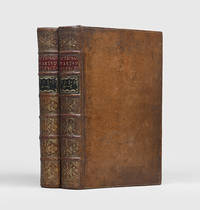
4 volumes in-12 (164 x 98 mm), demi-maroquin rouge à petits coins, dos lisses ornés de compartiments fleuronnés et cloisonnés, tranches mouchetées rouges (rel. moderne dans le goût de l'époque), 248 p.; 242 p.; 231 p. et 257 p., (1) n.ch. d'errata. Véritable édition originale, premier tirage, dit tirage "A", conforme en tous points à l'inventaire minutieux des critères établissant son antériorité par Max Brun. Tiré à 2000 exemplaires, ce premier tirage parut au début d'avril 1782 pour être épuisé dès le 7 mai 1782. Le roman remporta immédiatement un succès prodigieux et seize différentes éditions parurent en cette même année 1782. (Max Brun, 'Bibliographie des éditions des Liaisons dangereuses portant le millésime de 1782', in "Le Livre et l'Estampe", n° 33, 1963, p. 8-10 et 40-41. 'En français dans le texte', n°174). Bel exemplaire, parfaitement relié en demi-maroquin rouge dans le goût de l'époque, sans rousseurs, grand de marges.
ref. 28394Bruxelles. Etablissement Encyclographique, 1828. Encyclopédie du Règne Végétal. E.O. Collection de Plantes Remarquables par leur utilité, leur élégance, leur éclat ou leur nouveauté, consistant en 600 planches (plus une planche non coloriée)soigneusement lithographiées et coloriées accompagnées d'un texte pour chaque plante. Les planches sont dessinées par G.Severeyns et lithographiées par Burggraaff.Cette encyclopédie fut rédigée sous la direction de deux naturalistes belges: Pierre Corneille Van Geel (1796-1838) et Pierre-Auguste Joseph Drapiez (1778-1856). Edition en 6 vol. in-folio. Le Tome 6 est la liste alphabétique des noms latins, des noms français et une classification des plantes. Reliure d'époque en demi-cuir vert aux dos décorés sobrement. Bon état avec reliures usagées.
1773ref. 68280London: Printed for John Donaldson 1773. ENCYCLOPAEDIA BRITANNICA. Compiled upon a New Plan. In which the different sciences and arts are digested into distinct treatises or systems; and the various technical terms &c. are explained as they occur in the order of the alphabet. Illustrated with one hundred and sixty copperplates. By a Society of Gentlemen in Scotland. In three volumes. London: Printed for John Donaldson 1773. First London edition. This is an issue which uses the sheets of the first edition published in Edinburgh in 1771 with new preliminaries and a new preface made for the London audience. Three quarto volumes 10 1/4 x 8 inches; 260 x 204 mm. With 155 of 160 engraved copperplates some of which are folding and some have been hand-colored. Some plates are bound out of sequence. Vol I with 58 plates Vol II with 55 of 56 plates and Vol III with 42 of 46 plates. Volume II is missing plate #63 and Volume III is missing plates 111 112 113 and 115. Plates 111-113 are the plates on Midwifery which are often lacking as people would extract them because they portray graphic scenes of childbirth. Each volume with half-title. This edition is edited by William Smellie. and the engravings are by Andrew Bell. We could find only one complete copy at auction since 1966. Bound in contemporary full mottled calf. Spines with some restoration. Morocco spine labels Spines elaborately stamped in gilt and with a red and brown spine morocco label on each volume. Board edges tooled in gilt. Gilt dentelles. Previous owner's bookplate on front pastedown of each volume. Old ink ownership signature on front free endpaper of all volumes. Vol. I with a small tear to upper margin not affecting text. on page 469 and some occasional minor dampstaining to fore-edge margin not touching text. Vol. II with a repair to the crease of page one of the folding chemistry table. Generally pages are very clean. Overall a very lovely set. "The most famous of all encyclopaedias in the English language was sponsored by 'a Society of Gentlemen in Scotland'.The Edinburgh 'society' could well have consisted only of the editor the antiquarian William Smellie 1740-95 the engraver Andrew Bell 1726-1809 and the printer Colin Macfarquhar died 1793.The subtitle implicitly acknowledges the editor's indebtedness to Harris and Chambers though later on in the third edition of 1801 the dedication to the King sought to create the impression that the Britannica had been conceived as a means 'to counteract the tendency of anarchy and atheism of that pestiferous work' the French Encyclopédie of Diderot. In fact Smellie defined its purpose far more sensibly and convincingly in the preface of the first edition: 'Utility ought to be the principal intention of every publication'. The Encyclopaedia Britannica appeared first in numbers.1768-71. The precedent of Moréri and Bayle was followed when the second edition 1778-83 included history and biography.From the supplement to the fifth edition 1816-24 onward the Encyclopaedia Britannica following the example of the Encyclopédie appended the signatures of the contributors of articles of original value.and leading scholars and men of letters of all nations have continued to lend the lustre of their names to all subsequent editions" Printing and the Mind of Man. Printing and the Mind of Man 218. ESTC: N471190 HBS 68280. $20000. Printed for John Donaldson unknown
1773ref. 68280The First London Edition ENCYCLOPAEDIA BRITANNICA. EncyclopÊdia Britannica; or A Dictionary of Arts and Sciences. Compiled upon a New Plan. In which the different sciences and arts are digested into distinct treatises or systems; and the various technical terms &c. are explained as they occur in the order of the alphabet. Illustrated with one hundred and sixty copperplates. By a Society of Gentlemen in Scotland. In three volumes. London: Printed for John Donaldson 1773. First London edition. This is an issue which uses the sheets of the first edition published in Edinburgh in 1771 with new preliminaries and a new preface made for the London audience. Three quarto volumes 10 1/4 x 8 inches; 260 x 204 mm. With 160 engraved copperplates some of which are folding and some have been hand-colored. Some plates are bound out of sequence but complete. Vol I with 58 plates Vol II with 56 plates and Vol III with 46 plates. Each volume with half-title. This edition is edited by William Smellie. and the engravings are by Andrew Bell. We could find only one other complete copy at auction since 1966. Bound in contemporary full mottled calf. Spines with some restoration. Morocco spine labels Spines elaborately stamped in gilt and with a red and brown spine morocco label on each volume. Board edges tooled in gilt. Gilt dentelles. Previous owner's bookplate on front pastedown of each volume. Old ink ownership signature on front free endpaper of all volumes. Vol. I with a small tear to upper margin not affecting text. on page 469 and some occasional minor dampstaining to fore-edge margin not touching text. Vol. II with a repair to the crease of page one of the folding chemistry table. Generally pages are very clean. Overall a very lovely set. ìThe most famous of all encyclopaedias in the English language was sponsored by ëa Society of Gentlemen in Scotlandí.The Edinburgh ësocietyí could well have consisted only of the editor the antiquarian William Smellie 1740-95 the engraver Andrew Bell 1726-1809 and the printer Colin Macfarquhar died 1793.The subtitle implicitly acknowledges the editorís indebtedness to Harris and Chambers though later on in the third edition of 1801 the dedication to the King sought to create the impression that the Britannica had been conceived as a means ëto counteract the tendency of anarchy and atheism of that pestiferous workí the French EncyclopÈdie of Diderot. In fact Smellie defined its purpose far more sensibly and convincingly in the preface of the first edition: ëUtility ought to be the principal intention of every publicationí. The Encyclopaedia Britannica appeared first in numbers.1768-71. The precedent of MorÈri and Bayle was followed when the second edition 1778-83 included history and biography.From the supplement to the fifth edition 1816-24 onward the Encyclopaedia Britannica following the example of the EncyclopÈdie appended the signatures of the contributors of articles of original value.and leading scholars and men of letters of all nations have continued to lend the lustre of their names to all subsequent editionsî Printing and the Mind of Man. Printing and the Mind of Man 218. ESTC: N471190 HBS 68280. $30000 Printed for John Donaldson unknown books
In 8° i volumi di testo, in 4° i volumi di tavole. Splendida rilegatura coeva in piena pelle con titoli e motivi decorativi in oro al dorso. Ottimo stato di conservazione. L'opera si compone di 36 volumi di testo e 3 volumi di tavole incise di altissima qualità, il tutto per un totale di alcune decine di migliaia di pagine. Il primo volume presenta in antiporta una incisione con il ritratto di D'Alembert, mentre il secondo presenta una incisione col ritratto di Diderot. La presente edizione è una ristampa svizzera basata su quella pubblicata a Ginevra, e curata da Jean Leonard Pellet.
In 8°. Rilegatura in piena pelle coeva con nervature e titoli in oro su tassello al dorso. Stato di conservazione molto buono. Magnifica edizione svizzera della monumentale Enciclopedia di Diderot e D'Alembert, uno dei capisaldi del pensiero e della cultura umana, composta di 36 volumi di testo e di 3 volumi di splendide tavole incise. La presente edizione è la ristampa identica di quella curata alcuni anni prima da Pellet a Ginevra.