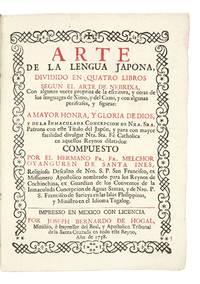
1738ref. 5506Mexico: Joseph Bernardo de Hogal 1738. FIRST EDITION. Hardcover. Fine. Bound in contemporary vellum. Manuscript annotation at front endpaper "Este libro va para D. Sebastian de Arauna beneficiado y cura en la Villa de Helorrio en el Señorio de Vizcaya". An extremely rare Japanese grammar printed in Mexico for the use of Franciscan missionaries to Japan. It also includes a number of sections devoted to the teaching of Chinese. In the course of the book the author "often compares several Asian languages -Japanese Tagalog Chinese and occasionally Malay; Arabic the language of Siam and one Amerindian language Nahuatl with European vernaculars like Castilian Basque Italian etc. and classical languages such as Greek Latin and Hebrew. "The cross-linguistic comparisons of Oyanguren are unique for the period in question not only in quantity but also in quality. Particularly his attempts to describe coincidences between two unrelated agglutinative languages Basque and Japanese and a language which has prefixes and suffixes like Tagalog contrasting them with the typological features of an isolating language Chinese are to be considered an important contribution in the history of linguistics. "The Basque Franciscan missionary Melchor Oyanguren de Santa Inés was born in Salinas Guipúzcoa in 1688. He set out for the Philippines in 1715 arriving there in 1717. He was sent to the missions in Cochinchina southern Vietnam where he was imprisoned and subsequently banished to Manila; there he fell ill. In 1721 he returned to Mexico to recover from his illness and went back to the Philippines in 1725. A year later he was appointed missionary priest for the town of Baños de Aguas Santas and served in Saryaya until 1736. Due to his frail health he had to return to Spain but upon reaching Mexico he was unable to continue his journey. In 1744 he assumed the position of superior of the hospice at the San Agustín de las Cuevas convent in Tlalpan-located in present-day Mexico City-where he died in 1747. While in Mexico he published this grammar of Japanese 1738 and another of Tagalog 1742. "Oyanguren's Japanese grammar. is valuable for analyzing how a non-Indo-European language like Japanese was described in the 18th century-in comparison with other non-Indo-European languages such as Basque Tagalog and Chinese. "His linguistic data of Japanese are mainly derived from the anonymous 'Vocabulario de Japón declarado primero en Portugués' printed in 1630 in Manila Colegio de Santo Tomás by the printers Tomás Pinpín and Iacinto Magauriva and attributed to Iacinto Esquivel - a Spanish translation of the 'Vocabulario da Lingoa de Iapam com a declaração em Portugues' completed in 1604 in Nagasaki. The most important grammatical sources for Oyanguren's Japanese 'Arte' were the Latin grammar of Antonio de Nebrija c. 1444-1522 and the grammar of Japanese written by the Spaniard Diego Collado d. 1638 - who had been inspired mainly by the works of Nebrija and João Rodrigues 1561-1634. The title of Oyanguren's book states that he included 'some terms from the Ximo and Cami languages' and in this regard he faithfully follows the 'Vocabulario'. Oyanguren was self-taught in Japanese relying on printed sources without the involvement of native speakers. He described Japanese essentially according to the Latin model of eight parts of speech. The final section is dedicated to rhetorical figures. "The languages the Franciscan grew up speaking were Basque and Spanish. As the titles of the grammars suggest he had learned Latin Greek Hebrew and Chinese; furthermore we know he possessed some knowledge of Vietnamese and Malay. It is possible that Oyanguren was familiar with certain Mesoamerican grammars although he compared Tagalog with Nahuatl on only one occasion. "The Japanese grammar was published by Joseph Bernardo de Hogal who was-as the title page states-"Minister and Printer to the Royal and Apostolic Tribunal of the Holy Crusade throughout this Kingdom." Hogal was born in Spain and established his printing house in 1721. His workshop was capable of printing with special typefaces such as Greek and musical notation. "Oyanguren enriched his grammar with word lists arranged either thematically-as seen in the final chapter regarding 'integral parts of the body'-or alphabetically as in the list of writing-related terms. He does not entirely break with his predecessors however as lists of verbs organized by morphological criteria are also included. At times Oyanguren presents the reader with original schemes or paradigms that do not appear in this form in any of his predecessors' works. In his chapter on declensions Oyanguren presents the reader with complete noun paradigms-including cases numbers and the four levels of social stratification. "As we have demonstrated elsewhere Zwartjes 2008 Oyanguren did not always intend to write a purely 'pedagogical' work in the strict sense of one designed for 'learning Japanese.' He composed a work that goes 'beyond practical pedagogy' as it contains numerous sections focused more on general education. His countless references to so many different languages likely held little pedagogical value for those unfamiliar with them or for those who simply wished to learn a language without needing to delve into comparative linguistics. References to Basque could offer no practical pedagogical value to non-Basque speakers and the comparisons do not appear to have been intended exclusively for those who merely wished to learn Japanese." Klöter and Zwartjes Chinese in the Grammars of Tagalog and Japanese of the Franciscan Melchor Oyanguren de Santa Inés in Histoire Épistémologie Langage 302 p. 177 ff. Joseph Bernardo de Hogal hardcover
1738ref. 5506Mexico: Joseph Bernardo de Hogal 1738. FIRST EDITION. Hardcover. Fine. Bound in contemporary vellum. Manuscript annotation at front endpaper "Este libro va para D. Sebastian de Arauna beneficiado y cura en la Villa de Helorrio en el Señorio de Vizcaya". An extremely rare Japanese grammar printed in Mexico for the use of Franciscan missionaries to Japan. It also includes a number of sections devoted to the teaching of Chinese. In the course of the book the author "often compares several Asian languages -Japanese Tagalog Chinese and occasionally Malay; Arabic the language of Siam and one Amerindian language Nahuatl with European vernaculars like Castilian Basque Italian etc. and classical languages such as Greek Latin and Hebrew. "The cross-linguistic comparisons of Oyanguren are unique for the period in question not only in quantity but also in quality. Particularly his attempts to describe coincidences between two unrelated agglutinative languages Basque and Japanese and a language which has prefixes and suffixes like Tagalog contrasting them with the typological features of an isolating language Chinese are to be considered an important contribution in the history of linguistics. "The Basque Franciscan missionary Melchor Oyanguren de Santa Inés was born in Salinas Guipúzcoa in 1688. He set out for the Philippines in 1715 arriving there in 1717. He was sent to the missions in Cochinchina southern Vietnam where he was imprisoned and subsequently banished to Manila; there he fell ill. In 1721 he returned to Mexico to recover from his illness and went back to the Philippines in 1725. A year later he was appointed missionary priest for the town of Baños de Aguas Santas and served in Saryaya until 1736. Due to his frail health he had to return to Spain but upon reaching Mexico he was unable to continue his journey. In 1744 he assumed the position of superior of the hospice at the San Agustín de las Cuevas convent in Tlalpan-located in present-day Mexico City-where he died in 1747. While in Mexico he published this grammar of Japanese 1738 and another of Tagalog 1742. "Oyanguren's Japanese grammar. is valuable for analyzing how a non-Indo-European language like Japanese was described in the 18th century-in comparison with other non-Indo-European languages such as Basque Tagalog and Chinese. "His linguistic data of Japanese are mainly derived from the anonymous 'Vocabulario de Japón declarado primero en Portugués' printed in 1630 in Manila Colegio de Santo Tomás by the printers Tomás Pinpín and Iacinto Magauriva and attributed to Iacinto Esquivel - a Spanish translation of the 'Vocabulario da Lingoa de Iapam com a declaração em Portugues' completed in 1604 in Nagasaki. The most important grammatical sources for Oyanguren's Japanese 'Arte' were the Latin grammar of Antonio de Nebrija c. 1444-1522 and the grammar of Japanese written by the Spaniard Diego Collado d. 1638 - who had been inspired mainly by the works of Nebrija and João Rodrigues 1561-1634. The title of Oyanguren's book states that he included 'some terms from the Ximo and Cami languages' and in this regard he faithfully follows the 'Vocabulario'. Oyanguren was self-taught in Japanese relying on printed sources without the involvement of native speakers. He described Japanese essentially according to the Latin model of eight parts of speech. The final section is dedicated to rhetorical figures. "The languages the Franciscan grew up speaking were Basque and Spanish. As the titles of the grammars suggest he had learned Latin Greek Hebrew and Chinese; furthermore we know he possessed some knowledge of Vietnamese and Malay. It is possible that Oyanguren was familiar with certain Mesoamerican grammars although he compared Tagalog with Nahuatl on only one occasion. "The Japanese grammar was published by Joseph Bernardo de Hogal who was-as the title page states-"Minister and Printer to the Royal and Apostolic Tribunal of the Holy Crusade throughout this Kingdom." Hogal was born in Spain and established his printing house in 1721. His workshop was capable of printing with special typefaces such as Greek and musical notation. "Oyanguren enriched his grammar with word lists arranged either thematically-as seen in the final chapter regarding 'integral parts of the body'-or alphabetically as in the list of writing-related terms. He does not entirely break with his predecessors however as lists of verbs organized by morphological criteria are also included. At times Oyanguren presents the reader with original schemes or paradigms that do not appear in this form in any of his predecessors' works. In his chapter on declensions Oyanguren presents the reader with complete noun paradigms-including cases numbers and the four levels of social stratification. "As we have demonstrated elsewhere Zwartjes 2008 Oyanguren did not always intend to write a purely 'pedagogical' work in the strict sense of one designed for 'learning Japanese.' He composed a work that goes 'beyond practical pedagogy' as it contains numerous sections focused more on general education. His countless references to so many different languages likely held little pedagogical value for those unfamiliar with them or for those who simply wished to learn a language without needing to delve into comparative linguistics. References to Basque could offer no practical pedagogical value to non-Basque speakers and the comparisons do not appear to have been intended exclusively for those who merely wished to learn Japanese." Klöter and Zwartjes Chinese in the Grammars of Tagalog and Japanese of the Franciscan Melchor Oyanguren de Santa Inés in Histoire Épistémologie Langage 302 p. 177 ff. Joseph Bernardo de Hogal hardcover books
1476in-4 (284x185 mm), 117 ff. (su 118, ultimo bianco mancante), carattere romano, legatura in pelle del XIX secolo, cornice oro con fiori e drappeggio ai piatti, dorso con titolo e ricchi motivi vegetali sempre in oro. Rara terza edizione (dopo Roma 1472 e Milano 1475) della più vivace delle operette cavalchiane, la più ricca di aneddoti esempalri, miracoli, di proverbi e di altri materiali folclorici. Il trattato vuol mettere in guardia dai vizi che nascono dal cattivo uso della lingua. Precedono alcune considerazioni sulla nobiltà e l'utilità del linguaggio (quasi un abbozzo dei Frutti della Lingua), poi si passano ordinatamente in rassegna i peccati che l'uomo commette parlando (la bestemmia, la moralizzazione, lo spergiuro, la menzogna...). I bersagli più insistentemente colpiti sono i giullari, le mezzane disposte, le donne fatue, gli incantatori, i negromanti. In Cavalca, come in tutti i maggiori predicatori domenicani del primo Trecento, vi è una vivissima preoccupazione per il diffondersi di nuovi movimenti ereticali, in particolare quello degli "apostoli", seguaci di Gherardo Segarelli. Esemplare con margini molto ampi (macchia d'umido all'ultimo foglio, lievi fioriture ai primissimi f.) e di illustre provenienza (note di Martini ed ex libris di Olschki, Colombi). . Gamba 308. BMC VI, 626. DBIt XII, 577-586. Goff C 338. IGI 2633..
1606ref. 12594A Paris, chez David Douceur, 1606. In-folio de (4)-674 pp. (mal chiffré 666) 1 f.n.ch. (souscription de l'imprimeur).MASSET (Jean). Exact et très facile acheminement à la Langue Françoise, par Jean Masset, mis en latin par le mesme Autheur pour le soulagement des estrangers… Paris, chez David Douceur, 1606. In-folio de (4)-32-24 pp.JUNIUS (Adrian de Jonge, dit Hadrianus). Nomenclator octilinguis omnium rerum propria nomina continens, ab Adriano Junio antehac collectus, nunc vero renovatus… et in capita 77…distinctus… Accessit huic… editioni alter Nomenclator… Hermanni Germbergii opera et studio, cum indice. Parisiis, apud Douceur, 1606. In-folio de (4)-192 pp. 18 ff.n.ch. (index).3 parties en 1 vol. in-folio, veau marbré, dos orné à nerfs, pièces de titre en maroquin rouge et noir, tranches rouges (reliure du XIXe siècle à l'imitation).
1980ref. ZB394031The Hague: Mouton 1980. Price HAS BEEN REDUCED by 10% until Monday Nov. 2 weekend sale item volumes 1-20. 1980-1999 an uninterrupted run of complete volumes partly bound library markings textually clean & tight PRICE IS FOR THE LOT. - If you are reading this this item is actually physically in our stock and ready for shipment once ordered. We are not bookjackers. Buyer is responsible for any additional duties taxes or fees required by recipient's country. Photos available upon request. The Hague: Mouton unknown
1484[400 incunabolo- Arezzo Linguistica](cm. 32) Ottime mz. pelle dell'800 titolo in oro entro tassello al dorso, lievi abrasioni alle cuffie. -cc.198nn., caratteri romani e greci, 57 linee, spazi per lettere capitali. L'opera apparve nel 1471, e nel 1477 a Treviso per il Manzolo e Licechtestein. Tutte le edizioni contengono un raro vocabolario di parole latine e greche, con etimologia ortografia e significati. Ebbe molte edizioni e costituisce uno dei capisaldi della linguistica italiana, fissò l'unità ortografica latina delle parole derivanti dal greco. Il Tortelli, erudito nato ad Arezzo (1400-1466), dottore in teologia e medicina fu amico di Leonardo Bruni e collaborò, con Nicolò V, nella costituzione della Biblioteca vaticana di cui fu bibliotecario. Esemplare assolutamente completo, con le due carte bianche, all'inizio e in fine , originali. Qualche lieve ombreggiatura e alone per lo più marginale all'angolo di poche carte all'inizio e in fine, peraltro esemplare veramente bello, fresco nitido e a grandi margini. Provenienza: Asta Sotheby's Firenze 1982, lotto 68. *HC15569; * IGI 9686; * GOFF T 399; *BMC V 357; * POLAIN 3794; * PROCTOR 4787; * HARVARD LIBRARY 2048; * WALTERS "INC. TYPOGR" p. 397; *OLSCHKI "INC. TYPOGR" CAT. 94 (1915) N°357; * CAT. ROSENTHAL "INCUNABULA" (1900) CAT. 24 N°3331. [F83] Libro
1530ref. 14854Coloniae, Opera et Impensa Joannis Soteris, 1530. In-4 (29 x 19,5 cm) de (28)-595-(5) pp. (AA, BB4 ||6 a-z, A-Z, Aa-Dd6), vélin souple à rabats, dos à trois nerfs, titre manuscrit sur le dos, lacets (reliure de l'époque).
ref. 12071[Paris], , [1694 et 1709]]. 16 pièces en 1 volume in-8, veau brun, dos orné à nerfs, tranches rouges (reliure de l’époque).
1539ref. 16135Paris, Denis Janot, Estienne Caveiller, 1539. 2 parties en 1 vol. in-8 gothique (15,5 x 9,3 cm) de (2)-CLXIIII ff. (2)-LXIIII ff. (sign. a-x8, Aa8-Hh8), maroquin janséniste vert, dos à nerfs, tranches dorées sur marbrure, dentelle intérieure (Hardy-Mennil).
1830ref. PHO-21101830, à Paris, Imprimerie Royale, 3 volumes in-8° et 1 atlas ,1 portrait-frontispice ,5 planches et 1 carte et itinéraire dépliante (900x 650mm). 3 fnch-xii-475pp,426pp,404pp., Très rare et complet- très bel exemplaire sans rousseurs, relié plein cuir orange, imitation écailles, dos lisse avec pièce d’auteur et titre, tomaison (frottements aux pièces). Dans l’Atlas : 5 planches et 1 grande carte repliée par Jomard (Gay. 243 Numa Broc Afrique pp 64-65).
1808in-4 (mm 31x24) pp. (6 compreso antiporta con ideogrammi) 27, (1); brossura muta. Il presente esemplare comprende due dediche ed una lunga lettera del Montucci (17 linee) A DACIER, Sécrétaire de l'Institut de France e 2 fogli sciolti d'ideogrammi cinesi. In appendice all'opera è riprodotta la lettera (inoltrata nel 1804), inviata all'autore da Staunton in risposta alla sua richiesta di sostenere la pubblicazione del dizionario (p. 25-27). Importantissimo esemplare di questo studio, alone d'umido nel margine inferiore bianco, fortunatamente non tocca il testo, qualche lieve fioritura della carta. Montucci nacque a Siena il 22 maggio 1762. Dopo il soggiorno in Gran Bretagna, nel 1806 si stabilì a Berlino su invito di Federico Guglielmo III. Le guerre napoleoniche impedirono il finanziamento alle sue ricerche sinologiche, ma riuscì comunque ad approfondire grazie all'amicizia con Julius Heinrich von Klaproth. Nel 1808 pubblicò il De studiis sinicis in imperiali Athenaeo Petropolitano recte instaurandis dissertatio isagogica. Testimonium unicum de auctoris hujus dissertationis in Sinicis peritia? ... / by Geo. Tho. Staunton Ludovicus Quien, impensis Caroli Quien, MDCCCVIII [1808] (Berolinum: Quien, 1808) indirizzato all'Accademia Imperiale di San Pietroburgo. Includes Testimonium unicum de auctoris hujus dissertationis in Sinicis peritia? ... / by Geo. Tho. Staunton. Nei quattro mesi in cui gli interpreti risiedettero a Londra, Montucci entrò in contatto con loro, avendo ricevuto l'incarico di assisterli nella redazione della lettera di Giorgio III all'imperatore della Cina che lord Macartney avrebbe dovuto consegnare. Una copia del documento, conservato nella Biblioteca apostolica Vaticana (Borgiano cinese, 394), recante la dicitura "Collated with the Original thus entitled "King of England's Letter to the Emperor" delivered in 1793", venne eseguita da Montucci il 29 febbraio 1804 per Staunton. Un esame della scrittura consente di accertare che i 992 caratteri del testo furono scritti da Montucci e non, come afferma Pelliot (1995, p. 43), "par une main chinoise". "M. Montucci a fait imprimer à Berlin , une lettre De studiis Sinicis, mais cette lettre que M. Montucci,avoit composée sans aucun secours". Persa ogni speranza di poter pubblicare il dizionario cinese, Montucci nel 1825 vendette a papa Leone XII la sua preziosa collezione di libri e i caratteri cinesi che aveva fatto fondere per la stampa del dizionario a partire dal 1810, poi trasferita presso il museo Borgiano di Propaganda Fide e in fine acquisita dalla Biblioteca Vaticana. In ogni caso, Montucci fu uno dei pochissimi sinologi del suo tempo formatosi al di fuori del mondo missionario e coloniale e gli deve essere attribuito il merito di avere costituito la più ricca biblioteca d'Europa sull'argomento. Rarissimo, tra i pochissimi esemplari censiti, questo figura nella vendita del 1833 del "catalogue de la bibliothèque du feu le B.on Dacier," .al n. 502. . .
1619ref. 42923Yverdon, de l'Imprimerie de la Société Helvétiale Caldoresque, 1619. In-4 de (32)-1030 pp., 1 tableau dépliant inclus dans la pagination, vélin ivoire à petits rabats (reliure de l' époque).
1695ref. 42637Marseille, Henri Brebion, 1695. 2 parties en 1 vol. in-12 de (24)-172-(4) pp., 180-(20) pp. (sign. a6 e6 A-O6 P4 A-Q6 R4, le dernier blanc), portrait gravé hors texte, veau brun, dos orné à nerfs orné, pièce de titre en maroquin rouge (reliure de l’époque).
1900ref. 2111902160201143Shinshu Ueda Town Japan Linguistics Joint Stock Company 1900. Soft Cover. Fine. Number of books: 1 Shinshu Ueda Town Japan Linguistics Joint Stock Company paperback
1869ref. 88612Imprimerie Impériale (1851-1870) | Paris 1869-1870 | 26.5 x 36.4 cm | 2 volume en reliures de l'éditeur
1830ref. PHO-17051830, à Paris, imprimerie royale, 3 volumes in-8°et 1 atlas ,1 portrait-frontispice ,5 planches et 1 carte et itinéraire dépliante (900x 650mm). 3 fnch-xii-475pp,426pp, 404pp..Très rare et complet- très bel exemplaire, relié plein buffle rouge, dos lisse avec auteur et titre, tomaison, atlas, titre au plat, couvertures conservées Dans l’Atlas : 5 planches et 1 grande carte repliée par Jomard
1579ref. 15274Paris, Mamert Patisson, 1579. In-8 de (32)-295 pp. 1 f.bl., basane marbrée, dos orné à nerfs, pièce de titre en maroquin rouge, tranches jaspées (reliure du XVIIIe siècle).
1637ref. 40303Rouen, Jean Le Boullenger, 1637. In-4 de (682) ff., maroquin brun janséniste, dos à nerfs, blason doré dans l'angle gauche supérieur du premier plat, dentelle intérieure, tranches dorées sur marbrures (Dupré).
1680ref. 44695A Genève, chez Jean Herman Widerhold, 1680-1679. 2 parties en 1 vol. in-4 à 2 colonnes de (20)-88-(2)-480 pp. et 560 pp., vélin dur à recouvrement (reliure de l'époque).
1543gr. vol. in-4 antico, ccnn 4, cc 316, leg. p. perg. settecentesca, tit. mss ai tagli. Dedicat. a Giacomo da Elisco di Savona. Alcune chiose di mano coeva. Ediz. orig. rarissima di uno dei primi vocabolari in volgare del giureconsulto Alberto Accarisi originario di Cento in Ferrara (1497ca - 1544) ed il primo libro stampato a Cento. Gamba 2753. Fumagalli, Lexicon, p.79. Minuscoli lavori di tarli sulle ultime 10 cc al margine bianco inf. senza lesioni al testo e lievi brun. in prossimità dell'angolo destro inferiore. Belliss. esempl. a larghi margini. [054]
In 8°, cart. rustico coevo (segni d'uso). Manoscritto cartaceo composto da 367 carte cos? suddivise: cc58 (numerate a matita in tempi recenti); cc. 127 (numerazione coeva a inchiostro); cc. 182 (numerate a matita in tempi recenti). Piccolo monumento di erudizione, per quanto ne sappiamo inedito, steso forse dalla mano di Tommaso Maria Alfani (domenicano, amico e corrispondente di Vico, Zeno e Muratori e molti altri. Il nome dell'A. si ricava all'interno della parte del titolo "Delle voci e formole che si debbono evitare nello scrivere pulitamente toscano di F.T.M.A. Opera da potersi fare per pubblico utilizzo" e dall'ultimo capitolo dal titolo "Brevissimae inscriptiones e autoribus collectae ab F. Thoma Maria Alfani ab anno 1721"
1729ref. 43251Grenoble, Pierre Faure, 1729. In-4 de 22 pp., (1) f. blanc, demi-veau olive à coins, dos orné à nerfs, filet doré d'encadrement sur les plats (reliure du XIXe).
1580ref. 43551Orléans, Éloy Gibier, 1580. Petit in-8 de (8)-311-(1) pp. (*4, A-Qq4), portrait hors texte, vélin dur, titre manuscrit en long (reliure de l'époque).
194957 volumi. STATO: USATO, COME NUOVO. TITOLO: Treccani. Enciclopedia Italiana di Scienze, Lettere ed Arti. L'Opera in 49 volumi si compone di: 35 voll.di testo e 1 volume di indici, 1 vol.della prima appendice, 2 voll.della seconda appendice, 2 voll.della terza appendice, 3 volumi della quarta appendice, 5 volumi della 5 appendice. Appendice 2000 costituita da 2 volumi di indici, 2 volumi di Append Esemplare ancora imballato
ref. EXE-516Lausanne et Paris, Librairie Payot, 1916. In-8°, demi-chagrin pain d'épice, couverture conservée.