Bright, Professor Emeritus of Linguistics and Anthropology University of California Los Angeles ReseBiblio.com

21 997 résultats
2010réf. DADAX1163797618Kessinger Publishing 2010-09-10. paperback. New. 6.00x0.90x9.00. Buy with confidence. Excellent Customer Service & Return policy. Kessinger Publishing paperback
2010réf. DADAX1162974354Kessinger Publishing 2010-09-10. paperback. New. 8.25x1.09x11.00. Buy with confidence. Excellent Customer Service & Return policy. Kessinger Publishing paperback
2011réf. DADAX1258178435Literary Licensing LLC 2011-10-15. paperback. New. 7.52x1.08x9.25. Buy with confidence. Excellent Customer Service & Return policy. Literary Licensing, LLC paperback
2007réf. DADAX0548191549Kessinger Publishing 2007-07-25. hardcover. New. 6.00x1.38x9.00. Buy with confidence. Excellent Customer Service & Return policy. Kessinger Publishing hardcover
2009réf. DADAX1104594366Kessinger Publishing 2009-06-13. paperback. New. 6.00x0.91x9.00. Buy with confidence. Excellent Customer Service & Return policy. Kessinger Publishing paperback
1972réf. 4127Madrid: Ed. Gredos.- Año 1971: No. 12; Año 1972: No. 21 22; Año 1973: No.31 32; Año 1974: 41 42; Año 1975: 51 52; Año 1976: No. 61 62; Año 1977: No. 71 72; Año 1978: No. 81 82; Año 1979: No. 91 92; Año 1980: No. 101 102; Año 1981: No. 111 112; Año 1982: no. 121 122; Año 1983: No. 132.- Son 24 números los ofrecidos al precio unitario de 12 Eur. cada uno. LENGUA ESPAÑOLA Libro en español No. 1 paperback
réf. 19089909like new. unknown
réf. 1143285360.Gpaperback. Good. Access codes and supplements are not guaranteed with used items. May be an ex-library book. paperback
réf. 1498255264.Ghardcover. Good. Access codes and supplements are not guaranteed with used items. May be an ex-library book. hardcover
réf. 8495959038.Gpaperback. Good. Access codes and supplements are not guaranteed with used items. May be an ex-library book. paperback
réf. 1598590596.GaudioCD. Good. Access codes and supplements are not guaranteed with used items. May be an ex-library book. unknown
1931réf. 12829Prague: Jednota Ceskosloenskych Matematiku a Fysiku 1931. First Edition . Soft cover. Good. First Edition the original collection; 8vo original wraps; good covers sunned esp. spine; spine creased with tear; edges creased worn and bumped; cracked at pp96-7; pages toned; 326pp includes many important articles three by Trubetzkoy. Jednota Ceskosloenskych Matematiku a Fysiku paperback
1936réf. 12828Prague: Cercle Linguistique de Prague 1936. First Edition . Soft cover. Good. First Edition the original collection; 8vo original wraps; good covers sunned; faint stamp from the Library of Congress 'duplicate' on front cover; spine heavily sunned and chipped with tear; corners bumped and creased affects pages; edges torn worn and creased; pages toned. 294pp includes many important articles one by Trubetzkoy. Cercle Linguistique de Prague paperback
réf. 0-33866Novara De Agostini 1915 carta rip. a colori alla scala 1 : 500.000. Bella e importante carta geografica. Con le interessantissime densità etniche decisamente importanti. unknown
réf. 1847478107.Gpaperback. Good. Access codes and supplements are not guaranteed with used items. May be an ex-library book. paperback
réf. 0748610014.Gpaperback. Good. Access codes and supplements are not guaranteed with used items. May be an ex-library book. paperback
2017réf. 2-8466142355Editorial Cruïlla S.A 2017. Paperback. New. Spanish language. 11.50x8.86x0.39 inches. Editorial Cruïlla, S.A paperback
réf. A9780893912000Paperback / softback. New. This book provides a basic approach to the linguistic analysis of conversation building toward a theory of the aesthetics of conversation by analyzing spontaneous talk among friends. It sheds light on such issues as pacing turn-taking storytelling and humor showing the effects on interaction when participants' conversational styles differ. paperback
1961réf. 06606Lisboa: Centro De Estudos Filologicos 1961. PORT Three volumes. Small ownership label to end papers no markings some rubbing and small trears to head or foot of spine in two of the volumes Very Good. Volume I: xxix 334pp. Volume II: 393pp there is a coloured fold-out map in perfect order; a couple of line maps in text. Volume III: 265pp there are 4 coloured fold-out map in perfect order; 4 B&W photo plates. The articles are in French or in Portuguese. A heavy set. 5.0 JM HOJ 304/a5. Paperback. Very Good. 8vo - over 7¾" - 9¾". Centro De Estudos Filologicos Paperback
réf. 884800122X.Ghardcover. Good. Access codes and supplements are not guaranteed with used items. May be an ex-library book. hardcover
réf. 134605942X.Ghardcover. Good. Access codes and supplements are not guaranteed with used items. May be an ex-library book. hardcover
réf. B1611500Bogazici University Press n/a. n/a Bogazici University Press unknown
réf. 026262091X.Gpaperback. Good. Access codes and supplements are not guaranteed with used items. May be an ex-library book. paperback
réf. 205101079X.Gpaperback. Good. Access codes and supplements are not guaranteed with used items. May be an ex-library book. paperback
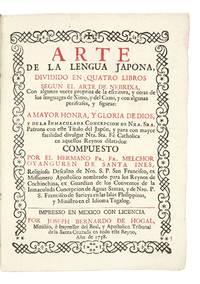
1738réf. 5506Mexico: Joseph Bernardo de Hogal 1738. FIRST EDITION. Hardcover. Fine. Bound in contemporary vellum. Manuscript annotation at front endpaper "Este libro va para D. Sebastian de Arauna beneficiado y cura en la Villa de Helorrio en el Señorio de Vizcaya". An extremely rare Japanese grammar printed in Mexico for the use of Franciscan missionaries to Japan. It also includes a number of sections devoted to the teaching of Chinese. In the course of the book the author "often compares several Asian languages -Japanese Tagalog Chinese and occasionally Malay; Arabic the language of Siam and one Amerindian language Nahuatl with European vernaculars like Castilian Basque Italian etc. and classical languages such as Greek Latin and Hebrew. "The cross-linguistic comparisons of Oyanguren are unique for the period in question not only in quantity but also in quality. Particularly his attempts to describe coincidences between two unrelated agglutinative languages Basque and Japanese and a language which has prefixes and suffixes like Tagalog contrasting them with the typological features of an isolating language Chinese are to be considered an important contribution in the history of linguistics. "The Basque Franciscan missionary Melchor Oyanguren de Santa Inés was born in Salinas Guipúzcoa in 1688. He set out for the Philippines in 1715 arriving there in 1717. He was sent to the missions in Cochinchina southern Vietnam where he was imprisoned and subsequently banished to Manila; there he fell ill. In 1721 he returned to Mexico to recover from his illness and went back to the Philippines in 1725. A year later he was appointed missionary priest for the town of Baños de Aguas Santas and served in Saryaya until 1736. Due to his frail health he had to return to Spain but upon reaching Mexico he was unable to continue his journey. In 1744 he assumed the position of superior of the hospice at the San Agustín de las Cuevas convent in Tlalpan-located in present-day Mexico City-where he died in 1747. While in Mexico he published this grammar of Japanese 1738 and another of Tagalog 1742. "Oyanguren's Japanese grammar. is valuable for analyzing how a non-Indo-European language like Japanese was described in the 18th century-in comparison with other non-Indo-European languages such as Basque Tagalog and Chinese. "His linguistic data of Japanese are mainly derived from the anonymous 'Vocabulario de Japón declarado primero en Portugués' printed in 1630 in Manila Colegio de Santo Tomás by the printers Tomás Pinpín and Iacinto Magauriva and attributed to Iacinto Esquivel - a Spanish translation of the 'Vocabulario da Lingoa de Iapam com a declaração em Portugues' completed in 1604 in Nagasaki. The most important grammatical sources for Oyanguren's Japanese 'Arte' were the Latin grammar of Antonio de Nebrija c. 1444-1522 and the grammar of Japanese written by the Spaniard Diego Collado d. 1638 - who had been inspired mainly by the works of Nebrija and João Rodrigues 1561-1634. The title of Oyanguren's book states that he included 'some terms from the Ximo and Cami languages' and in this regard he faithfully follows the 'Vocabulario'. Oyanguren was self-taught in Japanese relying on printed sources without the involvement of native speakers. He described Japanese essentially according to the Latin model of eight parts of speech. The final section is dedicated to rhetorical figures. "The languages the Franciscan grew up speaking were Basque and Spanish. As the titles of the grammars suggest he had learned Latin Greek Hebrew and Chinese; furthermore we know he possessed some knowledge of Vietnamese and Malay. It is possible that Oyanguren was familiar with certain Mesoamerican grammars although he compared Tagalog with Nahuatl on only one occasion. "The Japanese grammar was published by Joseph Bernardo de Hogal who was-as the title page states-"Minister and Printer to the Royal and Apostolic Tribunal of the Holy Crusade throughout this Kingdom." Hogal was born in Spain and established his printing house in 1721. His workshop was capable of printing with special typefaces such as Greek and musical notation. "Oyanguren enriched his grammar with word lists arranged either thematically-as seen in the final chapter regarding 'integral parts of the body'-or alphabetically as in the list of writing-related terms. He does not entirely break with his predecessors however as lists of verbs organized by morphological criteria are also included. At times Oyanguren presents the reader with original schemes or paradigms that do not appear in this form in any of his predecessors' works. In his chapter on declensions Oyanguren presents the reader with complete noun paradigms-including cases numbers and the four levels of social stratification. "As we have demonstrated elsewhere Zwartjes 2008 Oyanguren did not always intend to write a purely 'pedagogical' work in the strict sense of one designed for 'learning Japanese.' He composed a work that goes 'beyond practical pedagogy' as it contains numerous sections focused more on general education. His countless references to so many different languages likely held little pedagogical value for those unfamiliar with them or for those who simply wished to learn a language without needing to delve into comparative linguistics. References to Basque could offer no practical pedagogical value to non-Basque speakers and the comparisons do not appear to have been intended exclusively for those who merely wished to learn Japanese." Klöter and Zwartjes Chinese in the Grammars of Tagalog and Japanese of the Franciscan Melchor Oyanguren de Santa Inés in Histoire Épistémologie Langage 302 p. 177 ff. Joseph Bernardo de Hogal hardcover