4 071 résultats
1809réf. 26060Imprimerie Impériale | Paris 1809-1829 | 71 x 53.50 cm | une feuille
1809réf. 32879Imprimerie Impériale | Paris 1809-1829 | 71 x 53.50 cm | une feuille
1809réf. 26122Imprimerie Impériale | Paris 1809-1829 | 53 x 71 cm | une feuille
1809réf. 26080Imprimerie Impériale | Paris 1809-1829 | 53.50 x 71 cm | une feuille
1809réf. 32843Imprimerie Impériale | Paris 1809-1829 | 53.50 x 71 cm | une feuille
1809réf. 26228Imprimerie Impériale | Paris 1809-1829 | 53.50 x 71 cm | une feuille
1809réf. 26208Imprimerie Impériale | Paris 1809-1829 | 71 x 53.50 cm | une feuille
1809réf. 23435Imprimerie Impériale | Paris 1809-1829 | 70 x 51.50 cm | une feuille
1809réf. 25950Imprimerie Impériale | Paris 1809-1829 | 71 x 54 cm | une feuille
1809réf. 23386Imprimerie Impériale | Paris 1809-1829 | 71 x 54 cm | une feuille
1809réf. 26242Imprimerie Impériale | Paris 1809-1829 | - | une feuille
1809réf. 26092Imprimerie Impériale | Paris 1809-1829 | 53.50 x 71 cm | une feuille
1809réf. 32827Imprimerie Impériale | Paris 1809-1829 | 53.50 x 71 cm | une feuille
1809réf. 32870Imprimerie Impériale | Paris 1809-1829 | 71 x 53.50 cm | une feuille
1809réf. 32882Imprimerie Impériale | Paris 1809-1829 | 71 x 53.50 cm | une feuille
1860réf. X119704Paris, Benjamin Duprat 1860 xii + 146 + [2] pp., Edition originale de 1860, 25cm., brochure originale, texte et intérieur sont frais, bon état, X119704
1809réf. 26081Imprimerie Impériale | Paris 1809-1829 | 53.50 x 71 cm | une feuille
1809réf. 32842Imprimerie Impériale | Paris 1809-1829 | 53.50 x 71 cm | une feuille
1999français In-4 de XIX-325 pp. + nombreuses illustrations hors-texte in fine ; album de l'éditeur, sous jaquette.
réf. DADAX0195119959New unknown
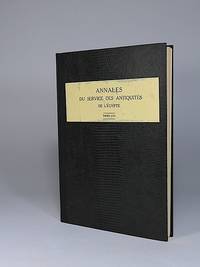
1959réf. 9999_02760Le Caire Organisme Général des Imprimeries Gouvernementales 1959. 1st Edition . Hardcover. . ~ ~ NOTE: THE PRICE OF THIS BOOK IS CURRENTLY REDUCED! ~ ~ . Quarto. Pp. 249. Plus many plates and folding plans. With text figures and illustrations. HARDCOVER bound in neat cloth and matching pebbled boards lettering-pieces to cover and spine cut from original wrappers. In fine condition. Excellent copy. ~ FIRST EDITION. For a complete table of contents and a list of contributors consult Wikipedia under series title. _O-7 Le Caire, Organisme Général des Imprimeries Gouvernementales hardcover
réf. SONG1402060459Used: Good unknown
1883réf. 31399New York: John B. Alden 1883. Hardcover. Gift Edition. 5 x 7.5in. xii. 332pp. Publisher's cloth boards with stamped decoration and titling. VERY GOOD. Shows marginal shelf rubbing of the extremities boards lightly handled former owner name of the period at the front endpaper otherwise the binding is strong and tight the text is clean and unmarked and the boards remain bright and distinct. As pictured. John B. Alden hardcover
1974réf. 052337Istanbul: Publication of the Mathematical Research Institute 1974. Leather. Fine. 8vo - over 7¾ - 9¾" tall. Original decorative full red leather bound. Gilt traditional style on boards. Large demy 8vo. 22 x 15 cm. Bilingual preface in German and Turkish. 12 2 p. 49 p. facsimile in Arabic. ills. Das Achte Buch zu den Conica des Apollonios von Perge. Rekonstruiert von Ibn al-Haysam. Herausgegeben und eingeleitet von Nazim Terzioglu. Ibn al-Haytham Alhazen was born c. 965 to an Arab family in Basra Iraq which was at the time part of the Buyid emirate. He held a position with the title vizier in his native Basra and made a name for himself for his knowledge of applied mathematics. As he claimed to be able to regulate the flooding of the Nile he was invited to by Fatimid Caliph al-Hakim in order to realise a hydraulic project at Aswan. However Ibn al-Haytham was forced to concede the impracticability of his project. Upon his return to Cairo he was given an administrative post. After he proved unable to fulfill this task as well he contracted the ire of the caliph Al-Hakim bi-Amr Allah and is said to have been forced into hiding until the caliph's death in 1021 after which his confiscated possessions were returned to him. Legend has it that Alhazen feigned madness and was kept under house arrest during this period. During this time he wrote his influential Book of Optics. Alhazen continued to live in Cairo in the neighborhood of the famous University of al-Azhar and lived from the proceeds of his literary production until his death in c. 1040. Among his students were Sorkhab Sohrab a Persian from Semnan and Abu al-Wafa Mubashir ibn Fatek an Egyptian prince. Signed and inscribed by Nazim Terzioglu 1912-1976 was one of the first mathematicians in Turkish academia. One of the contributions of Terzioglu as the director of the Mathematics Research Institute to Turkey's mathematical culture and the history of science was the systematic scan of the Islamic literature relevant to mathematics and the presentation of the information related to conic sections in ancient mathematics to the scientific community. As a result of these efforts the facsimile of two ancient texts of mathematics originally written in Arabic were realized. The first one is the preface of Mecmuatu'r-risail the Arabic translation by Beni Musa b. Sakir died in 873 of Conica which is the work of Apollonius of Perga BC 262-190 on the conic sections. This preface published with the title Das Vorwort des Astronomen Bani Musa b. Sakir describes how the Apollonius' Conica was acquired by the Islamic world. After that Terzioglu published the facsimile of the copy of the lost 8th book of Apollonius' Conica which was rewritten by Ibnu'l-Heysem 965-1039 with the help from other sources. In the introduction part of this book with the title Das Achte Buch zu den Conica des Apollonios von Perge the following information is provided in summary: In ancient mathematics the interest for conics starts with Menaechmus BC IV. Century and reaches the summit with Apollonius of Perga. Apollonius wrote his famous work Conica by processing previous information and adding up his own inventions. The first 7 volumes of this work consisting of 8 volumes in total are known whereas the 8th volume is missing. The Islamic and Western mathematicians working in this field took place in the reconstruction of the 8th volume. The most successful one of these works is that of Edmund Halley's 1656-1742 Apollonii Per-gaei conicorum Oxoniae 1710. The 8th book of Conica reconstructed by Ibn el-Heysem is the 4th manuscript with the name Makalatu'l-Hasan b.el-Hasan b.el Heysem fi el-kitabu'l-mahrutat in the Mecmu'atu'r-risail which is recorded under no. 1796 in Manisa Library. The fact that Ibn el-Heysem completed this work nearly 700 years before Halley is interesting. Publication of the Mathematical Research Institute hardcover
1916Very Good Turkish, Ottoman (1500-1928) Original color map. 50x60 cm. In Ottoman script. Scale: 1/200000. Ottoman map of Eastern Anatolia. Bargiri, Hoy, Baskal'a, Malazgird. It shows Lake Erçek located on the east of Lake Van which is an endorheic salt lake in Van Province in eastern Turkey, about 30 kilometres; on north side, Bargiri place where the oldest district of Van city; on east, Turkish and Azerbaijani and Iranian borders and Hoy city of the West Azerbaijan; and on west, map shows Malazgird [Malazgirt]. This is one the serie of the Bonn projection maps which are the first map series in modern techniques in Turkey and the Ottoman Empire. In order to produce these maps covering Turkish territory, Reconnaissance Branch was incorporated into The Mapping Commission. The maps were produced in the datum based on the latitude and longitude of Ayasofya Mosque in equal area Bonn Projection. The field works for the 123 sheets covering the country were conducted by 76 staff. The production was completed in 18 years starting from east west. Field works continued without stopping except in years 1914 and 1920. This map series called also reconnaissance maps contributed a lot to producing 1:25.000 scale maps.