3 781 résultats
1809réf. 25320Imprimerie Impériale | Paris 1809-1829 | 70.50 x 53.50 cm | une feuille
1995réf. x-075070487XFalmer Pr 1995. Hardcover. New. 1st edition. 297 pages. 9.75x6.50x1.00 inches. Falmer Pr hardcover
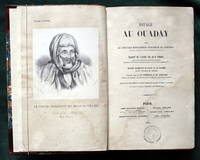
réf. 000903Hardcover. Good. Benjamin Duprat and others Paris 1851 first edition; large 8vo 170 x 240mm; pp lxxv 756 plus title to the plates section list of plates and the plates themselves together with a large folding map linen-backed of the area and dated 1845; the engraved plates with one exception are double page; the list calls for a total of ten plates including the portrait of the author and the folding map but one plate the first section of the double plate V is missing this featuring small items such as a stretcher a horse decoration and more; half brown morocco marbled sides skilfully rebacked with the original spine laid down and with appropriate new end papers; part of the marbled sides of the front cover scuffed; the early pages to about xv show the effects of some old wetting in the form of browning and with one page very skilfully repaired none with any loss of text or margins; neat small circular library stamps on the title and occasionally elsewhere including on the backs of the plates; occasional underlinings or brief notes in light pencil in the margins; overall a book in good condition generally clean and firm and not greatly affected by the matters mentioned; scarce in its original form as here. . . . Ouadây aka as Ouaddaï or Wadai is an area a former Sultanate in the east of Lake Chad and the border with Sudan. The Wadai Empire or Sultanate known locally as Burgu or Birgu emerged in the 17th century through conquest of the ruling Tunjur people of the area displacing them from the lands of the Sultanate of Darfur. It was overthrown by France in 1909/1912 and reconstituted under France in 1935. When Chad became independent in 1960 it became part of that new state. Its capital is Abéché. See Wikipedia for more detail. hardcover
1929Very Good Turkish Original manuscript color map of Middle East including Syria, Palestine and Transjordan. Signed by cartographer. 28x20 cm. In Turkish (with Latin letters). The Mapping Department, which moved to Ankara from Istanbul after the Independence War, settled in the Attar Basi Khan in Koyunpazari and the press section also started its studies in the building which is the Art School in Ulus today. In 1924, the department, which is still inside the General Directorate Garrison, moved to the hut-shaped buildings with single floor between the Military Sewinghouse and the General Directorate. On the other hand, the production of maps and plans, which were to be used in development services carried out in parallel to the revolutions starting with the declaration of the Republic and following each other, was considered to be based on a legal arrangement. Because of the necessity of an urgent legal arrangement, the bill of law concerning to the General Directorate of Mapping, whose preparations were initiated by Lieut. Gen. M. Sevki (Ölçer) who knew the importance of the subject, was sent to the Ministry of Defense at the beginning of 1925. After the approval of Ministry of Defense, the bill, which was sent to the Prime Ministry, was discussed in the Council of Ministers and presented to the Grand National Assembly of Turkey. As a result; the Mapping Department was re-organized as the General Directorate of Mapping affiliated with the Ministry of Defense with the law bearing the number 657 on May 2, 1925 in order to do all mapping works and meet the needs of maps and plans of all ministries, institutions and organizations. [.] The first application of photogrammetry was made in Kayas, Ankara with the Wild Autograph plotting apparatus which was purchased in that year. Captain Ömer Kadri and Captain Niyazi came back from their photogrammetry education in Germany. Major Halit and Major Nüzhet were sent to France for photogrammetry education and Captain Ishak and Captain Bahri were sent to Germany. Captain Ahmet (Denkmen) and Captain Ömer Kadri attended the Congress of Photogrammetry assembled in Berlin. (Source: The Illustrated History Of Turkish Cartography). Halid Ziya was born in Izmir, Tire. He went to Istanbul and continued to Hendese-i Mülkiye and Engineer Mekteb-i Âlîsi for seven years. After starting with "Aydin Province Umur-i Nafia Third Class Engineering", Halid Ziya Bey, who continued to work as a deputy chief engineer on 14 March 1910, left Aydin and returned to Istanbul after continuing this duty for about six and a half months. As a teacher, he taught Accounting, Algebra, Geometry, and Topography at Halkali Ziraat Mekteb-i Âlîsi and Darussafaka. Halid Ziya Bey, who was appointed as a teacher of Hendese and Cosmography in Kabatas High School, started to practice the profession of engineering and cadastral, which was his main specialty in 1327. After the First World War, the Istanbul Government started its activities in order to capture and neutralize Halid Ziya Bey and his friends. Upon the harsh measures taken, Halid Ziya Bey had to live as a fugitive in the Hasirci Mountains of Eskisehir for a while with the armed force attached to him. Halid Ziya Bey, who was involved in the movement in Anatolia until the end of the National Liberation Struggle, returned to his engineering duty after the proclamation of the Republic and was included in the cadastral works again. In 1925, Halid Ziya Bey was appointed as the Head of the Science Committee of the new cadastre organization. He wrote 5 books on cadastre, photogrammetry, trigonometry, and cadastral tools in 1928 and 1929. In addition, as a result of personal work in 1928, the road between the provincial division of the Republic of Turkey with cities has prepared a comprehensive map to show up in the forest and mining. (Source: Kadastro ne idi, nedir, ne olacaktir, Kadioglu - Yildirir. From Preface.). No scale.
1816Very Good English Original autograph letter signed (ALS) by Arbuthnot. Treasury Chambers, 20 May 1816. 24x18 cm. 2 p. Charles Arbuthnot, (1767- 1850), diplomat and Tory politician. He was Ambassador to the Ottoman Empire between 1804 and 1807 and held a number of political offices. He was a good friend of the Duke of Wellington. His second wife, Harriet, became a hostess at Wellington's society dinners, and wrote an important diary cataloging contemporary political intrigues. Arbuthnot also held a number of diplomatic postings, notably as consul general in Portugal between 1800 and 1801, as Minister to Sweden. He was appointed on 6 June 1804 as Ambassador to the Ottoman Empire and left Constantinople on 29 January 1807. In 1804 he was sworn of the Privy Council.
1946Very Good Turkish Paperback. Demy 8vo. (22 x 14 cm). In Turkish. 111, [2] p., 6 numerous b/w plates and 1 plan. A few important works were written on zoology, and in particular horse breeding in the early Republic of Turkey. These books were generally publications that argued that Turkish peasants should be a pioneer in horse breeding in the Anatolian aspect and that the government should support it in economic and social terms. This book was written extensively by Düzgünes, who studied zoology in the USA between 1950-1957. He took lessons from the American professors of his period (M. Lerner, J. Lush et al.) And published his research studies in the field of Poultry Breeding in the A-class science journal (American Poultry Science). Düzgünes, the author of books in the field of Statistics, Genetics, and Animal Breeding, translated the books of his professors in the USA into Turkish and introduced many technical terms related to his subject to Turkish. This book includes six black and white plates showing Turkish horse species and internal organs with a plan showing how to put four mares and a foal in the barn. Very scarce. Not in OCLC.; Turkish National Library 000029336.
12 volumes, complete. FIRST AND ONLY EDITION (aside from recent reprints). A scarce and exhaustive bibliography of works relating to the Arab world. Despite the title, this work describes numerous items printed before 1810. Very thorough descriptions. 4to, original wraps. Minimal wear to wraps, otherwise uncut, unopened, bright, and fine. An excellent set.
1809réf. 35401Imprimerie Impériale | Paris 1809-1829 | 71 x 54 cm | une feuille
réf. 548330Librairie Emile Bouillon Paris 1900 In-8 ( 255 X 170 mn ) de XXXV-211 pages, broché sous couverture imprimée. EDITION ORIGINALE RARE. Première monographie sur les Nusayrîs de Syrie, secte shi'ites-gûlat, et désigné sous le nom d'Alaouite, depuis le mandat Français en Syrie. Bibliographie importante commentés et analysées et qui recense toutes les sources historiques, mais aussi celles des relations de voyages. Plats détachés, exemplaire à relier.
1809réf. 26096Imprimerie Impériale | Paris 1809-1829 | 53.50 x 71 cm | une feuille
1809réf. 32836Imprimerie Impériale | Paris 1809-1829 | 53.50 x 71 cm | une feuille
1809réf. 26085Imprimerie Impériale | Paris 1809-1829 | 53.50 x 71 cm | une feuille
1888réf. PHO-2060Beyrouth, Imprimerie des Belles-Lettres, 1888, in-8° (245x165mm), xx-353pp., demi chagrin et coin (moderne), couverture conservée, défaut à la couverture, 5 premiers feuillets renforcés en marge
réf. 657Ienae Apud Ioh. Felicem Bielckium 1717 ( E. O. ) 1 fort vol. in - 8 ( 21 x 13 cm ) ( poids : 1,6 kg ) Frontisp., T. , (6) ff. n. ch. , 1348 pp. , (23) ff. n. ch. , 160 pp. . En latin . En frontispice , portrait de Ch. Stockius gravé par Fritzsche ( " Fritzsche sc. Lips. " ) . Contient nombreuses dédicaces ( Serenissimo Principi ac Domino Gvil. Ernesto Dvci Saxonniae , Jvliae , Cliviae ... , Serenissimo Principi ac Domino Joh. Gvilielmo Dvci Saxonniae , Jvliae , Cliviae ..., Serenissimo Principi ac Domino Ernesto Ludovico Dvci Saxonniae , Jvliae , Cliviae ... , Serenissimo Principi ac Domino Friderico Dvci Saxonniae , Jvliae , Cliviae ... , Serenissimis Academiae Jenensis nvtritoribvs maximis .... , Serenissimi Principes ... ) , Benevoli lectori ... , et in fine , Index Latinorum interpretamentorum , Dictionarium breve chaldaeo-rabbinicum exhibens tum voces , qvae in Daniele Esra et Targumim occurunt... . Bandeaux . Plein vélin de l' époque . Dos lisse , nom de l' auteur et titre à l' encre . Toutes tranches bleu-vert . Bon état . Vélin plus ou moins sali . Papier uniformément jauni . Petites taches d' encre pp. 371 , 719 et 1022 . Qqs lignes soulignées p. 501 . P. 433 ch. 435 . P. 547 ch. 541 , p. 548 ch. 542 et ainsi de suite jusqu' à la p. 640 ch. 636 . P. 641 ch. 635 , p. 642 ch. 636 et ainsi de suite jusqu' à la p. 985 ch. 979 . P. 986 ch. 990 , p. 987 ch. 991 et ainsi de suite jusqu' à la fin ( p. 1344 ch. 1348 ) .
1809- Imprimerie Impériale, Paris 1809-1829, 71x54cm, une feuille. - Original, unshaved, full-page etching from the "Imperial edition" of the Description de l'Égypte, or 'Recueil des observations et recherches faites en Égypte pendant l'expédition française, publié par les ordres de Sa Majesté l'Empereur Napoléon le Grand [A Collection of the observations and research carried out in Egypt during the French expedition, published on the orders of his Majesty the Emperor Napoleon the Great]'. Produced between February 1802 and 1830 on the orders of Naopleon Bonaparte and published between 1809 and 1828, 1,000 copies were printed and distributed to institutions, on vergé paper with an 'Égypte ancienne et moderne' watermark, visible when held up to the light. Light marginal spotting not touching image, otherwise in very fresh, fine condition. An engraving from the Description de l'Egypte, one of the masterpieces of French printing and the birth of a new field: Egyptology. A gigantic survey of Egypt at the time of Bonaparte's conquests in 1798 and 1799, the work is divided into 13 volumes of engravings making up 892 plates, of which 72 colored, as well as presenting the splendors of the Egypt of the Pharaohs in 9 volumes. The other volumes discuss natural history and present a fascinating portrait of Coptic and Islamic Egypt as it was seen by Bonaparte's Eastern Armies. The 'Egyptian campaign', militarily a disaster, demonstrates, through the engravings of the Description d'Egypte, the scientific success it nonetheless became thanks to the 167 expert members of the Commission of the Sciences and Arts of the Institut d'Egypte [Egyptian Institute] who followed Napoleon's army. The Institut gathered together in Egypt the mathematician Monge, the chemist Berthollet, the naturalist Geoffroy Saint-Hilaire as well as numerous artists, engineers, architects and doctors. They were tasked with re-discovering modern and ancient Egypt and displaying its natural treasures as well as the know-how of its inhabitants. This edition, the so-called "Imperial" edition of the plates for the Description de l'Egypte was printed in four large formats, two of which were specially created for it and christened "Moyen-Egypte" and "Grand-Egypte". A special press was built to print it, the process extending over 20 years, from 1809 to 1829. The "Imperial" edition proved so popular that a second edition, this time in black and white and without the "Egypte ancienne et moderne" watermark - known as the "Royal Edition" - was published during the Restoration by the printing house of C.-L.-F. Panckoucke (Paris). The engravings of the Description d'Egypte owe a great deal to Baron Dominique-Vivant Denon, illustrator, diplomat, collector and later Director of the Musée Napoléon (the Louvre). His exploration of the South of Egypt gave Bonaparte the idea of sending the experts of the Institut there, thus creating a faithful and complete portrait of the area. This was the research gathered together from 1802 in the mammoth Description de L'Egypte. Denon embarked on this story of archeological exploration at the age of 51, reaching first Alexandria and then Cairo before exploring Upper Egypt. Along with the members of the Institut d'Egypte, the Natural History Museum's painter H.J. Redouté (brother of Pierre-Joseph Redouté, author of Roses), the mineralogist Dolomiue, and the draughtsman Joly, Denon then explored the Nile Delta and Lower Egypt. When, however, he joined the 21st Light Infantry Regiment as it marched across Upper Egypt in pursuit of the retreating Mameluks in November 1798, he found himself the only civilian. In the very midst of the battle itself, he reeled off sketches of the works of art that peppered his path right up to the threshold of the Sudan. He said that he had crossed "a country that is, apart from its name, entirely unknown to Europeans, and therefore everything was worth describing" (Voyages dans la Basse et la Haute Egypte pendant le
1809- Imprimerie Impériale, Paris 1809-1829, 71x54cm, une feuille. - Gravure originale à l'eau-forte in plano, non rognée, extraite de l'édition dite « Impériale » de la Description de l'Égypte ou Recueil des observations et recherches faites en Égypte pendant l'expédition française, publié par les ordres de Sa Majesté l'Empereur Napoléon le Grand. Réalisée entre février 1802 et 1829 sur ordre de Napoléon Bonaparte et publiée à partir de 1809 [en réalité 1810], elle fut tirée à 1000 exemplaires sur Vergé filigrané « Égypte ancienne et moderne » et offerte aux institutions. Infimes et marginales piqûres sans aucune atteinte à la gravure, sinon excellent état de fraîcheur et de conservation. Volume ANTIQUITES, I : Ces gravures fournissent à Jean-François Champollion une documentation épigraphique fondamentale pour le déchiffrage des hiéroglyphes et inspirent une lignée d'archéologues comme Mariette, Maspero et Carter qui donnent un nouveau visage à l'Egypte ancienne. Elles suscitent un engouement tel qu'elles donnent naissance au phénomène de l'égyptomanie et à l'orientalisme de Delacroix, Fromentin, Marilhat, Decamps mais aussi Théophile Gautier... Financiers, politiciens, marchands, et fouilleurs de tous ordres se presseront sur les rives du Nil en quête de bonnes affaires à la suite de cette redécouverte de l'Egypte. A l'origine de l'égyptologie, ces planches connaîtront une postérité immense. LA DESCRIPTION DE L'EGYPTE, édition IMPERIALE (1809-1829) : La Description de l'Egypte est un des chefs d'uvre de l'édition française et le point de départ d'une nouvelle science : l'égyptologie. Titanesque exposé de l'Egypte au temps des conquêtes de Bonaparte entre 1798 et 1799, elle est répartie en 23 volumes dont 13 volumes de gravures rassemblant près de 1000 planches en noir et 72 en couleur. Les 6 volumes de planches intitulées Antiquités sont consacrés aux splendeurs de l'Egypte pharaonique. L'Histoire naturelle est répartie en 3 volumes de gravures. Un volume est consacré aux Cartes géographiques et topographiques tandis que les 3 volumes : Etat Moderne dressent un portrait saisissant de l'Egypte copte et islamique telle qu'elle était vue par les armées d'Orient de Bonaparte. La « campagne d'Egypte », désastre militaire, dévoile à travers les gravures de la Description de l'Egypte la réussite scientifique qu'elle est devenue, grâce aux quelques 167 savants membres de la Commission des sciences et des arts de l'Institut d'Egypte qui suivaient l'armée de Napoléon. L'Institut a réuni en Egypte le mathématicien Monge, le chimiste Berthollet, le naturaliste Geoffroy Saint-Hilaire, ainsi que de nombreux artistes, ingénieurs, architectes, médecins... Ils eurent la charge de redécouvrir l'Egypte moderne et antique, d'en montrer les richesses naturelles, et le savoir-faire de ses habitants. L'édition originale, dite « Impériale », de la Description de l'Egypte fut réalisée sur quatre formats de grande taille, deux d'entre eux spécialement créés pour elle et baptisés formats « Moyen-Egypte » et « Grand-Egypte ». On construisit une presse spécifique pour son impression, qui s'étala sur vingt ans, entre 1809 et 1829. L'édition Impériale s'avéra si populaire qu'une deuxième édition en 37 volumes entièrement en noir et sans le filigrane « Egypte ancienne et moderne », dite édition « Panckoucke », fut publiée à partir de 1821 par l'imprimerie C.-L.-F. Panckoucke (Paris). La réalisation de ce monument d'érudition doit beaucoup au baron Dominique Vivant Denon, illustrateur, diplomate, collectionneur et par la suite directeur du musée Napoléon du Louvre qui accompagna Napoléon en Egypte avec de nombreux autres savants mais décida seul de s'aventurer dans le Sud du pays, alors que les autres scientifiques conviés restaient confinés dans la région du Caire. Les fabuleux croquis rapportés par Denon lors de sa romanesque chevauchée donnèrent l'idée à Bonaparte d'y envoyer les autres membres de l'Institut et ainsi dresser un portrait fidèle et c
1809- Imprimerie Impériale, Paris 1809-1829, 71x54cm, une feuille. - Original, unshaved, full-page etching from the "Imperial edition" of the Description de l'Égypte, or 'Recueil des observations et recherches faites en Égypte pendant l'expédition française, publié par les ordres de Sa Majesté l'Empereur Napoléon le Grand [A Collection of the observations and research carried out in Egypt during the French expedition, published on the orders of his Majesty the Emperor Napoleon the Great]'. Produced between February 1802 and 1830 on the orders of Naopleon Bonaparte and published between 1809 and 1828, 1,000 copies were printed and distributed to institutions, on vergé paper with an 'Égypte ancienne et moderne' watermark, visible when held up to the light. Light marginal spotting not touching image, otherwise in very fresh, fine condition. An engraving from the Description de l'Egypte, one of the masterpieces of French printing and the birth of a new field: Egyptology. A gigantic survey of Egypt at the time of Bonaparte's conquests in 1798 and 1799, the work is divided into 13 volumes of engravings making up 892 plates, of which 72 colored, as well as presenting the splendors of the Egypt of the Pharaohs in 9 volumes. The other volumes discuss natural history and present a fascinating portrait of Coptic and Islamic Egypt as it was seen by Bonaparte's Eastern Armies. The 'Egyptian campaign', militarily a disaster, demonstrates, through the engravings of the Description d'Egypte, the scientific success it nonetheless became thanks to the 167 expert members of the Commission of the Sciences and Arts of the Institut d'Egypte [Egyptian Institute] who followed Napoleon's army. The Institut gathered together in Egypt the mathematician Monge, the chemist Berthollet, the naturalist Geoffroy Saint-Hilaire as well as numerous artists, engineers, architects and doctors. They were tasked with re-discovering modern and ancient Egypt and displaying its natural treasures as well as the know-how of its inhabitants. This edition, the so-called "Imperial" edition of the plates for the Description de l'Egypte was printed in four large formats, two of which were specially created for it and christened "Moyen-Egypte" and "Grand-Egypte". A special press was built to print it, the process extending over 20 years, from 1809 to 1829. The "Imperial" edition proved so popular that a second edition, this time in black and white and without the "Egypte ancienne et moderne" watermark - known as the "Royal Edition" - was published during the Restoration by the printing house of C.-L.-F. Panckoucke (Paris). The engravings of the Description d'Egypte owe a great deal to Baron Dominique-Vivant Denon, illustrator, diplomat, collector and later Director of the Musée Napoléon (the Louvre). His exploration of the South of Egypt gave Bonaparte the idea of sending the experts of the Institut there, thus creating a faithful and complete portrait of the area. This was the research gathered together from 1802 in the mammoth Description de L'Egypte. Denon embarked on this story of archeological exploration at the age of 51, reaching first Alexandria and then Cairo before exploring Upper Egypt. Along with the members of the Institut d'Egypte, the Natural History Museum's painter H.J. Redouté (brother of Pierre-Joseph Redouté, author of Roses), the mineralogist Dolomiue, and the draughtsman Joly, Denon then explored the Nile Delta and Lower Egypt. When, however, he joined the 21st Light Infantry Regiment as it marched across Upper Egypt in pursuit of the retreating Mameluks in November 1798, he found himself the only civilian. In the very midst of the battle itself, he reeled off sketches of the works of art that peppered his path right up to the threshold of the Sudan. He said that he had crossed "a country that is, apart from its name, entirely unknown to Europeans, and therefore everything was worth describing" (Voyages dans la Basse et la Haute Egypte pendant le
1809- Imprimerie Impériale, Paris 1809-1829, 70,5x53,5cm, une feuille. - Original, unshaved, full-page etching from the "Imperial edition" of the Description de l'Égypte, or 'Recueil des observations et recherches faites en Égypte pendant l'expédition française, publié par les ordres de Sa Majesté l'Empereur Napoléon le Grand [A Collection of the observations and research carried out in Egypt during the French expedition, published on the orders of his Majesty the Emperor Napoleon the Great]'. Produced between February 1802 and 1830 on the orders of Naopleon Bonaparte and published between 1809 and 1828, 1,000 copies were printed and distributed to institutions, on vergé paper with an 'Égypte ancienne et moderne' watermark, visible when held up to the light. Light marginal spotting not touching image, otherwise in very fresh, fine condition. An engraving from the Description de l'Egypte, one of the masterpieces of French printing and the birth of a new field: Egyptology. A gigantic survey of Egypt at the time of Bonaparte's conquests in 1798 and 1799, the work is divided into 13 volumes of engravings making up 892 plates, of which 72 colored, as well as presenting the splendors of the Egypt of the Pharaohs in 9 volumes. The other volumes discuss natural history and present a fascinating portrait of Coptic and Islamic Egypt as it was seen by Bonaparte's Eastern Armies. The 'Egyptian campaign', militarily a disaster, demonstrates, through the engravings of the Description d'Egypte, the scientific success it nonetheless became thanks to the 167 expert members of the Commission of the Sciences and Arts of the Institut d'Egypte [Egyptian Institute] who followed Napoleon's army. The Institut gathered together in Egypt the mathematician Monge, the chemist Berthollet, the naturalist Geoffroy Saint-Hilaire as well as numerous artists, engineers, architects and doctors. They were tasked with re-discovering modern and ancient Egypt and displaying its natural treasures as well as the know-how of its inhabitants. This edition, the so-called "Imperial" edition of the plates for the Description de l'Egypte was printed in four large formats, two of which were specially created for it and christened "Moyen-Egypte" and "Grand-Egypte". A special press was built to print it, the process extending over 20 years, from 1809 to 1829. The "Imperial" edition proved so popular that a second edition, this time in black and white and without the "Egypte ancienne et moderne" watermark - known as the "Royal Edition" - was published during the Restoration by the printing house of C.-L.-F. Panckoucke (Paris). The engravings of the Description d'Egypte owe a great deal to Baron Dominique-Vivant Denon, illustrator, diplomat, collector and later Director of the Musée Napoléon (the Louvre). His exploration of the South of Egypt gave Bonaparte the idea of sending the experts of the Institut there, thus creating a faithful and complete portrait of the area. This was the research gathered together from 1802 in the mammoth Description de L'Egypte. Denon embarked on this story of archeological exploration at the age of 51, reaching first Alexandria and then Cairo before exploring Upper Egypt. Along with the members of the Institut d'Egypte, the Natural History Museum's painter H.J. Redouté (brother of Pierre-Joseph Redouté, author of Roses), the mineralogist Dolomiue, and the draughtsman Joly, Denon then explored the Nile Delta and Lower Egypt. When, however, he joined the 21st Light Infantry Regiment as it marched across Upper Egypt in pursuit of the retreating Mameluks in November 1798, he found himself the only civilian. In the very midst of the battle itself, he reeled off sketches of the works of art that peppered his path right up to the threshold of the Sudan. He said that he had crossed "a country that is, apart from its name, entirely unknown to Europeans, and therefore everything was worth describing" (Voyages dans la Basse et la Haute Egypte pendan
1809- Imprimerie Impériale, Paris 1809-1829, 71x54cm, une feuille. - Original, unshaved, full-page etching from the "Imperial edition" of the Description de l'Égypte, or 'Recueil des observations et recherches faites en Égypte pendant l'expédition française, publié par les ordres de Sa Majesté l'Empereur Napoléon le Grand [A Collection of the observations and research carried out in Egypt during the French expedition, published on the orders of his Majesty the Emperor Napoleon the Great]'. Produced between February 1802 and 1830 on the orders of Naopleon Bonaparte and published between 1809 and 1828, 1,000 copies were printed and distributed to institutions, on vergé paper with an 'Égypte ancienne et moderne' watermark, visible when held up to the light. Light marginal spotting not touching image, otherwise in very fresh, fine condition. An engraving from the Description de l'Egypte, one of the masterpieces of French printing and the birth of a new field: Egyptology. A gigantic survey of Egypt at the time of Bonaparte's conquests in 1798 and 1799, the work is divided into 13 volumes of engravings making up 892 plates, of which 72 colored, as well as presenting the splendors of the Egypt of the Pharaohs in 9 volumes. The other volumes discuss natural history and present a fascinating portrait of Coptic and Islamic Egypt as it was seen by Bonaparte's Eastern Armies. The 'Egyptian campaign', militarily a disaster, demonstrates, through the engravings of the Description d'Egypte, the scientific success it nonetheless became thanks to the 167 expert members of the Commission of the Sciences and Arts of the Institut d'Egypte [Egyptian Institute] who followed Napoleon's army. The Institut gathered together in Egypt the mathematician Monge, the chemist Berthollet, the naturalist Geoffroy Saint-Hilaire as well as numerous artists, engineers, architects and doctors. They were tasked with re-discovering modern and ancient Egypt and displaying its natural treasures as well as the know-how of its inhabitants. This edition, the so-called "Imperial" edition of the plates for the Description de l'Egypte was printed in four large formats, two of which were specially created for it and christened "Moyen-Egypte" and "Grand-Egypte". A special press was built to print it, the process extending over 20 years, from 1809 to 1829. The "Imperial" edition proved so popular that a second edition, this time in black and white and without the "Egypte ancienne et moderne" watermark - known as the "Royal Edition" - was published during the Restoration by the printing house of C.-L.-F. Panckoucke (Paris). The engravings of the Description d'Egypte owe a great deal to Baron Dominique-Vivant Denon, illustrator, diplomat, collector and later Director of the Musée Napoléon (the Louvre). His exploration of the South of Egypt gave Bonaparte the idea of sending the experts of the Institut there, thus creating a faithful and complete portrait of the area. This was the research gathered together from 1802 in the mammoth Description de L'Egypte. Denon embarked on this story of archeological exploration at the age of 51, reaching first Alexandria and then Cairo before exploring Upper Egypt. Along with the members of the Institut d'Egypte, the Natural History Museum's painter H.J. Redouté (brother of Pierre-Joseph Redouté, author of Roses), the mineralogist Dolomiue, and the draughtsman Joly, Denon then explored the Nile Delta and Lower Egypt. When, however, he joined the 21st Light Infantry Regiment as it marched across Upper Egypt in pursuit of the retreating Mameluks in November 1798, he found himself the only civilian. In the very midst of the battle itself, he reeled off sketches of the works of art that peppered his path right up to the threshold of the Sudan. He said that he had crossed "a country that is, apart from its name, entirely unknown to Europeans, and therefore everything was worth describing" (Voyages dans la Basse et la Haute Egypte pendant le
1869- Aux bureaux de l'Illustration, Paris 1869, 20,5x29cm, broché. - Edition originale. Ouvrage illustré de gravures hors-texte. Dos défraîchi restauré à l'aide d'une pièce adhésive, petites déchirures marginales avec légers manques angulaires sur les plats, quelques rares rousseurs. [ENGLISH DESCRIPTION ON DEMAND]
1809- Imprimerie Impériale, Paris 1809-1829, 71x54cm, une feuille. - Original, unshaved, full-page etching from the "Imperial edition" of the Description de l'Égypte, or 'Recueil des observations et recherches faites en Égypte pendant l'expédition française, publié par les ordres de Sa Majesté l'Empereur Napoléon le Grand [A Collection of the observations and research carried out in Egypt during the French expedition, published on the orders of his Majesty the Emperor Napoleon the Great]'. Produced between February 1802 and 1830 on the orders of Naopleon Bonaparte and published between 1809 and 1828, 1,000 copies were printed and distributed to institutions, on vergé paper with an 'Égypte ancienne et moderne' watermark, visible when held up to the light. Light marginal spotting not touching image, otherwise in very fresh, fine condition. An engraving from the Description de l'Egypte, one of the masterpieces of French printing and the birth of a new field: Egyptology. A gigantic survey of Egypt at the time of Bonaparte's conquests in 1798 and 1799, the work is divided into 13 volumes of engravings making up 892 plates, of which 72 colored, as well as presenting the splendors of the Egypt of the Pharaohs in 9 volumes. The other volumes discuss natural history and present a fascinating portrait of Coptic and Islamic Egypt as it was seen by Bonaparte's Eastern Armies. The 'Egyptian campaign', militarily a disaster, demonstrates, through the engravings of the Description d'Egypte, the scientific success it nonetheless became thanks to the 167 expert members of the Commission of the Sciences and Arts of the Institut d'Egypte [Egyptian Institute] who followed Napoleon's army. The Institut gathered together in Egypt the mathematician Monge, the chemist Berthollet, the naturalist Geoffroy Saint-Hilaire as well as numerous artists, engineers, architects and doctors. They were tasked with re-discovering modern and ancient Egypt and displaying its natural treasures as well as the know-how of its inhabitants. This edition, the so-called "Imperial" edition of the plates for the Description de l'Egypte was printed in four large formats, two of which were specially created for it and christened "Moyen-Egypte" and "Grand-Egypte". A special press was built to print it, the process extending over 20 years, from 1809 to 1829. The "Imperial" edition proved so popular that a second edition, this time in black and white and without the "Egypte ancienne et moderne" watermark - known as the "Royal Edition" - was published during the Restoration by the printing house of C.-L.-F. Panckoucke (Paris). The engravings of the Description d'Egypte owe a great deal to Baron Dominique-Vivant Denon, illustrator, diplomat, collector and later Director of the Musée Napoléon (the Louvre). His exploration of the South of Egypt gave Bonaparte the idea of sending the experts of the Institut there, thus creating a faithful and complete portrait of the area. This was the research gathered together from 1802 in the mammoth Description de L'Egypte. Denon embarked on this story of archeological exploration at the age of 51, reaching first Alexandria and then Cairo before exploring Upper Egypt. Along with the members of the Institut d'Egypte, the Natural History Museum's painter H.J. Redouté (brother of Pierre-Joseph Redouté, author of Roses), the mineralogist Dolomiue, and the draughtsman Joly, Denon then explored the Nile Delta and Lower Egypt. When, however, he joined the 21st Light Infantry Regiment as it marched across Upper Egypt in pursuit of the retreating Mameluks in November 1798, he found himself the only civilian. In the very midst of the battle itself, he reeled off sketches of the works of art that peppered his path right up to the threshold of the Sudan. He said that he had crossed "a country that is, apart from its name, entirely unknown to Europeans, and therefore everything was worth describing" (Voyages dans la Basse et la Haute Egypte pendant le
1809- Imprimerie Impériale, Paris 1809-1829, 53,5x70,5cm, une feuille. - Original, unshaved, full-page etching from the "Imperial edition" of the Description de l'Égypte, or 'Recueil des observations et recherches faites en Égypte pendant l'expédition française, publié par les ordres de Sa Majesté l'Empereur Napoléon le Grand [A Collection of the observations and research carried out in Egypt during the French expedition, published on the orders of his Majesty the Emperor Napoleon the Great]'. Produced between February 1802 and 1830 on the orders of Naopleon Bonaparte and published between 1809 and 1828, 1,000 copies were printed and distributed to institutions, on vergé paper with an 'Égypte ancienne et moderne' watermark, visible when held up to the light. Light marginal spotting not touching image, otherwise in very fresh, fine condition. An engraving from the Description de l'Egypte, one of the masterpieces of French printing and the birth of a new field: Egyptology. A gigantic survey of Egypt at the time of Bonaparte's conquests in 1798 and 1799, the work is divided into 13 volumes of engravings making up 892 plates, of which 72 colored, as well as presenting the splendors of the Egypt of the Pharaohs in 9 volumes. The other volumes discuss natural history and present a fascinating portrait of Coptic and Islamic Egypt as it was seen by Bonaparte's Eastern Armies. The 'Egyptian campaign', militarily a disaster, demonstrates, through the engravings of the Description d'Egypte, the scientific success it nonetheless became thanks to the 167 expert members of the Commission of the Sciences and Arts of the Institut d'Egypte [Egyptian Institute] who followed Napoleon's army. The Institut gathered together in Egypt the mathematician Monge, the chemist Berthollet, the naturalist Geoffroy Saint-Hilaire as well as numerous artists, engineers, architects and doctors. They were tasked with re-discovering modern and ancient Egypt and displaying its natural treasures as well as the know-how of its inhabitants. This edition, the so-called "Imperial" edition of the plates for the Description de l'Egypte was printed in four large formats, two of which were specially created for it and christened "Moyen-Egypte" and "Grand-Egypte". A special press was built to print it, the process extending over 20 years, from 1809 to 1829. The "Imperial" edition proved so popular that a second edition, this time in black and white and without the "Egypte ancienne et moderne" watermark - known as the "Royal Edition" - was published during the Restoration by the printing house of C.-L.-F. Panckoucke (Paris). The engravings of the Description d'Egypte owe a great deal to Baron Dominique-Vivant Denon, illustrator, diplomat, collector and later Director of the Musée Napoléon (the Louvre). His exploration of the South of Egypt gave Bonaparte the idea of sending the experts of the Institut there, thus creating a faithful and complete portrait of the area. This was the research gathered together from 1802 in the mammoth Description de L'Egypte. Denon embarked on this story of archeological exploration at the age of 51, reaching first Alexandria and then Cairo before exploring Upper Egypt. Along with the members of the Institut d'Egypte, the Natural History Museum's painter H.J. Redouté (brother of Pierre-Joseph Redouté, author of Roses), the mineralogist Dolomiue, and the draughtsman Joly, Denon then explored the Nile Delta and Lower Egypt. When, however, he joined the 21st Light Infantry Regiment as it marched across Upper Egypt in pursuit of the retreating Mameluks in November 1798, he found himself the only civilian. In the very midst of the battle itself, he reeled off sketches of the works of art that peppered his path right up to the threshold of the Sudan. He said that he had crossed "a country that is, apart from its name, entirely unknown to Europeans, and therefore everything was worth describing" (Voyages dans la Basse et la Haute Egypte pendan
1915Very Good French Original business card. 6x9,5 cm. In Arabic and French. On card, engraved b/w portrait photo of Sultan, his tughra (dated 1331 Hegira), and the sign of Lahej sultanate. Lahej was a Sheikdom based in Lahej in Southern Arabia. The Sultanate became self-ruled in 1728 and gained independence in 1740. In 1839, the Sultanate became the Protectorate of Aden of the British Empire, though nominally the 'Abdali Sultan retained his status. The the Protectorate of Aden was briefly ruled again by the Ottomans during World War I, but regained by the British and absorbed into Federation of South Arabia in 1963. The 'Abdali dynasty was officialy abolished in 1967, through the proclamation by South Yemen. Hegira: 1331 = Gregorian: 1915.
1903Very Good Arabic Original wrappers in dark green cloth spine. Demy 8vo. (21 x 14 cm). In Arabic 40 p. First and Only Edition in book form of this work on synonyms in the Arabic language, printed for the Arabic universities as an early textbook in Bulaq Printing House. The Bulaq or El-Amiriya Press is the first official and governmental printing press to be established in Egypt, and function according to industrial printing basis, causing not just a qualitative but also a quantitative and knowledgeable leap in science throughout the Arab region. The Bulaq Press was part of Mohamed Aly's inclusive development plans for the modernization of Egypt. The Khedive, first initiated his plans by establishing a strong Egyptian army; one that is capable of strengthening his grip on the country. It thus became essential that this army be provided with the necessary instructive and educational books and material, by which to learn military plans and techniques, as well as the different types of artillery and laws that define a soldier's duties and rights. A pressing need eventually developed for establishing a governmental press; one that should provide such material. By 1815 CE., Mohamed Aly initiated the process of bringing the art of printing to Egypt by sending the first official delegation, headed by Nicole El Masabki, to Milan in Italy, to learn the principles of printing. The same delegation was later able to return and establish the first official press in Egypt. Only three copies located in OCLC: 978241754.