3804 risultati
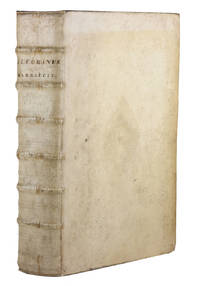
1698rif. H4GD9LIIY5STPadova: Typographia Seminaria 1698. Blind-tooled vellum ca. 1800 reusing and retooling vellum from a slightly earlier blind-tooled binding sewn on 6 double cords each board with a large scrollwork centrepiece over traces of the old one in a panel design made of fillets and corner pieces with the title finely lettered in pen and ink in the 2nd of 7 compartments the old title still faintly visible underneath it and the old volume number VIII faintly visible in the 3rd compartment. Folio 35.5 x 25 cm. With 2 title pages 1 primary and 4 secondary divisional titles in volume 1 more than a dozen woodcut head- and tailpieces plus numerous repeats and dozens of woodcut decorated initials about 9 series plus numerous repeats. Set in roman italic and Arabic types 3 sizes of Arabic with incidental Greek and Hebrew. 2 volumes bound as 1. The first scholarly printed Quran prepared by the anti-Islamic Catholic Ludovico Marracci with a much more accurate Arabic text than any previously printed and the first accurate Latin translation also including extensive notes based on the Islamic commentaries as well as the editor's extensive "refutations" of each sutra. Each sura is given first in Arabic then in Latin translation followed by notes and then the refutation. The entire first volume of about 430 pages is taken up with preliminary matter including a 24-page life of Muhammad one of the first detailed biographies ever printed and again more accurate than its predecessors an 8-page profession of faith with the Arabic and Latin in parallel columns and additional commentaries and introductory matter. The fact that this edition was produced explicitly as an attempt to refute the views of Islam has naturally led Islamic scholars to dismiss it but both the Arabic text and the Latin translation were far better than any previously printed and had no serious rival until the Leipzig edition of 1834. The commentaries also made a great deal of Islamic scholarship available to a European audience for the first time and both the Arabic and the Latin text influenced nearly every edition for the next 150 years.With two bookplates and an occasional early manuscript note and a few letters or numbers inscribed in the foot margin of one leaf. With a tear running into the text of one leaf repaired but otherwise in very good condition. With generous margins. The boards are slightly bowed and there is a small tear repaired at the foot of the spine. A ground-breaking work of Quranic scholarship a valuable source for the study of the Quran and an essential source for European views of Islam.l Cat. Bibl. A.-R. Courbonne dont la vent . 1er février 1842 30 this copy; A. Hamilton Europe and the Arab world 34; Schnurrer 377; O. A. Sheikh Al-Shabab The place of Marraccis Latin translation of the Holy Quran: . in: Journal of King Saud University: language & tanslation 13 2001 pp. 57-74; USTC 1736471/1737617/1748538; not in Atabey; Blackmer; Philologia orientalis but cited in 225g 360a 380b 381c. Typographia Seminaria, hardcover
1900rif. 55709Turkey 1900. Contemporary morocco. Very good. Small oblong folio 16 by 30 cm. 28 leaves. Quranic manuscript in Jali Diwani script; gilt text recto and verso 3 lines per page on polished cream paper interleaved with onionskin protective leaves. Contemporary deep brown paneled morocco wallet binding rubbed tooled in gilt and blind; decorative paper pastedowns. Binding skilfully rebacked to style; neat professional repair to tear at front cover panel. Light marginal tidemarks; notable old ink marks continuous line across two leaves; occasional small marginal perforations not affecting text. Very good. Rare example of a text from the Qur'an in the Jali Diwani script an elaborate intertwining Arabic cursive developed during the early Ottoman era in the sixteenth century. The text in the present manuscript is entirely in gilt and derives from Juz 29 entitled Tabaraka "Blessed is" after the opening word of the first sura. One of the thirty roughly equal portions into which the Qur'an is divided Juz 29 comprises four complete suras: Al-Mulk "The Dominion"; Nuh "Noah"; Al-Jinn "The Jinn"; Al-Mursalat "The Emissaries. Copies of the Qur'an found in mosques especially in earlier times when manuscripts where very costly were often bound into these thirty portions. According to Islamic tradition during the month of Ramadan the entire Qur'an is recited usually at the rate of one juz each evening. unknown
1900rif. 55709Turkey 1900. Contemporary morocco. Very good. Small oblong folio 16 by 30 cm. 28 leaves. Quranic manuscript in Jali Diwani script; gilt text recto and verso 3 lines per page on polished cream paper interleaved with onionskin protective leaves. Contemporary deep brown paneled morocco wallet binding rubbed tooled in gilt and blind; decorative paper pastedowns. Binding skilfully rebacked to style; neat professional repair to tear at front cover panel. Light marginal tidemarks; notable old ink marks continuous line across two leaves; occasional small marginal perforations not affecting text. Very good. Rare example of a text from the Qur'an in the Jali Diwani script an elaborate intertwining Arabic cursive developed during the early Ottoman era in the sixteenth century. The text in the present manuscript is entirely in gilt and derives from Juz 29 entitled Tabaraka "Blessed is" after the opening word of the first sura. One of the thirty roughly equal portions into which the Qur'an is divided Juz 29 comprises four complete suras: Al-Mulk "The Dominion"; Nuh "Noah"; Al-Jinn "The Jinn"; Al-Mursalat "The Emissaries. Copies of the Qur'an found in mosques especially in earlier times when manuscripts where very costly were often bound into these thirty portions. According to Islamic tradition during the month of Ramadan the entire Qur'an is recited usually at the rate of one juz each evening. unknown books
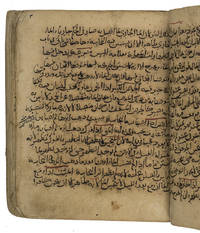
rif. ABC_45853Levant 1290. Contemporary blind-tooled calf mostly covered with later calf leaving only the contemporary back cover exposed. 19th century European paper endpapers. With a loose leaf of 18th century European paper with Arabic manuscript writing on one side. Small 4to in 6s 17 x 14 cm. Arabic manuscript 15 to 17 lines to the page written in clear cursive ta'liq script on brown Middle Eastern paper. With occasional red rubrication. Lengthy and well preserved 13th century Arabic manuscript law book on the fatwa produced in the Levant by an anonymous author. A fatwa is legal advice given by a Muslim authority on request with the purpose of resolving a religious or legal problem that has arisen among members of Islam. The person who gives the legal information is familiar with Islamic jurisprudence fiqh and is referred to as a mufti; the one who asks for legal advice is called Mustafti. According to the famed 13th-century Islamic jurist Ibn al-Qaayyim al-Jawziya mufti were Gods agents". The present anonymous work seems to treat the jurisprudence of the fatwa itself rather than declaring fatwa on something. The title means "The book of kitab analisys or understanding al-waaqi of the fatwa fi'l-Fatawi". As described in the book itself this is the first volume of an unknown total.Fatwas were produced by jurists from the 10th century onward and in the 13th century when the present copy was made several important Islamic lawbooks were compiled in India at the Sultanate of Delhi.Provenance: 1963 Elghanyan to Hagop Kevorkian 1872-1962; sold at Sotheby's 18 April 1983 Kevorkian collection lot 25; private collector.Binding a bit short. Shelf marks on the front pastedown. Later annotations on the 19th century front endpapers. First leaf repaired. A few minor holes throughout paper browned 2 quires in the middle detached. Otherwise in remarkably good condition for its age.l Schoenberg Database: 29775. unknown