AnonymeLivre Rare Book

4 040 résultats
réf. 23023In8 broché,sans couvertures,texte bicolore; quelques mouillures, dans l'état
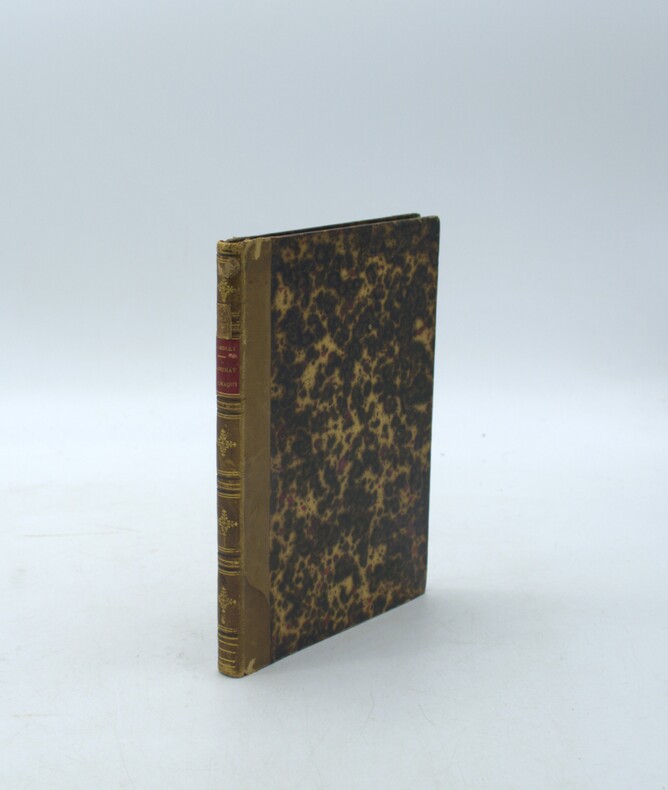
réf. PHO-2150Sd, sl, se. In-8 (20 × 14,5 cm), demi-basane du XIXe siècle, dos lisse orné de pièces de titre et d’auteur rouges, frottements, mouillures marginales sur quelques feuillets, ancien travail de vers, un feuillet replié.
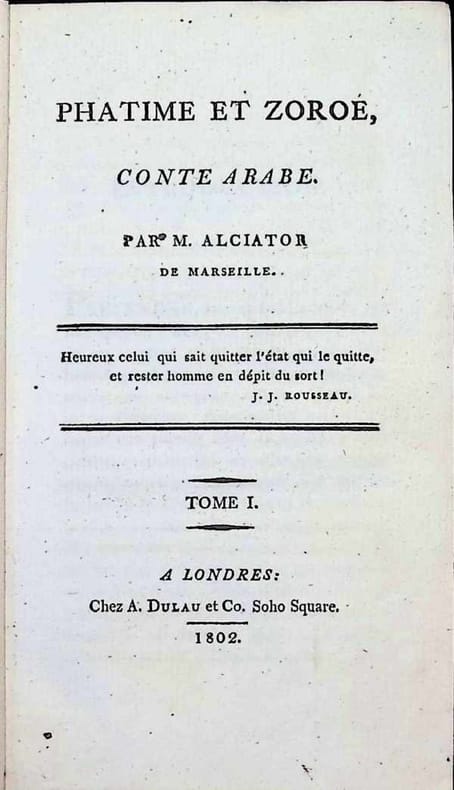
1802réf. 029633Londres 1802 Chez A. Dulau et Co Full-Leather (Hardcover) 1st Edition
1958réf. 0044351958 Paris, 1958. Petit in-folio (256 X 335 mm) en feuilles, sous couverture rempliée imprimée en rouge, chemise et étui de l'éditeur ; (1) f. blanc, (2) ff. de faux-titre et titre imprimé en deux couleurs, 183 pages, (1) page, (2) ff. de table et justification du tirage, (1) f. blanc. Quelques rousseurs sur la couverture, sans gravité, petite tache brune en tête du dos de la chemise.
1948Very Good Arabic Original chromo-lithograph map in brown tones. On a special paper with an ongoing blindstamped "Regestre Robur" during the borders. Folded. 70x100 cm. In Arabic. Scale: 1 /1.000.000. Chipped on margins, split on folded traces. Slight discoloration and one stain on lower margin. Otherwise a good copy. An attractive and detailed map of Syria shows the capital (as Aleppo n that map), other cities like Damascus, Raqqa, Homs, Latakia, Ayn al-Arab, Idlib, Hama, Deir Ez-Zor, Jarabulus, et alli. And it shows Turkey on the north (as Turkey containing Hatay and Alexandrette), The Mediterranean shores of the land as well as Lebanon and Palestine (and Jerusalem) on the west, Sharq al-Urdun (Jordan) and Iraq on the south and east. It's very detailed on showing the roads spread throughout the land like railways and ancient roads from the Roman period. Additionally this roads can be followed to the other Arabic countries and regions on the map. This map was calligraphed by Kamel Al-Baba, (1905-1991), who was a Lebanese contemporary / modern calligrapher. He is the son of famous calligrapher Mokhtar Al-Baba. Cannot be found in WorldCat.; Not in Library of Congress Map Collection. Very scarce.
1970Very Good Arabic Original pamphlet. Large roy. 8vo. (25 x 17,5 cm). Texts in completely Arabic. [4] pp., ills. An extremely rare propaganda and political proclamation in Arabian related to Jerusalem and Palestine question. It has a "call to arms" for the struggle. A unique brochure. Not in OCLC.; Not in IISG.
1868- Librairie de Hachette, Paris 1868, Grd. in-8 (16,5x24,5cm), 693pp., relié. - Edition originale illustrée de 6 cartes (2 dépliantes et 4 sur double page) et 2 plans, ainsi que de 81 figures sur bois in-texte et hors-texte. Reliure en demi chagrin bordeaux d'époque. Dos à nerfs orné. Les plats ont été retendus d'un papier marbré ainsi que les gardes intérieures. Traces brunes sur les premiers feuillets, ensuite quelques brunissures sur certains feuillets. Bon exemplaire. Un des meilleurs livres illustrés sur l'Afrique de l'ouest. En 1863, le général Faidherbe, gouverneur du Soudan, missionna le lieutenant Mage pour une expédition d'exploration le long du Niger en Afrique de L'ouest, et au Sénégal. Ce voyage d'exploration, destinée également à installer des routes commerciales dura trois années. Mage pénétra dans des régions jamais encore explorées, et donna la première description de l'empire Toucouleur de Ségou. [ENGLISH DESCRIPTION ON DEMAND]
1844Very Good Turkish, Ottoman (1500-1928) In contemporary cloth bdg. Roy. 8vo. (24 x 17 cm). In Ottoman script. 43, 59 p. Divan literature is described as "a certain tradition literature with its rules and boundaries" in the most general form. These rules and boundaries have enabled the formation of common expressions in religion and in Sufi intellection in particular and in poetry by the influence of Persian literature, and they have made it traditional in time. In this context, in classical Turkish poetry, whose male poets are predominant in quality and quantity, patriarchal rhetoric presents an outlook that its frame has been established by common tropes, metaphors, poetic themes and in short by similar imaginations and ideas. The divans of Lady Mihri (died after 1512), Lady Leyla (died in 1848) and Lady Seref (1809-1861) have different aesthetic understandings in that context. Laylâ Hanim was one of the few Turkish women poets who made a collection of her poems. Lived in Istanbul and died in 1848. Her family was close to the Ottoman Sultanate and Leylâ Hanim, witnessed the reign of Mahmud II (1808-1839) and Abdülmecid I (1839-1861). She is the daughter of Moralizâde Hâmid Efendi. Her mother Hadîce Hanim is the sister of Keçecizâde Izzet Molla, a notable bureucrat and poet of the times. She has three brothers, Atâullah Mehmed Efendi, Nurullah Mehmed Efendi and Hâlid Efendi, who died at a young age. She had financial problems after her father's death and she expressed those in her poems. Some of her poems in the divan mention that her father and brother Hâlid Efendi have lived in Bursa for a while. She is educated by Keçecizâde Izzet Molla, she is quick-witted. She experienced a short marriage, which lasted about a week; after the divorce she devoted herself to poetry. Her grave is in Galata Mevlevîhanesi. Following books include information of her life, characteristics and poetry: Fatin Tezkiresi (363), Ahmet Rif'at's Lugat-i Târîhiyye ve Cogrâfiyye (154), Tuhfe-i Nâ'ilî (895), Sicill-i Osmânî (93), Bursali Mehmet Tahir's Osmanli Müellifleri (406), Haci Begzâde Ahmet Muhtar's Sâir Hanimlarimiz (51-2), Mehmed Zihnî Efendi's Mesâhir'ün-Nisâ (195), and Semseddin Sâmî's Kâmusü'l-A'lâm (4060). These resources indicate that Leylâ Hanim is from a noble family and the links of the family to the high cadres of Ottoman bureaucracy and their intellectual property have left traces in her poetry. AH 1299 = AD 1882. Fourth Edition. (Source: All poetry). OCLC 163633996.; Özege 4177 / 2. First Bulaq Edition. Litho. Rare.
18201st edition. Later boards. 8vo. 543 pages, 21 cm. In French. Title translates to From the Urban and Rural Economy of the Arabs and Jews. A monumental history of Arabian economy drawn from Greco-Roman sources. Reynier (1762-1824) was an notable Swiss-French scholar of ancient and modern economic history who accompanied Napoleon on his expedition to Egypt, where he served as High Superintendent of Revenues and Finances. SUBJECTS: Arabs. Jews -- Politics and government. Jews -- Social conditions. Jews -- Agriculture. OCLC lists 10 copies worldwide, but only 2 copies in North America (Penn and Harvard) (OCLC: 698357953) . A colleague offers a copy for sale for USD 2500. Ex-library with usual markings. Pages are ridged and wavy, but Very Good Condition. (YID-41-9-PE)
1890réf. 69382Maison Quantin | Paris 1890 | 24.50 x 31.50 cm | relié
1831réf. 61718Théophile Barrois et Benjamin Duprat | Paris 1831 | 13 x 21 cm | relié
1971réf. 171721al-Khobar: The International Publications Industries 1971. Keep the following in mind and everything will be easy Fourth printing of this institutionally rare phrasebook which adopts "a short cut method simple and easy enough for a businessman to teach himself the spoken Arabic while relaxing in the Aircraft or in his Hotel room. Many of the oil industry people in Arabia owe their local friendship to this book". Arranged by topic the book has sections on greetings shopping food and drink and other practicalities such as taking one's car to a mechanic. The unnamed author places a premium on language as a key to understanding local culture: "you will find the Gulf Arabs intensely loyal to their friends as well as to their families. Most of them are blessed with a keen sense of humor. For these and other reasons such as their hospitality and courtesy you will enjoy getting acquainted with them". Further sections discuss the etiquette of being a guest at a traditional wedding and how to behave if invited to a private house as a guest. WorldCat lists only four copies in institutions Oxford National Library of Wales National Library of Israel Bilkent University. Small octavo 115 x 117 mm. Wire stitched in the original printed wrappers spine lettered in black. Minor wear to wrappers contents lightly toned not affecting text. A very good copy. unknown
1961réf. 78570Les Editions de Minuit | Paris 1961 | 14 x 22.50 cm | broché
1922- Lucien Vogel éditeur, Paris 1922, 18x24cm, relié. - Set of eight original prints in color, drawn on laid paper. The XXXIII and XXXVI sketches are signed lower left and right boards. The boards are introduced by a text Joan Ramon Fernandez. Original prints made ??for the illustration of The Gazette fashionable, one of the finest and most influential twentieth century fashion magazines, celebrating the talent of creators and artists French burgeoning art deco. Famous fashion magazine founded in 1912 by Lucien Vogel, The Gazette fashionable appeared until 1925 with an interruption during the War of 1915 to 1920, due to mobilization of its editor. She is 69 Deliveries from just 2000 copies and is illustrated including 573 color plates and 148 sketches depicting models of fashion designers. Upon publication, these luxury publications "are for bibliophiles and worldly aesthetes" (Françoise Tétart-Vittu "good Gazette of tone" in the fashion dictionary, 2016). Printed on fine laid paper, they use a typeface created specifically for the magazine by Georges Peignot, the Cochin character, taken in 1946 by Christian Dior. The prints are made with the technique of metal stencil, enhanced color and some outlined in gold or palladium. The adventure began in 1912 when Lucien Vogel, man of the world and fashion - it has already participated in Femina magazine - decided to found with his wife Cosette de Brunhoff (John's sister, the father of Babar) Gazette good tone in which the subtitle is then "Art, fashions and frivolities." Georges Charensol quotes the editor: "In 1910, he observed, there was no truly artistic fashion magazine and representative of the spirit of his time. So I thought of making a glossy magazine with truly modern artists [...] I was certain of success because for any fashion country can compete with France. "(" A great art editor. Lucien Vogel "in literary News, No. 133, May 1925). The success of the magazine is immediate, not only in France but also the US and South America. Originally, Vogel therefore brings together a group of seven artists: André-Édouard Marty and Pierre Brissaud, followed by Georges Lepape and Dammicourt; and finally his friends from the School of Fine Arts as are George Barbier, Bernard Boutet de Monvel or Charles Martin. Other talents come quickly reach the equipped Guy Arnoux, Léon Bakst, Benito, Boutet de Monvel, Umberto Brunelleschi, Chas Laborde, Jean-Gabriel Domergue, Raoul Dufy, Edward Halouze Alexander Iacovleff, Jean Emile Laboureur Charles Loupot, Charles Martin, Maggie Salcedo. These artists, mostly unknown when Lucien Vogel appealed to them, will eventually become iconic figures and artistic sought. These are the same illustrators who make the drawings advertisements Gazette. The boards highlight the dresses and sublime seven artists of the time: Lanvin, Doeuillet, Paquin, Poiret, Worth, Vionnet and Doucet. The designers provide for each number of exclusive models. Nevertheless, some of Illustrations contained no real model, but only the idea that the illustrator is done in the fashion of the day. Gazette fashionable is a milestone in the history of fashion. Combining the aesthetic requirement and plastic unit, it brings together for the first time the great talents of the world of arts, literature and fashion and imposed by this alchemy, a new image of women, slender, independent and bold, also driven by the new generation of designers Coco Chanel, Jean Patou, Rochas Marcel ... Recovery in 1920 by Condé Montrose Nast, Gazette fashionable modeled for the new composition and the aesthetic choices of the "little dying newspaper" that Nast had bought a few years ago: the Vogue magazine. [FRENCH VERSION FOLLOWS] Ensemble de huit estampes originales en couleur, tirées sur papier vergé. Les croquis XXXIII et XXXVI sont signés en bas à gauche et à droite des planches. Les planches sont introduites par un texte de Jeanne Ramon-Fernandez. Reliure à la bradel en plein papier à motif décoratif, do
1859- Librairie de L. Hachette et Cie., Paris 1859, In-8 (13x21,1cm), 526pp., relié. - Edition originale. Reliure en demi chagrin rouge d'époque. Dos à nerfs orné de 4 fleurons dans des caissons à froid. Auteur, titre et date dorés. Tête dorée. Papier bien frais (quelques rares pâles rousseurs). Bel exemplaire. En décembre 1854, Joseph-Arthur de Gobineau (1816-1882), alors premier secrétaire à la légation de Francfort, est nommé secrétaire d'une mission extraordinaire en Perse, conduite par le ministre Prosper Bourée et ordonnée par l'empereur Napoléon III. Sur le chemin de la Perse, Gobineau parcourt Malte, l'Egypte et les pays de la péninsule arabique. La deuxième partie de Trois ans en Asie est certainement la partie la plus riche de cet ouvrage, une mine d'informations sur la société persane de cette époque. Animé par le même enthousiasme pour la Perse, Gobineau publiera, en 1864, Religions et philosophies dans l'Asie centrale, puis, en 1869, une Histoire des Perses et enfin, entre 1872 et 1874, son recueil des six Nouvelles Asiatiques. [ENGLISH DESCRIPTION ON DEMAND]
1910Very Good Turkish, Ottoman (1500-1928) Original lithograph map with brown, white and blue tons. 81x57 cm. In Ottoman script (Old Turkish with Arabic letters). All toponyms are in Ottoman Turkish and Arabic. Scale: 1:500,000. Shows Mediterranean shores on the north, Bahr-i Lût [i.e. the Dead Sea], Aqaba Bay, areas of Arabic tribes in very detail, in addition, special huge lands like 'Al-Hism Land'. Also, it shows holy places, antiquities, fortresses, rivers; and Turkish Sanjaks, Qazas, Nahiyes, Qariyes based on the Ottoman administrative system. Cartographer is not indicated, but, it's composed for military purposes in the last period of the Imperial Ottoman, especially for showing Arabian tribes spreading over vast areas in its period, just before World War 1 (date of the printing of this map), such as 'Houtat Tribe'. A very detailed and attractive map of Palestine and Quds area and their topography. Following the Muslim conquest of Palestine in 636-640, several Muslim ruling dynasties succeeded each other as they wrestled control of Palestine: the Rashiduns; the Umayyads, who built the Dome of the Rock and the al-Aqsa Mosque in Jerusalem; the Abbasids; the semi-independent Tulunids and the Ikhshidids; the Fatimids; and the Seljuks. In 1099, the Crusaders established the Kingdom of Jerusalem in Palestine, which the Ayyubid Sultanate conquered in 1187. The Crusaders failed to retake Palestine despite further attempts. The Egyptian Mamluks took Palestine from the Mongols (who had conquered the Ayyubid Sultanate) in 1260. The Ottomans captured Palestine in 1516 and ruled it until Egypt took it in 1832. Eight years later, the United Kingdom intervened and returned the region to the Ottomans. Considerable demographic changes happened during the 19th century and with the regional migrations of Druze, Circassians, and Bedouin tribes. The emergence of Zionism also brought many Jewish immigrants from Europe and the revival of the Hebrew language. Arabs in Palestine, both Christian and Muslim, settled and Bedouin, were historically split between the Qays and Yaman factions. These divisions had their origins in pre-Islamic tribal feuds between Northern Arabians (Qaysis) and Southern Arabians (Yamanis). The strife between the two tribal confederacies spread throughout the Arab world with their conquests, subsuming even uninvolved families so that the population of Palestine identified with one or the other. Their conflicts continued after the 8th-century Civil war in Palestine until the early 20th century and gave rise to differences in customs, tradition, and dialect which remain to this day. Beit Sahour was first settled in the 14th century by a handful of Christian and Muslim clans (hamula) from Wadi Musa in Jordan, the Christian Jaraisa and the Muslim Shaybat and Jubran, who came to work as shepherds for Bethlehem's Christian landowners, and they were subsequently joined by other Greek Orthodox immigrants from Egypt in the 17th-18th centuries. Due to the legacy of the Ottoman period, the ethnic origins of some rural and urban Palestinians are either Albanian, Circassian, or from other non-Arab populations.
1899Very Good Turkish, Ottoman (1500-1928) Paperback. Foolscap 8vo. (18 x 13 cm). In Ottoman script (Turkish with Arabic letters). 80 p., [10] unnumbered b/w plts. Yenisehirlizâde Halit Eyüp was the son-in-law of Ahmet Midhat Efendi, one of the shaded names of Turkish literature. This rare book has 10 unnumbered b/w plates shows firstly Abd Al-Rahman Khan, (1845-1901), who was Emîr of Afghanistan and played a prominent role in the fierce and long-drawn struggle for power waged by his father and his uncle, A'?am Khân, against his cousin Shîr 'Alî, the successor of Dost Mo?ammad Khân. And then, Khaybar Fortress, Peshaver city in India, Tajik chief of Afghanistan: Maaz Khan (two-paged print), a view of Kabul city (two-paged print), Ghaznawid Fortress, North Gate of Kandahar, Herat Fortress (two-pages print), Cohat Fortress, a portrait of Afghan Sufi. An extremely rare and richly illustrated book of the history of Afghanistan. Hegira: 1316 = Gregorian: 1899. First and Only Edition. TBTK 12178.; Özege 19966.; Three copies located in OCLC: 944246927 (One copy in Library of Congress - Karl Süssheim Collection, No. 7.).; 163633157 (Orient-Institut Istanbul and Bayerische Staatsbibliothek).
1886réf. RO80101671LEROUX Ernest. 1880 - 1886. In-Folio. Relié demi-cuir. Bon état, Couv. légèrement passée, Dos satisfaisant, Intérieur acceptable. 975 + 860 pages. Titre et fleurons dorés sur demi-chagrin marron. Légères épidermures sur le cuir. Coins légèrement frottés. Etiquette de code sur la coiffe en-tête et tampons de bibliothèque sur la page de titre et dans quelques marges.. . . . Classification Dewey : 492.7-Arabe
1831- Théophile Barrois et Benjamin Duprat, Paris 1831, In-8 (13x21cm), 189pp. 32pp., relié. - Mention de seconde édition, corrigée et augmentée. La première est parue sans nom d'auteur et n'a bénéficié que d'un tirage confidentiel, c'est pourquoi on ne la trouve que très rarement. L'illustration comprend un portrait au frontispice de Hussein Pacha, une carte repliée, et 10 tableaux sur l'état de l'armée. 7 planches pour L'univers pittoresque. Reliure en pleine basane verte d'époque. Dos lisse orné de 2 fers et d'un grand fer central romantique en miroir, filets et roulettes. Pièce de titre en maroquin bordeaux. Traces de frottements en coiffes et coins. Bel exemplaire. Le commandant Fernel (1793-1854) était attaché à l'état-major de l'armée d'Afrique, il nous conte dans cet ouvrage à tendance légitimiste l'histoire de la prise d'Alger. Le dernier chapitre est consacré aux particularités de la région, dattier, canne à sucre, grenades, chameaux... Cette campagne, on le sait, aura des répercussions considérables sur la presence française en Afrique du nord. In fine, l'exemplaire a été truffé de la partie de L'Univers pittoresque sur Algers, écrite par Rozet, capitaine du génie, qui contient 7 planches sur acier. [ENGLISH DESCRIPTION ON DEMAND]
1890- Maison Quantin, Paris 1890, In-4 (24,5x31,5cm), 245pp., relié. - Edition originale de cet ouvrage magnifiquement illustré d'un titre-frontispice en couleurs, d'une quatrième de couverture en couleurs et de 150 aquarelles par Charles Lallemand gravés par Michelet. Tirage sur grand papier, vélin fort. Les aquarelles ont été faites in situ par l'auteur. Cartonnage d'éditeur bleu ciel biseauté. Dos lisse orné d'un croissant et une étoile, de roulettes et d'un tunisien en couleur en tenue pittoresque. Tranches dorées. Sur le plat supérieur le titre et le drpeau tunisien. Plaque signée Lenègre & cie. Salissures sur le premier plat. Dos devenue légèrement turquoise. Coiffes un peu affaissées. Traces de frottement. Parfaite fraîcheur du papier. Bel exemplaire de cette superbe publication, dont le texte constitue un témoignage sur la Tunisie de la fin du XIXe et une réelle admiration pour son peuple, son histoire et sa contrée. [ENGLISH DESCRIPTION ON DEMAND]
1832- Paulin, Paris 1832, 13x20,5cm, 3 volumes reliés. - Edition originale de la traduction française. Reliures à la bradel en plein cartonnage vert sapin, dos lisse partiellement décolorés et ornés de filets dorés, traces de frottements sur les mors, gardes et contreplats de papier vert d'eau, coins émoussés, tranches jaunes, reliures de l'époque. Ouvrage illustré de figures dans le texte et bien complet de ses 2 cartes ainsi que de ses 5 gravures hors-texte. Indications de rangement de bibliothèque, à l'encre rouge, en têtes des contreplats, quelques petites rousseurs. [ENGLISH DESCRIPTION ON DEMAND]
réf. 4430P., Barbin, 1680. Deux volumes in 12 basane de l'époque (coiffes usagées).
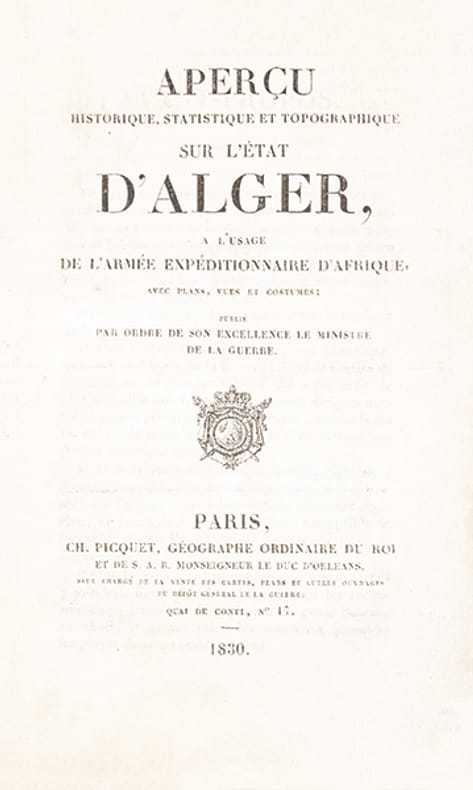
réf. 388922 volumes: un volume de texte in-12 (180 x 110 mm), broché, couverture imprimée, (4), xiii, 256 p. et un volume d'atlas in-folio oblong (265 x 347 mm), 6 cartes et plans dépliants et 11 planches. Paris, Charles Picquet géographe du roi (…), 1830.
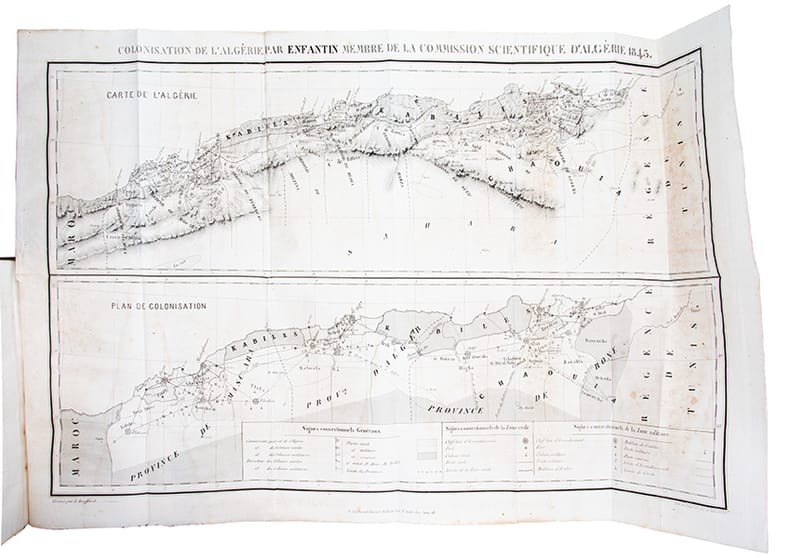
réf. 39394In-8 (225 x 142 mm), demi-chagrin bordeaux, pièce de titre de veau bronze (rel. moderne), (4), 542 pages, 4 pages de catalogue, grande carte (42 x 66 cm) et tableau statistique dépliants. Paris, P. Bertrand, 1843.
1821Tholuck's investigation of Sufism as an independent phenomenomas taking it to be a pantheistic interpretation of Islam. xii, 331 pages. Bookplate and inscription of William Farrer on front pastedown and front free endpaper. Missing lower two thirds of spine. Light spotting to title page, annotation in red ink opposite title page.