4.142 Ergebnisse
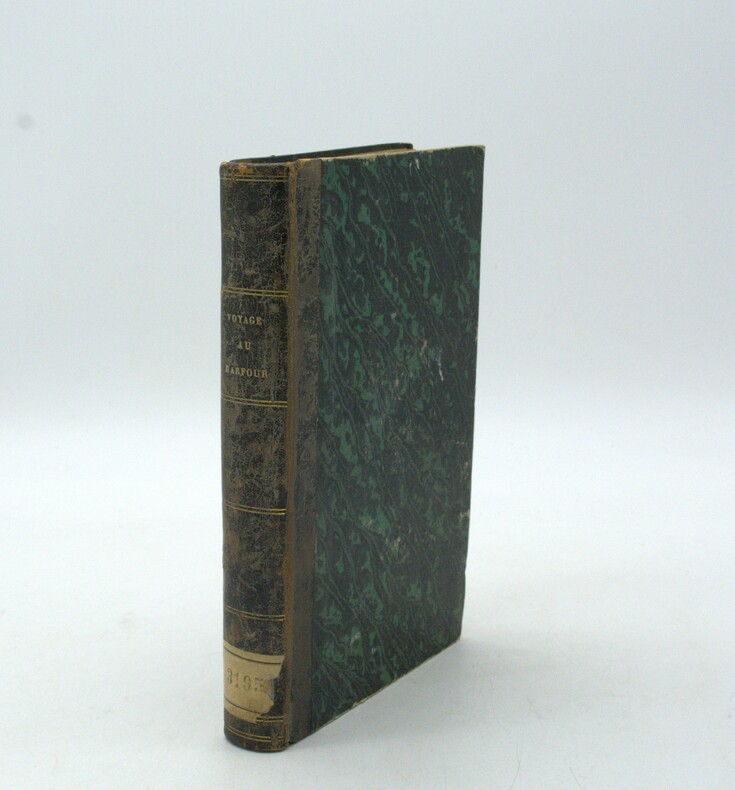
1845Best.-Nr. PHO-1947Au Kaire, Chez Benjamin Duprat, Libraire de l'Institut et de la Bibliothèque Royale & chez le Traducteur, 1845. In-8, LXXXVIII-491pp., demi basane verte, dos lisse avec titre, cachets, étiquette au dos, rousseurs, déchirure sur la grande carte, frottements Épître dédicatoire à Mohammed Aly Vice-Roi d'Égypte. Préface par M. JOMARD contenant des remarques sur la région du Nil Blanc supérieur. Portrait-frontispice du sultan Abou Madian. Ouvrage bien complet des 5 planches repliées dont 2 cartes in fine ainsi que du feuillet d'Errata.
1932Best.-Nr. 21719Paris, Ernest Leroux, 1932 ; 2 tomes in-4° (Texte et Album), broché ; 276 pp., [2] ff. de tables ; [11] ff. de planches de Plans, 247 planches photographiques de 1 ou 2 vues chacune, pour un total de 386 pp.
1961Best.-Nr. 78653Les Editions de Minuit | Paris 1961 | 14 x 22.50 cm | broché
Best.-Nr. 13491Grabadin h.e. compendii secretorum medicamentorum libri duo cum Mundini, Honesti, Manardi et Sylvii observationibus et Cui access. Plantarum descript. Imagines ex vivo Ionnis Costaie annott. Venize. Juntas. 1623. Fort in-folio (35x23 cms). 6 ff. dont titre-252-6 ff. dont titre-278 ff. et 12 feuillets dont 1 blanc. Reliure de l'époque très mauvais état, sans dos (cassé).
First edition, 4to, 15,[1]pp., purchase note in Sir Thomas' hand "Sotheby 66", orig. blue paper wrappers bound in, uncut, middle hill boards, spine chipped. A catalogue of 127 manuscripts rich in Arabic and Persian works, purchased by Guise between 1788 and 1795, at great personal expense, while he was Head Surgeon to the General Hospital. "His rarest manuscripts (according to his catalogue published in 1800) were purchased from the widow of Dastur Darab who between 1758 and 1760 had taught Avestan to Anquetil du Perron, the first translator of the Avesta into a European language."?British Library. ESTC locates copies at the British Library, National Library of Scotland, Gottingen (Germany) & New York Public Library.
1894Best.-Nr. 89789J. Rothschild | Paris 1894 | 14.5 x 23 cm | Relié
1983Very Good Arabic Original creme bdg. HC. Folio. (32,5 x 27 cm). Texts in Arabic with a bilingual title on verso of the cover in English and Arabic. [18] p., [15] unnumbered full paged color plates of the buildings in Jeddah separately tissue papers. Signed and inscribed in Turkish by Cidde emini [i.e. The Lord Mayor of Jeddah] Mohamed Said Farsi, dated 8.5.1984 to Turkish architect Selim Sabuncuoglu as 'Sayin Selim Sabuncuoglu, en güzel temennilerimle Jedda'dan bir hatira. Jeddah emini, Sait Farisi'. Sealed "YÜTAS: Construction Production Industry and Trade Co.". Dr. Mohammed Said Farsi, (1937-2019), was a former Lord Mayor of Jeddah, and a man of such aesthetic integrity that he traveled the world to meet with sculptors, painters, and musicians before replanning the city according to his own meticulously constructed vision. (Source: The Rake). Dr. Farsi was a visionary civic leader and philanthropist who is widely considered to be the father of modern Jeddah. He presided over a five-fold increase in the city's population, led its transformation, including creating the famous Jeddah corniche - a unique public space and an open-air gallery. Dr. Farsi, a noted art lover, was also the first mayor to introduce Western art and sculpture to an Arab city. He is survived by his son Hani Farsi and former wife Naglaa Asaad. Born in Makkah in 1937, Dr. M S Farsi qualified as an architect in Alexandria and returned to Saudi Arabia in the early 1960s. He entered government service in 1963 and rose rapidly. Just two years later he was appointed to the post of Planning Officer for the Western Region of Saudi Arabia. Covering an area larger than the United Kingdom and having within its boundaries the port city of Jeddah and the Holy Cities of Makkah and Medinah, this territory was in effect Saudi Arabia's window to the world and it was under Dr. Farsi's aegis that plans for these three cities were drawn up; given the immense significance of this work, Dr. Farsi liaised with the very highest levels of government. In 1972, Dr. Farsi became Mayor of Jeddah, a city that had grown from the historic walled city of his childhood to a large modern conurbation of more than 300,000 people. Until the middle of the following decade, Dr. Farsi presided over a period of spectacular and unprecedented growth for the city, which saw its population increase five-fold. That chaos was averted in the face of such a population explosion was due in no small part to Dr. Farsi's enlightened leadership. It is remarkable that in the midst of creating much-needed infrastructure, Dr. Farsi found time to create a city that was as beautiful as it was functional; with a carefully preserved historic center, gracious boulevards, and charming parks. A collector of Islamic and Western art, Dr. Farsi's vision as a city planner was to integrate important contemporary art into public spaces, thus enriching the lives of the inhabitants and reflecting the on-going cultural significance of the city, and his mayoralty is today remembered for its artistic flowering and for being at the forefront of design. Dr. Farsi made use of local artists and materials as well as commissioning works from many great Western masters, including Henry Moore, Victor Vasarely, Alexander Calder, Arnaldo Pomodoro, Joan Miró, Cesar Baldaccini, Sylvestre Monnier, Jean Arp, and Jacques Lipchitz, among many other stellar names in the international art world. He was the first mayor to introduce Western art and sculpture to an Arab city, as well as the first to display art that depicted the physical human form. At the time he stepped down, in 1986, Jeddah boasted over 400 pieces of public art. When he retired in 1986, Dr. Farsi returned to one of his primary passions - education. Within just one year he successfully qualified for his doctorate, attaining a Ph.D. from the University of Alexandria. (Source: Pressat).
1982Fine Fine English Original brown imitation leather bdg. Dust wrapper. In publisher's special slip-case. Folio. (31 x 26,5 cm). Texts in entirely English, bilingual title on the slipcase in English and Arabic. 143, [1] p., fully color and b/w photos. Signed and inscribed in Turkish by Cidde emini [i.e. The Lord Mayor of Jeddah] Mohamed Said Farsi, dated 8.5.1984 to Turkish architect Selim Sabuncuoglu as 'Sayin Selim Sabuncuoglu, en güzel temennilerimle Jedda'dan bir hatira. Jeddah emini, Sait Farisi'. Sealed "YÜTAS: Construction Production Industry and Trade Co.". Dr. Mohammed Said Farsi, (1937-2019), was a former Lord Mayor of Jeddah, and a man of such aesthetic integrity that he traveled the world to meet with sculptors, painters, and musicians before replanning the city according to his own meticulously constructed vision. (Source: The Rake). Dr. Farsi was a visionary civic leader and philanthropist who is widely considered to be the father of modern Jeddah. He presided over a five-fold increase in the city's population, led its transformation, including creating the famous Jeddah corniche - a unique public space and an open-air gallery. Dr. Farsi, a noted art lover, was also the first mayor to introduce Western art and sculpture to an Arab city. He is survived by his son Hani Farsi and former wife Naglaa Asaad. Born in Makkah in 1937, Dr. M S Farsi qualified as an architect in Alexandria and returned to Saudi Arabia in the early 1960s. He entered government service in 1963 and rose rapidly. Just two years later he was appointed to the post of Planning Officer for the Western Region of Saudi Arabia. Covering an area larger than the United Kingdom and having within its boundaries the port city of Jeddah and the Holy Cities of Makkah and Medinah, this territory was in effect Saudi Arabia's window to the world and it was under Dr. Farsi's aegis that plans for these three cities were drawn up; given the immense significance of this work, Dr. Farsi liaised with the very highest levels of government. In 1972, Dr. Farsi became Mayor of Jeddah, a city that had grown from the historic walled city of his childhood to a large modern conurbation of more than 300,000 people. Until the middle of the following decade, Dr. Farsi presided over a period of spectacular and unprecedented growth for the city, which saw its population increase five-fold. That chaos was averted in the face of such a population explosion was due in no small part to Dr. Farsi's enlightened leadership. It is remarkable that in the midst of creating much-needed infrastructure, Dr. Farsi found time to create a city that was as beautiful as it was functional; with a carefully preserved historic center, gracious boulevards, and charming parks. A collector of Islamic and Western art, Dr. Farsi's vision as a city planner was to integrate important contemporary art into public spaces, thus enriching the lives of the inhabitants and reflecting the on-going cultural significance of the city, and his mayoralty is today remembered for its artistic flowering and for being at the forefront of design. Dr. Farsi made use of local artists and materials as well as commissioning works from many great Western masters, including Henry Moore, Victor Vasarely, Alexander Calder, Arnaldo Pomodoro, Joan Miró, Cesar Baldaccini, Sylvestre Monnier, Jean Arp, and Jacques Lipchitz, among many other stellar names in the international art world. He was the first mayor to introduce Western art and sculpture to an Arab city, as well as the first to display art that depicted the physical human form. At the time he stepped down, in 1986, Jeddah boasted over 400 pieces of public art. When he retired in 1986, Dr. Farsi returned to one of his primary passions - education. Within just one year he successfully qualified for his doctorate, attaining a Ph.D. from the University of Alexandria. (Source: Pressat). Jeddah: 'Bride of the Red Sea'. This is a cosmopolitan city, ancient and modern hub, the unique seat of civilis[.]. R
1955Very Good Turkish Original silver gelatin photographic print mounted on cardboard. 53x42 cm (Photo size: 38x30 cm). Signed by Yildiz Moran. Yildiz (Vahid) Moran Arun was born on 24 July 1932, in Istanbul. She is the youngest of three children born to Nemide Moran and Ahmet Vahid Moran. Her father, Ahmet Vahid Moran, was a military officer who served in important positions both at home and abroad. He was the writer of Turkey's very first English-Turkish dictionary printed in Latin script in 1924. In 1950, Yildiz Moran quit her high school education during her final year at Robert College and, following the guidance of her uncle, the art historian Mazhar Sevket Ipsiroglu, went to Great Britain to study photography. After completing her education at Bloomsbury Technical College (1950-52) and Ealing Broadway Technical College, she began to work for John Vickers, the acclaimed photographer of The Old Vic. Moran combined her technical and theoretical knowledge with the practical experience she gained at the studio and stage shoots. She had the opportunity to meet famous artists of the time. The exhibitions and works she saw during her time in Great Britain helped her develop her photographic vision. Following her internship period, she began to make a living taking portrait and lobby photographs. She opened her first exhibition in 1953 in Cambridge. In 1954, she held four more exhibitions in London. All these shows attracted much attention. In her first exhibition, her entire collection was sold. She went traveling in Europe. After making a photo book on Spain and Portugal, she returned to Turkey in 1954. Between 1955 and 1962, she held five solo exhibitions. In 1963, she married Özdemir Asaf (Halit Özdemir Arun) and gave birth to three children in four years. She dedicated the rest of her life to her children. She opened her last exhibition in 1970, in Istanbul. After that, she only took part in retrospective exhibitions. She quit her professional photography career and began to work as a translator and dictionary writer. Between 1981 and 1987, she prepared the complete works of Özdemir Asaf for publication and translated some of his poetry and prose into English. In 1982, the Istanbul State Academy of Fine Arts Photography Institute awarded her honorary membership on account of her contributions to the art of photography. Lyrically conveying a universal language through her own perspective, Moran became a school in herself with her "timeless" photographs. Turkey's first academically-trained photographer, Yildiz Moran is renowned for the new vision and aesthetic she introduced into photography and is considered to be one of the best photographers of all time. Masterfully combining the tradition of the East with the aesthetic of the West, she left behind a legacy of black and white photographs beautifully composed to capture the world of light and shadow reflecting on people and lands. Considering the conditions in the world of photography in the 1950s and 1960s, it is a great achievement that she defined the age of 20 her passion for photography as the foundation of her life, became the first academically-trained woman photographer in her country, acquired in-depth knowledge of the discipline and combined this knowledge with her talent and hard work. "The camera must be like an extension of your being so that it doesn't create an obstruction between you and your subjects. Anything that has poetry in it is the subject of photography. My only intention has always been to photograph what was universal while staying true to the concept embodied by my subject." Besides her portraits, landscapes, and abstract details, she is also known for her photographs reflecting the lives of the Anatolian people. As a woman photographer traveling in Anatolia, she accessed otherwise inaccessible environments, moments, and perspectives; and, with profound respect, she conveyed the purity of the people she met there and allowed us... (Biography: Merih Akogul).
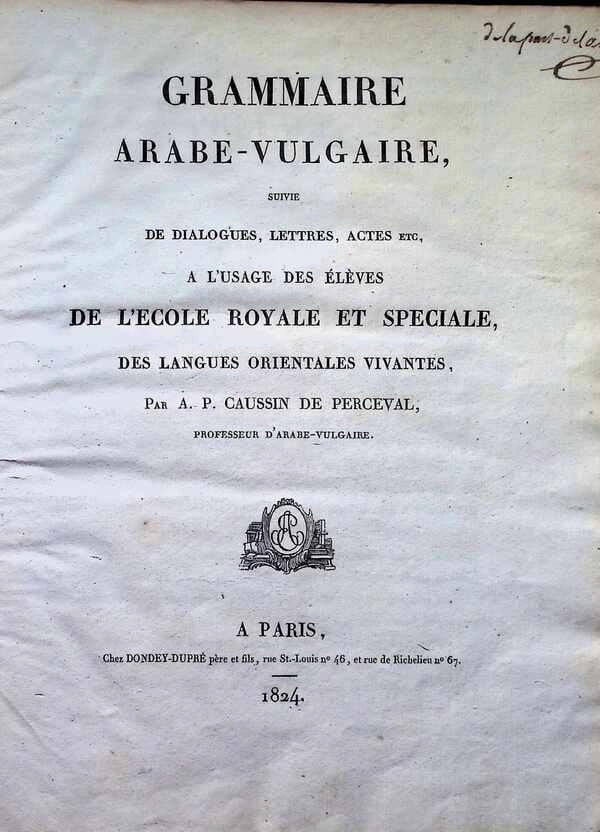
1824Best.-Nr. 031246Paris 1824 Dondey-Dupré père et fils Half-Leather 1st Edition
Best.-Nr. PHO-1451A l'Imprimerie Nationale, Paris, Ernest Leroux et Paul Geuthner Éditeur, 1922-1949. . Édition bilingue: Texte arabe avec traduction française en regard. 5 volumes In-8° de: Tome I (4e tirage,1927) 2ff-XLVI & 443pp. Tome II (5e tirage,1949), XIV & 465 pp. Tome III (5e tirage, 1949), XXVI & 476 pp. Tome IV (4e tirage, 1922), 479 pp. Le Tome V, constitue l'index ,(3e tirage , 1927) 91 pp.. Broché avec couverture éditeur ,non coupé .
1947Best.-Nr. 0042991947 Sans lieu [Paris], Éditions Manuel Bruker, sans date [1947]. In-folio en feuilles (252 X 338) sous chemise rempliée illustrée, chemise et étui de l'éditeur ; 94 pages, (2) ff..
1653Best.-Nr. P2-6E-2Lugdini Batavorum, Bonaventurae & Abraham Elseviriorum, 1653. In-folio, plein veau époque, dos à nerfs. 16pp-1f-2922 colonnes, texte sur 2 colonnes, première édition. Notes manuscrites sur le titre et dans quelques marges, rousseurs, mouillures sur 20pp à l’index, maque de pp à l’index, petits trous de vers en marge. Jacobus Golius, mathématicien et orientaliste, étudia l’Arabe avec Erpenius, qui lui succéda en tant que professeur d’Arabe à l’université de Leide en 1625. Puis il prit la chaire des mathématiques dans la même université. Son dictionnaire Arabe-Latin restera la grande référence jusqu’au XIX siècle.
1845Best.-Nr. 70157Imprimerie Royale | Paris 1845 | 9.50 x 15 cm | 2 volumes reliés en 1
1980Best.-Nr. 77800S. n. | s. l. s. d. [circa 1980] | 16 x 21.50 cm | une feuille
1815Best.-Nr. 90277Charles-Joseph Panckoucke | Paris 1815 | 12.3 x 20.7 cm | Relié
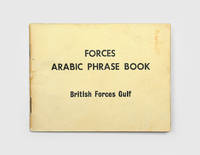
1967Best.-Nr. 196308No stated place or publisher: 1967. First edition introducing vocabulary for topics ranging from food and drink greetings and personal details to specialised military terms like "rocket launcher" and "Trucial Oman Scouts". We have traced no other copies in institutions or commerce. The phrasebook opens with encouragement: "The Arab regards his language as the greatest in the world. So when he hears someone trying to speak his language he is delighted. You will find your efforts to speak Arabic get a very warm response" p. 1. There are also a number of "Do's and Don'ts" such as do not be discouraged when you do not understand anything and do not point the soles of your feet at anyone. Alongside individual words the book also introduces phrases like "I'd like a cup of coffee please" "Is there a well near here" and "I am a soldier". In 1967 after the British withdrawal from Aden Middle East Command was renamed HQ British Forces Gulf and relocated to Bahrain. The distinction between Bahraini and Trucial Omani vocabulary for example "village" as qarya or balad respectively and the inclusion of regional variants for example fee ammaan Illah for "Goodbye" suggest that it was issued to the Trucial Oman Scouts. Landscape duodecimo. With 7 pp. of note paper at rear as issued. Original yellow paper wrappers wire-stitched as issued front wrapper lettered in black rear wrapper with printer's slug in black. Wrappers a little soiled at edges and spine rear wrapper with strong vertical crease contents clean: a very good copy. unknown
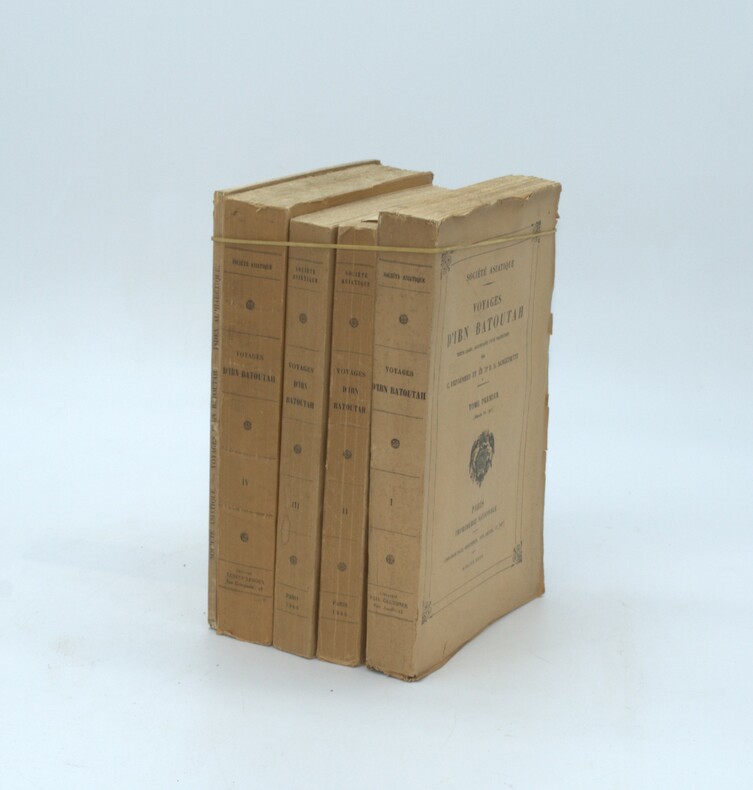
1922Best.-Nr. PHO-1362A l'Imprimerie Nationale, Paris, Ernest Leroux et Paul Geuthner Éditeur, 1922-1949. . Édition bilingue: Texte arabe avec traduction française en regard. 5 volumes In-8° de: Tome I (4e tirage,1927) 2ff-XLVI & 443pp. Tome II (4e tirage,1914), XIV & 465 pp. Tome III (4e tirage, 1914), XXVI & 476 pp. Tome IV (4e tirage, 1922), 479 pp. Le Tome V, constitue l'index ,(3e tirage , 1927) 91 pp.. Broché avec couverture éditeur ,tome 1,4 et annexe non coupé , étiquettes au dos et cachets (tome 2 et 3) , manque au dos tome 3.
1804Good Turkish, Ottoman (1500-1928) Original full leather bdg. in traditional Ottoman style. Repaired skillfully. 4to. (29 x 18 cm). In Ottoman script. 2 volumes set in one: ([15], 327 p.; [6], 315 p.). Vasif tarihi. Mahasin ül-âsâr ve hakayik ül-ahbâr. 2 volumes set. Özege 22519. Extremely rare. First Edition. In the late eighteenth century the Ottoman Empire experienced a time of profound crisis, political as well as intellectual, moral, and ideological. This dissertation explores the mental and moral climate of the period through the work of Ahmed Vasif Efendi, a statesman, ambassador, intellectual, and author of one of the century's largest histories, and also through his personal development as a reformer. Divided into five chapters, each treating a distinct aspect of Vasif's thought, this dissertation argues that Ottoman elites after 1774 responded to growing foreign and domestic challenges with not only military reform but a broad re-evaluation of subjects like war, peacemaking, moral rule, and human agency in history. It suggests these debates, including a basic disagreement over the legitimate place of human reason and action across life's many spheres, indicate a vital if fractured response to the crisis, and an incipient breakdown in certain storied intellectual frameworks.
1845- Imprimerie royale, Paris 1845, 9,5x15cm, 2 volumes reliés en 1. - Edition originale de la traduction française, des corrections, des additions et des éclaircissements, établis par Joseph Toussaint Reinaud en 1845, d'après le texte arabe imprimé en 1811 par les soins de Louis Langlès. Reliure à la bradel en plein papier marbré, plats de couverture conservés, reliure signée Thomas Boichot. Très rare exemplaire sans rousseur. [ENGLISH DESCRIPTION ON DEMAND]
1921Very Good Turkish, Ottoman (1500-1928) Original map. Oblong atlas folio. (57 x 77 cm). In Ottoman script. Folded. Stains on the upper side. Slightly chipped margins. Filistin haritasi. Scale: 1/250.000. Erkilet was an officer of the Ottoman Army and the general of the Turkish Army. In fall 1941 he, along with General Ali Fuad Erden, visited the occupied territories in Ukraine (including Crimea) on the invitation of Gerd von Rundstedt. From there he and other Turkish officers flew to Rastenburg to meet Hitler in person. In 1943 he published his essays on that trip under the title "What I Saw on the Eastern Front". Being a staunch Turanist, he was briefly detained for Panturkic activities in 1948 together with some other prominent Turanists.
1928Very Good Turkish, Ottoman (1500-1928) Original wrappers. Demy 8vo. (21 x 14 cm). In Ottoman script (Old Turkish with Arabic letters). 83 p. Chipped on extremities of pages and cover, minor stains on edges. Otherwise a good copy. First and only edition of this first work in book form on Baku and Azerbaijani oil. After the occupation of the Republic of Azerbaijan by the Red Army, many Azerbaijani intellectuals such as Mehmed Emin Resûlzâde (1884-1955) sought refuge in Turkey, established a publishing house called "Milli Azerbaycan Nesriyâti" [i.e. National Azerbaijan Publication] in 1928, Istanbul, and to make the voice of Azerbaijanis heard in exile to influence world public opinion. This book was published as the 9th publication of this publishing house. It was printed in Orhaniye Printing house in 1928 and was actually composed of the articles written by the author in the "Azeri-Turk" magazine. The first article appeared in the issue dated 15 August 1928, with other articles following it. The book, in which Mehmed Emin Rasülzade also penned a presentation, consists of the chapters: The Role of Oil in the World War, Azerbaijan at the Genoa Conference, Azerbaijan at the Hague Conference, the American Rivalry in Britain, A Common Front against the Bolsheviks, the Pursuits of the Oil Competition. Compiled from Mehdiyev's articles, is not only a propaganda work against the Russian occupation but also the first in-depth work written on Baku and Azerbaijan oil. Many sources in the text are referenced in footnotes. Mehdiyev says that world politics is shaped by the economy and oil is the most important factor in this context. In addition to expressing how important it is for the First World War, he also makes predictions about how oil will shape world politics in the future. According to Mehdiyev, whoever dominates the world's oil reserves will be the strongest state in the world. Based on M. Fanning, Mehdiyev states that Azerbaijani and Baku oil has an estimated 8 million barrels of resource rather than Mexican, American, Turkish, and Iranian oil. Only one paper copy in Bogaziçi University's Library in Turkey according to the OCLC: 82001141.; Özege 1960.
1955Very Good Turkish Original silver gelatin photographic print mounted on cardboard. 53x42 cm (Photo size: 38x30 cm). Signed by Yildiz Moran. Yildiz (Vahid) Moran Arun was born on 24 July 1932, in Istanbul. She is the youngest of three children born to Nemide Moran and Ahmet Vahid Moran. Her father, Ahmet Vahid Moran, was a military officer who served in important positions both at home and abroad. He was the writer of Turkey's very first English-Turkish dictionary printed in Latin script in 1924. In 1950, Yildiz Moran quit her high school education during her final year at Robert College and, following the guidance of her uncle, the art historian Mazhar Sevket Ipsiroglu, went to Great Britain to study photography. After completing her education at Bloomsbury Technical College (1950-52) and Ealing Broadway Technical College, she began to work for John Vickers, the acclaimed photographer of The Old Vic. Moran combined her technical and theoretical knowledge with the practical experience she gained at the studio and stage shoots. She had the opportunity to meet famous artists of the time. The exhibitions and works she saw during her time in Great Britain helped her develop her photographic vision. Following her internship period, she began to make a living taking portrait and lobby photographs. She opened her first exhibition in 1953 in Cambridge. In 1954, she held four more exhibitions in London. All these shows attracted much attention. In her first exhibition, her entire collection was sold. She went traveling in Europe. After making a photo book on Spain and Portugal, she returned to Turkey in 1954. Between 1955 and 1962, she held five solo exhibitions. In 1963, she married Özdemir Asaf (Halit Özdemir Arun) and gave birth to three children in four years. She dedicated the rest of her life to her children. She opened her last exhibition in 1970, in Istanbul. After that, she only took part in retrospective exhibitions. She quit her professional photography career and began to work as a translator and dictionary writer. Between 1981 and 1987, she prepared the complete works of Özdemir Asaf for publication and translated some of his poetry and prose into English. In 1982, the Istanbul State Academy of Fine Arts Photography Institute awarded her with honorary membership on account of her contributions to the art of photography. Lyrically conveying a universal language through her own perspective, Moran became a school in herself with her "timeless" photographs. Turkey's first academically-trained photographer, Yildiz Moran is renowned for the new vision and aesthetic she introduced into photography and considered to be one of the best photographers of all time. Masterfully combining the tradition of the East with the aesthetic of the West, she left behind a legacy of black and white photographs beautifully composed to capture the world of light and shadow reflecting on people and lands. Considering the conditions in the world of photography in the 1950s and 1960s, it is a great achievement that she defined at the age of 20 her passion for photography as the foundation of her life, became the first academically-trained woman photographer in her country, acquired in-depth knowledge of the discipline and combined this knowledge with her talent and hard work. "The camera must be like an extension of your being so that it doesn't create an obstruction between you and your subjects. Anything that has poetry in it is the subject of photography. My only intention has always been to photograph what was universal while staying true to the concept embodied by my subject." Besides her portraits, landscapes, and abstract details, she is also known for her photographs reflecting the lives of the Anatolian people. As a woman photographer traveling in Anatolia, she accessed otherwise inaccessible environments, moments, and perspectives; and, with profound respect, she conveyed the purity of the people she met there and allowed us... (Biography: Merih Akogul).
1955Very Good Turkish Original silver gelatin photographic print mounted on cardboard. 53x42 cm (Photo size: 38x30 cm). Signed by Yildiz Moran. Yildiz (Vahid) Moran Arun was born on 24 July 1932, in Istanbul. She is the youngest of three children born to Nemide Moran and Ahmet Vahid Moran. Her father, Ahmet Vahid Moran, was a military officer who served in important positions both at home and abroad. He was the writer of Turkey's very first English-Turkish dictionary printed in Latin script in 1924. In 1950, Yildiz Moran quit her high school education during her final year at Robert College and, following the guidance of her uncle, the art historian Mazhar Sevket Ipsiroglu, went to Great Britain to study photography. After completing her education at Bloomsbury Technical College (1950-52) and Ealing Broadway Technical College, she began to work for John Vickers, the acclaimed photographer of The Old Vic. Moran combined her technical and theoretical knowledge with the practical experience she gained at the studio and stage shoots. She had the opportunity to meet famous artists of the time. The exhibitions and works she saw during her time in Great Britain helped her develop her photographic vision. Following her internship period, she began to make a living taking portrait and lobby photographs. She opened her first exhibition in 1953 in Cambridge. In 1954, she held four more exhibitions in London. All these shows attracted much attention. In her first exhibition, her entire collection was sold. She went traveling in Europe. After making a photo book on Spain and Portugal, she returned to Turkey in 1954. Between 1955 and 1962, she held five solo exhibitions. In 1963, she married Özdemir Asaf (Halit Özdemir Arun) and gave birth to three children in four years. She dedicated the rest of her life to her children. She opened her last exhibition in 1970, in Istanbul. After that, she only took part in retrospective exhibitions. She quit her professional photography career and began to work as a translator and dictionary writer. Between 1981 and 1987, she prepared the complete works of Özdemir Asaf for publication and translated some of his poetry and prose into English. In 1982, the Istanbul State Academy of Fine Arts Photography Institute awarded her honorary membership on account of her contributions to the art of photography. Lyrically conveying a universal language through her own perspective, Moran became a school in herself with her "timeless" photographs. Turkey's first academically-trained photographer, Yildiz Moran is renowned for the new vision and aesthetic she introduced into photography and is considered to be one of the best photographers of all time. Masterfully combining the tradition of the East with the aesthetic of the West, she left behind a legacy of black and white photographs beautifully composed to capture the world of light and shadow reflecting on people and lands. Considering the conditions in the world of photography in the 1950s and 1960s, it is a great achievement that she defined the age of 20 her passion for photography as the foundation of her life, became the first academically-trained woman photographer in her country, acquired in-depth knowledge of the discipline and combined this knowledge with her talent and hard work. "The camera must be like an extension of your being so that it doesn't create an obstruction between you and your subjects. Anything that has poetry in it is the subject of photography. My only intention has always been to photograph what was universal while staying true to the concept embodied by my subject." Besides her portraits, landscapes, and abstract details, she is also known for her photographs reflecting the lives of the Anatolian people. As a woman photographer traveling in Anatolia, she accessed otherwise inaccessible environments, moments, and perspectives; and, with profound respect, she conveyed the purity of the people she met there and allowed us... (Biography: Merih Akogul).
1906Best.-Nr. ys3303L'Edition d'art H. Piazza Sélection Abraxas-libris Broché sous emboitage 1906 In-8 (17 x 23,4 cm), broché sous emboîtage, couverture rempliée, 222 pages, 1 de 348 exemplaires sur vélin, superbes compositions en couleurs de E. Dinet commentées par Sliman Ben Ibrahim Bamer ; légères pliures au dos, par ailleurs intérieur très frais, bel exemplaire. Livraison a domicile (La Poste) ou en Mondial Relay sur simple demande.