IBN BATOUTAH ,(Ibn Battuta), DEFRÉMERY , SANGUINETTILivre Rare Book

4 142 résultats
1922réf. PHO-1091A l'Imprimerie Nationale, Paris, Ernest Leroux et Paul Geuthner Éditeur, 1922-1949. . Édition bilingue: Texte arabe avec traduction française en regard. 5 volumes In-8° de: Tome I (4e tirage,1927) 2ff-XLVI & 443pp. Tome II (5e tirage,1949), XIV & 465 pp. Tome III (5e tirage, 1949), XXVI & 476 pp. Tome IV (4e tirage, 1922), 479 pp. Le Tome V, constitue l'index ,(3e tirage , 1927) 91 pp.. Broché avec couverture éditeur .
1902réf. 3834PARIS. L’EDITION D’ART. H. PIAZZA, EDITEUR. 1902. IN-8 (17,5 X 23,5 X 3 CENTIMETRES ENVIRON) DE 175 ET (5) PAGES, RELIURE D’EPOQUE 1/2 MAROQUIN HAVANE A COINS, DOS LISSE ORNE D’UN DECOR MOSAIQUE, TITRE DORE SUR ETIQUETTE MAROQUIN VERT, TETE DOREE, COUVERTURE ILLUSTREE EN COULEURS CONSERVEE (KAUFFMANN-HORCLOIS RELIEUR). ILLUSTRE DE 52 COMPOSITIONS EN OR ET EN COULEURS, DONT 6 A PLEINE PAGE. CHAQUE PAGE DE TEXTE ENCADREE D’UN DECOR GEOMETRIQUE EN NOIR OU EN COULEURS. PREMIER TIRAGE LIMITE A 300 EXEMPLAIRES NUMEROTES. UN DES 260 SUR PAPIER VELIN A LA CUVE, CELUI-CI HORS COMMERCE, IMPRIME POUR M. E. GRENINGAIRE. “LE PLUS RARE DES OUVRAGES DE DINET” (CARTERET. IV. 141). EX-LIBRIS GRAVE “E. BRUELL”. TRES BEL EXEMPLAIRE.
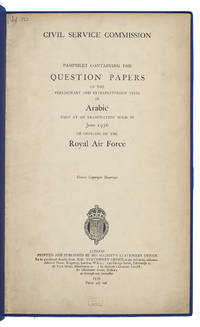
1936réf. ABC_46032London: printed and published at Her Majesty's Stationary Office 1936. Original publisher's printed paper wrappers in later blue paper wrappers. Folio. Printed in English and Arabic. British government publication of an interpretership examination for Arabic translation. It provides the examination questions that officers in the Royal Air Force had to answer correctly to pass as an interpreter of Arabic. The work contains several questions that include translating Arabic texts printed in Arabic type.Library stamp on foot of front cover title-page and pp. 8 and 9: "Liverpool Public Libraries". In good condition.l Consolidated List of Government Publications 1936 p.147; not in WorldCat. printed and published at Her Majesty's Stationary Office, unknown
1848réf. 90552Imprimerie Nationale | Paris 1848 | 13 x 21 cm | Relié
1893réf. 90856Imprimerie Nationale | Paris 1893 | 14 x 22.7 cm | Relié
réf. SONG0071768793Used: Good unknown
1885Very Good English Original dark green cloth bdg. Brief title and "Stirps Arabica Vicit" with a saber and crescent moon gilded on the front board. A very good copy. 4to. (30 x 24 cm). In English. 66 p., 5 engraved plates. First and only edition of this handsome and illustrated book of the first Arabian horses presented by Ottoman Sultan Abdulhamid II, bred by Huntington in North America. Arabian horse breeding in North America properly began with the world tour taken by General Ulysses S. Grant after he served as president of America, it is that in March of 1878 the General and his son Jesse arrived in Istanbul (Constantinople ), after the day the Grants toured the private stables of Sultan Abdul Hamid II are distinctly contradictory. Randolph Huntington was an American horse breeder who demonstrated the possibilities inherent in the Arab horse for the purpose of developing a new breed of saddle and road horses. During his first years on the farm, he bought and sold many colts and fillies as coach horses in New York City. He soon came to recognize the value of the Clay stock in that community which was largely the result of the breeding of a horse called Henry Clay which was brought to the nearby Genesee valley and whose stock was distributed through the valley. On May 31, 1879, there arrived in America two very fine stallions which were presented to General U.S. Grant by the Sultan of the Ottoman Empire. These stallions were named Leopard and Linden Tree. It is generally acknowledged that Linden Tree was a Barb-Arabian while Leopard was a pure Arabian. Prior to the time that these horses arrived in America, the very favorable results from inbreeding to produce typical Clay horses were shown to be practical. After seeing the stallions, Leopard and Linden Tree, Randolph Huntington at once started negotiations to breed three virgin Clay mares to each of these stallions. He hoped thereby to improve the road horse quality of his horses. In the following years, he called them Clay-Arabs. Since Huntington wanted to breed only virgin mares. Leopard was a Seglawi Jedran, desert-bred by the Anazeh, foaled in 1873 and presented by Jedaan Ibn Mheyd of the Fedaan Anazeh to the Turkish governor of Syria. (Some accounts list Ibn Mheyd as the breeder, while Carol Mulder, with typical caution, makes the distinction that we only know he presented the horse) The governor then presented the horse to Abdul Hamid II, who in turn gave him to General Grant.
1745réf. PHO-885Paris & Rouen , Nyon & Machuel ,1745. 8 volumes in-12 (170x100), plein veau époque , dos à nerfs avec pièces de titre et tomaison , tranches rouges , défauts d’usage (coiffes arasées , coins usés , reliures frottées , manque au dos Tome 7, etc) , Édition illustrée des portraits de l'auteur et de sa femme morte durant le voyage et 5 plans H.T. et une planche.
1836- Fisher, son, & co., London 1836, Pet. in-4 (21x28,5cm), 3 volumes reliés. - Edition originale, abondamment illustrée de 2 cartes et de 121 gravures sur acier par Bartlett, dont 3 titres gravés avec vignettes. Volume 1 : 38, Volume 2 : 37, Volume 3 : 46. Impression sur vélin teinté, planches sur velin fort. Plusieurs graveurs ont participé à la réalisation de cet ouvrage : Jorden, sand, finsbury, Higham, Finden... Cartonnage de l'éditeur réalisée en demi chagrin vert aux plats de percaline vert sapin gauffrés. Dos lisse orné d'une plaque spéciale avec divers ornements, une femme vêtue à l'orientale, un croissant et 2 chameaux. Plats repoussés d'une grande plaque décorative formée d'entrelacs de fruits et de fleurs, eux-mêmes composant 4 médaillons avec cavaliers, caravane, chameaux... et d'un grand fer central : une urne flanquée de 2 chameaux. Dos éclaircis uniformément. Traces de frottement sur les dos. Le long du mors supérieur du tome 2, manque de percaline sur 2,5cm. Coins repliés. Une tache blanchâtre sur le plat supérieur du tome 1 (un cercle de 8mn de diamètre). Des zones décolorées sur 2 plats. P.43 au tome 2, une déchirure en marge. Les 2 dernières planches du tome 2 avec trace de mouillure sur un coin. Ensemble frais mais quelques rousseurs sur les titres gravés, au dos de quelques planches et sur certaines planches, notamment à la fin du tome 2. Bel exemplaire. Ex-libris Bibliothèque Castletown dans le premier tome. Second ex-libris dans les 2 autres tomes : Thomas Conolly. Composé de 121 vues du Moyen-orient, scènes animées avec des personnages en costumes, on y voit des représentations de Damas, Jerusalem, Tripoli, Jaffa, Acre, Alexandrie, les temples, les antiquités, les rivières et les sites remarquables. Toutes les gravures sont finement exécutées et, bien que marquées par un souci réaliste et naturaliste, engendrent une perception romantique et exotique du monde arabe. [ENGLISH DESCRIPTION ON DEMAND]
1868réf. 90434E. Maillet Challamel | Paris 1868 | 14 x 22.5 cm | Relié
réf. 21270Paris Librairie de Firmin-Didot et Cie 1884 grand in 8 (29x21) 1 volume reliure plein chagrin marron orné de l'éditeur (Engel, d'après Souze), dos lisse orné, plats entiérement ornés d'un très fin décor géométrique orientaliste doré et argenté, tranches dorées, XV et 705 pages, avec de nombreuses illustrations dont 10 chromolithographies, 4 cartes et 366 gravures dont 70 grandes planches, quelques rares rousseurs éparses. Le milieu et la race (L'Arabie. Les Arabes. Les Arabes avant Mahomet); Les origines de la civilisation arabe (Mahomet, Naissance de l'empire Arabe; Le Coran; Les conquêtes des arabes); L'empire des Arabes (Les Arabes en Syrie; Les Arabes à Bagdad; Les Arabes enen Perse et dans l'Inde; Les Arabes en Égypte; Les Arabes dans l'Afrique Septentrionale; Les Arabes en Espagne; Les Arabes en Sicile, en Italie et en France; Luttes du christianisme contre l'islamisme, les croisades); Les moeurs et les institutions des Arabes (Les Arabes nomades et sédentaires des campagnes; Les Arabes des villes, moeurs et coutumes; Institutions politiques et sociales des Arabes; Les femmes en Orient; Religion et morale); La civilisation des Arabes (Origines des connaissances des Arabes, leur enseignement et leur méthode; Langue, philosophie, littérature et histoire; Mathématiques et astronomie; Sciences géographiques; Sciences physiques et leur applications; Sciences naturelles et médicales; Les arts Arabes; L'architecture Arabe; Commerce des Arabes, leurs relations avec divers peuples; La civilisation de l'Europe par les Arabes, leur influence en Occident et en Orient); La décadence de la civilisation arabe (les successeurs des Arabes, influence des européens en orient; Causes de la grandeur et de la décadence des Arabes, état actuel de l'islamisme). Très bel exemplaire ( Photographies sur demande / We can send pictures of this book on simple request )
1565In-folio, (8), 369pp, (1), legatura in pergamena coeva, titolo manoscritto al dorso; rilegato con Tractatus tres de balneis Patavinis e con Tractatus de modo componendi Medicinas, & de dosi earum, e Antidotarium. Medico di origine veneta morto nel 1460, esercitò a Padova anche come insegnante presso la locale e prestigiosa Università di medicina, dove dai documenti risulta professore dal 1422 al 1441. La sua opera Consilia, stampata nei primi decenni del secolo successivo, è molto conosciuta e apprezzata. Viene anche ricordato per l’attività di chirurgo ed esperto di anatomia: si dice che abbia eseguito personalmente quattordici dissezioni complete. Trattandosi di uno studioso quattrocentesco, i suoi interessi botanici sono strettamente legati alla sua attività di medico nella preparazione dei medicamenti che provenivano per la maggior parte dal mondo vegetale. Il prestigio dei Consilia durerà per alcuni secoli e molti saranno gli autori di medicina che attingeranno alle sue informazioni scientifiche e alla struttura del libro, organizzato sapientemente nella discussione di 305 casi clinici comprendenti tutta la materia medica conosciuta, chirurgia e anatomia comprese. In-folio, (8), 369pp, (1), contemporary vellum binding, handwritten title on the spine; bound with Tractatus tres de balneis Patavinis and with Tractatus de modo componendi Medicinas, & de dosi earum, and Antidotarium. Doctor of Venetian origin who died in 1460, he also practiced in Padua as a teacher at the local and prestigious University of Medicine, where the documents prove him as professor from 1422 to 1441. His work Consilia, printed in the first decades of the following century, is well known and appreciated. He is also remembered for his activity as a surgeon and anatomy expert: he is said to have personally performed fourteen complete dissections. Being a fifteenth-century scholar, his botanical interests are closely linked to his activity as a doctor in the preparation of medicines that mostly came from the plant world. The prestige of the Consilia will last for a few centuries and many medical authors will draw on its scientific information and on the structure of the book, expertly organized in the discussion of 305 clinical cases including all known materia medica, surgery and anatomy included.
réf. 28181Imprimerie de La République, An III. In-8 en demi-chagrin avec dos à nerfs et caractères dorés. Discours préliminaire de 22 pages puis 136 pages de la Grammaire Arabe de Volney avec tableaux et Proverbes Arabes. Les " Poésies d'Abd El-Kader, Ses Règlements Militaires " ont été reliés en fin d'ouvrage et comptent 68 pages,dont 60 en langue arabe. Demi-chagrin XIXème.Tableaux.Bon état.Qques piqûres.
1948réf. 356161948 Guise - Maslahat al-Misbaha al-Misriya - 1948 - 2 volumes in-folio - Reliure plein chagrin vert - Plats ornés de calligraphies arabes - coiffes, coins et coupes usées au premier volume - petites taches à quelques pages du tome 1 - Bon exemplaire -
1687In-4°, (24cc), 344pp, 32pp, buone condizioni, legatura in pergamena, prima edizione. Esempi di idiomi grammaticali arabi, presi da varie fonti, libro pubblicato per la prima volta a Padova nel 1687. Agapito dalla Val di Fiemme era un francescano ed un professore di arabo al seminario di Padova. In-4°, (24cc), 344pp, 32pp, good condition, vellum binding, first edition. Examples of Arabic grammatical idioms collected from various sources, first published at Padua in 1687. Agapitus a Valle Flemmarum was a Franciscan and professor of Arabic at the seminary in Padua.
1842Very Good English Original leather bdg. Folio. First 3 volumes of 5: ([xL], 688 p.; [xvi], 695 p.; 384 p.). Ibn Khallikan's biographical dictionary. [= Translated from the Arabic by Bn. (Baron) William Mac Guckin de Slane, (1801-1878). First 3 volumes of 5 volumes set. Muslim judge and author of a classic Arabic biographical dictionary. Ibn Khallikân studied in Irbîl, Aleppo, and Damascus. Ibn Khallikan was an assistant to the chief judge of Egypt until 1261, when he became qâ?î al-qu?ât (chief judge) of Damascus. He adhered to the Shâfi'î branch of Muslim law, and for the first years had deputy judges of the other three main branches. In 1271 he was dismissed. He taught in Cairo until he regained his judgeship and returned to Damascus in 1278. Ibn Khallikân's fame rests on his biographical dictionary Wafayât al-a'yân wa-anbâ' abnâ' az-zamaân ('Deaths of Eminent Men and History of the Sons of the Epoch'; trans. by Baron de Slane, Ibn Khallikan's Biographical Dictionary, 1842-74). He began arranging material for it in 1256 and worked on it until 1274, continuing to improve it with marginal notes. He excluded the Prophet Mu?ammad, the caliphs, and other subjects about whom adequate information already existed. Ibn Khallikân selected factual material for his biographies with intelligence and scholarship and rounded them out with poetry and anecdotes. His book is a valuable source for his contemporaries and contains excerpts from earlier biographies no longer extant. (Source: Encyclopediæ Britrannica).
1835- Madame Huzard, Paris 1835, 31x43cm, relié. - First edition and the first printing of the plates. Plate volume only. Bradel binding of marbled paper boards by T. Boichot, preserved covers repaired and laid down. This copy retains its 18 plates mounted on guards, but lacks the title page, showing details of the work undertaken to remove the western obelisk at Luxor, as well as various sites and costumes in Egypt linked to the places visited by the expedition. Tiny wormtracks occasionally affecting some engravings, dampstain to upper margin, traces of sewing to inner margin. Very rare. [FRENCH VERSION FOLLOWS] Edition originale et premier tirage des planches. Volume de planches seul. Reliure à la bradel en plein cartonnage recouvert de papier marbré, couverture restaurée et doublée conservée, reliure signée de T. Boichot. Exemplaire bien complet de ses 18 planches montées sur onglets, mais sans la page de titre, reproduisant les détails des travaux exécutés pour l'enlèvement de l'obélisque occidental de Luxor, et divers sites et costumes d'Egypte se rattachant aux lieux habités par l'expédition. Minuscules galeries de vers affectant parfois certaines gravures, une mouillure en marge supérieure, traces de couture en marge intérieure. Très rare.
2014réf. 111335Snoeck Publishers. New. Paperback. FREE UPGRADE to Courier/Priority Shipping Upon Request - IN STOCK AND IMMEDIATELY AVAILABLE FOR SHIPMENT - Flawless copy brand new pristine never opened - Text in French. -- with a bonus offer-- . 2014. 9461611765 . Snoeck Publishers paperback
réf. 70897Dover Publications. As New. Paperback. FREE UPGRADE to Courier/Priority Shipping Upon Request - IN STOCK AND IMMEDIATELY AVAILABLE FOR SHIPMENT - AS NEW THE TEXT BLOCK IS PRISTINE CLEAN UNMARKED AND IN EXCELLENT CONDITION - - ND Circa 1990 Appears unread. -- with a bonus offer--; 1 x 8.4 x 5.3 Inches . N.D. 0486203514 . Dover Publications paperback
réf. 37846New York: A. L. Burtt Company. As New. Hardcover. FREE UPGRADE to Courier/Priority Shipping Upon Request – – IN STOCK AND IMMEDIATELY AVAILABLE FOR SHIPMENT - Text clean unmarked. -- with a bonus offer--; T-Salegeo; Sale George translator Into English from the Original Arabic; with Explanatory Notes Selected By Frederic Mynon Cooper to Which is Prefixed a Life of Mohammed The Koran.with Explanatory Notes Selected By Frederic Mynon Cooper to Which is Prefixed a Life of Mohammed . A. L. Burtt Company hardcover
réf. 71236c.1880. . Albumen print. Four-part panorama very good tonal range and in good condition. [c.1880]. unknown
1882réf. 44882A. Lévy | Paris 1882 | 28 x 37 cm | reliure de l'éditeur
1882Very Good Turkish, Ottoman (1500-1928) Original Ottoman cloth bdg. Cr. 8vo. (20 x 14 cm). In Ottoman script (Old Turkish with Arabic letters). 293 p., 17 b/w plates and 1 folding map, and 1 folding linguistic table (including alphabets used in India such as Sanskrit, Brahmi, Devanagari and their pronunciations in Latin and Arabic alphabets). Slightly loosed spine, skillfully repaired a part of the spine, fading and chipped on the board's extremities, slight stains on the plates. Overall a good copy. Extremely rare (with a map and the plate at the end of the book) first edition of this eye-witness travel account of the Indo-Islamic culture during the British Raj in the late 19th century, by the Hamidian period Turkish ambassador and scholar Sirvanî (1831-1890), who had written and translated three geographical books as well. Sirvânî completed his travel memoirs on his return from India to Constantinople, where he was sent as an ambassador by Sultan Abdulhamid II between 1877-1879. The narrative of his journey begins with the landing in India from Constantinople by ferry. He describes the splendid and fascinating British Indian cities, regions, and buildings such as Bombay, Poona, Dakkan, Udaipur, Baroda, Ajmer, Jaipur, Amber Fortress, Allahabad, Benares, Calcutta, Jaipur, Lucknow, Agra, Alexandre, Delhi, Nepal, Racputana, Indor, Sind, Bundelkhand, Datia, Chatarpur, Bina, Mihr, Bihar, Bengal, Ceylon, Aligarh, Sirhind, Lahore, Kashmir, Dekkan, Orissa, Avrang, Bijapur, Malia, Khandesh, Gujarat, Hugli, Madras, Maisur, Jehlam, Sialkot, Rawalpindi, Nevshar, Mardan, Swat (now in Pakistan), Beloojistan, Peshawar, Afghanistan, Kabul, Ghazna, Kandahar, Herat, Badakhshan, etc. This first-hand travel account offers an invaluable insight into the customs of Indian peoples living in the region as well as the onomastics and ethnography of India and Afghanistan. He met Sayyid Ahmed Khan, who was the founder of the Aligarh University which was famous as the Aligarh School (founded in 1877) among the Indian people. The Aligarh Movement was the push to establish a modern system of education for the Muslim population of British India, during the later decades of the 19th century. The work includes a large chapter of Mecca, where Sirvânî stayed for a long time. He gives detailed information on the Islamic pilgrimage (Haj) and the Arabian Peninsula in this chapter. OCLC 19769728, 1030091889 (Six copies worldwide).; Ihsanoglu, pp. 269-270.; Özege 7654.; Karatay I, 268.; TBTK 1438.
réf. 365678Ottoman lands undated early 18th c. C.E. Ink on on aharli paper. Text in black and red ink 23 lines per page. 158 ff. 1 vols. 6 x 8 inches. Later red leather spine cloth boards. Old paper repairs throughout pencil page numbers in a European hand. Two ownership inscriptions dated A.H. 1128-1152 1716-1739 C.E. Very good. Ink on on aharli paper. Text in black and red ink 23 lines per page. 158 ff. 1 vols. 6 x 8 inches. An important compendium of Islamic jurisprudence in the Hanafi school by ʻAbd AllÄh ibn Aḥmad Nasafī d. A.H. 710 / 1310 C.E. It systematically presents authoritative Hanafi rulings without extended argumentation. The introduction highlights its purpose as a concise yet comprehensive reference. A foundational Hanafi legal text Kanz al-Daqâ'iq is an abridgment of the author's al-Wâfî widely studied in Ottoman madrasas. unknown
réf. 365678Ottoman lands undated early 18th c. C.E. Ink on on aharli paper. Text in black and red ink 23 lines per page. 158 ff. 1 vols. 6 x 8 inches. Later red leather spine cloth boards. Old paper repairs throughout pencil page numbers in a European hand. Two ownership inscriptions dated A.H. 1128-1152 1716-1739 C.E. Very good. Ink on on aharli paper. Text in black and red ink 23 lines per page. 158 ff. 1 vols. 6 x 8 inches. An important compendium of Islamic jurisprudence in the Hanafi school by ʻAbd AllÄh ibn Aḥmad Nasafī d. A.H. 710 / 1310 C.E. It systematically presents authoritative Hanafi rulings without extended argumentation. The introduction highlights its purpose as a concise yet comprehensive reference. A foundational Hanafi legal text Kanz al-Daqâ'iq is an abridgment of the author's al-Wâfî widely studied in Ottoman madrasas. unknown books