GOGUYER (A.).Livre Rare Book

3 792 résultats
1888réf. PHO-2060Beyrouth, Imprimerie des Belles-Lettres, 1888, in-8° (245x165mm), xx-353pp., demi chagrin et coin (moderne), couverture conservée, défaut à la couverture, 5 premiers feuillets renforcés en marge
réf. 657Ienae Apud Ioh. Felicem Bielckium 1717 ( E. O. ) 1 fort vol. in - 8 ( 21 x 13 cm ) ( poids : 1,6 kg ) Frontisp., T. , (6) ff. n. ch. , 1348 pp. , (23) ff. n. ch. , 160 pp. . En latin . En frontispice , portrait de Ch. Stockius gravé par Fritzsche ( " Fritzsche sc. Lips. " ) . Contient nombreuses dédicaces ( Serenissimo Principi ac Domino Gvil. Ernesto Dvci Saxonniae , Jvliae , Cliviae ... , Serenissimo Principi ac Domino Joh. Gvilielmo Dvci Saxonniae , Jvliae , Cliviae ..., Serenissimo Principi ac Domino Ernesto Ludovico Dvci Saxonniae , Jvliae , Cliviae ... , Serenissimo Principi ac Domino Friderico Dvci Saxonniae , Jvliae , Cliviae ... , Serenissimis Academiae Jenensis nvtritoribvs maximis .... , Serenissimi Principes ... ) , Benevoli lectori ... , et in fine , Index Latinorum interpretamentorum , Dictionarium breve chaldaeo-rabbinicum exhibens tum voces , qvae in Daniele Esra et Targumim occurunt... . Bandeaux . Plein vélin de l' époque . Dos lisse , nom de l' auteur et titre à l' encre . Toutes tranches bleu-vert . Bon état . Vélin plus ou moins sali . Papier uniformément jauni . Petites taches d' encre pp. 371 , 719 et 1022 . Qqs lignes soulignées p. 501 . P. 433 ch. 435 . P. 547 ch. 541 , p. 548 ch. 542 et ainsi de suite jusqu' à la p. 640 ch. 636 . P. 641 ch. 635 , p. 642 ch. 636 et ainsi de suite jusqu' à la p. 985 ch. 979 . P. 986 ch. 990 , p. 987 ch. 991 et ainsi de suite jusqu' à la fin ( p. 1344 ch. 1348 ) .
12 volumes, complete. FIRST AND ONLY EDITION (aside from recent reprints). A scarce and exhaustive bibliography of works relating to the Arab world. Despite the title, this work describes numerous items printed before 1810. Very thorough descriptions. 4to, original wraps. Minimal wear to wraps, otherwise uncut, unopened, bright, and fine. An excellent set.
1929Very Good Turkish Original manuscript color map of Middle East including Syria, Palestine and Transjordan. Signed by cartographer. 28x20 cm. In Turkish (with Latin letters). The Mapping Department, which moved to Ankara from Istanbul after the Independence War, settled in the Attar Basi Khan in Koyunpazari and the press section also started its studies in the building which is the Art School in Ulus today. In 1924, the department, which is still inside the General Directorate Garrison, moved to the hut-shaped buildings with single floor between the Military Sewinghouse and the General Directorate. On the other hand, the production of maps and plans, which were to be used in development services carried out in parallel to the revolutions starting with the declaration of the Republic and following each other, was considered to be based on a legal arrangement. Because of the necessity of an urgent legal arrangement, the bill of law concerning to the General Directorate of Mapping, whose preparations were initiated by Lieut. Gen. M. Sevki (Ölçer) who knew the importance of the subject, was sent to the Ministry of Defense at the beginning of 1925. After the approval of Ministry of Defense, the bill, which was sent to the Prime Ministry, was discussed in the Council of Ministers and presented to the Grand National Assembly of Turkey. As a result; the Mapping Department was re-organized as the General Directorate of Mapping affiliated with the Ministry of Defense with the law bearing the number 657 on May 2, 1925 in order to do all mapping works and meet the needs of maps and plans of all ministries, institutions and organizations. [.] The first application of photogrammetry was made in Kayas, Ankara with the Wild Autograph plotting apparatus which was purchased in that year. Captain Ömer Kadri and Captain Niyazi came back from their photogrammetry education in Germany. Major Halit and Major Nüzhet were sent to France for photogrammetry education and Captain Ishak and Captain Bahri were sent to Germany. Captain Ahmet (Denkmen) and Captain Ömer Kadri attended the Congress of Photogrammetry assembled in Berlin. (Source: The Illustrated History Of Turkish Cartography). Halid Ziya was born in Izmir, Tire. He went to Istanbul and continued to Hendese-i Mülkiye and Engineer Mekteb-i Âlîsi for seven years. After starting with "Aydin Province Umur-i Nafia Third Class Engineering", Halid Ziya Bey, who continued to work as a deputy chief engineer on 14 March 1910, left Aydin and returned to Istanbul after continuing this duty for about six and a half months. As a teacher, he taught Accounting, Algebra, Geometry, and Topography at Halkali Ziraat Mekteb-i Âlîsi and Darussafaka. Halid Ziya Bey, who was appointed as a teacher of Hendese and Cosmography in Kabatas High School, started to practice the profession of engineering and cadastral, which was his main specialty in 1327. After the First World War, the Istanbul Government started its activities in order to capture and neutralize Halid Ziya Bey and his friends. Upon the harsh measures taken, Halid Ziya Bey had to live as a fugitive in the Hasirci Mountains of Eskisehir for a while with the armed force attached to him. Halid Ziya Bey, who was involved in the movement in Anatolia until the end of the National Liberation Struggle, returned to his engineering duty after the proclamation of the Republic and was included in the cadastral works again. In 1925, Halid Ziya Bey was appointed as the Head of the Science Committee of the new cadastre organization. He wrote 5 books on cadastre, photogrammetry, trigonometry, and cadastral tools in 1928 and 1929. In addition, as a result of personal work in 1928, the road between the provincial division of the Republic of Turkey with cities has prepared a comprehensive map to show up in the forest and mining. (Source: Kadastro ne idi, nedir, ne olacaktir, Kadioglu - Yildirir. From Preface.). No scale.
1816Very Good English Original autograph letter signed (ALS) by Arbuthnot. Treasury Chambers, 20 May 1816. 24x18 cm. 2 p. Charles Arbuthnot, (1767- 1850), diplomat and Tory politician. He was Ambassador to the Ottoman Empire between 1804 and 1807 and held a number of political offices. He was a good friend of the Duke of Wellington. His second wife, Harriet, became a hostess at Wellington's society dinners, and wrote an important diary cataloging contemporary political intrigues. Arbuthnot also held a number of diplomatic postings, notably as consul general in Portugal between 1800 and 1801, as Minister to Sweden. He was appointed on 6 June 1804 as Ambassador to the Ottoman Empire and left Constantinople on 29 January 1807. In 1804 he was sworn of the Privy Council.
1946Very Good Turkish Paperback. Demy 8vo. (22 x 14 cm). In Turkish. 111, [2] p., 6 numerous b/w plates and 1 plan. A few important works were written on zoology, and in particular horse breeding in the early Republic of Turkey. These books were generally publications that argued that Turkish peasants should be a pioneer in horse breeding in the Anatolian aspect and that the government should support it in economic and social terms. This book was written extensively by Düzgünes, who studied zoology in the USA between 1950-1957. He took lessons from the American professors of his period (M. Lerner, J. Lush et al.) And published his research studies in the field of Poultry Breeding in the A-class science journal (American Poultry Science). Düzgünes, the author of books in the field of Statistics, Genetics, and Animal Breeding, translated the books of his professors in the USA into Turkish and introduced many technical terms related to his subject to Turkish. This book includes six black and white plates showing Turkish horse species and internal organs with a plan showing how to put four mares and a foal in the barn. Very scarce. Not in OCLC.; Turkish National Library 000029336.
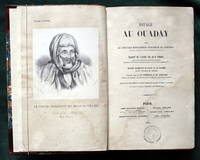
réf. 000903Hardcover. Good. Benjamin Duprat and others Paris 1851 first edition; large 8vo 170 x 240mm; pp lxxv 756 plus title to the plates section list of plates and the plates themselves together with a large folding map linen-backed of the area and dated 1845; the engraved plates with one exception are double page; the list calls for a total of ten plates including the portrait of the author and the folding map but one plate the first section of the double plate V is missing this featuring small items such as a stretcher a horse decoration and more; half brown morocco marbled sides skilfully rebacked with the original spine laid down and with appropriate new end papers; part of the marbled sides of the front cover scuffed; the early pages to about xv show the effects of some old wetting in the form of browning and with one page very skilfully repaired none with any loss of text or margins; neat small circular library stamps on the title and occasionally elsewhere including on the backs of the plates; occasional underlinings or brief notes in light pencil in the margins; overall a book in good condition generally clean and firm and not greatly affected by the matters mentioned; scarce in its original form as here. . . . Ouadây aka as Ouaddaï or Wadai is an area a former Sultanate in the east of Lake Chad and the border with Sudan. The Wadai Empire or Sultanate known locally as Burgu or Birgu emerged in the 17th century through conquest of the ruling Tunjur people of the area displacing them from the lands of the Sultanate of Darfur. It was overthrown by France in 1909/1912 and reconstituted under France in 1935. When Chad became independent in 1960 it became part of that new state. Its capital is Abéché. See Wikipedia for more detail. hardcover
1995réf. x-075070487XFalmer Pr 1995. Hardcover. New. 1st edition. 297 pages. 9.75x6.50x1.00 inches. Falmer Pr hardcover
1838réf. 40347Crochard & Cie | Paris 1838 | 13 x 21.50 cm | relié
réf. 45679Paris Librairie de L. Hachette et Cie 1855 in 18 (13x8) 1 volume reliure cartonnée imprimée de l'éditeur, 61 pages [1], des rousseurs sur les premières et sur les dernières pages. Général Eugène Daumas, ex-colonel de Spahis, ex-directeur central des affaires arabes à Alger. Troisième édition. Bon exemplaire
1809réf. 25323Imprimerie Impériale | Paris 1809-1829 | 53.50 x 70.50 cm | une feuille
1809réf. 26101Imprimerie Impériale | Paris 1809-1829 | 71 x 53.50 cm | une feuille
1809réf. 26072Imprimerie Impériale | Paris 1809-1829 | 71 x 53.50 cm | une feuille
1809réf. 32854Imprimerie Impériale | Paris 1809-1829 | 71 x 53.50 cm | une feuille
1954réf. 87236Plon | Paris 1954 | 13.50 x 20 cm | broché
1809réf. 25937Imprimerie Impériale | Paris 1809-1829 | 71 x 54 cm | une feuille
1892réf. 0043551892 Paris, Calmann Lévy, 1892. Grand in-8 (199 X 280 mm) percaline bleue de l’éditeur reliée à la Bradel, premier plat illustré d’une plaque polychrome de Paul Souze avec l’auteur et le titre dorés, dos lisse orné d’un dessin polychrome, auteur et titre dorés, tranches dorées (Engel Rel.) ; XXIII-483 pages, 2 cartes dépliantes, (1) f. de table, (1) f. blanc. Petites taches d'encre noire au cartonnage, rousseurs aux premiers et derniers feuillets, sinon corps d'ouvrage frais.
1809réf. 25320Imprimerie Impériale | Paris 1809-1829 | 70.50 x 53.50 cm | une feuille
1983réf. BN100032Wiesbaden : Harrassowitz 1983. 1983. Ergebnisse der Ausgrabungen auf der Hirbet el-M¨a¨ Tel Masos 1972-1975 - 3 Bände komplett Volkmar Fritz und Aharon Kempinski Abhandlungen des Deutschen Palästinavereins Ergebnisse der Ausgrabungen auf der Hirbet el-M¨a¨ Tel Masos 1972-1975 - 3 Bände komplett Volkmar Fritz und Aharon Kempinski Abhandlungen des Deutschen Palästinavereins Wiesbaden : Harrassowitz unknown
1839AN ABSOLUTELY OUTSTANDING COPY OF THE FIRST AND ONLY EDITION OF THIS EXTREMELY EARLY AND IMPORTANT EXPLICATION OF THE KORAN. 3 leaves; 192 pp + 43 pp Arabic text starting from the back of the book, with a separate title-page. A LARGE-PAPER COPY, BEAUTIFULLY PRINTED WITH HUGE MARGINS ON EXTREMELY FINE, THICK LAID PAPER. 4to. Original paper wraps. ENTIRELY UNCUT, FINE AND BRIGHT, LIKE NEW. Chauvin (X, 70) gives a long notice of this extremely important publication.
1846A PRISTINE LARGE-PAPER COPY OF THE FIRST AND ONLY EDITION. XII, 168 pp. + addenda leaf (often missing, but present here). An introduction to the Chronicon Samaritanum or Liber Josuae. A LARGE-PAPER COPY, beautifully printed (in Latin, with some Hebrew types) with huge margins on extremely fine, thick laid paper (this copy about twice as thick as normal copies). Large 4to. Original unprinted wraps. Uncut and unopened. Some wear and tear to wraps, INTERNALLY FINE AND BRIGHT, COMPLETELY FRESH, LIKE NEW.
1967Complet en 3 volumes, I: 453pp., II: xlviii + 104 + 408pp., III: 255 + 208pp., contenant plusieurs textes en arabe et en syriaque, Réimpression de l'édition 1893, 26cm., reliures d'éditeur en toile avec titre doré (qqs.rousseurs), texte et intérieur frais, bon état, peu commun, poids: 3.5kg., [CONTENU détaillé: I: Essai sur la transmission de la science antique au moyen age. Doctrines et pratiques chimiques, Traditions techniques et traductions arabico-latines avec la publication nouvelle du "Liber Ignium" de Marcus Graecus et impression originale du "Liber Sacerdotum", avec 25 figures d'appareils, table analytique et index // II: L'alchimie syriaque comprenant une introduction et plusieurs traités d'alchimie syriaques et arabes d'après les manuscrits du British Museum et de Cambridge. Texte et traduction avec notes, commentaires, reproduction des signes et des figures d'appareils, table analytique et index // III: L'alchimie arabe, comprenant un introduction historique et les traités de Cratès, d'El-Habib, d'Ostanès et de Djaber, tirés des manuscrits de Paris et de Leyde. Texte et traduction, notes, figures, table analytique et index], W102954
1828réf. 109061828 Paris, Firmin-Didot Frères, 1828-1829; 2 tomes reliés en 1 volume in-4°, demi-basane fauve de l'époque, dos lisse orné de jeux de filets gras et maigres dorés et de fleurons dorés, titre doré; VII - 461pp. ; (4) - 435pp. Texte sur 2 colonnes.
1809réf. 25939Imprimerie Impériale | Paris 1809-1829 | 71 x 54 cm | une feuille
1809réf. 25832Imprimerie Impériale | Paris 1809-1829 | 71 x 54 cm | une feuille