4 142 résultats
réf. DADAX0812240871New unknown
réf. DADAX0860785556New unknown
réf. DADAX0860784355New unknown
réf. DADAX087840273XNew unknown
réf. DADAX0878403868New unknown
réf. DADAX0878407898New unknown
réf. DADAX0915957760New unknown
réf. DADAX0415079977New unknown
réf. DADAX0521293014New unknown
réf. DADAX0521635586New unknown
réf. DADAX0710304978New unknown
réf. DADAX0710305036New unknown
réf. DADAX1589017374New unknown
réf. SONG0198151500Used: Good unknown
réf. SONG0521777712Used: Good unknown
réf. SONG1589017374Used: Good unknown
réf. SONG1593338589Used: Good unknown
réf. SONG9774163524Used: Good unknown
réf. SONG0748635580Used: Good unknown
réf. SONG0521272963Used: Good unknown
réf. SONG9774162242Used: Good unknown
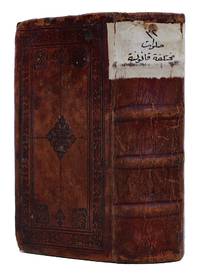
réf. 66237Khenchara Lebanon: Monastery of St John the Baptist 1787. 8vo. 17 x 10 cm. pp. x735. Contemporary russet morocco binding floral decoration stamped in blind on back and front spine with raised bands manuscript title-label in Arabic stuck to the top of the spine. A number of small engravings including one of the nativity head- and tail-pieces. Edges and corners rubbed small area of water damage to back board; internally there is some occasional light water-staining and foxing. Generally very good. This is the second impression of a Horologion printed in Arabic at the press established in 1734 at the Monastery of St John the Baptist in Khenchara by Abdallah Zakhir. It contains the breviary hymns and prayers for the Byzantine rite printed in black and red Arabic script. Khenchara, Lebanon: Monastery of St John the Baptist, 1787. hardcover
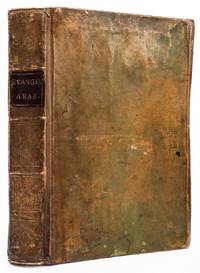
réf. 63499Romae Rome: Ex Typographia Medicea 1619. Folio 33.5x21 cm. pp. 4 9-462 2 with at recto the printer's letter repeated with the date of the 1591 original edition blank at verso. Contemporary green vellum spine with raised bands and gilt-decorated compartments red Morocco label marbled endpapers edges dyed red. Title printed in red and black with Medici's woodcut coat-of-arms printer's advice "Typographus lectori". With 149 text woodcuts by Leonardo Parassole c.1570-c.1630 after Antonio Tempesta 1555-1630 their monograms appearing on a number of the illustrations. The woodcuts are remarkable examples of Tempesta's work notable for their clarity of composition and their didactic narrative of the episodes depicted. Ex libris Luigi Bossi Milan 1758-1835 with his engraved heraldic bookplate to front pastedown along with T. Fenteman & Sons Leeds booksellers label to upper corner. Title-page lightly browned boards faded and discoloured some occasional light toning generally a very good copy printed on thick paper the woodcuts in strong impressions throughout. Rare 1619 reissue or of the original 1591 stock of the Arabic Medicean Gospels. The text lines are almost identical with those of the Arabic issue but now have an interlinear Latin version added which was prepared by Antonius Sionita. In 1584 the last year of the papacy of Gregory XIII who had constantly endeavoured to effect a union between the Church of Rome and the eastern Christians Cardinal Ferdinando de' Medici the brother and later the successor of the Grand Duke of Tuscany founded a printing press in Rome with a vast selection of oriental types cut by the French typographer Robert Granjon. Run by a versatile orientalist Giovan Battista Raimondi the press had various aims. One was to produce propaganda which would attract the eastern Christians to Roman Catholicism. Another was to corner the publishing market in an area where typography was prohibited and to make a financial profit from the sale in the east of books printed in Arabic. The third aim was to further European knowledge and to provide good editions of Arabic versions of certain standard non-religious texts. These included the writings of Avicenna al-Idrisi's geographical compendium al-Tusi's adaptation of Euclid's text on geometry and various works on Arabic grammar and syntax. The first major publication was the 1591 edition of the Gospels. This copy has an interlinear Latin translation but the work was also issued solely in Arabic. It contains 149 fine woodcut illustrations made by Leonardo Parasole mainly after designs by one of the best known Florentine artists of his day Antonio Tempesta who owed much of his fame to the frescoes he painted in the Vatican and in a number of Roman palaces. The woodcut in the Gospel of St Mark of the presentation of the head of John the Baptist to Salome Mark 6:28 by a man in Turkish dress reminds us of the common association between the great enemy of Christendom in the sixteenth century and the ancient heathens. The Arabic text is printed in Robert Granjon's famous large fount generally considered the first satisfactory Arabic printing type; as all early printed editions of the Arabic Gospels it is based on the Alexandrian Vulgate cf. Darlow/M. 1636. The Latin version is by Leonardo Sionita. The work begins with page 9 without a title-page or any preliminary matter at all: "the intended prefatory matter was apparently never published" Darlow/M. Darlow & Moule 1637 & 1643; Schnurrer Bibliotheca arabica 318; Brunet II 1122-23; Graesse II 531 Romae [Rome]: Ex Typographia Medicea, 1619. hardcover
réf. DADAX9004191534New unknown
réf. SONG1647121868Used: Good unknown