3793 risultati
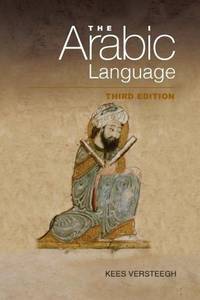
1995rif. x-075070487XFalmer Pr 1995. Hardcover. New. 1st edition. 297 pages. 9.75x6.50x1.00 inches. Falmer Pr hardcover
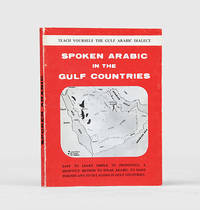
1971rif. 171721al-Khobar: The International Publications Industries 1971. Keep the following in mind and everything will be easy Fourth printing of this institutionally rare phrasebook which adopts "a short cut method simple and easy enough for a businessman to teach himself the spoken Arabic while relaxing in the Aircraft or in his Hotel room. Many of the oil industry people in Arabia owe their local friendship to this book". Arranged by topic the book has sections on greetings shopping food and drink and other practicalities such as taking one's car to a mechanic. The unnamed author places a premium on language as a key to understanding local culture: "you will find the Gulf Arabs intensely loyal to their friends as well as to their families. Most of them are blessed with a keen sense of humor. For these and other reasons such as their hospitality and courtesy you will enjoy getting acquainted with them". Further sections discuss the etiquette of being a guest at a traditional wedding and how to behave if invited to a private house as a guest. WorldCat lists only four copies in institutions Oxford National Library of Wales National Library of Israel Bilkent University. Small octavo 115 x 117 mm. Wire stitched in the original printed wrappers spine lettered in black. Minor wear to wrappers contents lightly toned not affecting text. A very good copy. unknown
rif. A9780359654222Paperback / softback. New. paperback
1990rif. 13327Le Caire: Institut français d'archéologie orientale 1990. Broché. Etat satisfaisant. in-4. Pages 326-645. Etudes urbaines T. I/2 1990. Rencontre d'Aix-en-Provence 6-8 juin 1984. Jaquette piquée. Institut français d'archéologie orientale unknown
rif. 52108117-nnew. unknown
rif. 52108118like new. unknown
rif. 19137897-nnew. unknown
1991rif. 103758Fondationdu Roi Abdul-Aziz/Institut du Monde Arabe 1991. paperback. Bueno. París 1991. Fondationdu Roi Abdul-Aziz/Institut du Monde Arabe. Rústica. 457 FRANCÉS 135 ÃRABE pp. 27x21. Fondationdu Roi Abdul-Aziz/Institut du Monde Arabe paperback
1991rif. 97500Fondationdu Roi Abdul-Aziz/Institut du Monde Arabe 1991. paperback. Bueno. París 1991. Fondationdu Roi Abdul-Aziz/Institut du Monde Arabe. Rústica. 457 FRANCÉS 135 ÃRABE pp. 27x21. Fondationdu Roi Abdul-Aziz/Institut du Monde Arabe paperback
rif. ria9781399542708_inpPaperback / softback. New. New Book; Fast Shipping from UK; Not signed; Not First Edition; This is the third edition fully revised and updated of this indispensable introduction to Arabic linguistics. paperback
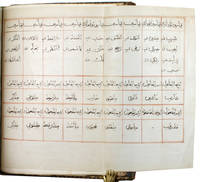
1830rif. ABC_483971830. Contemporary navy blue morocco with the title lettered in gold on spine marbled endpapers. 4to 21.5 x 27 cm. With 2 folding tables 17 lines to the page written in red and black ink. A unique handwritten vocabulary and phrasebook of English and Arabic from the first half of the 19th century. This meticulously prepared manuscript is written in the fashion of a printed book opening with a title page and ending with an index of topics. It is divided into four main sections: nouns adjectives verbs and example sentences. The vocabulary especially in the nouns section is arranged by subjects which include such interesting headings as "Druggist" "Painter" "Merchant" "Cities" "the Bride's Paraphernalia" "Precious Jewels" "War" "The Church" "Clerical Vestments" "Ecclesiastical Degrees & Kinds of Sin" "Festivals" and "Monks their prayers and their dress". Presumably the dictionary was created to help a traveller or merchant who may have had an association with the Church. The final section offers an interesting selection of phrases and sheds some light on the experience of foreign language learning in the early 19th century. The phrases are a mixture of sentences that would be useful in daily life and such as would be included to practice the words from the vocabulary. Examples include: "We roasted a lamb and ate the whole of it and drank wine with it"; "I descended from above with the youth my enemy"; "I shot the bear in the water and he sank"; and "Why dost thou scratch thy head and spit in fire". As a cheat sheet for Arabic grammar the author includes two folding tables of Arabic verb tenses and conjugations. Overall a curious example of a 19th-century Arabic vocabulary and phrasebook.With a presentation note in English indicating it was a Christmas gift in 1881 presented by G. W. Bernard Esq. Binding and spine worn some browning and staining throughout. Otherwise in good condition. unknown
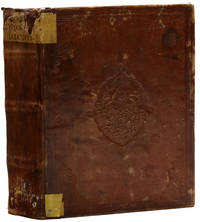
1770rif. ABC_48344Probably Egypt 1770. Near-contemporary brown leather with a blind-stamped oriental rosette as a center piece and similar style corner pieces on both boards a partial manuscript title label on the spine. 4to ca. 17 x 22 cm. Arabic and Italian manuscript on paper 19 lines per extensum paginated throughout from right to left. Manuscript dictionary comprising some 9000 Arabic terms and their Italian translations. It was formerly owned by the German oriental scholar and Franciscan priest Arsenius Rehm 1738-1808 who lived in Cairo between 1769 and 1776 building a large collection of manuscripts which he brought with him when he worked for some time at the Franciscan abbey of Frauenberg at Fulda Hesse. After his death his collection remained at the monastery until it was purchased by the Benedictine Abbey of St Boniface Munich in 1852. The present volume which had not been part of the collection proper remained in Frauenberg whose library was dispersed in 2021 by the Franciscan Province. "The library includes a fairly extensive Arabic dictionary of his though not written by him. It offers only the Italian translation of the Arabic words. In the Arabic style it begins from our perspective at the end" cf. Bihl.With old stamps of the Frauenberg Abbey library on the final leaf with attribution to Arsenius Rehm in indelible pencil ca. 1900. The binding is somewhat rubbed and scuffed; remains of old spine labels. Interior shows only occasional light staining; very well preserved.l Michael Bihl Geschichte des Franziskanerklosters Frauenberg Fulda 1907 p. 137. hardcover
1855rif. ABC_47909London: William Watts 1855. Original elaborately embossed brown calf with the title lettered in gold on the spine red edges. 8vo 22 x 14 cm. Rare edition of one of the best Arabic translations of the Bible. This work is based on the 1671 version from Rome which was the first printed edition of the complete Bible in Arabic. However the version from 1671 was not vocalised written with vowel points but the present edition from London is.The Arabic translation of the Bible from 1671 was done under the direction of Sergius Risi d. 1638 the archbischop of Damascus. It had been requested by the Archbischop of Aleppo and other important figures from the Eastern Church as manuscript copies had become rare and were often found to be incorrect. Risi and his team compared the Arabic manuscripts of the Bible they had access to with Hebrew and Latin versions and then composed their own translation. They first completed the Arabic Pentateuch. The Old and New Testament followed in 1647 and 1650 respectively after Risi's passing. These translations were revised and then finally published in 1671. It was the only Arabic translation of the complete Bible until 1811. Numerous new translations were made in 19th century. The present Catholic edition of the Arabic Bible translation existed alongside the 1860 Protestant translation by Cornelius van Alen van Dyck.According to the title-page this edition of the Old Testament was printed in 1855. However none of the relevant reference works mention an 1855 edition. Since the title-page of the New Testament bears the year 1857 it is possible that the Old Testament was also printed in that year and the date on the title-page is a printing mistake. The 1857 edition is also fairly rare on the market as we have only been able to find it in 1 sales record of the past 100 years.With the label of Watkins' bookbinding factory mounted on the front pastedown and a purple Spanish stamp from the library of someone with a law degree on the final leaf. The edges and corners of the boards are somewhat scuffed the binding is rubbed with some loss of material on the spine. The leaves are somewhat browned mild foxing throughout the back pastedown has a tear in the gutter. Otherwise in good condition.l BM General catalogue vol 2 p. 1276-198/199 other eds.; Darlow & Moule 1684; WorldCat 1402269394 1 copy 1857 ed.; cf. Green Journeymen middlemen: travel transculture and technology in the origins of Muslim printing. In: International journal of Middle East studies vol. 41 2 2009 pp. 203-224. William Watts, unknown
1992rif. 544178Austin: W. Thomas Taylor 1992. Softcover. Fine. First edition. Tied flexible pale red paper over flexible boards. One of 100 copies. Fine. Translated from Spanish versions of the original Arabic. An attractive volume. W. Thomas Taylor unknown
rif. DADAX0359651631Lulu 2014-06-25. null. hardcover. New. 6.00x1.44x9.00. Buy with confidence. Excellent Customer Service & Return policy. Lulu hardcover
rif. SONG0359654223Lulu 2019-05-11. null. paperback. Used: Good. 5.99x1.73x9.02. Buy with confidence. Excellent Customer Service & Return policy. Lulu paperback
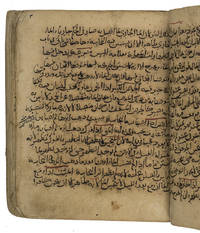
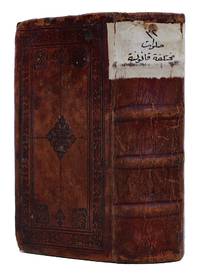
rif. ABC_45853Levant 1290. Contemporary blind-tooled calf mostly covered with later calf leaving only the contemporary back cover exposed. 19th century European paper endpapers. With a loose leaf of 18th century European paper with Arabic manuscript writing on one side. Small 4to in 6s 17 x 14 cm. Arabic manuscript 15 to 17 lines to the page written in clear cursive ta'liq script on brown Middle Eastern paper. With occasional red rubrication. Lengthy and well preserved 13th century Arabic manuscript law book on the fatwa produced in the Levant by an anonymous author. A fatwa is legal advice given by a Muslim authority on request with the purpose of resolving a religious or legal problem that has arisen among members of Islam. The person who gives the legal information is familiar with Islamic jurisprudence fiqh and is referred to as a mufti; the one who asks for legal advice is called Mustafti. According to the famed 13th-century Islamic jurist Ibn al-Qaayyim al-Jawziya mufti were Gods agents". The present anonymous work seems to treat the jurisprudence of the fatwa itself rather than declaring fatwa on something. The title means "The book of kitab analisys or understanding al-waaqi of the fatwa fi'l-Fatawi". As described in the book itself this is the first volume of an unknown total.Fatwas were produced by jurists from the 10th century onward and in the 13th century when the present copy was made several important Islamic lawbooks were compiled in India at the Sultanate of Delhi.Provenance: 1963 Elghanyan to Hagop Kevorkian 1872-1962; sold at Sotheby's 18 April 1983 Kevorkian collection lot 25; private collector.Binding a bit short. Shelf marks on the front pastedown. Later annotations on the 19th century front endpapers. First leaf repaired. A few minor holes throughout paper browned 2 quires in the middle detached. Otherwise in remarkably good condition for its age.l Schoenberg Database: 29775. unknown
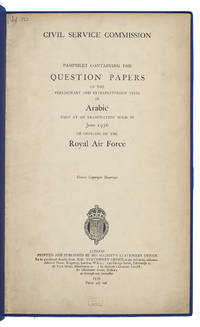
1936rif. ABC_46032London: printed and published at Her Majesty's Stationary Office 1936. Original publisher's printed paper wrappers in later blue paper wrappers. Folio. Printed in English and Arabic. British government publication of an interpretership examination for Arabic translation. It provides the examination questions that officers in the Royal Air Force had to answer correctly to pass as an interpreter of Arabic. The work contains several questions that include translating Arabic texts printed in Arabic type.Library stamp on foot of front cover title-page and pp. 8 and 9: "Liverpool Public Libraries". In good condition.l Consolidated List of Government Publications 1936 p.147; not in WorldCat. printed and published at Her Majesty's Stationary Office, unknown
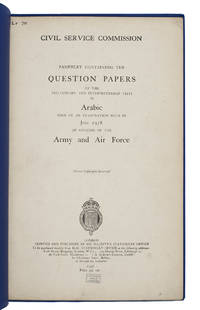
1938rif. ABC_46033London: printed and published at Her Majesty's Stationary Office 1938. Original publisher's printed paper wrappers in later blue paper wrappers. Folio. Printed in English and Arabic. British government publication of an interpretership examination for Arabic translation. It provides the examination questions that officers in the Army and Air Force had to answer correctly to pass as an interpreter of Arabic. The work contains several questions that include translating Arabic texts printed in Arabic type.Library stamp on foot of front cover title-page and pp. 8 and 9: "Liverpool Public Libraries". In good condition.l Consolidated List of Government Publications 1936 p.147; WorldCat 1 copy: British Library. printed and published at Her Majesty's Stationary Office, unknown
rif. 14676Late 19th or early 20th century Koummya Arabic dagger with cast brass scabbard. The scabbard has silver engraved motifs and metal accents. The dagger measures 18" along the curve and has a hand carved wood handle with brass encasement rounding the hilt. The blade is curved sharp and slides securely into the sheath. It shows use but no damage. In good condition. unknown
2013rif. 000802New York: Random House. Light edgewear to slipcase. Vols are clean crisp tight as new. . As New. Soft cover. 2013. Random House paperback
rif. 66237Khenchara Lebanon: Monastery of St John the Baptist 1787. 8vo. 17 x 10 cm. pp. x735. Contemporary russet morocco binding floral decoration stamped in blind on back and front spine with raised bands manuscript title-label in Arabic stuck to the top of the spine. A number of small engravings including one of the nativity head- and tail-pieces. Edges and corners rubbed small area of water damage to back board; internally there is some occasional light water-staining and foxing. Generally very good. This is the second impression of a Horologion printed in Arabic at the press established in 1734 at the Monastery of St John the Baptist in Khenchara by Abdallah Zakhir. It contains the breviary hymns and prayers for the Byzantine rite printed in black and red Arabic script. Khenchara, Lebanon: Monastery of St John the Baptist, 1787. hardcover
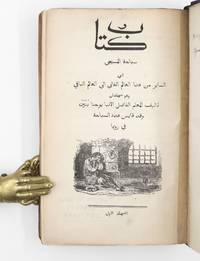
1834rif. 372732Malta: press of the Anglican Church Missionary Society 1834. First edition in Arabic. Title vignette of Bunyan in prison 7 plates captioned in Arabic. 6 281 1 imprint 2 blank pp. 1 vols. 8vo in 6s. Original silky cloth over boards twentieth-century binder's cloth spine. Joints crudely rehinged title leaf reinforced at gutter; binding cracked and a few leaves loosened. Contemporary presentation inscription on pastedown. Very good internally fine. First edition in Arabic. Title vignette of Bunyan in prison 7 plates captioned in Arabic. 6 281 1 imprint 2 blank pp. 1 vols. 8vo in 6s. Bunyan's Pilgrim's Progress translated into Arabic with a life of the author by Christoph Friedrich Schlienz. From the title page this is nominally the first volume but press marks are continuous and the text is complete: the end part twentieth sees the Pilgrim reach the Celestial City. Printed at Malta by the Anglican missionaries. William R. Whittingham 1805-1879 graduated the General Theological Seminary in 1825 and was named librarian of the newly founded school. He later accepted a position on the faculty in 1836. Whittingham was consecrated the fourth Bishop of Maryland in 1840 and served in that capacity until his death. This copy with his contemporary gift inscription to the GTS library "From the Rev. W.R. Whittingham 1834" RARE FIRST EDIITION IN ARABIC of a classic of English literature and of Christian devotion. Roper Arabic printing in Malta 1825-1845 56. OCLC: 57188645 Columbia Glasgow Tübingen 643954559 Manchester. Provenance: William R. Whittingham gif tinscription 1834; General Theological Seminary bookplates and inkstamps press of the Anglican Church Missionary Society unknown
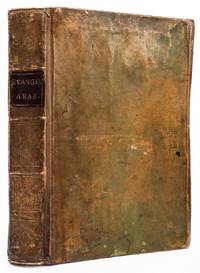
rif. 63499Romae Rome: Ex Typographia Medicea 1619. Folio 33.5x21 cm. pp. 4 9-462 2 with at recto the printer's letter repeated with the date of the 1591 original edition blank at verso. Contemporary green vellum spine with raised bands and gilt-decorated compartments red Morocco label marbled endpapers edges dyed red. Title printed in red and black with Medici's woodcut coat-of-arms printer's advice "Typographus lectori". With 149 text woodcuts by Leonardo Parassole c.1570-c.1630 after Antonio Tempesta 1555-1630 their monograms appearing on a number of the illustrations. The woodcuts are remarkable examples of Tempesta's work notable for their clarity of composition and their didactic narrative of the episodes depicted. Ex libris Luigi Bossi Milan 1758-1835 with his engraved heraldic bookplate to front pastedown along with T. Fenteman & Sons Leeds booksellers label to upper corner. Title-page lightly browned boards faded and discoloured some occasional light toning generally a very good copy printed on thick paper the woodcuts in strong impressions throughout. Rare 1619 reissue or of the original 1591 stock of the Arabic Medicean Gospels. The text lines are almost identical with those of the Arabic issue but now have an interlinear Latin version added which was prepared by Antonius Sionita. In 1584 the last year of the papacy of Gregory XIII who had constantly endeavoured to effect a union between the Church of Rome and the eastern Christians Cardinal Ferdinando de' Medici the brother and later the successor of the Grand Duke of Tuscany founded a printing press in Rome with a vast selection of oriental types cut by the French typographer Robert Granjon. Run by a versatile orientalist Giovan Battista Raimondi the press had various aims. One was to produce propaganda which would attract the eastern Christians to Roman Catholicism. Another was to corner the publishing market in an area where typography was prohibited and to make a financial profit from the sale in the east of books printed in Arabic. The third aim was to further European knowledge and to provide good editions of Arabic versions of certain standard non-religious texts. These included the writings of Avicenna al-Idrisi's geographical compendium al-Tusi's adaptation of Euclid's text on geometry and various works on Arabic grammar and syntax. The first major publication was the 1591 edition of the Gospels. This copy has an interlinear Latin translation but the work was also issued solely in Arabic. It contains 149 fine woodcut illustrations made by Leonardo Parasole mainly after designs by one of the best known Florentine artists of his day Antonio Tempesta who owed much of his fame to the frescoes he painted in the Vatican and in a number of Roman palaces. The woodcut in the Gospel of St Mark of the presentation of the head of John the Baptist to Salome Mark 6:28 by a man in Turkish dress reminds us of the common association between the great enemy of Christendom in the sixteenth century and the ancient heathens. The Arabic text is printed in Robert Granjon's famous large fount generally considered the first satisfactory Arabic printing type; as all early printed editions of the Arabic Gospels it is based on the Alexandrian Vulgate cf. Darlow/M. 1636. The Latin version is by Leonardo Sionita. The work begins with page 9 without a title-page or any preliminary matter at all: "the intended prefatory matter was apparently never published" Darlow/M. Darlow & Moule 1637 & 1643; Schnurrer Bibliotheca arabica 318; Brunet II 1122-23; Graesse II 531 Romae [Rome]: Ex Typographia Medicea, 1619. hardcover
rif. 365678Ottoman lands undated early 18th c. C.E. Ink on on aharli paper. Text in black and red ink 23 lines per page. 158 ff. 1 vols. 6 x 8 inches. Later red leather spine cloth boards. Old paper repairs throughout pencil page numbers in a European hand. Two ownership inscriptions dated A.H. 1128-1152 1716-1739 C.E. Very good. Ink on on aharli paper. Text in black and red ink 23 lines per page. 158 ff. 1 vols. 6 x 8 inches. An important compendium of Islamic jurisprudence in the Hanafi school by ʻAbd AllÄh ibn Aḥmad Nasafī d. A.H. 710 / 1310 C.E. It systematically presents authoritative Hanafi rulings without extended argumentation. The introduction highlights its purpose as a concise yet comprehensive reference. A foundational Hanafi legal text Kanz al-Daqâ'iq is an abridgment of the author's al-Wâfî widely studied in Ottoman madrasas. unknown