[GREAT BRITAIN - ARABIC].Biblio.com
3804 resultados
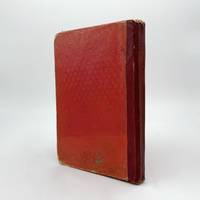
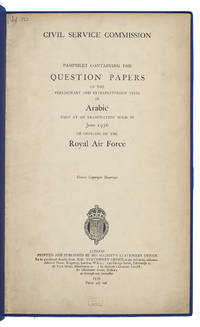
1936ref. ABC_46032London: printed and published at Her Majesty's Stationary Office 1936. Original publisher's printed paper wrappers in later blue paper wrappers. Folio. Printed in English and Arabic. British government publication of an interpretership examination for Arabic translation. It provides the examination questions that officers in the Royal Air Force had to answer correctly to pass as an interpreter of Arabic. The work contains several questions that include translating Arabic texts printed in Arabic type.Library stamp on foot of front cover title-page and pp. 8 and 9: "Liverpool Public Libraries". In good condition.l Consolidated List of Government Publications 1936 p.147; not in WorldCat. printed and published at Her Majesty's Stationary Office, unknown
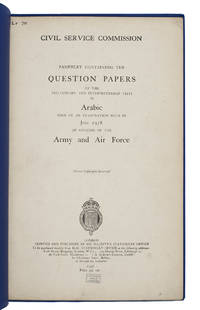
1938ref. ABC_46033London: printed and published at Her Majesty's Stationary Office 1938. Original publisher's printed paper wrappers in later blue paper wrappers. Folio. Printed in English and Arabic. British government publication of an interpretership examination for Arabic translation. It provides the examination questions that officers in the Army and Air Force had to answer correctly to pass as an interpreter of Arabic. The work contains several questions that include translating Arabic texts printed in Arabic type.Library stamp on foot of front cover title-page and pp. 8 and 9: "Liverpool Public Libraries". In good condition.l Consolidated List of Government Publications 1936 p.147; WorldCat 1 copy: British Library. printed and published at Her Majesty's Stationary Office, unknown
ref. 14676Late 19th or early 20th century Koummya Arabic dagger with cast brass scabbard. The scabbard has silver engraved motifs and metal accents. The dagger measures 18" along the curve and has a hand carved wood handle with brass encasement rounding the hilt. The blade is curved sharp and slides securely into the sheath. It shows use but no damage. In good condition. unknown
2013ref. 000802New York: Random House. Light edgewear to slipcase. Vols are clean crisp tight as new. . As New. Soft cover. 2013. Random House paperback
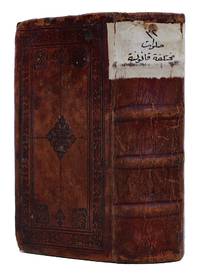
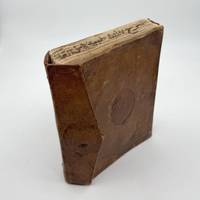
ref. 66237Khenchara Lebanon: Monastery of St John the Baptist 1787. 8vo. 17 x 10 cm. pp. x735. Contemporary russet morocco binding floral decoration stamped in blind on back and front spine with raised bands manuscript title-label in Arabic stuck to the top of the spine. A number of small engravings including one of the nativity head- and tail-pieces. Edges and corners rubbed small area of water damage to back board; internally there is some occasional light water-staining and foxing. Generally very good. This is the second impression of a Horologion printed in Arabic at the press established in 1734 at the Monastery of St John the Baptist in Khenchara by Abdallah Zakhir. It contains the breviary hymns and prayers for the Byzantine rite printed in black and red Arabic script. Khenchara, Lebanon: Monastery of St John the Baptist, 1787. hardcover
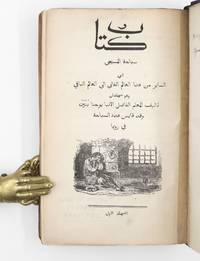
1834ref. 372732Malta: press of the Anglican Church Missionary Society 1834. First edition in Arabic. Title vignette of Bunyan in prison 7 plates captioned in Arabic. 6 281 1 imprint 2 blank pp. 1 vols. 8vo in 6s. Original silky cloth over boards twentieth-century binder's cloth spine. Joints crudely rehinged title leaf reinforced at gutter; binding cracked and a few leaves loosened. Contemporary presentation inscription on pastedown. Very good internally fine. First edition in Arabic. Title vignette of Bunyan in prison 7 plates captioned in Arabic. 6 281 1 imprint 2 blank pp. 1 vols. 8vo in 6s. Bunyan's Pilgrim's Progress translated into Arabic with a life of the author by Christoph Friedrich Schlienz. From the title page this is nominally the first volume but press marks are continuous and the text is complete: the end part twentieth sees the Pilgrim reach the Celestial City. Printed at Malta by the Anglican missionaries. William R. Whittingham 1805-1879 graduated the General Theological Seminary in 1825 and was named librarian of the newly founded school. He later accepted a position on the faculty in 1836. Whittingham was consecrated the fourth Bishop of Maryland in 1840 and served in that capacity until his death. This copy with his contemporary gift inscription to the GTS library "From the Rev. W.R. Whittingham 1834" RARE FIRST EDIITION IN ARABIC of a classic of English literature and of Christian devotion. Roper Arabic printing in Malta 1825-1845 56. OCLC: 57188645 Columbia Glasgow Tübingen 643954559 Manchester. Provenance: William R. Whittingham gif tinscription 1834; General Theological Seminary bookplates and inkstamps press of the Anglican Church Missionary Society unknown
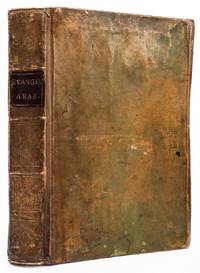
ref. 63499Romae Rome: Ex Typographia Medicea 1619. Folio 33.5x21 cm. pp. 4 9-462 2 with at recto the printer's letter repeated with the date of the 1591 original edition blank at verso. Contemporary green vellum spine with raised bands and gilt-decorated compartments red Morocco label marbled endpapers edges dyed red. Title printed in red and black with Medici's woodcut coat-of-arms printer's advice "Typographus lectori". With 149 text woodcuts by Leonardo Parassole c.1570-c.1630 after Antonio Tempesta 1555-1630 their monograms appearing on a number of the illustrations. The woodcuts are remarkable examples of Tempesta's work notable for their clarity of composition and their didactic narrative of the episodes depicted. Ex libris Luigi Bossi Milan 1758-1835 with his engraved heraldic bookplate to front pastedown along with T. Fenteman & Sons Leeds booksellers label to upper corner. Title-page lightly browned boards faded and discoloured some occasional light toning generally a very good copy printed on thick paper the woodcuts in strong impressions throughout. Rare 1619 reissue or of the original 1591 stock of the Arabic Medicean Gospels. The text lines are almost identical with those of the Arabic issue but now have an interlinear Latin version added which was prepared by Antonius Sionita. In 1584 the last year of the papacy of Gregory XIII who had constantly endeavoured to effect a union between the Church of Rome and the eastern Christians Cardinal Ferdinando de' Medici the brother and later the successor of the Grand Duke of Tuscany founded a printing press in Rome with a vast selection of oriental types cut by the French typographer Robert Granjon. Run by a versatile orientalist Giovan Battista Raimondi the press had various aims. One was to produce propaganda which would attract the eastern Christians to Roman Catholicism. Another was to corner the publishing market in an area where typography was prohibited and to make a financial profit from the sale in the east of books printed in Arabic. The third aim was to further European knowledge and to provide good editions of Arabic versions of certain standard non-religious texts. These included the writings of Avicenna al-Idrisi's geographical compendium al-Tusi's adaptation of Euclid's text on geometry and various works on Arabic grammar and syntax. The first major publication was the 1591 edition of the Gospels. This copy has an interlinear Latin translation but the work was also issued solely in Arabic. It contains 149 fine woodcut illustrations made by Leonardo Parasole mainly after designs by one of the best known Florentine artists of his day Antonio Tempesta who owed much of his fame to the frescoes he painted in the Vatican and in a number of Roman palaces. The woodcut in the Gospel of St Mark of the presentation of the head of John the Baptist to Salome Mark 6:28 by a man in Turkish dress reminds us of the common association between the great enemy of Christendom in the sixteenth century and the ancient heathens. The Arabic text is printed in Robert Granjon's famous large fount generally considered the first satisfactory Arabic printing type; as all early printed editions of the Arabic Gospels it is based on the Alexandrian Vulgate cf. Darlow/M. 1636. The Latin version is by Leonardo Sionita. The work begins with page 9 without a title-page or any preliminary matter at all: "the intended prefatory matter was apparently never published" Darlow/M. Darlow & Moule 1637 & 1643; Schnurrer Bibliotheca arabica 318; Brunet II 1122-23; Graesse II 531 Romae [Rome]: Ex Typographia Medicea, 1619. hardcover
ref. 365678Ottoman lands undated early 18th c. C.E. Ink on on aharli paper. Text in black and red ink 23 lines per page. 158 ff. 1 vols. 6 x 8 inches. Later red leather spine cloth boards. Old paper repairs throughout pencil page numbers in a European hand. Two ownership inscriptions dated A.H. 1128-1152 1716-1739 C.E. Very good. Ink on on aharli paper. Text in black and red ink 23 lines per page. 158 ff. 1 vols. 6 x 8 inches. An important compendium of Islamic jurisprudence in the Hanafi school by ʻAbd AllÄh ibn Aḥmad Nasafī d. A.H. 710 / 1310 C.E. It systematically presents authoritative Hanafi rulings without extended argumentation. The introduction highlights its purpose as a concise yet comprehensive reference. A foundational Hanafi legal text Kanz al-Daqâ'iq is an abridgment of the author's al-Wâfî widely studied in Ottoman madrasas. unknown
1833ref. 365677Ottoman lands 1833. Ink on thick burnished paper 21 lines per page in Levantine-style script in black ink with headings and occasional passages in red ink dated A.H. 1249 = C.E. 1833. 448 pp. The first few pages extensively annotated in margins in a later scholarly hand with numerous doodles and pen starts on last leaves. 1 vols. 8vo 8 x 6 inches. Leather wallet binding with fore edge guard boards decorated with a shamsa motif in blind top edge marked in ink "Sharh al-Shatibi". A bit shaken textblock loose in binding very good overall. Ink on thick burnished paper 21 lines per page in Levantine-style script in black ink with headings and occasional passages in red ink dated A.H. 1249 = C.E. 1833. 448 pp. The first few pages extensively annotated in margins in a later scholarly hand with numerous doodles and pen starts on last leaves. 1 vols. 8vo 8 x 6 inches. Ibn al-QÄsıh 1316-1399 C.E. an eminent scholar of Qira'at and Islamic textual transmission was born in Baghdad and studied in Egypt where he mastered the ten canonical recitations 'ashara. He later became a renowned instructor at Madânî Mosque where he taught many scholars. His works particularly Siraj al-QÄriʾal-mubtadî wa Tadhkar al-Muqriʾal-mutahi are critical to the tradition of Qira'at pedagogy. This manuscript is an early nineteenth-century copy of a standard work an extensive and detailed commentary on al-Shatıbi's Ḥırz al-Amani a foundational text in the science of Qur'anic recitation. While al-Shatıbi's work is a didactic poem that systematically presents the rules of Qira'at this commentary expands upon its meanings with in-depth linguistic grammatical and recitational analyses providing a comprehensive exegesis that was widely studied by advanced scholars. The presence of extensive marginal annotations suggests active scholarly engagement making this manuscript an invaluable resource for the study of classical Qira'at methodologies and textual transmission. A significant scholarly manuscript offering a deeply analytical and authoritative commentary on one of the most important texts in the Qira'at tradition. unknown
ref. 1593333161.Ghardcover. Good. Access codes and supplements are not guaranteed with used items. May be an ex-library book. hardcover
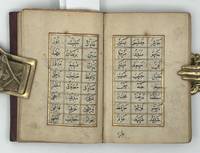
1730ref. 369933Ottoman Empire 1730. Polychrome double page ornamental opening text in black ink in a rounded naskh hand 8 lines per page fully vocalized with gold dot aya markers all within gilt rule borders. Attributes within gilt frames 30 per page. Occasional annotations in red. 117 ff. Dated at end A.H. 1143. 1 vols. 12mo. Late nineteenth century Islamic binding of red leather plaque stamped in silver with fore edge guard. Some minor smudging of passages a few paper flaws. Twentieth-century ownership inscriptions on first blank. Very good plus overall. Polychrome double page ornamental opening text in black ink in a rounded naskh hand 8 lines per page fully vocalized with gold dot aya markers all within gilt rule borders. Attributes within gilt frames 30 per page. Occasional annotations in red. 117 ff. Dated at end A.H. 1143. 1 vols. 12mo. Attractive pocket devotional with short surahs tables of the Attributes of Allah and other prayers. unknown
1870ref. 351950Cairo 1870. Single sheet bifolium a proof of the last page of Galatians and first page of Ephesians marked with corrections in pencil. 1 vols. 8vo. Removed. Some paper flaws along gutter. Good. Single sheet bifolium a proof of the last page of Galatians and first page of Ephesians marked with corrections in pencil. 1 vols. 8vo. Proof sheet from an edition of the Arabic New Testament Galatians 6:7 to end and Ephesians 1:1-19 without full vowel markers with marginal references and notes. With a contemporary holograph note in English: "proof sheet corrected . given to me by the American Vice Consul at Cairo". See Darlow & Moule 1688 for Beirut edition 1860: "very many editions with or without the full vowel points have since been priinted unknown
1886ref. 52630Leiden: E. J. Brill 1886. First Edition. xxii 327 pp. 1 vols. 8vo. Half brown morocco. Bookplate of Max L. Margolis with his signature on title. Somewhat rubbed internally fine. First Edition. xxii 327 pp. 1 vols. 8vo. On Aramaic loan words and phrases in classical Arabic. With the ownership signature of linguist and scholar of Jewish history Max L. Margolis. E. J. Brill unknown
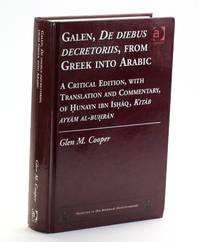
2011ref. 508901Ashgate 2011. Hardcover. FINE. 615pp. Perfectbound in printed hard covers sans DJ as issued. FINE copy entirely clean and sharp. 'This volume presents the first edition of the Arabic translation by Hunayn ibn Ishaq of Galen's Critical Days De diebus decretoriis together with the first translation of the text into a modern language. The substantial introduction contextualizes the treatise within the Greek and Arabic traditions. Galen's Critical Days was a founding text of astrological medicine. In febrile illnesses the critical days are the days on which an especially severe pattern of symptoms a crisis was likely to occur. The crisis was thought to expel the disease-producing substances from the body. If its precise timing were known the physician could prepare the patient so that the crisis would be most beneficial. After identifying the critical days based on empirical data and showing how to use them in therapy Galen explains the critical days via the moon's influence. In the historical introduction Glen Cooper discusses the translation of the Critical Days in Arabic and adumbrates its possible significance in the intellectual debates and political rivalries among the 9th-century Baghdad elite. It is argued that Galen originally composed the Critical Days both to confound the Skeptics of his own day and to refute a purely mathematical rationalist approach to science. These features made the text useful in the rivalries between Baghdad scholars. Al-Kindi d.c. 866 famously propounded a mathematical approach to science akin to the latter. The scholar-bureaucrat responsible for funding this translation Muhammad ibn Musa d. 873 al-Kindi's nemesis may have found the treatise useful in refuting that approach. The commentary and notes to the facing page translation address issues of translation as well as important concepts.'. Ashgate hardcover
2008ref. mfm0308-16Archipelago Books 2008 New York: Archipelago 2008. First edition. First printing. Hardbound. SIGNED BY AUTHOR on title page. Brand new! A pristine unread copy very fine/very fine in all respects. Purchased new and never opened except for author to sign. SIGNED BY AUTHOR on title page in English and Arabic. He has signed his name only without any inscriptions. You cannot find a better copy. Signed by Authors. 1st Edition. Hardcover. New/New. Archipelago Books hardcover
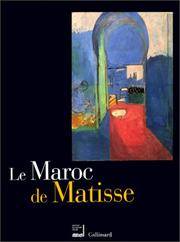
1999ref. 330482-KF22Paris : Gallimard & Institu Du Monde Arabe 1999. Hardcover. Good. Original black cloth silver lettered spine dust jacket profusely illustrated with colour and b/w photographs and illustrations 4to. Paris : Gallimard & Institu Du Monde Arabe hardcover
1863ref. 92359London: Samuel Bagster 1863. Hardcover. Very Good. viii 118p. Original cloth. Titled in gilt on front cover. 16 cm. Modest fading on backstrip and around edges of front cover. Library stamping on front free endpaper indicating that this was owned and discarded by Redemptorist Communities in Ireland. Arabic text with Introduction in English. Ferrette identified on the title page as a missionary of the irish Presbyterian Church at Damascus believed that he had come up with a great typographic method for dealing with the vowel problem in Arabic type. Ferrette's suggested fix did not catch on and his suggested fix is now mostly forgotten. Most copies located by OCLC list W. M. Watts as publisher and are dated 1863 on the title-page. This copy with the same pagination lists Bagster as publisher and is undated. We suspect that Bagster persuaded the publisher or Ferrette to issue some copies with Bagster's name as publisher for sale in Bagster's theological bookstore. We doubt that it is a later or second edition. OCLC locates one copy Huntington with the Bagster imprint. It is dated as 1836 which seems likely to be an error in dating caused by transposing the last two numbers. Samuel Bagster hardcover
1909ref. 052749Istanbul: Mahmud Bey Matbaasi. H.: 1325. 1909. Hardcover. Very Good. 8vo - over 7¾ - 9¾" tall. In contemporary cloth bdg. Cr. 8vo. 19 x 13 cm. In Ottoman script. 88 1 p. Usûl-i tedris-i Arabî. Mösyö Ahn'in usûlünden muktebesdir. Translated by Ismail Hemeti b. Osman. Ismail Hâmeti is one of the teachers of Beirut Idadî School. First Edition is published in 1898 in Beyrut. The Ministry of Education of the period made some changes in the program regarding the method of teaching Arabic translation and speaking. Additionally he wanted the change to include the program of the sixth and seventh classes of "Idadîs". In accordance with this change made by the Ministry of Education this book was started immediately since there were no books to be taught in Arabic teaching and it was also published after the education by the Ministry of Education with its 422 numbered permission on August 11 1914. The method followed in the book is in accordance with the change made by the Ministry of Education in the program. The author states that on the cover of his book he prepared his work based on the "Monsieur Ahn" i.e. Jean Françoise Ahn procedure. This statement shows that the authors investigate the methods that arise about language teaching and closely follow the methods which are followed in the teaching of Western languages in order to prepare books suitable for these methods. Because the author adapted the rules of the method put forward by a Western linguist to the teaching of the Arabic language and tried to prepare his book. The topics in the work are covered at a level that the reader can understand easily. The first part of the book begins with exercises on translations from Arabic to Turkish and from Turkish to Arabic. Arabic words and Turkish meanings are given across each word. As the topics progress both the number of sample sentences and level increases gradually. In the second chapter grammar topics are handled in the same way under the title of "Kavâid-i Esasiye". In the third part 45 prepositions are listed first with the title "edevât". he meanings of the prepositions are given and then each is given as an example. After prepositions there is a section under the title of "lugat" i.e. dictionary. Source: Ikinci Mesrutiyet'ten günümüze Türkiye'de Arapça ögretimi by Hasan Soyupek. A rare book on Arabic grammar and linguistics. Second Edition. Hegira-Hijri: 1325 = Gregorian: 1909. Özege 22297 For 1904 Edition. Çögenli 173. Mahmud Bey Matbaasi., [H.: 1325]. hardcover
1974ref. 052337Istanbul: Publication of the Mathematical Research Institute 1974. Leather. Fine. 8vo - over 7¾ - 9¾" tall. Original decorative full red leather bound. Gilt traditional style on boards. Large demy 8vo. 22 x 15 cm. Bilingual preface in German and Turkish. 12 2 p. 49 p. facsimile in Arabic. ills. Das Achte Buch zu den Conica des Apollonios von Perge. Rekonstruiert von Ibn al-Haysam. Herausgegeben und eingeleitet von Nazim Terzioglu. Ibn al-Haytham Alhazen was born c. 965 to an Arab family in Basra Iraq which was at the time part of the Buyid emirate. He held a position with the title vizier in his native Basra and made a name for himself for his knowledge of applied mathematics. As he claimed to be able to regulate the flooding of the Nile he was invited to by Fatimid Caliph al-Hakim in order to realise a hydraulic project at Aswan. However Ibn al-Haytham was forced to concede the impracticability of his project. Upon his return to Cairo he was given an administrative post. After he proved unable to fulfill this task as well he contracted the ire of the caliph Al-Hakim bi-Amr Allah and is said to have been forced into hiding until the caliph's death in 1021 after which his confiscated possessions were returned to him. Legend has it that Alhazen feigned madness and was kept under house arrest during this period. During this time he wrote his influential Book of Optics. Alhazen continued to live in Cairo in the neighborhood of the famous University of al-Azhar and lived from the proceeds of his literary production until his death in c. 1040. Among his students were Sorkhab Sohrab a Persian from Semnan and Abu al-Wafa Mubashir ibn Fatek an Egyptian prince. Signed and inscribed by Nazim Terzioglu 1912-1976 was one of the first mathematicians in Turkish academia. One of the contributions of Terzioglu as the director of the Mathematics Research Institute to Turkey's mathematical culture and the history of science was the systematic scan of the Islamic literature relevant to mathematics and the presentation of the information related to conic sections in ancient mathematics to the scientific community. As a result of these efforts the facsimile of two ancient texts of mathematics originally written in Arabic were realized. The first one is the preface of Mecmuatu'r-risail the Arabic translation by Beni Musa b. Sakir died in 873 of Conica which is the work of Apollonius of Perga BC 262-190 on the conic sections. This preface published with the title Das Vorwort des Astronomen Bani Musa b. Sakir describes how the Apollonius' Conica was acquired by the Islamic world. After that Terzioglu published the facsimile of the copy of the lost 8th book of Apollonius' Conica which was rewritten by Ibnu'l-Heysem 965-1039 with the help from other sources. In the introduction part of this book with the title Das Achte Buch zu den Conica des Apollonios von Perge the following information is provided in summary: In ancient mathematics the interest for conics starts with Menaechmus BC IV. Century and reaches the summit with Apollonius of Perga. Apollonius wrote his famous work Conica by processing previous information and adding up his own inventions. The first 7 volumes of this work consisting of 8 volumes in total are known whereas the 8th volume is missing. The Islamic and Western mathematicians working in this field took place in the reconstruction of the 8th volume. The most successful one of these works is that of Edmund Halley's 1656-1742 Apollonii Per-gaei conicorum Oxoniae 1710. The 8th book of Conica reconstructed by Ibn el-Heysem is the 4th manuscript with the name Makalatu'l-Hasan b.el-Hasan b.el Heysem fi el-kitabu'l-mahrutat in the Mecmu'atu'r-risail which is recorded under no. 1796 in Manisa Library. The fact that Ibn el-Heysem completed this work nearly 700 years before Halley is interesting. Publication of the Mathematical Research Institute hardcover
1974ref. A109390Bagdad: Parti Arabe Socialiste ÒBAASÓ 1974. 1st edition. Near Fine. small octavo. softback with stiff wrappers 392pp. portraits ÔLe Rapport Politique adopte par le Huitieme Congres Regional du Parti Arabe Socialiste ÒBAASÓ- IRAK Janvier 1974. Inc. Portraits of Comrades Hassan Al-Bakr & Saddam Hussein. FRENCH TEXT. Scarce Parti Arabe Socialiste ÒBAASÓ unknown
1999ref. BN428033Paris : Gallimard & Institu Du Monde Arabe 1999. 1999. Hardcover. Le Maroc de Matisse Le Maroc de Matisse Institut Du Monde Arabe Paris : Gallimard & Institu Du Monde Arabe hardcover
ref. BN513978Myths Historical Archetypes and Symbolic Figures in Arabic Literature Beiruter Texte und Studien Neuwirth Angelika; Embaló Birgit; Günther Sebastian und Jarrar Maher Myths Historical Archetypes and Symbolic Figures in Arabic Literature Beiruter Texte und Studien Neuwirth Angelika; Embaló Birgit; Günther Sebastian und Jarrar Maher Myths Historical Archetypes and Symbolic Figures in Arabic Literature Beiruter Texte und Studien Neuwirth Angelika; Embaló Birgit; Günther Sebastian und Jarrar Maher unknown
2010ref. BN622570Intl Book Centre 2010. 2010. Hardcover. Des Metiers photo images in arabic script Arabic Edition Des Metiers photo images in arabic script Arabic Edition Librarie du Liban Arabic Butterfly books Intl Book Centre hardcover
2010ref. BN622569Intl Book Centre 2010. 2010. Hardcover. Photo Images of School Materials Arabic Edition Photo Images of School Materials Arabic Edition Arabic Butterfly Books Intl Book Centre hardcover
1983ref. BN100032Wiesbaden : Harrassowitz 1983. 1983. Ergebnisse der Ausgrabungen auf der Hirbet el-M¨a¨ Tel Masos 1972-1975 - 3 Bände komplett Volkmar Fritz und Aharon Kempinski Abhandlungen des Deutschen Palästinavereins Ergebnisse der Ausgrabungen auf der Hirbet el-M¨a¨ Tel Masos 1972-1975 - 3 Bände komplett Volkmar Fritz und Aharon Kempinski Abhandlungen des Deutschen Palästinavereins Wiesbaden : Harrassowitz unknown