BEAURIEUX Rémy.Livre Rare Book

rif. 12130album édité par le protectorat de la République Française au Maroc. In 4 cartonné souple, texte us beau vergé, non numéroté, aquarelle sur le premier plat. Illustrations en couleurs hors-texte de Mattéo BRONDY, Georges LASCRPUX, R. PINATEL, Melle PREVOOST, Gabriel ROUSSEAU… et photos dans le texte, de MM. FELIX-FLANDRIN-GILOT-RATEL. Gravures dur bois en tête de M. G. HAINAUT. Imprimerie MOULLOT Marseille-Paris sans date ( 1925) .Très bon état.
1882- Extrait de la Revue des deux mondes, s.l. (Paris) 1882, 15,5x25cm, agrafé. - First edition. Plain paper cover. Rare. [FRENCH VERSION FOLLOWS] Edition originale. sous couverture muette. Rare.
1898Paper wrappers (marbled) with typed spine label. Some pages creased. Minor shelfwear. ; Proefschrift (Diss. ) ; 130 pages
19112 vols.: 134 + 116pp., 16cm., in the collection "Sammlung Göschen", softcover (bit used), good condition, X76024
rif. 87272Paris, Librairie Hachette, 1965. 11 x 16, 559 pp., 5 cartes dépliantes en couleurs, quelques dessins, reliure d'édition + jaquette, bon état (jaquette légèrement défraîchie).
rif. 48879Paris, France-Empire, 1980. 14 x 22, 198 pp., 14 planches en N/B, broché, bon état.
2008rif. 100143276Droz Librairie 2008 317 pages in8. 2008. Broché. 317 pages.
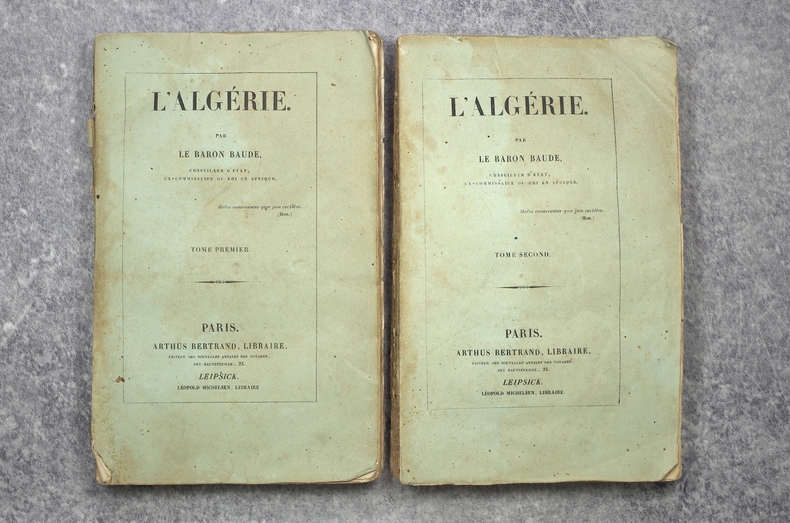
1841rif. 264PARIS. ARTHUS BERTRAND, LIBRAIRE. 1841. 2 VOLUMES IN-8 BROCHES (14,5 X 22,5 X 6,5 CENTIMETRES ENVIRON) DE (4) + XXVIII + 404 ET (4) + 492 PAGES, COUVERTURE BLEU VERT, TITRE IMPRIME EN NOIR. ILLUSTRE DE 3 CARTES REPLIEES. RARE. UN DES PLUS IMPORTANTS OUVRAGES PARUS SUR L’ALGERIE. (BRUNET. 28410). PETITES TRACES D’HUMIDITE ANCIENNE SANS GRAVITE SUR CERTAINES PAGES, QUELQUES DEFAUTS EXTERIEURS, DONT MANQUES DE PAPIER AU DOS, DEBOITES, SINON BON EXEMPLAIRE QUI MERITERAIT D’ETRE RELIE.
rif. 13974440Bruxelles: Bibliothèque Royale, 1968 in-4,xv-68 pages, frontispice en coul., 10 ills. dans le texte et 24 planches h.-t., bibliographie. Broché.
Hardcover in-12, XXVI-373 pages, reliure plein cuir, couverture conservée. Bel exemplaire. [FRA-3]
2003Octavo in offwhite illus glossy paper wraps; 211 pages : illustrations ; 22 cm In Arabic. / Sa'id, Nuri, 1888-1958; Iraqi statesmen; biography; Iraq; political and social conditions; history; memoirs. Prime ministers -- Iraq -- Biography. Premiers ministres -- Irak -- Biographies. Prime ministers. Physiciens -- Irak -- Biographies. Iraq -- History -- Hashemite Kingdom, 1921-1958. Irak -- Histoire -- 1921-1958 (HachÈmites) Iraq. Irak -- 1921- ... Irak -- Politique et gouvernement.
2008Light blue/white octavo (dark and light blue spine); 351 p ; 20 cm. In Arabic. || Journalists, Palestinian Arab -- Palestine -- Diaries; Biography.
1984rif. R240019923PRESSES POCKET. 1984. In-12. Broché. Bon état, Couv. convenable, Dos satisfaisant, Intérieur frais. 290 pages. Nombreuses planches de photographies en couleur et en noir et blanc.. . . . Classification Dewey : 492.7-Arabe
1960rif. 508216Minerva Herder'sche Verlagshandlung / Herder 1960. Hardcover. NEAR FINE. ca. 1960 quality facsimile of the 1882 Herder edition. xviii 330pp. 8vo sewn binding in orange cloth. Critical text of the original Arabic with German translation followed by a critical text of the Latin commentaries all preceded by a lengthy German introduction. Spine faintly sunned very clean and sharp otherwise with tight binding and fresh pages. Minerva [Herder'sche Verlagshandlung / Herder] hardcover
1993Broch?. 105 pages. Tr?s bon ?tat.
2001Broch?. 210 pages. Tr?s bon ?tat.
1999Broch?. 188 pages. Tr?s bon ?tat.
rif. 100.105Paris, Librairie Plon, 1923. 13 x 20, 2 volumes, 314 + 242 pages, quelques photos, reliure carton marbré, tome 2 partiellement coupé, tête mouchetée, non rogné, couverture conservée (3 pièces pour les 2 volumes) très bon état.
rif. 97877Paris, Société d'Editions Géographiques, Maritimes et Coloniales, 1931. 14 x 21, 267 pp., 1 carte dépliante, broché, non coupé, bon état.
1907rif. 17871907 br. in-8, 1er pl. un peu défr., goutt. à témoin, qq. rouss., 66 p., imprimerie nationale,
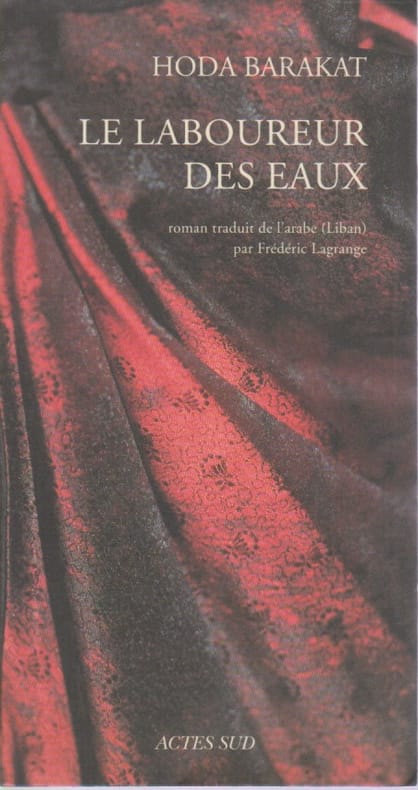
rif. 68160Traduit de l'arabe (Liban), Actes Sud, 2001, 210 pp., broché, annotation nen première page, bon état.
rif. 55369Paris, L'Harmattan, 2004. 13 x 21, 241 pp., broché, très bon état.
1952rif. 1137ALGER. SERVICE DES ANTIQUITES. 1952. BROCHURE IN-8 DE 80 PAGES, COUVERTURE BLANCHE, TITRE IMPRIME EN BISTRE. ILLUSTRE DE 52 REPRODUCTIONS IN ET HORS TEXTE ET D'UNE CARTE REPLIEE EN COULEURS. BEL EXEMPLAIRE.
in-8°, 366 pages, broché, couverture illustree. Très bel exemplaire. [NV-22]
1809- Imprimerie Impériale, Paris 1809-1829, 71x54cm, une feuille. - Original, unshaved, full-page etching from the "Imperial edition" of the Description de l'Égypte, or 'Recueil des observations et recherches faites en Égypte pendant l'expédition française, publié par les ordres de Sa Majesté l'Empereur Napoléon le Grand [A Collection of the observations and research carried out in Egypt during the French expedition, published on the orders of his Majesty the Emperor Napoleon the Great]'. Produced between February 1802 and 1830 on the orders of Naopleon Bonaparte and published between 1809 and 1828, 1,000 copies were printed and distributed to institutions, on vergé paper with an 'Égypte ancienne et moderne' watermark, visible when held up to the light. Light marginal spotting not touching image, otherwise in very fresh, fine condition. An engraving from the Description de l'Egypte, one of the masterpieces of French printing and the birth of a new field: Egyptology. A gigantic survey of Egypt at the time of Bonaparte's conquests in 1798 and 1799, the work is divided into 13 volumes of engravings making up 892 plates, of which 72 colored, as well as presenting the splendors of the Egypt of the Pharaohs in 9 volumes. The other volumes discuss natural history and present a fascinating portrait of Coptic and Islamic Egypt as it was seen by Bonaparte's Eastern Armies. The 'Egyptian campaign', militarily a disaster, demonstrates, through the engravings of the Description d'Egypte, the scientific success it nonetheless became thanks to the 167 expert members of the Commission of the Sciences and Arts of the Institut d'Egypte [Egyptian Institute] who followed Napoleon's army. The Institut gathered together in Egypt the mathematician Monge, the chemist Berthollet, the naturalist Geoffroy Saint-Hilaire as well as numerous artists, engineers, architects and doctors. They were tasked with re-discovering modern and ancient Egypt and displaying its natural treasures as well as the know-how of its inhabitants. This edition, the so-called "Imperial" edition of the plates for the Description de l'Egypte was printed in four large formats, two of which were specially created for it and christened "Moyen-Egypte" and "Grand-Egypte". A special press was built to print it, the process extending over 20 years, from 1809 to 1829. The "Imperial" edition proved so popular that a second edition, this time in black and white and without the "Egypte ancienne et moderne" watermark - known as the "Royal Edition" - was published during the Restoration by the printing house of C.-L.-F. Panckoucke (Paris). The engravings of the Description d'Egypte owe a great deal to Baron Dominique-Vivant Denon, illustrator, diplomat, collector and later Director of the Musée Napoléon (the Louvre). His exploration of the South of Egypt gave Bonaparte the idea of sending the experts of the Institut there, thus creating a faithful and complete portrait of the area. This was the research gathered together from 1802 in the mammoth Description de L'Egypte. Denon embarked on this story of archeological exploration at the age of 51, reaching first Alexandria and then Cairo before exploring Upper Egypt. Along with the members of the Institut d'Egypte, the Natural History Museum's painter H.J. Redouté (brother of Pierre-Joseph Redouté, author of Roses), the mineralogist Dolomiue, and the draughtsman Joly, Denon then explored the Nile Delta and Lower Egypt. When, however, he joined the 21st Light Infantry Regiment as it marched across Upper Egypt in pursuit of the retreating Mameluks in November 1798, he found himself the only civilian. In the very midst of the battle itself, he reeled off sketches of the works of art that peppered his path right up to the threshold of the Sudan. He said that he had crossed "a country that is, apart from its name, entirely unknown to Europeans, and therefore everything was worth describing" (Voyages dans la Basse et la Haute Egypte pendant le