3 792 résultats
réf. 71236c.1880. . Albumen print. Four-part panorama very good tonal range and in good condition. [c.1880]. unknown
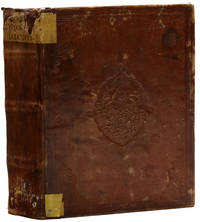
1770réf. ABC_48344Probably Egypt 1770. Near-contemporary brown leather with a blind-stamped oriental rosette as a center piece and similar style corner pieces on both boards a partial manuscript title label on the spine. 4to ca. 17 x 22 cm. Arabic and Italian manuscript on paper 19 lines per extensum paginated throughout from right to left. Manuscript dictionary comprising some 9000 Arabic terms and their Italian translations. It was formerly owned by the German oriental scholar and Franciscan priest Arsenius Rehm 1738-1808 who lived in Cairo between 1769 and 1776 building a large collection of manuscripts which he brought with him when he worked for some time at the Franciscan abbey of Frauenberg at Fulda Hesse. After his death his collection remained at the monastery until it was purchased by the Benedictine Abbey of St Boniface Munich in 1852. The present volume which had not been part of the collection proper remained in Frauenberg whose library was dispersed in 2021 by the Franciscan Province. "The library includes a fairly extensive Arabic dictionary of his though not written by him. It offers only the Italian translation of the Arabic words. In the Arabic style it begins from our perspective at the end" cf. Bihl.With old stamps of the Frauenberg Abbey library on the final leaf with attribution to Arsenius Rehm in indelible pencil ca. 1900. The binding is somewhat rubbed and scuffed; remains of old spine labels. Interior shows only occasional light staining; very well preserved.l Michael Bihl Geschichte des Franziskanerklosters Frauenberg Fulda 1907 p. 137. hardcover
1929Very Good Turkish Original manuscript color map of Middle East including Syria, Palestine and Transjordan. Signed by cartographer. 28x20 cm. In Turkish (with Latin letters). The Mapping Department, which moved to Ankara from Istanbul after the Independence War, settled in the Attar Basi Khan in Koyunpazari and the press section also started its studies in the building which is the Art School in Ulus today. In 1924, the department, which is still inside the General Directorate Garrison, moved to the hut-shaped buildings with single floor between the Military Sewinghouse and the General Directorate. On the other hand, the production of maps and plans, which were to be used in development services carried out in parallel to the revolutions starting with the declaration of the Republic and following each other, was considered to be based on a legal arrangement. Because of the necessity of an urgent legal arrangement, the bill of law concerning to the General Directorate of Mapping, whose preparations were initiated by Lieut. Gen. M. Sevki (Ölçer) who knew the importance of the subject, was sent to the Ministry of Defense at the beginning of 1925. After the approval of Ministry of Defense, the bill, which was sent to the Prime Ministry, was discussed in the Council of Ministers and presented to the Grand National Assembly of Turkey. As a result; the Mapping Department was re-organized as the General Directorate of Mapping affiliated with the Ministry of Defense with the law bearing the number 657 on May 2, 1925 in order to do all mapping works and meet the needs of maps and plans of all ministries, institutions and organizations. [.] The first application of photogrammetry was made in Kayas, Ankara with the Wild Autograph plotting apparatus which was purchased in that year. Captain Ömer Kadri and Captain Niyazi came back from their photogrammetry education in Germany. Major Halit and Major Nüzhet were sent to France for photogrammetry education and Captain Ishak and Captain Bahri were sent to Germany. Captain Ahmet (Denkmen) and Captain Ömer Kadri attended the Congress of Photogrammetry assembled in Berlin. (Source: The Illustrated History Of Turkish Cartography). Halid Ziya was born in Izmir, Tire. He went to Istanbul and continued to Hendese-i Mülkiye and Engineer Mekteb-i Âlîsi for seven years. After starting with "Aydin Province Umur-i Nafia Third Class Engineering", Halid Ziya Bey, who continued to work as a deputy chief engineer on 14 March 1910, left Aydin and returned to Istanbul after continuing this duty for about six and a half months. As a teacher, he taught Accounting, Algebra, Geometry, and Topography at Halkali Ziraat Mekteb-i Âlîsi and Darussafaka. Halid Ziya Bey, who was appointed as a teacher of Hendese and Cosmography in Kabatas High School, started to practice the profession of engineering and cadastral, which was his main specialty in 1327. After the First World War, the Istanbul Government started its activities in order to capture and neutralize Halid Ziya Bey and his friends. Upon the harsh measures taken, Halid Ziya Bey had to live as a fugitive in the Hasirci Mountains of Eskisehir for a while with the armed force attached to him. Halid Ziya Bey, who was involved in the movement in Anatolia until the end of the National Liberation Struggle, returned to his engineering duty after the proclamation of the Republic and was included in the cadastral works again. In 1925, Halid Ziya Bey was appointed as the Head of the Science Committee of the new cadastre organization. He wrote 5 books on cadastre, photogrammetry, trigonometry, and cadastral tools in 1928 and 1929. In addition, as a result of personal work in 1928, the road between the provincial division of the Republic of Turkey with cities has prepared a comprehensive map to show up in the forest and mining. (Source: Kadastro ne idi, nedir, ne olacaktir, Kadioglu - Yildirir. From Preface.). No scale.
1912réf. 738901912 Paris, Armand Colin, 1912, in 12 broché, XXX-379 pages ; couverture imprimée (fanée).
1992Arles, Sindbad, 1992; in-8, 122 pp., broché. Collection « Mémoires de la Méditerranée ». Traduit de l'arabe (Egypte) par Richard Jacquemond. Très bon état.
1988Paris, Sindbad, la "Bibliothèque Arabe", 1988; in-8, 315 pp., broché, couverture à rabats. Traduit de l'arabe par Antoine Cottin. Troisième édition. Très bon état.
1942Paris, Éditions d’Art H. Piazza, 1942; in-12, 140 pp., broché. Collection « Ex-Oriente Lux ». Très bon état.
1835Paris, Beaule & Jubin, 1835; in-8, XVI-430 pp. + 444 pp. + 444 pp. + 440 pp. + 447 pp. + 416 pp., brochés. Les 6 volumes. Bonne édition, avec une éloge de Galland. Ce texte est la traduction de Galland, traduit de l'arabe, mais dont la tradition orale vient de Perse et d'Inde. Cette traduction de Galland a été établie au tout début du 18ème siècle. Il l'a rédigé lui-même en s'inspirant du manuscrit. Il a ajouté Sindbad le marin qui ne faisait pas parti du texte original, mais qui était dans le manuscrit. Illustré de 12 gravures. Bon état.
1942réf. D3254Paris, Éditions d’Art H. Piazza, 1942 ; in-12, 140 pp., broché. Collection «Ex-Oriente Lux». Très bon état.
1899réf. _202401103Paris, Éditions de la Revue Blanche, puis Eugène Fasquelle, Éditeur, 1899-1904 ; in-8 (148 x 234 mm), XXIV-[4°]-352 + 372 + [4]-320 + 336 + 304 + 306 + 276 + 356 + 336 + 328 + 348 + 324 + 332 + 336 + 332 + 292 pp., cartonnages d'éditeur, papier simili-toile, coloris vert clair, dos lisses, pièces de titre vert foncé, têtes rognées. Les 16 volumes. Éditions de la Revue Blanche (de 1899 à 1901) – [1902 ?] – Eugène Fasquelle, Éditeur (de 1903 à 1904). Traduction littérale et complète du texte arabe, par le Dr J.-C. MARDRUS.
1835réf. A2420Paris, Beaule & Jubin, 1835 ; in-8, XVI-430 + 444 + 444 + 440 + 447 + 416 pp., brochés. Les 6 volumes. Bonne édition, avec une éloge de Galland. Ce texte est la traduction de Galland, traduit de l'arabe, mais dont la tradition orale vient de Perse et d'Inde. Cette traduction de Galland a été établie au tout début du 18ème siècle. Il l'a rédigé lui-même en s'inspirant du manuscrit. Il a ajouté Sindbad le marin qui ne faisait pas parti du texte original, mais qui était dans le manuscrit. Illustré de 12 gravures. Bon état.
1988réf. 202006502Paris, Sindbad, la "Bibliothèque Arabe", 1988 ; in-8, 315 pp., broché, couverture à rabats. Traduit de l'arabe par Antoine Cottin. Troisième édition. Très bon état.
1992réf. H2586Arles, Sindbad, 1992 ; in-8, 122 pp., broché. Collection «Mémoires de la Méditerranée». Traduit de l'arabe (Egypte) par Richard Jacquemond. Très bon état.
réf. 23128Probably Persia Circa 18th century. Finely written in Arabic calligraphy in black outlined and highlighted in red and gold. Small Folio 6.5” x 3.75” handsomely presented within a cream mount. A very finely preserved example. Probably Persia unknown
in-16°, broché. Bon état. [LP-9] Texte en français et arabe.
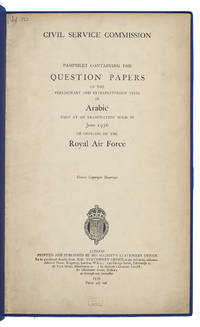
1936réf. ABC_46032London: printed and published at Her Majesty's Stationary Office 1936. Original publisher's printed paper wrappers in later blue paper wrappers. Folio. Printed in English and Arabic. British government publication of an interpretership examination for Arabic translation. It provides the examination questions that officers in the Royal Air Force had to answer correctly to pass as an interpreter of Arabic. The work contains several questions that include translating Arabic texts printed in Arabic type.Library stamp on foot of front cover title-page and pp. 8 and 9: "Liverpool Public Libraries". In good condition.l Consolidated List of Government Publications 1936 p.147; not in WorldCat. printed and published at Her Majesty's Stationary Office, unknown
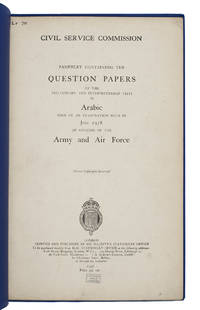
1938réf. ABC_46033London: printed and published at Her Majesty's Stationary Office 1938. Original publisher's printed paper wrappers in later blue paper wrappers. Folio. Printed in English and Arabic. British government publication of an interpretership examination for Arabic translation. It provides the examination questions that officers in the Army and Air Force had to answer correctly to pass as an interpreter of Arabic. The work contains several questions that include translating Arabic texts printed in Arabic type.Library stamp on foot of front cover title-page and pp. 8 and 9: "Liverpool Public Libraries". In good condition.l Consolidated List of Government Publications 1936 p.147; WorldCat 1 copy: British Library. printed and published at Her Majesty's Stationary Office, unknown
réf. LFA-126720464Une plaquette de 14 pages, format 135 x 190 mm, brochée, s.d., Vollot, bon état
1915Paris, Hachette, 1915; in-4, 85 pp., reliure d'éditeur pleine toile estampée et imprimée. Contient les contes les plus populaires des 'Mille et Une Nuits' (Ali-Baba, Aladdin, Sheherazade). Nombreux dessins en noir. Bon état.
1915réf. F0411Paris, Hachette, 1915 ; in-4, 85 pp., reliure d'éditeur pleine toile estampée et imprimée. Contient les contes les plus populaires des 'Mille et Une Nuits' (Ali-Baba, Aladdin, Sheherazade). Nombreux dessins en noir. Bon état.
in-4°, 89 pp., nombreuses photos en couleurs, broché, couverture illustrée. Tres bel exemplaire. [P-18] Catalogue de vente.
2012br., (accroc en couv.) bon état
1999N°3-4, de Mars-Avril 1999, de la revue fondée par Emmanuel Mounier et dirigée par Olivier Mongin; au sommaire: "Réalignements stratégiques en Asie centrale et en Iran", entretien avec Olivier ROY, "Algérie: les traumatismes de la langue et le raï" par Mohamed BENRABAH; dossier "Le Pari de la réforme": nombreux articles sur les laboratoires de la "troisième voie" et les social-démocraties européennes, et sur le réformisme en France. Français
1999réf. 13971Paris, Esprit, 1999 1 volume 14,8 x 23,9cm Broché sous couverture au 1er plat orné d'une vignette. 307p., 2 feuillets. Bon état.
réf. 45623, Sfax, École Doctorale de la Faculté de Droit de Sfax 2012, in-8, br., (accroc en couv.) bon état, 338-[1ff.]p.