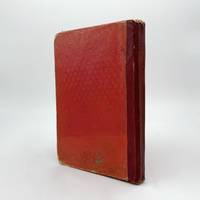
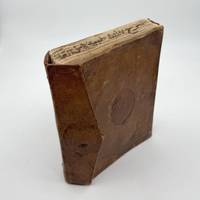
(Arabic Manuscript)Biblio.com
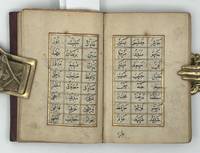
4 040 résultats
1730réf. 369933Ottoman Empire 1730. Polychrome double page ornamental opening text in black ink in a rounded naskh hand 8 lines per page fully vocalized with gold dot aya markers all within gilt rule borders. Attributes within gilt frames 30 per page. Occasional annotations in red. 117 ff. Dated at end A.H. 1143. 1 vols. 12mo. Late nineteenth century Islamic binding of red leather plaque stamped in silver with fore edge guard. Some minor smudging of passages a few paper flaws. Twentieth-century ownership inscriptions on first blank. Very good plus overall. Polychrome double page ornamental opening text in black ink in a rounded naskh hand 8 lines per page fully vocalized with gold dot aya markers all within gilt rule borders. Attributes within gilt frames 30 per page. Occasional annotations in red. 117 ff. Dated at end A.H. 1143. 1 vols. 12mo. Attractive pocket devotional with short surahs tables of the Attributes of Allah and other prayers. unknown
réf. 365678Ottoman lands undated early 18th c. C.E. Ink on on aharli paper. Text in black and red ink 23 lines per page. 158 ff. 1 vols. 6 x 8 inches. Later red leather spine cloth boards. Old paper repairs throughout pencil page numbers in a European hand. Two ownership inscriptions dated A.H. 1128-1152 1716-1739 C.E. Very good. Ink on on aharli paper. Text in black and red ink 23 lines per page. 158 ff. 1 vols. 6 x 8 inches. An important compendium of Islamic jurisprudence in the Hanafi school by ʻAbd AllÄh ibn Aḥmad Nasafī d. A.H. 710 / 1310 C.E. It systematically presents authoritative Hanafi rulings without extended argumentation. The introduction highlights its purpose as a concise yet comprehensive reference. A foundational Hanafi legal text Kanz al-Daqâ'iq is an abridgment of the author's al-Wâfî widely studied in Ottoman madrasas. unknown
1833réf. 365677Ottoman lands 1833. Ink on thick burnished paper 21 lines per page in Levantine-style script in black ink with headings and occasional passages in red ink dated A.H. 1249 = C.E. 1833. 448 pp. The first few pages extensively annotated in margins in a later scholarly hand with numerous doodles and pen starts on last leaves. 1 vols. 8vo 8 x 6 inches. Leather wallet binding with fore edge guard boards decorated with a shamsa motif in blind top edge marked in ink "Sharh al-Shatibi". A bit shaken textblock loose in binding very good overall. Ink on thick burnished paper 21 lines per page in Levantine-style script in black ink with headings and occasional passages in red ink dated A.H. 1249 = C.E. 1833. 448 pp. The first few pages extensively annotated in margins in a later scholarly hand with numerous doodles and pen starts on last leaves. 1 vols. 8vo 8 x 6 inches. Ibn al-QÄsıh 1316-1399 C.E. an eminent scholar of Qira'at and Islamic textual transmission was born in Baghdad and studied in Egypt where he mastered the ten canonical recitations 'ashara. He later became a renowned instructor at Madânî Mosque where he taught many scholars. His works particularly Siraj al-QÄriʾal-mubtadî wa Tadhkar al-Muqriʾal-mutahi are critical to the tradition of Qira'at pedagogy. This manuscript is an early nineteenth-century copy of a standard work an extensive and detailed commentary on al-Shatıbi's Ḥırz al-Amani a foundational text in the science of Qur'anic recitation. While al-Shatıbi's work is a didactic poem that systematically presents the rules of Qira'at this commentary expands upon its meanings with in-depth linguistic grammatical and recitational analyses providing a comprehensive exegesis that was widely studied by advanced scholars. The presence of extensive marginal annotations suggests active scholarly engagement making this manuscript an invaluable resource for the study of classical Qira'at methodologies and textual transmission. A significant scholarly manuscript offering a deeply analytical and authoritative commentary on one of the most important texts in the Qira'at tradition. unknown
1886réf. 52630Leiden: E. J. Brill 1886. First Edition. xxii 327 pp. 1 vols. 8vo. Half brown morocco. Bookplate of Max L. Margolis with his signature on title. Somewhat rubbed internally fine. First Edition. xxii 327 pp. 1 vols. 8vo. On Aramaic loan words and phrases in classical Arabic. With the ownership signature of linguist and scholar of Jewish history Max L. Margolis. E. J. Brill unknown books
1886réf. 52630Leiden: E. J. Brill 1886. First Edition. xxii 327 pp. 1 vols. 8vo. Half brown morocco. Bookplate of Max L. Margolis with his signature on title. Somewhat rubbed internally fine. First Edition. xxii 327 pp. 1 vols. 8vo. On Aramaic loan words and phrases in classical Arabic. With the ownership signature of linguist and scholar of Jewish history Max L. Margolis. E. J. Brill unknown
1922- Lucien Vogel éditeur, Paris 1922, 18x24cm, relié. - Set of eight original prints in color, drawn on laid paper. The XXXIII and XXXVI sketches are signed lower left and right boards. The boards are introduced by a text Joan Ramon Fernandez. Original prints made ??for the illustration of The Gazette fashionable, one of the finest and most influential twentieth century fashion magazines, celebrating the talent of creators and artists French burgeoning art deco. Famous fashion magazine founded in 1912 by Lucien Vogel, The Gazette fashionable appeared until 1925 with an interruption during the War of 1915 to 1920, due to mobilization of its editor. She is 69 Deliveries from just 2000 copies and is illustrated including 573 color plates and 148 sketches depicting models of fashion designers. Upon publication, these luxury publications "are for bibliophiles and worldly aesthetes" (Françoise Tétart-Vittu "good Gazette of tone" in the fashion dictionary, 2016). Printed on fine laid paper, they use a typeface created specifically for the magazine by Georges Peignot, the Cochin character, taken in 1946 by Christian Dior. The prints are made with the technique of metal stencil, enhanced color and some outlined in gold or palladium. The adventure began in 1912 when Lucien Vogel, man of the world and fashion - it has already participated in Femina magazine - decided to found with his wife Cosette de Brunhoff (John's sister, the father of Babar) Gazette good tone in which the subtitle is then "Art, fashions and frivolities." Georges Charensol quotes the editor: "In 1910, he observed, there was no truly artistic fashion magazine and representative of the spirit of his time. So I thought of making a glossy magazine with truly modern artists [...] I was certain of success because for any fashion country can compete with France. "(" A great art editor. Lucien Vogel "in literary News, No. 133, May 1925). The success of the magazine is immediate, not only in France but also the US and South America. Originally, Vogel therefore brings together a group of seven artists: André-Édouard Marty and Pierre Brissaud, followed by Georges Lepape and Dammicourt; and finally his friends from the School of Fine Arts as are George Barbier, Bernard Boutet de Monvel or Charles Martin. Other talents come quickly reach the equipped Guy Arnoux, Léon Bakst, Benito, Boutet de Monvel, Umberto Brunelleschi, Chas Laborde, Jean-Gabriel Domergue, Raoul Dufy, Edward Halouze Alexander Iacovleff, Jean Emile Laboureur Charles Loupot, Charles Martin, Maggie Salcedo. These artists, mostly unknown when Lucien Vogel appealed to them, will eventually become iconic figures and artistic sought. These are the same illustrators who make the drawings advertisements Gazette. The boards highlight the dresses and sublime seven artists of the time: Lanvin, Doeuillet, Paquin, Poiret, Worth, Vionnet and Doucet. The designers provide for each number of exclusive models. Nevertheless, some of Illustrations contained no real model, but only the idea that the illustrator is done in the fashion of the day. Gazette fashionable is a milestone in the history of fashion. Combining the aesthetic requirement and plastic unit, it brings together for the first time the great talents of the world of arts, literature and fashion and imposed by this alchemy, a new image of women, slender, independent and bold, also driven by the new generation of designers Coco Chanel, Jean Patou, Rochas Marcel ... Recovery in 1920 by Condé Montrose Nast, Gazette fashionable modeled for the new composition and the aesthetic choices of the "little dying newspaper" that Nast had bought a few years ago: the Vogue magazine. [FRENCH VERSION FOLLOWS] Ensemble de huit estampes originales en couleur, tirées sur papier vergé. Les croquis XXXIII et XXXVI sont signés en bas à gauche et à droite des planches. Les planches sont introduites par un texte de Jeanne Ramon-Fernandez. Reliure à la bradel en plein papier à motif décoratif, do
réf. 509720 in 8 (22x13,5) Un cahier manuscrit de 194 pages renfermant 110 contes de sources diverses, avec le texte en langue arabe finement calligraphié à l'encre noire et la traduction française en regard (fine et très lisible écriture). Les 110 contes sont titrés, et il est aussi donné la précision du nom des auteurs arabes. Attibué au Général Oliva? (roussillonnais), réalisé en Syrie, vers 1930 ??
1979Fine Turkish Paperback. Pbo. Roy. 8vo. (24 x 17 cm). Reprint in Arabic; large introduction, and annotations in Turkish. [4], [xLvi], 236 p. El-Bark el-Sâmî. [= Kitab al-Barq al-Shami]. Abridged by Al-Bundârî. Published, prepared and introduction by Ramazan Sesen. Muhammad ibn Hamed Isfahan was a Persian historian, scholar, and rhetorician. He left a valuable anthology of Arabic poetry to accompany his many historical works and worked as a man of letters during the Zengid and Ayyubid period. He was born in Isfahan in the year 1125, and studied at the Nizamiyya school in Baghdad. He graduated into the bureaucracy, and held jurisdiction over Basra and Wasit. He then became a deputy of the vizier ibn Hubayra. After the death of ibn Hubayra, he went to Damascus in 1166 CE (562 Islamic Calendar) and entered the service of the qadi of Damascus, Kamal ad-Din. The qadi presented him to the Zengid Nur ad-Din, who appointed him a professor in the school he had established there, which then became known as the Imadiyya school in his honour. Nur ad-Din was later appointed to be his Chancellor. After the death of Nur ad-Din in 1174, Imad ad-Din was removed from all his bureaucratic duties, and was banished from the palace. He went to live in Mosul and later entered the service of Saladin, the Kurdish Sultan of Egypt during that time. When Saladin took control of Damascus, Saladin's vizier, al-Qadi al-Fadil, appointed him chancellor, and he also became al-Fadil's deputy. Saladin had been unsure of his talent because he was only a scribe, Imad ad-Din soon became one of the sultan's favourites. As chancellor he did not have to perform the everyday duties of the chancery scribes, and he had a lot of leisure time in Egypt. From then on he accompanied Saladin on all his campaigns. After a certain raid, he was chosen to kill one of the prisoners, but the prisoner was a child and was instead exchanged for a Muslim prisoner held by the Crusaders. Imad ad-Din was present at the Battle of Marj Uyun, the Battle of Hattin, and the subsequent campaign to expel the Crusaders from the Holy Land. At Acre, he criticized Saladin for giving away the city's treasure instead of spending it on the reconquest. At Beirut, he became ill, but was the only scribe capable of writing the terms of surrender. He had recuperated in time to see the aftermath of the Siege of Jerusalem (1187), where he again criticized Saladin's generosity; he was also disgusted by those in charge of the ransom who took bribes, and the rich Crusader nobles who took their treasures with them rather than ransoming the poor. He was present at Acre again during the Third Crusade when the Christians retook the city of Acre, and was among those who fled after the defeat. After Saladin's death in 1193, he began writing his biographies of the sultan. He wrote the Kitab al-Barq al-Shami, which is lost, but was abridged by al-Bundari. This study contains just 5th volume of manuscript abridged by Al-Bundârî.
1995Very Good English Paperback. Pbo. Roy. 8vo. (24 x 17 cm). In Turkish and facsimile in Ottoman script. [xvi], 25, [14], 48 p. Study on one of important books on 'kâfiye'. Kitâbu'l-Kavâfî. Prep. by Kenan Demirayak.
2006Octavo in while wraps illus. in color; 107 pages ; 21 cm In Arabic. Uncommon. Fiction, Novel. Palestine. Gaza. "Ghareeb Asqalani (whose real name is Ibrahim al-Zand) was born in the village al-Majdal Ashkelon in the south of Palestine in 1947. He has been living in the Gaza Strip with his family since 1948. He studied at the college of Agriculture in the University of Alexandria in Egypt, and received a degree in (Higher) Education in Islamic Studies in Cairo. He has worked as an agricultural engineer on the Euphrates Dam in Syria, as well as a teacher in the Gaza Strip. He also worked as a director in the Ministry of Culture and a Media spokesperson for the Palestine International Book Fair. He represented Palestine at the Spring Palestinian Culture Fair in 1997, and since 2010 has been Deputy Secretary General to the Palestinian Writersí Union and Chairman of the Gaza branch. He is the author of nine novels, six short story collections, three collections of essays, as well as three collections of stories online. His articles have been published widely across national print media. He was the winner of the short story prize from New Bethlehem University in 1976, and from the Palestinian Writersí Union in 1991. His short stories have been translated into English, French, Spanish and Russian." ó Publisher.
2004Octavo in white color illus wraps; 180p; 22cm, bibliographical references (pages 175-176). In Arabic. Uncommon. Muslim women -- History. Women in literature. Musulmanes -- Histoire. Femmes dans la littÈrature. Muslim women.
E. J. Brill, Leyden - Luzac & Co., London. 1916. In-8 Carré. Relié. Bon état. Couv. convenable. Dos satisfaisant. Intérieur frais. Env. 400 pages. Illustré de quelques reproductions en noir et blanc hors texte. Texte en arabe, avec lecture de droite à gauche. Composed in A.H. 658 = A.D. 1260. Edited with an Introduction, Notes and Indices from several Old Mss., by MIRZA MUHAMMAD, Ibn 'Abdu'l-Wahhab-I-Qazwini. And printed for the Trustees of the 'E.J.W. Gibb Memorial', Vol. XVI, II.
1916réf. RO40171470E. J. Brill, Leyden - Luzac & Co., London. 1916. In-8. Relié. Bon état, Couv. convenable, Dos satisfaisant, Intérieur frais. Env. 400 pages. Illustré de quelques reproductions en noir et blanc hors texte. Texte en arabe, avec lecture de droite à gauche.. . . . Classification Dewey : 492.7-Arabe
réf. 34968Traduction intégrale sur les manuscrits originaux par René R. Khawam, 1979, 301 pp., broché, traces d'usage, quelques rousseurs sur la tranche supérieure, trace de mouillure sur la partie inférieure de la couverture, pages de garde partiellement brunies, état correct.
réf. ABE-15644698323138 CARTES POSTALES VERS 1900-6018: LA GRANDE PRIERE (NON VOYAGEE)-6297: MAURESQUE (NON VOYAGEE)-6607: JEUNE FILLE ARABE (NON VOYAGEE)-6612: JEUNE MAURESQUE (VOYAGEE)-6615: FILLETTES ARABES (NON VOYAGEE)-6617: OCCUPATIONS DOMESTIQUES FILLETTES ARABES (NON VOYAGEE)-6619: JEUX DE FILLETTES (NON VOYAGEE)-FEMMES MAURESQUES EN PROMENADE (NON VOYAGEE) (BCP6)
1711réf. 64014CBs.l., [um 1711]. 8°. 20 x 14 cm. [53] Blatt. Halblederband im Stile der Zeit mit marmoriertem Deckelbezug. [6 Warenabbildungen]
1990réf. 102885Bordas 1990 In-4 cartonné 29,8 cm sur 23. 144 pages. Bon état d’occasion.
1933réf. 28050Le Caire Imprimerie De L'institut Français 1933 202 pp
1964réf. 28051Damas Institut Français Se Damas 1964 In-4 298 pp
1952réf. 642PARIS. 1952. BROCHURE IN-8 DE 130 PAGES, COUVERTURE ILLUSTREE, TITRE IMPRIME EN ROUGE. ILLUSTRE DE DESSINS DANS LE TEXTE ET DE 4 PLANCHES HORS-TEXTE. BON EXEMPLAIRE.
réf. 90499aafGallimard, 2002, in-4to, 300 p. richement illustrée, cartonnage original ill..
2005réf. ABE-1533720343724164 PAGES-21,5 CM X 28,5 CM-PORTFOLIO L'AGE D'OR DES SCIENCES ARABES,10P-AUX MARCHES DU PETIT PALAIS, 10P-VISITE D'ATELIER DANS LE MONDE REVE DE XAVIER VEILHAN, 6P-COLLECTION PRIVEE SOUVENIRS DU DUC DE TALLEYRAND, 6P-LES DIALOGUES COLORES DE DUNCAN PHILLIPS, 8P-CHARLOTTE PERRIAND, LA PIONNIERE, 6P-L'ART EN CHAMPAGNE, 12P-LE MEILLEUR DE L'ARCHITECTURE 2005, 10P-LA MARQUETERIE DE PIERRES DURES, 6P-SEVRES CONTEMPORAIN, 4P-L'AUTRE OPERA GARNIER, 6P
1995réf. 29766Paris Institut Du Monde Arabe / Flammarion 1995 GRAND In-8 239 pp, nombreuses reproductions couleurs
1857réf. 105683Vagner Duprat 1857 Nancy, N. Vagner / Paris, B. Duprat, 1857, X-266 p., demi-chagrin, environ 23x16cm, manque sur la coiffe supérieur, un pli prononcé sur le coin inférieur du second plat, des frottements d'usage sur la reliure, un mors fragile, pages jaunies, bon état pour le reste.
réf. 055111Tripoli Centre Mondial d'Etudes et de Recherches du Livre Vert 1984 in 12 (17x12) 1 volume reliure toilée verte de l'éditeur, dos et plat supérieur titrés en lettres dorées, 283 pages. Tome 1 seul. Bel exemplaire ( Photographies sur demande / We can send pictures of this book on simple request )