1178 resultados
1960ref. 1203061(Minden, Gruber, etwa 1960). 12 S. m. Noten Illustr. OBroschur (Umschl. gebräunt).
1953ref. 1248732(Linz, Oberösterreichischer Landesverlag, (1953). Gr.-8vo. 341, (3) S., 1 Farbtafel. OLwdbd m. OUmschl. (Umschl. an der Oberkante eingerissen).
1827ref. 1307497Berlin, Decker, 1827. Gestochene Porträt-Tafel, 8, 341, (3) S. Neuer Ppbd (innen gebräunt u. braunfleckig, 2 kl. alte Bibl.-Stempel auf Titel u. S. III).
1931ref. 1305417Hamburg, Hamburgische Universität, 1931. Gr.-8vo. 126 S., 1 Bl. Rückenbroschur (etwas angestaubt u. außen braunfleckig).
1886ref. 1309161Breslau, Max, 1886. 3 Bl., 123, (3) S. Hlwd d. Zeit (beschabt, Stempel verso Titel, durchgehend begriffen u. fleckig, zahlr. Blätter mit teils hinterlegten Randläsuren u. Einrissen im Falz).
1874ref. 1198285New York, B. Westermann u. Köln u. Leipzig, E. H. Mayer, 1874 u. 1876. 95, (1) S. u. 127, (1) S. Hlwdbd d. Zeit u. neuer Ppbd, beide m. eingebundenen OUmschlägen (1. Name auf Umschl. u. Titel, gering braunfleckig; 2. etwas berieben, St. a. d. Titelrückseite, leicht braunfleckig).
1816ref. 1215851Breslau, Grass, Barth u. Comp., 1816. 4to. 2 Bl., 78 S. in lateinisch-niederdeutschem Paralleldruck. Ppbd d. Zeit (Kanten beschabt, fliegender Vorsatz am Kopf ausgerissen, alter Stempel a. d. Titel).
1931ref. 1306114Königsberg, Gräfe und Unzer, (1931). Gr.-8vo. Titelbild, 7, 222 S. Hlwdbd d. Zeit m. goldgeprägtem Rückentitel (Einbd gering fleckig, Stempel auf Vorsatz, gering stockfleckig, einige Bleistiftanstreichungen).
1785ref. 61789Newcastle: T. Angus 1785. First Edition. First printing. 18mo 14.5cm. Contemporary half brown calf with brown paper over boards gilt rules to spine titled in gilt on red leather spine label; later endleaves; 1-190 i.e. 180pp with pp. 164-180 mispaginated as 174-190. A-P6. Lacking the final leaf of errata. A sound copy with minor external wear some internal browning small marginal loss to H2 just affecting text lacking the errata leaf but otherwise complete: around Very Good. A rather obscure long poem satirizing contemporary British political and social life in 172 numbered stanzas. According to Richard Oliver Heslop Northumberland Words 1892 "Titus" is the pseudonym of a William Hilton identified as "William Hilton of the Customs." The work per Heslop "includes a few dialect words." HESLOP Northumberland Words appendix: Bibliographical List of Works Illustrative of the Dialect of Northumberland p.22. ESTC T3168. T. Angus unknown
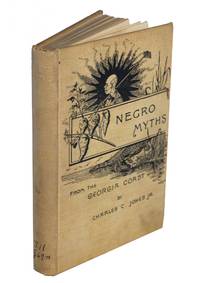
1888ref. 177281888. Jones Charles C. Negro Myths from the Georgia Coast 1888 presenting a late nineteenth-century compilation of African American folklore recorded in the Gullah dialect of the Georgia and South Carolina coastal region with direct relevance to the study of Black oral traditions linguistic history and post-emancipation cultural expression. The volume gathers fable-like narratives often centered on anthropomorphic animals that reflect storytelling traditions rooted in African diasporic heritage and adapted within enslaved and freed communities of the coastal South. Its use of Gullah a Creole language shaped by West African linguistic structures and English situates the work within ongoing efforts of the period to document vernacular speech and preserve forms of cultural expression that had developed under slavery and persisted into Reconstruction and beyond. Jones Charles C. Negro Myths from the Georgia Coast. Boston and New York: Houghton Mifflin and Company 1888. First edition. The text is rendered in Gullah dialect reflecting the linguistic patterns of African American communities along the Georgia and South Carolina coasts including areas around Savannah and Charleston. Jones raised in a plantation environment and familiar with the regional speech patterns compiled these narratives as part of a broader nineteenth-century interest in folklore and dialect studies contributing to early written records of Gullah language and storytelling traditions. Single volume. Ex libris. Minor foxing to the front pastedown and bumped corners; overall very good condition. A late nineteenth-century printed record of African American folklore and language from the coastal South documenting narrative forms and speech patterns that remain central to the study of Gullah culture and linguistic history. unknown
2010ref. DADAX1163921920Kessinger Publishing 2010-09-10. paperback. New. 6.00x1.24x9.00. Buy with confidence. Excellent Customer Service & Return policy. Kessinger Publishing paperback
2008ref. DADAX143682124XKessinger Publishing 2008-06-29. paperback. New. 8.25x1.01x11.00. Buy with confidence. Excellent Customer Service & Return policy. Kessinger Publishing paperback
2007ref. DADAX0548609047Kessinger Publishing 2007-10-02. paperback. New. 6.00x1.36x9.00. Buy with confidence. Excellent Customer Service & Return policy. Kessinger Publishing paperback
ref. A9781163921920Paperback / softback. New. paperback
ref. A9781345071740Hardback. New. hardcover
2001ref. BN444567Stichting Uitgeverij Historische Vereniging Nijverdal En Omstreken 2001. 2001. Softcover. Arfgoed. Uutdrukking'n Sprekwoarn en Sprekwiezen in de sproake van de gemeente Heldern Arfgoed. Uutdrukking'n Sprekwoarn en Sprekwiezen in de sproake van de gemeente Heldern Alferink Johan voorwoord & Hennie Kuipers tekneingen & Werkgroep Dialect van de Historische Vereniging Nijverdal en Omstreken Stichting Uitgeverij Historische Vereniging Nijverdal En Omstreken paperback
ref. 46467711-nnew. unknown
ref. P5881Prague: Družstevní Práce 1935. Octavo 19.8 × 12 cm. Original embossed ochre cloth orange dust wrappers by Ladislav Sutnar; 8 115 2 pp. Frontis drawing by Ferdiš Duša. Light sun-tanning to spine; else very good or better in very good dust jacket. Scarce third book of poems by this Silesian poet who became famous for defending the rights of speakers of the so-called Lach dialects a group of dialects situated between the Czech and Polish languages. Although Åysohorsky grew up speaking German and initially published in German he later refused to write in standard Czech publishing numerous works in Lachian. A scholar of Slavic studies he systematized the grammar of Lachian and created the first published works using this dialect. Claiming persecution by Czech authorities who refused to recognize Lachian as an independent language he later asked Stalin to intercede on his behalf. He spent time in the Soviet Union and Boris Pasternak even translated several volumes of his poetry. Because of his controversial status in Czechoslovakia his books were later banned and removed from libraries and the book trade. Nevertheless because he was a poet of the oppressed and of the working class Åysohorsky found acclaim with the Czechoslovak interwar leftist literary and artistic scene. This book also serves as an introduction to the Lach dialect with a long dictionary and introduction to pronunciation and a note that the orthography and grammar is based on an 1898 work by Jan Loriš. Binding by František Muzika typographic design and wrappers by Ladislav Sutnar. Outside the Czech Republic KVK OCLC show copies at Bamberg and Regensburg University Herder Institut Oxford UCL and Urbana-Champaign. unknown
1954ref. 9031Lancashire Dialect Society 1954 -1966. 11 parts 8vo. original printed wrappers wire-stitched as issued a very good clean run. Sold from an institution with its annotations on front wrappers and cancelled bookplates on front inside wrappers. The run comprises nos. 4 Dec 1954 5 Dec 1955 6 Dec 1956 7 Jan 1958 8 Jan 1959 9 Jan 1960 10 Jan 1961 11 Jan 1962 13 Jan 1964 14 Jan 1965 and 15 Jan 1966. Runs of this publication are to say the least uncommon. Lancashire Dialect Society, unknown
ref. B9781019914649Hardback. New. hardcover
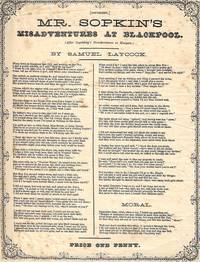
ref. 7394Publisher and date not stated. At foot: 'PRICE ONE PENNY.' On one side of a piece of wove paper roughly 220 x 170 mm. Enclosed within decorative border. Foxed and creased with edges trimmed to edge of border. Thin strip of card mound adhering to one edge of reverse. Text clear and entire. Printed in two columns employing characteristically Victorian typography. Twenty-six four-line stanzas the last two being the 'MORAL.'. Begins 'When down at Blackpool last July and walking on the Pier I met a pretty maiden so I said "How do my dear" "What do you here love by yourself How is it you're alone Come tell me all about it now and where your sweetheart's gone." ' The woman is a confidence trickster and the narrator loses his cane hat and 'best cloth coat' before 'Detective Twig'em' is called in. No copy on COPAC or in the British Museum. The poem may have featured in earlier editions but it was certainly collected in the third edition of Laycock's 'Warblin's fro' an Owd Songster' Oldham 1894. See Image Publisher and date not stated. hardcover
ref. B9781021089076Hardback. New. hardcover
ref. A9781344649186Hardback. New. hardcover
ref. B9781016713344Hardback. New. hardcover
1697ref. ST15929aYork: J. White for Francis Hildyard 1697. Third Edition. 157 x 92 mm. 6 1/4 x 3 5/8". 2 p.l. 124 pp. Dark blue crushed morocco by Charles Lewis rear flyleaf with early owner's ink notation to this effect giving 1831 as the date of the binding covers bordered by three gilt rules raised bands spine compartments with rows of gilt flowers tan morocco label gilt-rolled turn-ins marbled endpapers all edges gilt. Front pastedown with engraved armorial bookplate of William Gott; 1906 article reporting on a sale at Sotheby's mentioning this volume specifically laid in at front; rear flyleaf with ink note: "Hibberts sale. 1829 / binding by C. Lewis 1831." Wing M-1810; ESTC R19511. Very slight signs of wear to leather but the attractive binding extremely well preserved and very pleasing. Leaves apparently lightly pressed some foxing and browning to the title page occasional minor foxing elsewhere small repairs to worming on upper corner and head edge of A2 but still a clean and fresh copy internally. First printed in 1685 this is a book with two very different parts the first being a rowdy and amusing poem on Yorkshire ales and the second a much more serious and important linguistic work on the Yorkshire dialect--both offered here in a binding by a prominent English craftsman. Scion of a landed county family and author of well-regarded legal treatises attorney George Meriton 1634-1711 began to create a record of the Yorkshire dialect in 1683 when he published "A York-shire Dialogue in its Pure Natural Dialect." A second edition was printed in 1685 prefaced by the poem "The Praise of York-shire Ale" and with the addition of a pioneering dialect glossary. Our third edition includes more dialogues in the York dialect. According to linguist Martyn Wakelin Meriton's work is still "of the utmost value to our knowledge of late 17th century northern phonology." In addition the work was influential in encouraging others to document regional dialects in Britain. This is an uncommonly seen item. The son of a Hanoverian immigrant Charles Lewis 1786-1836 was apprenticed to Henry Walther at 14 and obtained his freedom in 1807. He set up a shop in Scotland Yard had other addresses in the Strand before establishing himself in Duke Street St. James in 1817. By 1823 he was employing 21 journeymen a number of whom are illustrated in a watercolor of the bindery reproduced in Middleton's "A History of English Craft Bookbinding Technique" p. 349. Lewis was patronized by the great collectors of the day including William Beckford who favored him above all others. In a letter to the bookseller George Clarke written in 1831--the year our binding was done--Beckford declared: "Lewis was and is and I hope will continue to be the first artist in this line that Europe can boast of." Our tasteful binding is a fine and well-preserved example of his work. The provenance here is significant. The first known owner of our volume was the outstanding book collector George Hibbert F.R.S. 1757-1837 Member of Parliament wealthy shipowner and one of the earliest members of the Roxburghe Club elected 1816. This copy of Meriton is almost certainly lot #4914 in the "Catalogue of the Library of George Hibbert Esq. of Portland Place" London 1829 p. 267. Historian David Hancock in Oxford DNB characterized Hibbert as "a renowned collector of paintings sculpture and books." Afterwards the volume was in the collection of Yorkshire bibliophile and industrialist William Gott 1797-1863 who "built up a magnificent collection of rare books." University of Leeds Library website The laid-in article at the front referring to a Sotheby’s sale in the early 20th century must refer to a third distinguished owner and a second vigorous bibliophile of the Gott dynasty of Yorkshire-born collectors William’s son John Gott 1830-1906 Bishop of Truro. Two years after the Bishop’s death his library was sold by Sotheby’s in a "Catalogue of the Choice Library of Valuable and Rare Printed Books and Ancient Manuscripts of the late Rt. Rev. John Gott D.D.". J. White for Francis Hildyard unknown