534 résultats
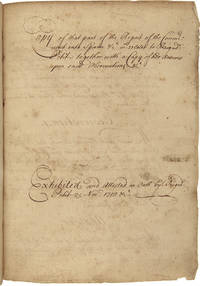
1708réf. 53351Minorca Spain. 1708–1713. Important Documents of the War of the Spanish Succession A lengthy and highly detailed manuscript volume containing documents related to the British takeover of Minorca after its capture from Spain during the War of Spanish Succession and an investigation into the governance of the island. In September 1708 British forces occupied the Mediterranean island with little opposition the inhabitants and nobles having mostly supported the Anglo-Dutch designs for the Spanish throne. The inherent importance of the island as a military outpost and trading way point in the Mediterranean led the British to occupy it for the rest of the war and to receive it as a possession in the Treaty of Utrecht which ended the conflict in 1713. The documents collected here relate to the English Brigadier Lewis Petit who served as Lieutenant Governor and Chief Engineer of the island during its occupation. As Chief Engineer Petit was in charge of improving the fortifications and defenses of Minorca and although a Spanish ally was named as titular Governor Petit exercised the true authority over the island. Although his improvement plans may have been sound his management of the island's public moneys was suspect. "Petit somehow found time to enter into commercial speculations on his own account. In partnership with two Spaniards and Stanhope's secretary Arent Furley Petit purchased a French prize at Mahón for 7800 dollars with which to trade between Minorca Majorca Sardinia and the Spanish and Barbary coasts. He advised Furley that he had found it necessary to use funds supplied for the fortifications to complete the purchase and urgently requested capital from his partners to repay this misappropriation. Petit's participation was valuable to the enterprise owing to his ability to land cargoes at Mahón without paying duty an activity much objected to by the local town government. "Petit was soon to find himself under the scrutiny of the inspectors sent from London to investigate irregularities in the expenditure of the army in Spain as an attempt to disgrace the previous ministry.The accusations against him concerned imperfections in his accounts including allegations of missing vouchers irregularities and overcharging in the numbers of workmen and mules and alleged differences between prices contracted and prices paid among other charges" - DNB. The documents compiled here therefore relate principally to the investigation of those actions by a specially convened Board of Commissioners and contain Petit's written responses to specific inquiries about his expenditures. In transmitting these answers the reports provide a detailed perspective regarding the management of Minorca's finances defenses and engineering improvements under Petit's charge. Moreover in order to buttress or to undermine those claims voluminous correspondence financial figures construction reports testimonies affidavits and other material are reproduced that span the length of the British occupation of the island before it officially became a possession. As a result the manuscript documents contained here provide a thorough encapsulation of the economic and military situation on Minorca and the growth of its importance as a British outpost in the Mediterranean. A highly valuable set of manuscript documents that meticulously details the development and management of a British possession gained through the War of Spanish Succession worthy of much deeper research. Thick quarto. Later three-quarter calf and marbled boards. Moderate wear to edges and spine extremities boards rubbed corners bumped. Small later ownership inscription on front pastedown. Light foxing and tanning marginal dust soiling. Composed in a neat legible hand. Very good. Untrimmed. DNB online. hardcover
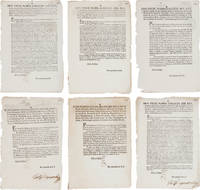
1561réf. 63610México. March 15 - November 6 1813. Rare Mexican Printings of Twenty-One Decrees from Spain's First Constitutional Government A substantial and significant collection of twenty-one rare Mexican printings of Spanish decrees issued by the short-lived but deeply influential constitutional government established in 1812. Each of these decrees was promulgated in Mexico by the Viceroy of New Spain Félix María Calleja del Rey y de la Gándara primer conde de Calderón in 1813. Drafted and ratified in the absence of any monarch Joseph Bonaparte had been rejected by the Spanish and the ousted Ferdinand VII had yet to return the constitution of 1812 followed a period of great political upheaval and married the liberal ideals of the French Revolution with an abiding fear of its outcome resulting in Spain's first ever constitutional monarchy. While the constitution left some power in the hands of the King his absence at the time of its implementation meant that Spain was effectively ruled by a constituent congress and regency council which notably included for the first time representatives from all of Spain's overseas dominions as well as the provinces on the Iberian Peninsula. The considerable majority of the proclamations in this group deal with the repercussions of this dramatically new form of government including clarifying details of the constitution publicly printing some of its laws and regulations and organizing programs meant to protect its legitimacy and longevity. While changes in home government and the Napoleonic Wars were certainly relevant to colonies in the New World a handful of these decrees also relate more materially to the Western Hemisphere including some related to colonial trade and the ongoing war for independence in Venezuela. All of the present documents were promulgated in Mexico City and are signed in type and most of them rubricked in manuscript by the Viceroy Félix María Calleja. Calleja was a general sent to New Spain in 1810 to put down the early rumblings of Mexican independence which he did with ruthless efficiency. He was Viceroy from 1813 to 1816 when he was replaced for fear that his merciless stamping of the insurrection would only further stoke the fires of anti-Spanish sentiment. The full list of decrees in this group ordered by the date they were promulgated by Calleja and accompanied by brief notes on their contents is as follows: All twenty-one documents share the same caption title: Don Felix Maria Calleja del Rey Bruder Losada Flores Campeño Montero de Espinosa Mariscal de Campo de los Exércitos Nacionales Virey Gobernador y Capitan General de Esta N.E. Presidente de Su Audiencia Superintendente General Subdelegado de la Hacienda Pública Minas Azogues y Ramo del Tabaco Juez Conservador de Éste Presidente de Su Junta y Subdelegado General de Correos en el Mismo Reyno. 1 El Orden de las Cortes Generales y Extraordinarias Comunicada…Que en los Papeles de Oficio Usen Siempre el Gobierno y Todas las Autoridades del Mismo Lenguage Que Usa la Constitucion.first lines of main text. March 15. Decrees that all official government papers should follow the language of the new constitution. 2 La Regencia del Reyno Se Ha Servido Levantar el Riguroso Bloqueo en Que Se Hallaba Puerto Cabello en la Provincia de Caracas. March 31. Lifts the Spanish blockade of Caracas now that a peace arrangement had been made with the insurgents in Venezuela. While the Royalists took back the province and the "First Republic of Venezuela" was officially ended in late 1812 it would only be a few months before Simon Bolívar returned and Caracas changed hands once again in the ongoing war for independence. 3 El Consejo de Estado y el Supremo Tribunal de Justicia Que Con Arreglo à la Constitution Política de la Monarquía Española Se Sirvieron Crear las Córtes Generales. March 31. Announcing that the Córtes Generales created by the new constitution and which was effectively the new governing body of the empire is officially in effect and performing duties as described in that document. 4 Las Córtes Generales y Extraordinarias Convencidas de la Necesidad y Utilidad de Que los Expedientes Sobre Infraccion de la Constitucion Sean Determinados Con la Mayor Prontitude Decretan. April 27. Declares that courts will prioritize cases regarding constitutional infractions above all others—one of many decrees particularly concerned with maintaining loyalty to the constitution. 5 Las Córtes Generales y Extraordinarias Queriendo Fixar Por Todos los Medios Posibles en la Memoria de los Españoles la Feliz Época de la Promulgacion de la Constitucion. May 22. In celebration of "the joyous event of the promulgation of the constitutional monarchy" this decree renames the public plaza in which the document was promulgated in every city in the empire to the "Plaza de Constitucion" and orders that a stone marker or monument be built to commemorate the event. When Ferdinand VII was reinstated as absolute monarch in 1814 monarchists tore down many of these monuments in celebration. Others remain to the present day including one in St. Augustine Florida which was still in Spanish hands in 1813. 6 Las Córtes Generales y Extraordinarias Con el Justo Fin de Redimir los Montes y Plantíos de Dominio Particular. May 25. 17 × 12 inches. A notable law removing all regulations on the use of private lands. Land owners would now be allowed to farm collect lumber hunt fish or otherwise profit from their land however they choose. The body of the decree begins our translation: "All laws and ordinances of forests and plantations are repealed and annulled in all their parts insofar as they concern those of private ownership and as a consequence the owners are left in full and absolute freedom to do with them what best suits them without subjection." 7 Las Córtes Decretan Que Ecsen los Individuos Que Actualmente Coponen la Regencia del Reyno y Que Se Encarguen de Ella Provisionalmente los Tres Consejeros de Estado Mas Antiguos Que en el Dia Se Hallan en Deicho Consejo Que Son. July 2. 17 × 12 inches. Appointing a new provisional regency to replace the regency which preceded the constitution to consist of Pedro Agar Gabriel Ciscar and the Archbishop of Toledo. 8 Atendiendo las Córtes Generales y Extraordinarias à la Importancia y Necesidad de Que No Solo los Individuos del Supremo Tribunal de Justicia Sino Tambien los Demas Magistrados y Jueces de Qualquiera Otro Tribunal. July 8. Establishes qualifications for judges and magistrates at all levels. In an attempt to reduce nepotism and ensure the proper enforcement of the new constitution all employees of the judiciary "must enjoy a positive public reputation be accredited in their field possessed of selflessness and good morals dedicated to the Constitution and to have proven themselves in reality to be friends of independence and the political freedom of the nation" our translation. 9 S.M. C D. Fernando VII Rey de España y de las Indias y S.M. el Emperador de Todas las Rusias Igualmente Animados del Deseo de Restablecer y Fortificar las Antiguas Relaciones de Amistad Que Han Subsistido Entre Sus Monariquías. July 13. 16 × 12 inches. The Mexican printing of this treaty between Spain and the Russian Emperor Nicolas I. It is a treaty of amity and commerce as well as a formal military alliance "with the express intention of waging a vigorous war with the Emperor of France their common enemy." 10 La Clase de Guerra Que el Enemigo Comun de los Pueblos de Europa Ha Heco y Hace a Esta Heroycion: Los Exquisitos Pero Siempre Pérfidos Medios Que Ha Puesto en Practica Para Dominarla. August 5. 17 × 12 inches. A solemn and dramatic public warning about the perfidious effects of disloyalty and internal division. Other governmental decrees are referenced including specific reference to numbers four and eight described above. 11 Deseando S.A. Dar un Testimonio Indudable de Su Religiosa Puntualidad en el Cumplimiento de Quanto Prescribe la Constitucion Politíca de la Monarquía. August 11. States that the secretary of state does not have the authority to pardon deserters who present themselves for trial. They will be sent to their respective companies to be judged by them in accordance with the severity of their crime notwithstanding special cases where an individual might be pardoned by the Regency. 12 Las Córtes Generales y Extraordinarias Decretan: El Supremo Tribunal de Justicia Debe Conocer de los Recursos de Nulidad Que Se Interpongan de las Sentencias Dadas en Última Instancia. August 21. Decrees that the supreme court will hear appeals from the previous session's special courts. 13 Las Córtes Generales y Extraordinarias Considerando Que la Reduccion de los Terrenos Communes á Dominio Particular Es Una de las Providencias Que Mas Imperiosamente Reclaman el Bien de los Pueblos. August 23. 21½ × 16¾ inches printed in two columns. A monumentally important law decreeing that all publicly owned lands in Spain the outlying islands and all of her colonies in the New World would be converted to private property. The broadside prints the full text of the law and begins: "The Córtes Generales.considering that the reduction of common lands to private ownership is one of the provisions that most imperiously demand the good of the people and the promotion of agriculture and industry and wanting at the same time to provide with this type of land an aid to public needs a reward for worthy defenders of the country and relief for non-proprietary citizens." Despite the lofty language realistically this law formed part of an ongoing program of confiscation of lands in order to defray mounting debts from the internal and external conflicts of the late 18th and early 19th centuries. The law divided the confiscated property into two even portions: one would be sold at auction and the proceeds contributed directly to the national debt the other would be divided into lots and apportioned to veterans or sold for a fee to landless citizens. 14 Las Córtes Generales y Extraordinarias…Se Propusieron Abrir la Carrera del Honor y Da la Gloria á los Hijos de las Familias Honradas de la Monarquía. September 2. 17 × 12 inches. In order to sustain the "positive feelings and equality" won by the war the government decrees that college university and military admissions cannot take into account whether or not someone is nobility even if that information is offered voluntarily. Along the same lines they also are not allowed to "permit expressions or distinctions which contribute to the fomentation in their ranks of the perfidious ideals of legal inequality or class rivalry." 15 Las Córtes Generales y Extraordinarias Considerando Que el Aniversario del Diez y Nueve de Marzo en Que Se Publicó la Constitucion. September 7. With Calleja's manuscript rubric but not signed. Outlines ceremonies for the upcoming first anniversary of the constitution. Every church is to sing a solemn Te Deum and an artillery salvo is to be fired in the public square of each city. 16 Las Córtes Generales y Extraordinarias Decretan: 1. La Regencia Actual de las Españas Compuesto Del. September 8. Decrees that the provisional regency is no longer provisional but actual and appoints the Archbishop of Toledo as its president. 17 Debiendo las Córtes Generales y Extraordinarias Fixar los Términos en Que la Regencia del Reyno Ha de Exercer Su Autoridad. September 10. 22¾ × 16 inches printed in two columns. Prints the rules and regulations related to the now official Regency council its composition and the extents of its power. The Regency's chief mission is described as to "Uphold the Constitution and its laws protect the individual liberty of the citizens and to elevate these over both the conservation of public order within and the security of the nation without." 18 Habiendo Ocurrido á la Regencia del Reyno el Diputado en Córtes Por Maracaybo D. José Domingo Rús. September 28. No rubric or signature. Responding to a petition by a citizen of Venezuela the Regency grants free import and export of all tools machines and artifacts for agriculture and industry to the province of Maracaybo. 19 Hemos Dado Cuenta á las Córtes Generales y Extraordinarias de la Consulta. September 30. No rubric or signature. Decrees that all persons involved in cases regarding a constitutional infraction should be suspended from employment and duties for the duration. 20 Las Córtes Generales y Extraordinarias Enteradas de Que Quasi en Todos los Puertos de la Península Se Cobraba Por Cuenta de la Inquisicion. October 20. No rubric or signature. Repeals certain duties levied by the Inquisition which was abolished by the new constitution. The text begins our translation: "The General Courts aware that in almost all the ports of the Peninsula vessels were charged on behalf of the Inquisition upon entering them and when they were foreigners or coming from foreign ports a right known as the Right of Inquisition and tax on on boxes of books assortments of prints handkerchiefs and printed fabrics boxes of tobacco and other effects." 21 Las Córtes Generales y Extraordinarias Decretan Por Punto General: Que la Facultad Que Segun la Pragmática de Matrimonios. November 6. In an unusual move for the generally liberal new government this text states that the Real Pragmática Sanción de Matrimonios continues in effect. The Pragmática required all males under the age of twenty-five and all females under the age of twenty-five of any class or race to secure formal consent from their fathers in order to marry and applied to Spain as well as all of its overseas possessions. As of 1803 the father was not required to supply any reason whatsoever for denying a marriage proposal and the law was generally seen as a tool to maintain strict class divisions. These broadside decrees printed in Mexico at an important moment in Spanish constitutional history are rare in the market and institutionally. We locate only a few copies of each in OCLC. A remarkably thorough and continuous set of rare Mexican printings of Spanish decrees from this time of great political and military turmoil and clearly demonstrating the direct influence of affairs in Europe on colonies in the Western Hemisphere. Old folds. Varying degrees of edge wear. Scattered tanning and staining. Very good. unknown
réf. 371476Amsterdam: Joseph Jacob and Abraham the sons of Solomon Proops 5522. Titled printed in red and black. 2 178 2 179-332 10 Introduction etc. 2 160 2 161-350pp. Publisher's introduction and other preliminaries misbound preceding the later Prophets. Folio 15-7/8x10 inches. Nineteenth or early 20th century half morocco and marbled paper boards rear joint splitting worn at joints and head and tail of spine. Foxing principally to the title tear to the final text leaf. Provenance: General Theological Seminary bookplate. Titled printed in red and black. 2 178 2 179-332 10 Introduction etc. 2 160 2 161-350pp. Publisher's introduction and other preliminaries misbound preceding the later Prophets. Folio 15-7/8x10 inches. Besides being the first bi-lingual edition in Hebrew and Spanish this edition is the first Hebrew book whose publication was financed by an American - Abraham Mendes de Castro 1689-1762 of Curaçao - intended for use in the West Indies with the sale proceeds to benefit the Jewish communities of Jerusalem and Hebron. Cowley 102; Darlow & Moule 5156; Zedner 102; not in Steinschneider or Roest Joseph, Jacob and Abraham, the sons of Solomon Proops unknown
1550réf. 67900En Leon i.e. Strassburg: en Casa de Sebastian Grypho i.e. Augustin Fries 1550. BIBLE IN SPANISH; ENZINAS Francisco de. First Edition in Spanish of Ecclesiasticus BIBLE IN SPANISH. ENZINAS Francisco de translator. Ecclesiastics. Libro de Jesus Hiio de Syrach qu'es llamado el Ecclesiastico. traduzido de Griego en lengua Castellana En Leon i.e. Strassburg: en Casa de Sebastian Grypho i.e. Augustin Fries 1550. First edition in Spanish of Ecclesiasticus. Small octavo 6 x 3 5/8 inches; 151 x 91 mm. 3 109 leaves. With numerous woodcut initials. With an imitation Gryphius woodcut device printed in reverse on title. We could only locate 3 copies at libraries Cambridge Madrid and Copenhagen. No other copy besides this present copy has been at auction in the past 50 years. Early 19th-century mottled sheep. Boards tooled in gilt. Spine stamped in gilt. With red morocco spine label lettered in gilt. Board edges tooled in gilt. Marbled endpapers. Some minor dampstaining mainly to lower blank margin of preliminaries. Signature G is toned. Leaves O3 and O4 with marginal paper repair not affecting text. Final leaf is toned and has a near invisible paper repair not affecting text. Overall a very good copy. "A native of Burgos educated at Louvain and Wittenberg Francisco de Enzinas 1518-52 was a humanist scholar and Protestant convert who produced the first Spanish version of the New Testament printed in 1543 in Antwerp. He formed a partnership with the Strassburg printer Augustin Fries to publish Spanish translations of Greek classics and the remainder of the Bible of which he was only able to complete Psalms Ecclesiasticus Job and Proverbs before his death. Baudrier VIII 241 not having seen or located a copy citing Brunet supplement II 712" "Even before the complete edition of Castellio's Latin Bible appeared Enzinas who had already produced a Spanish Bible New Testament in Antewerp in 1543 had translated the Psalter the Wisdom of Solomon Jesus Sirach present copy and the book of Job into Spanish. All of these appeared with the false address 'En Leon en casa de Sebastian Grypho' though they were in fact his translations from manuscript versions of Castellio's edition. Enzinas continued to work on his translations until his death on 30 December 1552. He had planned to have his Spanish Bible printed in Geneva but this fortunately for Calvin never came to pass." Gilly Spanien und der Basler Buchdruck pp. 342-9 510-11. Found in Sebastian Castellio 1515-1563: Humanist and Defender of Religious .By Hans R. Guggisberg Bruce Gordon. "FRIES Augustine: printer in Zurich and Strasburg began to print at the former place about 1540. In 1547 he printed two books in English by John Hooper Heitz p. 39. Soon after this he moved to Strasburg and there printed among other things several works in Spanish by Franzisco de Enzinas in 1550 and 1551 Wiffen I pp 179 etc." A Century of the English Book Trade: Short Notices of All Printers. By Edward Gordon Duff. HBS 67900. $8500. en Casa de Sebastian Grypho [i.e. Augustin Fries] unknown
réf. RGW19164AEtching and burnished aquatint TRIAL PROOF ON THIN JAPAN PAPER before all letters This is a posthumous printing but before the edition printed in 'L'Art' in 1877. Harris considers the quality of these impressions almost identical to the working proofs. unknown
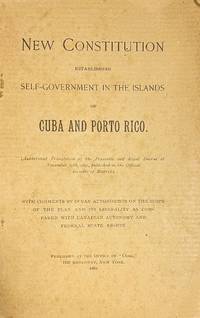
1898réf. 3455New York: Published at the Office of "Cuba" 1123 Broadway 1898. First edition. In original printed wrappers. Wrappers creased and dented; spine missing at bottom. Corners dog-eared. A few pages with wormholes not affecting text. Otherwise in very good condition. First edition. In original printed wrappers. 74 2 pp. Rare first edition of Spain's 1897 grant of autonomy to Cuba and Puerto Rico-its last failed attempt to retain the islands through reform and the first constitutional success for the Cuban and Puerto Rican autonomist movements. Issued by Cuban autonomist exiles in New York this publication presents the full English translation of the Royal Decree of November 25 1897 signed by Queen Regent María Cristina which established broad local self-government for Cuba and Puerto Rico. It is accompanied by political commentary from Eliseo Giberga a leader of the Cuban Autonomist Party and editorials from El País the party's principal newspaper in Havana. The decree promised legislative authority to elected insular parliaments universal male suffrage civil and political equality with mainland Spaniards and control over finance commerce education public works and internal justice while reserving military naval and foreign affairs to the Spanish central government. A unique provision among colonial constitutions preserved the islands' representation in the Spanish Cortes. Although hailed at the time as realizing "the dream of three generations of Cubans" the new constitutional system was overtaken by events. After the sinking of the USS Maine and the outbreak of the Spanish-American War in 1898 Spain was forced to cede Puerto Rico to the United States and withdraw from Cuba rendering the newly granted autonomy largely theoretical. The political structure outlined in this decree was never fully implemented. The publication also offers comparative analysis asserting that the rights granted exceeded those enjoyed by Canadian provinces under the British North America Act of 1867 and in some respects by U.S. states. It preserves the vision of peaceful constitutional reform promoted by the Cuban Autonomist Party soon eclipsed by military occupation and the shift toward independence under American influence. This volume captures Spain's last liberal attempt to modernize its empire-a transitional political vision for Cuba and Puerto Rico that was quickly overtaken by war U.S. intervention and the collapse of Spanish colonial rule in the Americas and Pacific. It is also a key document in the history of Cuban constitutionalism and Puerto Rican political status. Rare particularly in original wrappers; only a handful of institutional holdings recorded. RBH lists only one copy sold in the past fifty years Sotheby's 2021. . Published at the Office of "Cuba," 1123 Broadway unknown
1820réf. ZB394212American Association of Teachers of Spanish and Portuguese 1918-2000. volumes 1-83; lacks 9-12. 1918-2000. partly bound library markings textually clean & tight price is for the set. - If you are reading this this item is actually physically in our stock and ready for shipment once ordered. We are not bookjackers. Buyer is responsible for any additional duties taxes or fees required by recipient's country. Photos available upon request. American Association of Teachers of Spanish and Portuguese unknown
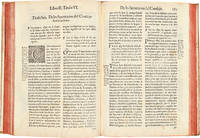
1681réf. 40803Madrid. 1681. Including Laws Regulating Indigenous Peoples and Banning the Encomienda The first comprehensive compilation of the laws of the Spanish Indies. Antonio Rodríguez de León Pinello compiled it by 1635 but it circulated only in manuscript until Fernando Jiménez de Paniagua brought it up to date and saw the work through the press in 1681. Prior to the publication of this massive work it was common practice for lawyers and courts in the various legal districts of the New World i.e. audiencias to compile in manuscript the laws in force in order that they might be used as precedents. Upon publication of this code the number of precedents did not decrease but increased: the courts continued to accept the cases and laws in the old local manuscript compilations as well as those on point and laws contained in the Recopilación. In sum this is a major work for all collections of international and Hispanic specific law. Folio. Later sheepskin leather labels. Binding rubbed at extremities. Light soiling to titlepages titlepage of first volume backed with paper. Minor soiling to text; some heavier dampstaining to first volume. Overall very good. SABIN 68386. PALAU 252516. EUROPEAN AMERICANA 681/135. hardcover
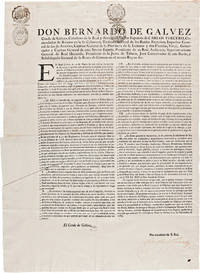
1785réf. 57874Mexico. November 22 1785. Announcing the Compañia Real de Filipinas Regulating Trade with the Philippines A very rare Mexico City printing of the announcement of the creation of the Royal Company of the Philippines by Spanish royal decree in 1785 which regulated and effectively monopolized trade with the Philippines. This copy bears the manuscript rubric of Don Bernardo de Gálvez and signature of his secretary Joseph de Gorraes. Gálvez then Viceroy of New Spain ordered this broadside printed for the reason that "An Establishment so important and of such general interest should be understood and known by all" our translation. The creation of the Royal Company would be particularly relevant to residents of Mexico as most if not all of the trade with the Philippines would come through New Spain. Accompanying the announcement this broadside also prints Articles 1 2 14 21 and 100 of the royal decree which were considered to effectively summarize the purpose and mechanics of the new Company. The articles printed here proclaim that the Company is to enjoy the protection of the Crown for at least twenty-five years establish a fund to back its shares describe how shares and subscriptions could be purchased and organize a general meeting of shareholders. Notably absent from this broadside is the important article of the decree which closed Manila's ports to foreign vessels giving the Company an effective monopoly on all trade between Asia and the Americas. The Royal Company of the Philippines quickly gained vast wealth from this lucrative deal transporting commodities such as indigo coffee sugar spices and cotton across the Pacific. Regardless of its initial success the Company did not endure - the wave of rebellions against Spanish rule in Central and South America in the early 19th century quickly rendered it obsolete and the company was officially dissolved in 1834. A rare broadside announcing this important Royal Decree to the people of the Western Hemisphere; OCLC records only one copy at the Bancroft Library. Broadside printed on two joined sheets of sealed paper 23½ x 17 inches in total. Old folds and light creases a few small worm holes. Very good. OCLC 21747301. unknown
1911réf. 030666Madrid: Imprenta Espanola / Fernando Fe / Victoriano Suarez 1911. 1st Edition 1st Printing. Soft cover. Near Fine. 291 Pp 1 Pp Advertisement For The Author's Works. Original Beige Wrappers Printed In Black Priced 3 Pesetas On Spine. Inscribed By Unamuno To The Cervantes Scholar Rudolph Rodolfo Schevill And Dated In Salamanca Vi/11 June 1911 The Year Of Publication. Covers With Slight Browning More Browning To Spine Water-Staining At Upper Right Corner Edges Of Rear Cover To 1/4" Deep But No Traces Elsewhere On Covers Or Pages. Contents Fine Pages Unopened Still Attached At Top. A Book Of Poetry Noted By Some As Containing The Finest Sonnets In The Spanish Language. Imprenta Espanola / Fernando Fe / Victoriano Suarez paperback
1701réf. ABC_48243Amsterdam 1701. Small 4to ca. 20 x 15 cm. Nicolas Chevalier Contemporary limp vellum with the manuscript title on the spine and a paper shelf mark label at the foot. With a general title and 2 divisional titles for ad 6 and ad 11 all with a woodcut vignette further with 2 hand-coloured engraved maps 1 folding engraved plate and several woodcut initials. 12 parts in 1 volume. 134 pp. Collection of very rare pamphlets and printed letters published under a collective title on the actual political circumstances of Northern Europe in the years 1699-1701 especially in connection with the death of the Spanish King Charles II born in 1661 in 1700 leading to the War of the Spanish Succession 1701-1714. The work includes 2 maps of Flanders and a folding plate of the Battle of Narva which took place on 30 November 1700. Although the pamphlets and letters were printed separately the present collection appears to be very rare as we have not been able to find any other copies with the same contents.Charles died childless. His possessions would go to one of his brothers-in-law: the French King Louis XIV 1638-1715 or the German Emperor Leopold I 1640-1705. Both had agreed already beforehand that they would divide Charles heritage to avoid disturbance of the European balance of power. In his last will however Charles had appointed the grandson of Louis XIV as his successor named from now on Philip V of Spain 1683-1746. The Treaty of The Hague affirmed this in 1701. With the deaccession stamp of the "Bibliothèque municipale de Nîmes" on the title page and its shelf mark label at the foot of the spine. The vellum at the foot of the spine with a tear the boards are somewhat stained. The leaves are occasionally browned and foxed. Otherwise in good condition.l Cf. Knuttel no. 14.510 ad 1 14.543 ad 6 14.588-14.589 ad 9 14.538 ad 10 and 14.538 a comparable collective title page with the imprint "Amsterdam Daniel de la Feuille 1701" with various texts ca. 78 pp.; STCN 317179241 1 copy the same general title page but with only 3 letters all different from ours. EUROPE HISTORY MILITARY HISTORY Broadsides Ephemera & Pamphlets France History / 17th Century History / 18th Century Military History 17th Century Military History 18th Century Spain hardcover
1787réf. 135132Madrid: En la Imprenta Real 1787. First nationwide Spanish census First edition of Spain's first nationwide census the census of 1787. The first census in Spain was undertaken in Castile as early as 1594 and there was a census of the Spanish Empire in 1776 but this was the first which embraced the whole country. It is sometimes known as the Census of Floridablanca after the reformist prime minister Count Floridablanca under whom it was undertaken from 1785 to 1787. The 43 tables list the regions of Spain alphabetically from Andalucia to Valencia but also include the Balearic and Canary Islands. The data accounts for the number of persons their ages religious affiliation and social status. The final population count is 10409879. Although the census did display modern demographic techniques the attempts to classify the population on class and occupation proved too rudimentary - servants were not classified in any consistent way and the scope of the hidalgo class varied considerably from region to region. Even so the census was a considerable demographic achievement and remains studied in modern Spanish demography; it is considered more accurate than the subsequent Spanish census of 1797. Quarto 301 x 225 mm. With 43 printed tables and large printed folding table at rear. Contemporary quarter sheep smooth spine ruled in gilt with green calf label marbled paper sides edges speckled red. Inked number "153" to title page. Scuffing and wear around extremities contents clean leaf a4 creased minor paper faults to tables XVIII and XXVIII 6 cm closed tear to map. A nice unrestored example. Goldsmiths' 13352; Palgrave I 242. unknown
1916réf. 73065Hongkong: printed by the Chinese Printing and Publishing Co. . No. 51 Gough Street 1916. First edition 8vo pp. viii 264; text in Chinese Spanish and English; mid-20th century black cloth gilt lettering on spine; light toning else a very good sound copy. "Relations between the then Empire of China and the Republic of Costa Rica began in 1911 with the arrival of the Chinese diplomat Tam Pui-Shum on Costa Rican coasts where he was received by the president of the country government authorities and representatives of the Chinese colony. Tam was the author of a Chinese-Spanish dictionary and a translation of Don Quixote into Chinese . introducing Spanish literature to the Chinese-speaking world . He had been China's representative to Spain and Mexico and was introduced as Special Commissioner of the Chinese Empire for Central America" es.Wikipedia. A tri-lingual dictionary and phrase book and a section on letter-writing at the back with two sample letters in all three languages dated Panama and Mexico City 1916 evidence for this edition being first. Apparently rare. The only other edition listed in OCLC is that of 1928 - of which only the BL and one in Sweden is noted. Of this earlier edition the earliest noted HongKong and Georgetown only in OCLC. printed by the Chinese Printing and Publishing Co. ... No. 51, Gough Street unknown
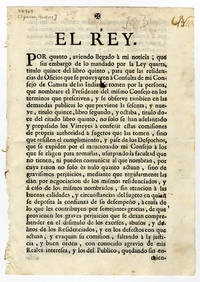
1758réf. 37969Madrid. 1758. A rare proclamation by Ferdinand VI King of Spain demanding that earlier laws regarding the appointment of judges in the Spanish Indies be observed. The decree states that disregard of these laws and guidelines in the past has been a great injustice causing injury to royal interests and to the general population. This proclamation was to be sent to the viceroys and audiencias throughout the Spanish Indies. This copy accomplished in manuscript at Aranjuez Spain on August 20 1758 is signed by Juan Emanuel Crespo with the inscription "Yo El Rey" and the annotation "Por mandado del Reyno exo. señor." A manuscript inscription on the blank verso of the final printed page dated December 4 1759 confirms that the decree had been reviewed by the President the fiscal and other high-ranking officials in Santiago de Chile. Not in OCLC Medina BHA or Palau. Folio. Dbd. Maltese cross at head of title. Contemporary and later manuscript annotations in ink and later pencil annotation on first page. Accomplished in manuscript with additional manuscript annotations. Manuscript inscription on blank verso of final printed page. Extremely light dampstaining in margins occasional minor soiling and ink stains the latter touching a few letters. Very good. unknown
1812réf. 2890London: Carpenter & Son 1812 Book. Very Good. Hardcover. 5 volumes. First English edition translated from the Spanish by G. A. Thompson. Quarto. Approx. 550pp. per volume. Collated complete. Early 20th century three-quarter polished tan calf marbled boards. Small contemporary engraved bookplate. Corners show light wear. Ex-library copy withdrawn with bookplate to front and rear endpapers perforated library stamp to title pages and a few unobtrusive ink library stamps. Light foxing to preliminary and end leaves. Overall a very good set generally very clean. Originally published at Madrid 1786-89 this great work is a valuable and comprehensive geographical historical and commercial gazetteer of the Americas. It covers the entire history of the Americas and is particularly rich in data relating to the Spanish possessions with particularly extensive sections on Chili Mexico Peru Venezuela etc. It also includes numerous entries dealing with Canada and the United States. The general section on "Nueva España New Spain is very well covered and begins with "A spacious kingdom of North America the limits of which toward the north are unknown.". California is covered giving a great deal of statistical information and includes a list of the missions of "New California" founded up to 1803. Appended is a vocabulary of provincial terms largely Spanish forming a catalogue of American plants birds and animals. A supplement provides the text of the Treaty of Peace between the United Kingdom and the United States War of 1812. "Thompson's edition for its additions etc. is infinitely superior to the original." Sabin. Sabin: 683. Carpenter & Son hardcover
1800réf. 54439London:: Printed For J. Wright Piccadilly By John Dean 1800. 1800. First edition in English. 4to. Translated from the original Spanish by Maurice Keatinge. Leather and boards viii 514 1 pp. frontispiece map preface. One of the most important firsthand accounts of the Spanish conquest of Mexico. Written by Bernardo Diaz del Castillo a foot soldier who served under Hernan Cortes during the expedition that led to the fall of the Aztec Empire. The book covers the expedition from Cuba to Mexico in 1519; first encounters with Indigenous peoples along the Gulf Coast; the alliance with the Tlaxcalans; the march to Tenochtitlan; meetings between Cortes and Moctezuma II; the uprising in Tenochtitlan and the retreat known as the La Noche Triste; the siege and fall of Tenochtitlan in 1521; etc. The book provides detailed descriptions of Indigenous cities markets and customs; military operations and logistics; relationships among Spanish commanders; daily life of common soldiers; the cultural shock experienced by Europeans encountering Mesoamerican civilization; etc. Encyclopedia Britannica: "Bernal Diaz del Castillo 1495 – 1584 was a Spanish soldier and author who took part in the conquest of the Aztec nation. Diaz's account is written in an unassuming colloquial style and has both historical and artistic value." A.S.W. Rosenstock 19 #193: "All the later histories of America have acknowledged their debt to Bernal Diaz and his work has been acclaimed one of the most valuable source books of the period." The author was an original member of Cortez’s expedition to conquer the Aztec nation. He was involved in the initial planning stages all the way to its culmination. One of the most important sources on the conquest of the Aztec Empire and Mexico. The original leather spine label is missing but a new leather label approximating the original has been placed inside this copy. Retains the original leather boards which exhibit perimeter wear. Internally there are repairs to the hinges with some toning of the text but remarkably free of foxing. In all a very good copy. Printed For J. Wright, Piccadilly, By John Dean, 1800. hardcover
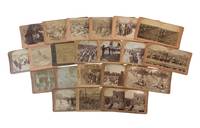
1898réf. 231301898. Spanish-American War stereoview archive circa 1898-1899 documenting how the war was pictured through mass-produced photographic views that followed U.S. mobilization battlefield action occupation and military life across both Cuba and the Philippines. These stereoviews preserves the visual system by which the war was circulated to American audiences showcasing camp organization troop movement burial hospital care naval power and overseas deployment. Particularly notable is the archive's coverage of the Rough Riders the Santiago campaign in Cuba and U.S. presence in Manila and Malate showing how stereoview photography helped normalize the war's expansion from anti-Spanish conflict into a broader American imperial presence. Archive of 21 stereoviews Various publishers. Spanish-American War stereoview archive. Cuba the Philippines and the United States circa 1898-1899. each measuring 3" x 7". The views are drawn from multiple phases and theaters of the war including camp and drill scenes in the United States embarkation and troop arrivals at Tampa battlefield and occupation imagery from Cuba and extensive and some grisly scenes from Manila and surrounding areas in the Philippines. Captions and images show soldiers in formation cavalry drill military reviews naval artillery hospital interiors encampments burial grounds and troops in active position. Cuban views include Morro Castle after bombardment dead and wounded on the battlefield of Santiago U.S. soldiers preparing to invade Cuba and troops dining near Cabañas Fortress. Philippine views include a departure for Manila American pickets routing a Filipino reconnoitering party the 18th Infantry engaged by Filipino outposts volunteers awaiting orders under the tropical sun Army Hospital Manila and "Our Boys in Camp at Malate P.I." One stereoview identifies Roosevelt's Rough Riders in the mobilization phase linking the archive to one of the war's most publicly mythologized units. As a group the stereoviews demonstrate the process by which the Spanish-American War was framed not simply as a short military victory over Spain but as a sustained structure of U.S. troop deployment and occupation extending from Cuba into the Philippines. The Manila and Malate scenes are especially important in this regard since they place American soldiers within the opening phase of the Philippine conflict where U.S. military presence quickly moved beyond liberation rhetoric into imperial control. The archive's mixture of battlefield casualties camp routine naval spectacle and celebratory review scenes shows how stereoscopic publishing converted war into a domestic viewing experience while reinforcing the legitimacy of American expansion abroad. Wear to mounts some toning; overall very good condition. A strong cross-theater visual archive of the Spanish-American War and the emergence of U.S. imperial power in Cuba and the Philippines. unknown
1637réf. ABC_50143Madrid: Juan Sanchez 1637. Disbound. Folio 21 x 29.2 cm. With a woodcut decorated initial. Interesting account in Spanish of two captures and defeats that the Lord Marquis of Floresdavila of His Majesty's Council of War and his Governor and Captain General in those parts had in different Berber villages on the borders of Oran.The "Marquis of Floresdavila" is Antonio Zúñiga y de la Cueva ca. 1590-1652 who was the second Marquis of Flores DAvila General of the Galleys of Naples and Sicily Governor of Oran and Mersw-el-Kébir and of the County od Rousillon and member of the War Council of King Philip IV. Antonio Zúñiga was accompanied during the execution of these very bloody battles by Father Juan Ponce de Léon a 17th-century Spanish presbyter who served as an official "qualifer" calificador of the Holy Office the Spanish Inquisition. The first battle was on 17 November 1636 and following days the other on 5 February 1637 both were bloody and many Muslims and enslaved people were killed. The result was the definitive subjugation of these regions around Oran to the throne of Spain which had not seen a Spaniard before.The pamphlet was printed by Juan Sánchez Frexeneda also known as Juan Sánchez de la Frexeneda a prominent 17th-century Spanish printer and typographer based in Madrid. He operated one of the active printing workshops in Madrid during the Spanish Golden Age active from roughly 1613 until his death in 1639. His press distributed current event broadsheets "Vendese en casa de Esperança Franciscea frontero del Colegio de Atocha" is printed on p. 1.With near- contemporary manuscript foliation in the upper outer corners of the leaves "148-151". Somewhat foxed the edges of the leaves are frayed. Juan Sanchez, unknown
réf. a-now-infamous-photo-afteHarman B/W Digital Fibre. Limitation of only 20 of each size. First ever printing. Hand numbered. Spanish Tony Media estate stamp to verso. Spanish Tony Sanchez facsimile signature to bottom right recto. Taken 1972 printed 2024. All prices are unframed. If you would like your print to be framed do get in touch. unknown
1937réf. SPANISHC002314Left Review London. 1937. First edition. Royal octavo. 24 pages. Wrappers. A publication arising from a letter signed by twelve European writers prominent in Europe including Aragon W.H. Auden Nancy Cunard Heinrich Mann Pablo Neruda Ramon Sender Tristan Tzara etc. The letter was addressed to the writers of England Scotland Ireland and Wales and asked whether they were for or against the government of Republican Spain. Somehow Ezra Pound got involved he was neutral in a combative kind of way: ''Spain is an emotional luxury to a gang of sap-headed dilettantes''. The majority of responses were in favour and these include messages from Samuel Beckett ''�Up the Republic!'' - almost the shortest contribution Kay Boyle Thomas Burke Cyril Connolly Aleister Crowley C. Day Lewis Liam O'Flaherty Ford Madox Ford David Gascoyne Victor Gollancz Laurence Housman Aldous Huxley C.L.R. James Arthur Koestler John Lehmann Rose Macaulay ''AGAINST FRANCO'' - the shortest contribution Hugh Macdiarmid Louis MacNeice John Middleton Murry Sylvia Pankhurst V.S. Pritchett Herbert Read Olaf Stapledon Sylvia Townsend Warner Clough Williams-Ellis etc etc. In the neutral camp were Vera Brittain Robert Byron T.S. Eliot H.G. Wells V. Sackville-West etc. Only five messages are in the ''Against'' section including ones from Edmund Blunden Arthur Machen and Evelyn Waugh. The following year a similar exercise was carried out in America where 418 writers gave their opinions. This pamphlet has also been the inspiration for questionnaires on the Vietnam War and even the Falklands War.Foxing mostly light on almost every page. Covers lightly stained. Spine starting to split. Good. Left Review, London. unknown
1971réf. 51506As New. Hardcover. FREE UPGRADE to Courier/Priority Shipping Upon Request – – IN STOCK AND IMMEDIATELY AVAILABLE FOR SHIPMENT - TEXT PRISTINE COMPLETE FOUR 4 VOLUME SET -Corresponds to ASIN: B0000DW6Q9 -- with a bonus offer--; Guidol Jose; Translated from the Spanish By Lyons Kenneth Goya 1746 - 1828 : Biography Analytical Study and Catalogue of His Paintings - With 1295 Plates Presented in Volumes II III and IV . 1971. hardcover
1957réf. 33570Meridian Books Inc. As New. FREE UPGRADE to Courier/Priority Shipping Upon Request - IN STOCK AND IMMEDIATELY AVAILABLE FOR SHIPMENT - Rebound in library gray-green hardcover binding; else Very Good condition Tight to the spine. This edition marked: "GREENWICH EDITIONS Original first published September 1957 by Meridian Books Inc. " and then "First Printing August 1957". -- Three pages with improperly shaped corners from the original printer paper cut. -several pages have small brown discolored spots on fore-edge or in page margins near fore-edge -- with a bonus offer--; 520-orteg; Ex-Library . 1957. Meridian Books, Inc hardcover
1957réf. 57006Meridian Books Inc. As New. Paperback. FREE UPGRADE to Courier/Priority Shipping Upon Request – – IN STOCK AND IMMEDIATELY AVAILABLE FOR SHIPMENT - Tight to the spine - 190 pages. -- with a bonus offer--; Ex-Library . 1957. Meridian Books, Inc paperback
1987réf. 74409Museum. New. Paperback. FREE UPGRADE to Courier/Priority Shipping Upon Request - IN STOCK AND IMMEDIATELY AVAILABLE FOR SHIPMENT - Flawless copy brand new pristine never opened -- Text in English. 48 pp. With 15 ills. 3 col. . 26 x 18 cm. -- with a bonus offer-- . 1987. Museum paperback
1983réf. 66181Luis Gonzalez-Robles and Jose M. Losada. As New. Paperback. FREE UPGRADE to Courier/Priority Shipping Upon Request – – IN STOCK AND IMMEDIATELY AVAILABLE FOR SHIPMENT - AS NEW THE TEXT BLOCK IS PRISTINE CLEAN UNMARKED AND IN EXCELLENT CONDITION - - Text in English. 72 pp. With 98 ills. 16 col. . 29 x 23 cm. -- with a bonus offer-- . 1983. Luis Gonzalez-Robles and Jose M. Losada paperback