Bowers, John MBiblio.com

840 results
2000ref. 2877D. S. Brewer. Good with no dust jacket. Hardcover. Ex-library copy with usual stamps call numbers and pocket. 'Write-off' has been stamped to top of textblock. Book appears unread. Very light shelfwear.; 0.63 x 9.21 x 6.14 Inches; 264 pages; This is an entirely new and original reading of 'Pearl' placing the anonymous masterpiece in the context of the Cheshire coterie that flourished at the court of Richard II during the 1390s. The brilliance of its poetic construction has long been acknowledged but here 'Pearl' is also shown to engage with the social religious and political events of the late fourteenth century. The poem's defense of infant baptism is seen as countering Lollard criticism of the sacraments its retelling of the Parable of the Vineyard as offering scriptural support to the aims of the Statute of Labourers. The poem's dazzling representation of aristocratic magnificence - jewelled crowns gem-embroidered gowns livery badges civic processions and monumental architecture - studied in this context relates to the spectacular royal culture of one of England's most ambitious monarchs. The courtly elegy offered consolation after the death of Anne of Bohemia while its vision of a royal child-bride figured in the intense national debate over the king's prospective marriage to the six-year-old Isabelle of France. Richard II's fall from power brought to an end not simply Cheshire privilege but also a poetic tradition that produced some of the finest works of English literature most notably 'Pearl' and 'Gawain and the Green Knight'. . 2000. 0859915999 . D. S. Brewer hardcover
2004ref. 2158Palgrave Macmillan. Near Fine with no dust jacket. Hardcover. Minor Shelfwear; The New Middle Ages; 0.7 x 8.3 x 5.5 Inches; 176 pages; Geoffrey Chaucer was not a writer primarily but a privileged official place-holder. Prone to violence including rape assault and extortion the poet was employed first at domestic personal service and subsequently at policework of various sorts protecting the established order during a period of massive social upset. Chaucer's Jobs shows that the servile and disciplinary nature of the daily work Chaucer did was repeated in his poetry which by turns flatters his aristocratic betters and deals out discipline to malcontent others. Carlson contends that it was this social and political quality of Chaucer's writings rathen than artistic merit that made him the "Father of English Poetry." . 2004. 1403966257 . Palgrave Macmillan hardcover
2007ref. 2395Peter Lang Pub Inc. Near Fine with no dust jacket. Hardcover. Minor bump at top of spine.; Studies on Themes and Motifs in Literature; 0.75 x 9 x 6 Inches; 228 pages; Both the alliterative Gest Hystoriale of the Destruction of Troy c. 1400 and the Laud Troy Book c. 1400 a metrical romance deal with the lives and feats of chivalric heroes and place special emphasis on the psychological effects of love. This book is a study of the motifs in John Clerk's and the Laud-poet's narratives and of their characterization of the Trojan War's principal actors. Both writers used the same source but their preferences for motifs and their attitudes toward the persons involved were often quite different. Thirteen illustrations mainly from medieval Guido manuscripts serve as a stimulus to those who want to know more about the medieval understanding of the Trojan War. . 2007. 1433100126 . Peter Lang Pub Inc hardcover
1904ref. 1404Macmillan & Co. Ltd. Very Good- with no dust jacket. Hardcover. Inner front hinge is cracked exposing webbing but textblock is firmly attached. Fraying to corners and spine ends. Former owner's details from Oct. 1934 on front free-endpaper.; Columbia University studies in Romance philology and literature; 167 pages . 1904. Macmillan & Co. , Ltd hardcover
1887ref. 314Clarendon Press. Very Good with no dust jacket. Hardcover. Stamped on title page. General edgewear to spine ends. Light soiling to covers.; Clarendon press series . 1887. Clarendon Press hardcover
ref. 0428110770.Gpaperback. Good. Access codes and supplements are not guaranteed with used items. May be an ex-library book. paperback
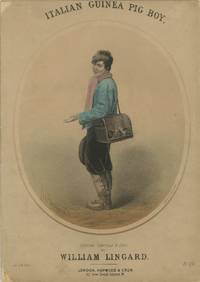
ref. List3684Folio 9 ½ x 13 inches 5 pp. Margins trimmed quite tight to title with some loss to publisher information on rear cover small chips else near fine with the hand colored lithographic cover by H.C. Maguire in fine condition. Near Fine. An interesting piece of sheet music perhaps shedding light on the term “guinea” as it applies to Italians which though it originated in Europe migrated to the United States. Lingard’s song begins “I’m poor Italian guinea pig boy Straight from Florence I come with my stock.” The song was anthologized later in Lingard songsters. The song is proof that the term was being used in performance and theater circles before the mass arrival of Italians in the United States. “Guinea” was also widely used to describe people of dark complexion during the period stemming from the Guinea region of West Africa. With an attractive lithographic cover of a cheerful enough looking boy extending his hand. We find two copies of this sheet at Oxford and the British Library with none held in the United States. unknown
1986ref. 2111902156000288Meiji shoin 1986. Soft Cover. Fine. The book is in fine condition. Meiji shoin paperback
1986ref. 2092902143400035Meiji shoin 1986. Soft Cover. Fine. Size: A5 size Meiji shoin paperback
1931ref. 2092902137405177Tokyo kenkyu-sha 1931. Soft Cover. Fine. Number of books: 1 book Tokyo kenkyu-sha paperback
ref. 2080202105400254Meiji shoin N.A. Soft Cover. Fine. Number of pages: 428p Size: 22cm Meiji shoin paperback
1990ref. 2080202102703884Meiji shoin 1990. Soft Cover. Fine. Page size: 292 pages Size: A5 size Meiji shoin paperback
1981ref. 6131Anchorage AK: National Bilingual Materials Development Center 1981. First edition. Paperback. Fine. 4to 136 pages wrappers TLS from Pulu laid in. Text in English and Yup'ik. No WorldCat copies outside of Alaska. National Bilingual Materials Development Center paperback
1976ref. 5591London: Officyna Stanislaw Gliwa 1976. First Limited edition. Hardcover. Fine/issued without. Oblong 8vo 29 pages brown cloth deckle-edged. Rare. Copy no. 100 of 275 only being publication no. 37 by the Gliwa Press. Handset by Maria Gliwa with presswork and linocuts by Stanislaw Gliwa. Printed on mould-made Italian paper 'Della Robbia' . Stankiewicz was a prominent political philosopher having lectured on politics history economics history and jurisprudence at over 40 universities. Both he and Stanislaw fought with the Polish forces in exile during WWII. This is an aphoristic dictionary e.g. " ELITISM: A now-derogatory terms revealing democracy's essentially anti-intellectual mood and its fear of 'meritocracy'. " Officyna Stanislaw Gliwa hardcover
1942In italiano e tedesco, brossura editoriale flessibile, ingiallita, con fioritura, qualche piega e piccola macchia d'inchiostro blu al piatto anteriore, piccola e superficiale abrasione al posteriore ed usura ai bordi, pagine ingiallite attorno ai testi, con sporadica fioritura, strappi agli angoli inferiori delle prime XXXVI pagine, bruniti e con fioritura i tagli. Numero pagine 150 USATO
1842Prima metà '800, rilegatura in mezza pelle, piatti cartonati, marmorizzati, con qualche superficiale abrasione ed usura da scaffalatura, dorso con titoli e decori dorati, pagine con sporadica fioritura, con una tavole f.t.più volte ripiegata, rari segni con matita rossa ai margini, ritratto in nero applicato all'antiporta. Numero pagine 242 USATO
2010Brossura editoriale in cartoncino flessibile lucido, dalla copertina illustrata in entrambi i piatti, con bandelle. Buonissimo lo stato di conservazione generale, pagine solide, perfettamente tenute, velate da colorazione brunita, come i tagli, ricche di disegni in nero, nel testo, di Teresa Sdralevich. Numero pagine 139. USATO
2004ril. Questo "Dizionario etimologico minore" contiene informazioni aggiornate e precise sull'origine e la storia di oltre 37.000 parole nei loro 68.000 significati. Di ogni voce vengono fornite la data di prima attestazione, l'etimologia prossima e remota e una serie di informazioni relative alla storia della parola, agli ambiti semantici in cui ogni voce è nata e si è sviluppata, alla sua fortuna nella storia della linguistica italiana.
2013br. Lo sviluppo in anni recenti di accostamenti teorici che, in contrapposizione ai paradigmi formalisti dello strutturalismo e del modello generativista, hanno posto al centro dell'interesse l'uso della lingua e gli aspetti cognitivi, semantici, testuali, pragmatici e culturali del linguaggio, non è rimasto privo di conseguenze nel campo della ricerca etimologica, che è parte integrante e imprescindibile della linguistica storica. Marginalizzata o degradata a semplice curiosità erudita dai paradigmi epistemologici dominanti nella seconda metà del Novecento, l'etimologia si ripropone oggi alla considerazione degli studiosi per il contributo che può dare alla comprensione di problemi che ha affrontato sin dall'antichità o in epoca più recente, attinenti alla concettualizzazione dell'esperienza, alla relazione con il mondo extralinguistico e i fenomeni culturali, alla dimensione semantica del linguaggio, agli usi concreti in cui si manifesta la lingua nella processualità della comunicazione.
2015brossura Il volume si compone di undici studi ripartiti in tre sezioni. Nella prima parte si discute dell'origine di tre parole curiose ma piuttosto comuni (stregua, scagnozzo, iosa), mentre nella seconda si esaminano cinque voci del tutto peregrine (isonne, baliere, boncio, gandavugli, guarmine). La terza parte prende in esame usi linguistici o grafici a prima vista aberranti: l'espressione un paio di nozze; le sgrammaticature di un sonetto di Luigi Pulci; l'affollamento degli accenti nella cosiddetta Giuntina di rime antiche (1527).
1998brossura Questo libro è dedicato alle radici del nostro essere: a quelle parole, per lo più greche e latine, con cui è stato dato nome alla vita, allo spirito, all'anima, al corpo, alla sorte fin dagli inizi di quella civiltà composita, sfaccettata, innovatrice che, a un certo punto (tardo) della sua storia, fu chiamata "europea".
2017brossura Dopo il sorprendente riscontro di pubblico avuto dal Piccolo repertorio di curiosità etimologiche, esce questo secondo volume, frutto della passione per la ricerca etimologica che mi ha accompagnato fin dagli anni dell'insegnamento liceale. I termini qui raccolti sono stati scelti a partire da letture di testi storico-letterari o da dialoghi con amici che hanno stimolato la mia innata curiosità per l'origine delle parole. Un invito, dunque, a ripercorrerne la storia, a incontrare i popoli che le hanno coniate, ad "aprirle come noci". «E come nelle noci si trova il gheriglio, allo stesso modo, una volta aperte, dentro le parole troviamo il concetto. E il concetto serve a orizzontarci con sicurezza dentro il nostro stesso pensare il mondo».
2012brossura In questo libro sono raccolti e catalogati i nomi locali sparsi sul territorio di Laurignano (CS), sia i toponimi attestati nelle fonti cartacee che i microtoponimi vivi nella tradizione orale.