22 122 résultats
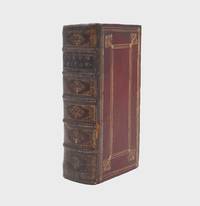
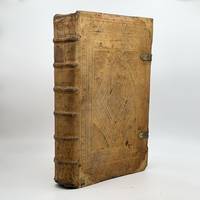
1549réf. 378214Lutetia i.e. Paris: Ex officina Roberti Stephani typographi Regii 1549. Second Estienne edition. 528; 361 7 pp. Complete with 2 terminal blanks. Second part has special title page. Woodcut Estienne devices to both titles. 16mo. Later eighteenth-century red morocco tooled gilt frames to boards lettered gilt spine with raised bands gilt tooling to outer and inner board edges marbled endpapers gilt edges. All pages ruled in red ink. Light rubbing to exterior front board nearly separated rear joint cracked chipping to spine ends. Moderate toning to margins light fox-spots to a few leaves partial crack in text block before second title page all leaves secure. Provenance: Douglas Maxwell Moffat bookplate; General Theological Seminary bookplates. Second Estienne edition. 528; 361 7 pp. Complete with 2 terminal blanks. Second part has special title page. Woodcut Estienne devices to both titles. 16mo. Produced in his twin capacities as a skilled printer and a trained classical scholar the Biblical output of Robert Estienne Latinized as Stephanus "had perhaps more influence than that of any other single man in the sixteenth century" Wordsworth in Darlow & Moule. He is known not only for the editions of the Bible that placed him on the Louvain faculty's index of prohibited books but as a publisher of important dictionaries Roman classics and contemporary educational writings. After his flight to Geneva around 1550 he also became an important publisher of the works of John Calvin. The 1546 & 1549 editions of the Greek New Testament are referred to as the "O mirificam" editions after the opening of the Latin preface. They are especially desirable as specimens of the typography of Claude Garamond who was commissioned by the king to design the Greek type used in Estienne's editions of the New Testament. "Estienne felt strongly the propriety of consecrating as it were the Royal Greek types in this way. He evidently felt also some stirrings of ambition as an editor; might not the resources of the King's Library now at his disposal enable him to produce a better text than that of Erasmus especially as he could use also the Complutensian text" Armstrong. Estienne's editorial ambitions culminated in the folio edition of 1550 which included a full critical apparatus but still reveal themselves in the texts of the O mirificam editions. Like the first edition the text of the 1549 edition largely agrees with Erasmus but it indeed incorporates the Complutensian text and also makes a number of independent readings with minor changes from the 1546 edition Darlow & Moule. An important and beautifully printed work. USTC 150379; Darlowe & Moule 4620; Renouard 73 1; Schreiber 102; Adams B1660. Armstrong Robert Estienne Royal Printer 136 Ex officina Roberti Stephani typographi Regii unknown books
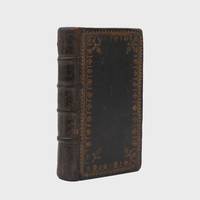
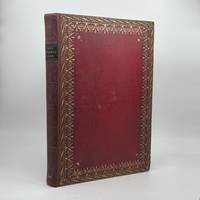
1569réf. 378213Lutetia i.e. Paris: Ex officina Roberti Stephani typographi Regii 1569. Only edition by Robert Estienne II. xxxii 494 2; 342 42 pp. With terminal blanks. Title page of second volume "Hai tou hagiou Paulou epistolai" dated 1569. Woodcut Estienne devices to both titles. 1 vols. 16mo. 19th-century full straight-grained blue morocco tooled gilt frames to boards gilt title fillets and ornaments to spine gilt tooling to outer and inner board edges marbled endpapers gilt edges. Preliminaries ruled in red ink. Joints a bit rubbed spine ends and corners lightly bumped. Moderate toning a few partial cracks to text block all leaves secure. A handsome copy. Provenance: Cecil Dunn-Gardner pencil note to front endleaf; General Theological Seminary bookplates blindstamps inkstamp to verso of title. Only edition by Robert Estienne II. xxxii 494 2; 342 42 pp. With terminal blanks. Title page of second volume "Hai tou hagiou Paulou epistolai" dated 1569. Woodcut Estienne devices to both titles. 1 vols. 16mo. Printed by the son of the great Reformation printer Robert Estienne Stephanus and brother of Henri Estienne II the text primarily follows the first Estienne edition of 1546 substituting readings from the editions of 1549 or 1550 in five places. "The book closely resembles in size and type the O mirificam editions of 1546 and 1549 copies of which had become difficult to procure. The body of the type has been slightly reduced" from that of the original Royal Greek types by Claude Garamond Darlow & Moule. USTC 140582; Darlow & Moule 4633; Renouard 171 1; Schreiber 239; Adams B1671 Ex officina Roberti Stephani typographi Regii unknown books
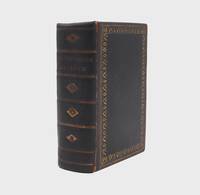
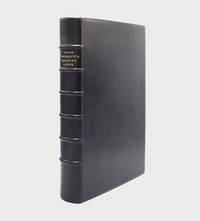
1624réf. 378211Lugduni Batavorum i.e. Leiden: Ex Officina Elzeviriana 1624. First Elzevir edition. xii 863 1 pp. Title page printed in red and black. Second part with half-title and separate register pagination continuous. 12mo. 19th-century straight-grained red morocco gilt rules to boards gilt-lettered spine with raised bands and gilt ornaments gilt tooling to outer and inner board edges marbled endpapers. Rubbing to joints which are starting but secure spine slightly darkened with chipping to its head. Moderate toning to text clean tear across leaf Kk3 mended with minor loss to a line of text. Provenance: William Gott trimmed armorial bookplate; Douglas Maxwell Moffat bookplate; General Theological Seminary bookplates. First Elzevir edition. xii 863 1 pp. Title page printed in red and black. Second part with half-title and separate register pagination continuous. 12mo. "The first of the Elzevir editions printed at the press established at Leyden by Bonaventure and Abraham Elzevir and celebrated for their fine type paper and convenient size" Darlow & Moule. The text is based on the 1565 version edited by Beza. Six more editions appeared from the Elzevir press the last in 1678. There are three known states of the first edition: one with a red and black title page and a listed publication city of Lugduni i.e. Lyon one with a plain title page and a listed publication city of Lugduni Batavorum i.e. Leiden and one with a red and black title page with a listed publication city of Lugduni Batavorum. Willems does not identify the third state but notes that the copies with red and black title pages were intended for distribution in Catholic countries. USTC 1547980; Darlow & Moule 4669 state C; STCN 378027026; Willems 225 ref Ex Officina Elzeviriana unknown books
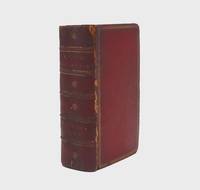
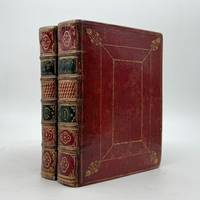
1701réf. 378206Amsterdam: Ex Officina Wetsteniana 1701. 565 2 pp. Without the map found in some copies but not called for by Darlow & Moule or STCN. 16mo. 19th-century red morocco gilt frames and corner fleurons to boards gilt-tooled and lettered spine gilt tooling to outer and inner board edges text block edges gilt multi-colored Dutch pastedowns. Title page printed in red and black. Spine somewhat darkened rubbing to joints. Moderate toning to margins of text block small faint stain to top-edge of first few leaves. A nice copy. Provenance: Frederick Keppel 19th-century armorial bookplate; Douglas Maxwell Moffat; General Theological Seminary bookplates. 565 2 pp. Without the map found in some copies but not called for by Darlow & Moule or STCN. 16mo. According to Darlow & Moule this was the third edition edited by Leusden and "the earliest Greek Testament to bear the name of the publisher Henricus Wetstenius Wetstein or Wettstein" Darlow & Moule 4718a; STCN 242135129 Ex Officina Wetsteniana unknown books
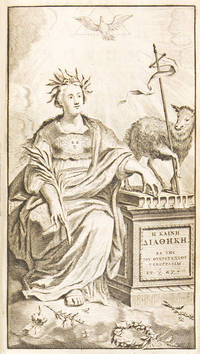
1633réf. 378209Amsterdam: Apud Guilielmum Blaeu 1633. Only Blaeu edition. 454 6 pp. Engraved allegorical title page. 16mo. Contemporary or near-contemporary morocco elaborate gilt frames and corner fleurons to boards lettered gilt spine with raised bands gilt tooling to outer and inner board edges marbled endpapers gilt edges. Light rubbing to exterior front joint starting at ends front hinge cracked. Moderate toning to text mostly unobtrusive faint stains to a few leaves. Provenance: Douglas Maxwell Moffat bookplate; General Theological Seminary bookplates. Only Blaeu edition. 454 6 pp. Engraved allegorical title page. 16mo. Based on the text of Beza's third edition but emended in places with readings from other editions particularly the second Estienne/Stephanus editions Darlow & Moule. Darlow & Moule 4681 Apud Guilielmum Blaeu unknown books
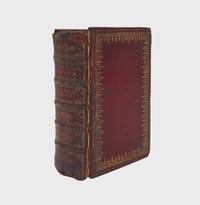
1609réf. 371891Geneva: Pierre de la Rouière 1609. In two columns. 28 184 283 1 84 203 1; 8 186 2 134 2pp. Folio 15 x 9-1/2 inches. Contemporary pigskin covers blocked in gilt and blind remnants of paper label on the spine gauffered edges lacks bosses and hinges and clasps worn at extremities and bottom of spine. Provenance: Johann Georg Feuchter of Jura-Weickersroda inscription on pastedown that the bible was purchased at an August 6 1728 auction for 4 florins and 30 groschen; General Theological Seminary blindstamp. In two columns. 28 184 283 1 84 203 1; 8 186 2 134 2pp. Folio 15 x 9-1/2 inches. Edited with introduction by Benito Arias Montanus 1527-1598 Spanish orientalist and editor of the Antwerp Polyglot a reprint of Plantin's similar edition. Darlow & Moole 5113 OT and 4662 NT Pierre de la Rouière unknown books
1642réf. 371830Paris: Ek basilikēs typographias Imprimerie Royale 1642. Engraved title by by Claude Mellan engraved head and tail pieces and initials. 2 453 3 pp. Extra-illustrated with a later English printed "Abbreviations and Connexions" leaf inserted after the title. Folio 15-1/2 x 10-5/8 inches. Late eighteenth or early nineteenth century red morocco gilt marbled endpapers gilt edges. Neatly rebacked. Cloth slipcase and chemise. Engraved title by by Claude Mellan engraved head and tail pieces and initials. 2 453 3 pp. Extra-illustrated with a later English printed "Abbreviations and Connexions" leaf inserted after the title. Folio 15-1/2 x 10-5/8 inches. Known as the Mazarin edition "since it appeared under the auspices of the great Cardinal" D&M it is the first edition of the Greek New Testament from the Imprimerie Royale founded just two years prior. Inserted before the engraved title page is a partly-printed certificate of the Collegium Mazarinaeum awarding this volume as a prize in Rhetoric to Philippus Matthaeus Guillot dated MDCC in manuscript i.e. 1700 and signed by the college's master P.-J. Le Chapelier Pierre-Jean le Chapelier de Mauron abbé de Ste Marie de Boquen in Brittany with the trace of a seal below. The College Mazarin or College des Quatre-Nations was established by bequest of Cardinal Mazarin 1602-1661 and opened its doors to students in 1688. Darlow & Moule 4687. Provenance: Philippus Matthaeus Guillot certificate his signature at foot of title engraving; Montagu Barton armorial bookplate; John Horatio Nelson gift inscription dated 1841; General Theological Seminary bookplate perforated stamp Ek basilikēs typographias [Imprimerie Royale] unknown books
1514réf. 372265Alcala de Henares: Arnao Guilem de Brocar 1514. First edition of the New Testament in Greek published as volume 5 of the Complutensian Polyglot. Woodcut arms of Cardinal Jiménez on title page with woodcut borderswoodcut initials. Text in Greek and Latin in two columns Collation: a4 A-Q6 a6 R-Z6 AA-LL6 MM8 2a11 3a6 b-f6 g4 -g4. 271 of 272 leaves lacking final blank. 1 vols. Folio. Recent full black morocco spine gilt gilt turn-ins red morocco doublures gilt marbled flyleaves. Minor toning or soiling to a few leaves. A clean fresh copy. First edition of the New Testament in Greek published as volume 5 of the Complutensian Polyglot. Woodcut arms of Cardinal Jiménez on title page with woodcut borderswoodcut initials. Text in Greek and Latin in two columns Collation: a4 A-Q6 a6 R-Z6 AA-LL6 MM8 2a11 3a6 b-f6 g4 -g4. 271 of 272 leaves lacking final blank. 1 vols. Folio. Produced under the patronage of Cardinal Ximenes archbishop of Toledo and founder of the university of Alcala. As part of the Complutensian Polyglot Bible the New Testament was printed first dated 10 January 1514; the Old Testament was completed only in 1517 and publication was delayed until 1522. "Undoubtedly the finest Greek fount ever cut and the only one of which it can be affirmed with certainty that it is based on the writing of a particular manuscript" Proctor. Pope Leo X lent the Codex Vaticanus to Ximenes and it was upon this manuscript that Brocar modelled his type. Proctor used it as the model for the type in his edition of the Oresteia of 1904. This volume complete with the six leaves of the travels of St. Paul printed only in Greek and often lacking as it was printed later. This is the first Greek New Testament ever printed 1514 but as it was not published until 1522 this text was unknown to Erasmus when he published his Greek New Testament in 1516. Douglas Maxwell Moffat 1881-1956 Yale class of 1903 was a Grolier Club member from 1929 until his death; the libraries at Yale University and the General Theological Seminary were beneficiaries of gifts from his widow. "As a collector he was interested in three fields primarily: editions of Vergil; Greek and Latin lyric poetry; and fine printing. Almost all his books were in superb condition and often of very interesting provenance" Yale University Library Gazette 35:2 p. 122. THE MOST FAMOUS PIECE OF PRINTING EXECUTED IN SPAIN. Darlow & Moule 1412/4593; PMM 52; Adams B968 Vol. 5; Norton Printing in Spain 1501-1520 27; Proctor Printing of Greek p. 144. Provenance: Douglas Maxwell Moffat bought from E.P. Goldschmidt; General Theological Seminary gift of Mrs. Douglas M. Moffat Arnao Guilem de Brocar unknown books
1653réf. 371930London: Roger Daniel 1653. Title in red and black. Engraved printer's device on the title state B. Text in two columns. 8 1279 1 pp. 4to 7-3/8 x 5-3/8 inches. Eighteenth century red morocco panelled in gilt spines gilt with black morocco lettering pieces marbled endpapers gilt edges. Provenance: Viscount Palmerston bookplate; General Theological Seminary bookplate. Title in red and black. Engraved printer's device on the title state B. Text in two columns. 8 1279 1 pp. 4to 7-3/8 x 5-3/8 inches. The rare first printing in England of the Septuagint the earliest translation of the Hebrew Old Testament into Greek the scarce printing in quarto format. The text is derived from the Sixtine text and edited by John Biddle 1615-1662 the Unitarian controversialist who was imprisoned by the Parliamentary Commissioners for his religious views. "Roger Daniel's version of the text of the Sixtine edition was prepared for the use of the scholars at Westminster School. This appeared in 1653 and was edited by the Socinian John Biddle. Its publication may have owed something to the interest in the Septuagint generated by Codex Alexandrinus and the frustration produced by the failure of Young's attempts to edit it" S. Mandelbrote "English Scholarship and the Greek Text of the Old Testament" p. 87. A rare issue from the same setting as the octavo edition imposed in quarto without rules separaring the columns. Wing 2nd ed. B2718A; ESTC R12599; Darlow & Moule 4692 Roger Daniel unknown books
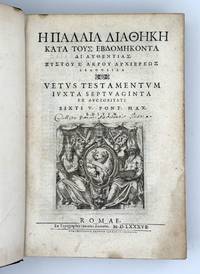
1587réf. 371783Rome: Franciscus Zanetti 1587. Text in Greek with short Latin notes at the end of each verse in two columns. Large engraved vignette on title with figures of Moses and Esdras on either side of the arms of Sixtus V. aâ´ A-3Sⶠ3Tâ¸. 8 783 1pp. Folio. Eighteenth century red morocco arms of the second Duke of Newcastle on the covers marbled endpapers gilt edges minor darkening to spine and wear to joints. Scattered minor dampstaining at lower outer corner of a few leaves. Provenance: Collegii Paris. Societas Jesu.early inscription on title; Douglass Maxwell Moffat booklabel with original invoice purchasing the volume from Davis & Orioli in 1940; General Theological Seminary bookplates. Text in Greek with short Latin notes at the end of each verse in two columns. Large engraved vignette on title with figures of Moses and Esdras on either side of the arms of Sixtus V. aâ´ A-3Sⶠ3Tâ¸. 8 783 1pp. Folio. Commissioned by Pope Sixtus V to assist the revisers who were preparing the Latin Vulgate edition ordered by the Council of Trent the "Sixtine" or "Roman" edition of the Septuagint was edited by Cardinal Antonio Carafa based on the Codex Vaticanus and became the standard for all the later editions of the Septuagint for three centuries after its publication. Darlow & Moule no. 4647; Adams B1246; BM STC Italian 1465-1600 p. 94 Franciscus Zanetti unknown books
1698réf. 255818Amsterdam: Ex Officina Westeniana 1698. 3rd Leusden edition. Additional engraved title-page and 2 folding engraved maps the Holy Land and the Mediterranean. 337 1. colophon; 142 1 pp. 8vo signatures alternating in 8s and 10s. 18th-century red morocco covers with gilt-rolled bordersgilt-tooled and -lettered spine multi-colored Dutch pastedowns without free endpapeers. a.e.g. Head of spine starting otherwise quite attractive. 3rd Leusden edition. Additional engraved title-page and 2 folding engraved maps the Holy Land and the Mediterranean. 337 1. colophon; 142 1 pp. 8vo signatures alternating in 8s and 10s. D & M doesn't mention the two fine engraved maps found in this copy; nor the separately printed COMPENDIOLUM 1699 with Leusden's useful concordance of all Greek words found in the New Testament. The Dutch Calvinist philologist Johann Leusden 1624 - 1699 was one of the foremost Biblical experts of his time. His edition of the Greek New Testament first appeared in 1675; this 1698 edition is quite scarce in the US and very rare with the Compendiolum. Darlow & Moule 4718a "Apparently the earlies Greek New Testament to bear the name of the publisher Henricus Wetstenius"; OCLC: 64158458 Ex Officina Westeniana unknown books
1653réf. 255179Londoni: Excudebat Rogerus Daniel: prostat autem venale apud Joannem Martin & Jacobum Allestrye sub signo Campanae in Cometerio D. Pauli 1653. The first edition of the Septuagint printed in England. 8 1279 1; 186 2 pp. plus terminal blank. 1 vols. 4to signed in 8's 195 x 143mm. Old vellum titled and dated in manuscript on the spine. Terminal leaves slightly soiled two ownership inscriptions on front endsheets and small Lincoln's Inn release/sale stamp vellum a bit handsoiled occasional modest foxing and dusting along upper margins but a very good copy. The first edition of the Septuagint printed in England. 8 1279 1; 186 2 pp. plus terminal blank. 1 vols. 4to signed in 8's 195 x 143mm. The first edition of the Septuagint printed in England with the Scholia the scarce printing in quarto format. The text is derived from the Sixtine text and edited by John Biddle 1615-1662 the Unitarian controversialist who was imprisoned by the Parliamentary Commissioners for his religious views. The SCHOLIA . has a separate title-leaf register and pagination. The same setting was imposed in both quarto and octavo formats the latter with rules separating the columns of text. In regard to institutional representation the edition in quarto is much more uncommon than that in octavo: ESTC locates 4 copies of the quarto printing in North America as opposed to 19 of the octavo printing. Occasionally Daniel's reprint of the New Testament is bound up with the octavo printings to form a complete Bible. Brunet cites that format but notes the sale of a copy on "Gr. Pap." presumably a copy in this format. Over the last 35 years ABPC records sale of one copy in quarto 1999 and four in octavo. ESTC R12599 & R236817; Wing B2718 octavo edition only; Darlow & Moule 4692; Brunet I:863 Excudebat Rogerus Daniel: prostat autem venale apud Joannem Martin & Jacobum Allestrye, sub signo Campanae in Cometerio D. Pauli unknown books
1665réf. 310448Cambridge: John Field 1665. Second edition of the Septuagint printed in England; variant B with misprint in Greek title and sun and cup transposed in motto on title. 2 19 1 755 i.e. 767 1 516 273 pp. Text in Greek type in two columns. 12mo. Full morocco gilt to style by John Gardner Borough Green marbled edges and endpapers. One gathering sprung. Second edition of the Septuagint printed in England; variant B with misprint in Greek title and sun and cup transposed in motto on title. 2 19 1 755 i.e. 767 1 516 273 pp. Text in Greek type in two columns. 12mo. A handsome copy of the second edition of the Septuagint printed in England following the first of 1653 and the first edition to include the oft reprinted preface by John Pearson. John Field was printer to Cambridge University. "Possibly a reissue by Hayes who was University Printer from 1669 to 1680" Darlow & Moule. Darlow & Moule 4702 John Field unknown books
1889réf. 231603London: John C. Nimmo 1889. No. 623 of 870 copies. Includes portrait 4 woodcuts and 20 etched aquatint illustrations from contemporary sources. Plates in two states. xxviii 351; xii 343 pp. 2 vols. 4to. Brown cloth with gilt armorial stamp on boards. Fine. No. 623 of 870 copies. Includes portrait 4 woodcuts and 20 etched aquatint illustrations from contemporary sources. Plates in two states. xxviii 351; xii 343 pp. 2 vols. 4to. John C. Nimmo unknown books
1880réf. 41816London: Chatto and Windus 1880. First edition. With about 400 Illustrations. 2 vols. 4to. Original gilt stamped red morocco and cloth covers slightly rubbed else a very nice copy. Bookplates of Nathaniel W. Conkling & Collin Armstrong. 2. Rowlandson Thomas. First edition. With about 400 Illustrations. 2 vols. 4to. Chatto and Windus unknown books
1891réf. 010550Boston: Little Brown and Company 1891. Book. Very Good. Cloth. Revised Edition. 12mo - over 6¾ - 7¾" tall. New and Revised Edition. Translated from the Greek by Thomas Wentworth Higginson. Two volumes in royal blue cloth covered boards with gilt lettering to the spines. Very Good spine ends beginning to wear gilt top edges dulled front paste downs have prior owner book plates those of William Jensen noted American chemist and chemical historian. Higginson's classic translation for the Enchiridion is known for its readability and accuracy. A rather uncommon edition and a handsome set. . Little, Brown, and Company Hardcover books
1584réf. 48696Antverpiae: Ex officina Christophori Plantini 1584. Folio 6 parts in 1; pp. 8 186 2; 128; collating: ¶ⴠA-Yâ´ Zâ¶; Aa-Qqâ´; woodcut device on title page; bound with: Biblica Hebraica Antverpiae 1584 Hebrew-Latin Old Testament Greek-Latin Apocrypha etc. in various pagings from back of book viz.: pp. 20 183 1; 283 1; 84; 203 1; collating from the back: †ⴠ‡ⶠA-OⶠPâ¸; a-xⶠy-z⸠aa-ggⶠAA-RRâ¶; in all 551 leaves; text in double column in Hebrew Greek and Latin; early 18th century calf blindstamped panels on covers red morocco label on spine; covers with dampstains corners bumped and showing small cracks starting at the extremities of the joints occasional light minor dampstaining but in all a very good and reasonably sound copy. Terminal flyleaf with elaborately penned inscription: "Isaac Sharpe flourishes dono Patris 1719." On the rear pastedown is Sharpe's early "Coll. Mag." bookplate dated April 4 1683 - possibly the date of his matriculation at Magdalene College Cambridge. The Greek N.T. starts at the beginning of the volume and the Hebrew O.T. at the end with the Greek Apocrypha of 128 pages between them. Each Testament has its own title page and the mention of the Apocrypha on both suggests that it was intended to form an appendix to either of the Testaments if they were issued separately. See Darlow & Moule 4645 and 5106: "This forms the latter half of the complete Bible in the original languages with an interlinear Latin translation; the whole reprinted from the Antwerp polyglot"; Voet A2 p. 320. Ex officina Christophori Plantini unknown books
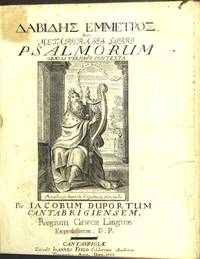
1666réf. 25559Cantabrigiæ: excudit Ioannes Field 1666. 4to pp. 72 431; inserted engraved vignette title-p.; parallel text in Greek and Latin; 2 short tears in fore-edge of title-p. not touching any letterpress worm track occasionally touching letters in first 60 leaves; stains on G2-G4; lacking the portrait of Charles II; contemporary calf-backed marbled boards red morocco label on spine; minor rubbing and wear small cracks starting at the extremities of the joints else generally a very good copy. Paraphrase in Homeric language and verse and its translation in Latin prose on opposite pages with a prefatory treatise on the ancient versions of the Old Testament. Translated by Jacob Duport. "Immediately after the Restoration he was made one of the king's chaplains and reinstated in the possession of his prebend at Lincoln but not of the archdeaconry of Stow as he preferred holding his fellowship and vice-mastership in Trinity College. Widdrington was now dispossessed of the Greek professorship and Duport restored to it but he resigned the chair the same year in favour of his pupil Isaac Barrow. On 19 July 1660 he was by royal mandate with many other learned divines created D.D. at Cambridge Kennett p. 251. He was installed dean of Peterborough 27 July 1664. In 1668 on the death of Dr. John Howorth master of Magdalene College Duport was recalled to Cambridge and appointed by James earl of Suffolk possessor of Audley End to fill the vacant headship. In the following year Duport was elected vice-chancellor of the university. Bishop Monk says that Duport 'appears to have been the main instrument by which literature was upheld in this university Cambridge during the civil dissensions in the seventeenth century and though seldom named and little known at present he enjoyed an almost transcendent reputation for a great length of time among his contemporaries as well as in the generation which immediately succeeded" DNB. Wing B2739a. excudit Ioannes Field unknown books
1923réf. 007945London: Basil Blackwell 1923. Book. Near Fine. Hardcover. Limited and Numbered Edition. 4to - over 9¾" - 12" tall. # 28 of 394 copies printed on Batchelor's Kelmscott hand-made paper for sale in Great Britain and 104 copies in America. Linen back with paper spine label and brown paper over boards cover label printed in red and black. Near fine slight bowing to boards small corner bumps. Basil Blackwell Hardcover books
1842réf. 4590New York: Daniel Phanad 1842. Edition Unknown. Full contemporary calf. Good; joints strained; some light occ. spotting. 8vo 2 3 - 360 pp. The New Testament in modern Greek. S & S #45-526; OCLC 3 loc's. Daniel Phanad (?) unknown books
1962réf. 52438Graz: Akademische Druck-u.Verlagsanstalt 1962. Hardcover. Very good. Two volumes large 8vo: pp. 16 966 6; 2 920 42. Publisher's light blue cloth. A nearly fine clean set with some slight erosion/scuffing at the covers of the second volume. Modern photo-reprint of this celebrated work of early modern biblical scholarship. First published in 1752 it was until the twentieth century regarded as "the most elaborate and valuable of all the critical editions of the New Testament" Orme. Edited by the scholar Johann Jakob Wetstein 1693-1754 a scion of the Amsterdam printing family who produced Gerhard von Maestricht's New Testament of 1711 the original edition includes the editio princeps of two pseudepigraphic works ascribed to Saint Clement of Rome which survive in Syriac. At his native city of Basel in 1713 Wetstein defended a thesis on the various readings of the New Testament. "After collating MSS. in various libraries he at length obtained in 1733 a professorship in the Remonstrants' college at Amsterdam in succession to Le Clerc. In 1730 the Wettstein press published his Prolegomena anonymously and in 1735 he edited for the same firm a revision of G. v. Maestricht's Testament. At length in 1751-2 he produced the critical edition at which he had been labouring for many years. Perhaps in deference to the opinions of his friends Wettstein did not print in his edition the text of Codex A as he seems at first to have intended or a recension of his own but merely reproduced the Elzevir text with very few variations. Immediately below however he indicated the changes which he considered absolutely necessary from which it is easy to construct 'Wettsteins's text.' Nearly all these proposed changed -- which according to Reuss number 159 -- had appeared in previous editions and are generally accepted do-day. . Below this matter stands the critical apparatus the most elaborate which had yet been published giving innumerable variants and citing as authorities for and against these a vast body of witnesses -- MSS. versions early fathers and printed editions. Wettstein introduced the practice of indicating uncial MSS. by roman letters and cursive MSS. by arabic numerals. In the revised and enlarged Prolegomena preceding the text which give some account of his labours and controversies Wettstein displays a marked antipathy to all the earliest MSS. which he suspected of having been corrupted by the Latin versions. The Animadversiones at the end of vol. 2 are more temperate and possess higher value. A distinctive feature of the book is the commentary printed at the foot of the page. This forms a curious treasury of notes illustrating both the matter and the language of the inspired writers by copious extracts from all kinds of authors -- classical patristic and rabbinic". References for the original edition: Dibdin 4th ed. 1: 156. Le Long/ Masch 1 1778: 243-46. Orme Bibliotheca Biblica 465: "Wetsteins's merits as a critic' says Dr. Marsh "undoubtedly surpass the merits of his predecessors: he alone contributed more to advance the criticism of the Greek Testament than all who had gone before him: and this task he performed not only without support either public or private but during a series of severe trials under which a mind of less energy than Wetstein's would infallibly have sunk." Full title and imprint: He Kaine Diatheke Novum Testamentum Graecum editionis receptae cum lectionibus variantibus codicum mss. editionum aliarum versionum et patrum nec non commentario pleniore ex scriptoribus veteribus Hebraeis Graecis et Latinis historiam et vim verborum illustrante Joannis Jacobi Wetstenii. Tomus I -II. Continens quatuor Evengelia. . Epistolas Pauli Acta Apostolorum Epistolas canonicas et Apocalypsin. Amstelaedami ex officinia Dommeriana. MDCCLI. Akademische Druck-u.Verlagsanstalt hardcover books
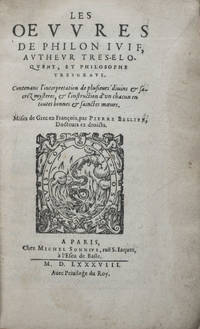
1588réf. 43973Paris: Michel Sonnius 1588. Early edition. Hardcover. f to vg. 12mo 7 x 4 3/4". 8 528 32 leaves. Contemporary full vellum with handwritten title to spine. Publisher's title vignette. Decorative headpieces and initials. Originally published in 1575 this first French language edition of the works of Philo a first-century Alexandrian philosopher known for his mostly allegorical interpretations of the Torah known in the Hellenic world as the Pentateuch. His works also include histories and comments on philosophy. Many of the titles by which texts and text groups are known as modern conventions and not inventions of Philo. This book contains no less than 24 titles including the following: - De la Création du Monde On The Creation of the World - Allégories des Saintes Lois Allegorical Expositions of the Holy Laws - Du Plantement On Planting - De la Vie de Moïse On the Life of Moses - De la Charité et de l'Amour de son Prochain On Charity and Love for Others - De l'État et Devoir du Juge On a Judge's Duty - De l'Érection et Création du Prince The creation and elevation of the Prince - De la Force et Grandeur de Courage On the Power and Grandeur of Courage - Les Dix Commandements The Ten Commandments - Des Lois Particulières On the Specific Laws - De la Circoncision On Circumcision - De la Monarchie On Monarchy - Quels doiuent estre les loyers & honneurs des Sacrificateurs Rents & Honors of Priests - Des animaux qui sont propres aux Sacroifices: & quelles sont les elpeces des Sacrifices Elements of Animal Sacrifices - De ceux qui offrent les hosties au Sacrifice Hosts of Sacrifices - Qu'il ne faut point receuoir au temple le loyer & gain de la paillarde Rent and Profit of the Merchants - Que tout homme de bien est libre Every Good Man is Free - De la vie contemplariue ou des vertus des personnes deuotes Contemplative Life and Virtues - De la Noblesse On Nobility - Des loyers & peines Rents and Penalties - Des maledictions Curses - Que le monde n'est perissable That the World isnot Perishable - Contre Flaccus: ou de la prouidence Against Flaccus: or the Providence - Des vertus & ambassade fait à Caius Virtues & Embassy to Caius Binding age-toned. Book block separating from binding but still holding. Fore-edge of front free endpaper and fly leaf creased and torn. Clear and sporadic water-staining along upper margin of pages throughout. Text in old French. Binding in overall fair to good interior in good to very good condition. Michel Sonnius hardcover books
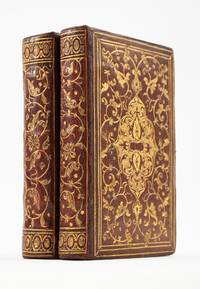
1568réf. ST20921Lutetia Paris: Robert Estienne II 1568. 128 x 87 mm. 5 x 3 1/2". Two volumes. LOVELY CONTEMPORARY RED MOROCCO GILT covers with large central azured arabesque surrounded by curling vines with azured leaves smooth spines with similar vines head and foot of spines with egg-and-dart roll similar to one used by Claude de Picques second volume with faint blind lettering to spine all edges gilt perhaps with some minor early restorations but if so then done with such care as to preclude certainty. Housed in modern suede-lined calf-backed clamshell boxes with magnetic closures. Printer's device on titles and final page decorative initials and headpieces. Front pastedown of volume I with ex-libris of Georgios Arvanitidis. Renouard 171:1; Schreiber 239; Darlow & Moule 4633; Adams B-1670. See: Verron "Les Reliures de l'Entrée de Charles IX à Paris 1572 . . . réalisées par Claude Picques" in Bulletin du Bibliophile 2014 no. 2 pp. 282-98. Just a touch of rubbing to extremities front hinge of second volume open but everything quite tight text with occasional mild browning small spots trivial smudges or tiny worm trails but A BEAUTIFUL COPY clean and fresh internally and the bindings tight and lustrous with very bright gilt With exceptional visual appeal these two precious volumes shining with gilt and containing the Greek New Testament from the renowned Estienne family of printers are of special interest because of their typography their bindings and their provenance. With the expressed goal of printing Greek texts from manuscripts in the royal library at Fontainebleau François I established the post of royal printer in Greek in 1539 appointed Robert Estienne I 1503-59 to the position in 1542 and commissioned the renowned Claude Garamond to cut a new Greek font for this project. To design the type the King called on his own celebrated calligrapher Angelo Vergecio who produced in collaboration with Garamond three different sizes of what came to be called the Royal Types or "grecs du roi." According to Schreiber "These cursive Greek types are universally acknowledged as the finest ever cut." In 1548 and 1549 Robert Estienne issued the press' first Greek Testament known as the "O mirificam" edition for the opening of the dedication to the king in 16mo or "pocket" format using the smaller font of Garamond's "grecs du roi." In 1550 Robert a Protestant moved to Geneva while his son Robert II 1533-70 a Catholic remained in Paris and took over as the royal printer in Greek. Our 1568 Testament--the only one issued by the son--is a reprinting of the "O mirificam" edition but expanded with the critical apparatus from the 1550 folio edition issued by the father. Schreiber notes that our edition is interesting from a typographical point of view as it contains an even more minute version of the already small grecs du roi type for the Table of Chapters. The exceptionally pretty volumes are done in the style of royal binder Claude Picques fl. 1539-78 and employ a decorative roll very similar to one that appears on the spine of the vellum bindings Picques did for "L'Entrée de Charles IX à Paris" 1572. Our volumes once graced the library of Constantinople collector Georgios Arvanitidis 1876-1953 whose library included a number of Estienne Greek editions. They were later in the distinguished library of Frederick B. Adams 1910-2001 director of the Pierpont Morgan Library from 1948-69 and then president of the prestigious Association Internationale de Bibliophilie from 1974-83. And they were featured in the celebrated 1929 Gumuchian catalogue of 398 historically exceptional bindings as item #71. Robert Estienne II unknown books
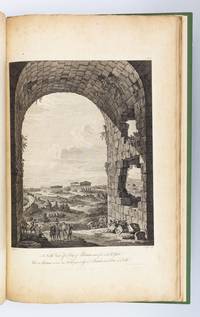
1768réf. ST17496-011London: Chez l'auteur 1768. First Edition in French. 590 x 380 mm. 23 1/4 x 15". 52 2 pp. Modern brown quarter morocco over green linen boards brown morocco label with gilt lettering on smooth spine edges untrimmed. WITH 25 FULL-PAGE ENGRAVED PLATES OF GRECIAN RUINS and seven smaller engraved plates in text including one on dedication page. A Large Paper Copy. Fowler p. 157; Millard British 41; Blackmer 1065; Brunet III 1329. Head of spine partly torn but with no loss contents with not infrequent light marginal soiling though plates uniformly clean other minor imperfections but an excellent copy with greatly generous margins with deep impressions of the type and with strong impressions of the plates. This work is the first significant account of the ancient city of Paestum being in the words of Blackmer "larger and much more complete than any of the previous publications." Located in the Tyrrhenian Sea off the coast of southern Italy Paestum or Poseidonia in Greek was founded by Greek colonists in the sixth century B.C. and still contains beautifully preserved ruins from that period including temples an amphitheater and painted tombs. Abandoned in the Medieval period Paestum wasn't rediscovered by the West until the 18th century with the first modern publication of the site not appearing until 1764 when a suite of plans by G. P. M. Dumont appeared with no text based on the observations of Jacques-Germain Soufflot. As Millard indicates the genesis of the present publication has an extremely complex history we do not even know with certainty who wrote the text but we do know that engraver Thomas Major 1729-99 whom DNB calls "the first great English landscape engraver" was responsible for preparing the plates. Because he had no first-hand knowledge of the site Major relied on images by other artists including Antonio Joli Gaetano Magri Robert Mylne and Jacques-Germain Soufflot. The text was first published in English and then in French the same year. According to Fowler "this work . . . was an important eighteenth-century pioneer contribution to the knowledge of Greek architecture in England"; and Millard tells us that "the book was surprisingly well received by reviewers" in both England and France remaining "the standard reference to Paestum until 'Les Ruines de Paestum ou Posidonia' by C.-M. Delagardette was issued in 1798.". Chez l'auteur unknown books
1889réf. 34983London: John C. Nimmo 1889. First edition. Cloth. Near fine copies; owner's book plate on front pastedown of Vol. I. xxviii 351 pp.; xii 343 pp. Illus. with 25 color plates and 25 b/w plates. Sm. 4to. No. 667 of 875 copies with duplicate plates one on plate paper proofs before letters and the other on Whatman paper with title and colored by hand. Includes Boston Daily newspaper ad clipping dated Dec. 6 1889. John C. Nimmo hardcover books