(Bible, NT, Greek) N TBiblio.com
22 297 résultats
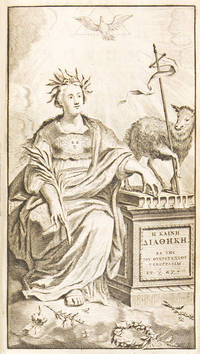
1698réf. 255818Amsterdam: Ex Officina Westeniana 1698. 3rd Leusden edition. Additional engraved title-page and 2 folding engraved maps the Holy Land and the Mediterranean. 337 1. colophon; 142 1 pp. 8vo signatures alternating in 8s and 10s. 18th-century red morocco covers with gilt-rolled bordersgilt-tooled and -lettered spine multi-colored Dutch pastedowns without free endpapeers. a.e.g. Head of spine starting otherwise quite attractive. 3rd Leusden edition. Additional engraved title-page and 2 folding engraved maps the Holy Land and the Mediterranean. 337 1. colophon; 142 1 pp. 8vo signatures alternating in 8s and 10s. D & M doesn't mention the two fine engraved maps found in this copy; nor the separately printed COMPENDIOLUM 1699 with Leusden's useful concordance of all Greek words found in the New Testament. The Dutch Calvinist philologist Johann Leusden 1624 - 1699 was one of the foremost Biblical experts of his time. His edition of the Greek New Testament first appeared in 1675; this 1698 edition is quite scarce in the US and very rare with the Compendiolum. Darlow & Moule 4718a "Apparently the earlies Greek New Testament to bear the name of the publisher Henricus Wetstenius"; OCLC: 64158458 Ex Officina Westeniana unknown
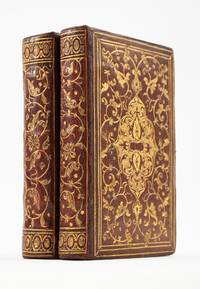
1568réf. ST20921Lutetia Paris: Robert Estienne II 1568. 128 x 87 mm. 5 x 3 1/2". Two volumes. LOVELY CONTEMPORARY RED MOROCCO GILT covers with large central azured arabesque surrounded by curling vines with azured leaves smooth spines with similar vines head and foot of spines with egg-and-dart roll similar to one used by Claude de Picques second volume with faint blind lettering to spine all edges gilt perhaps with some minor early restorations but if so then done with such care as to preclude certainty. Housed in modern suede-lined calf-backed clamshell boxes with magnetic closures. Printer's device on titles and final page decorative initials and headpieces. Front pastedown of volume I with ex-libris of Georgios Arvanitidis. Renouard 171:1; Schreiber 239; Darlow & Moule 4633; Adams B-1670. See: Verron "Les Reliures de l'Entrée de Charles IX à Paris 1572 . . . réalisées par Claude Picques" in Bulletin du Bibliophile 2014 no. 2 pp. 282-98. Just a touch of rubbing to extremities front hinge of second volume open but everything quite tight text with occasional mild browning small spots trivial smudges or tiny worm trails but A BEAUTIFUL COPY clean and fresh internally and the bindings tight and lustrous with very bright gilt With exceptional visual appeal these two precious volumes shining with gilt and containing the Greek New Testament from the renowned Estienne family of printers are of special interest because of their typography their bindings and their provenance. With the expressed goal of printing Greek texts from manuscripts in the royal library at Fontainebleau François I established the post of royal printer in Greek in 1539 appointed Robert Estienne I 1503-59 to the position in 1542 and commissioned the renowned Claude Garamond to cut a new Greek font for this project. To design the type the King called on his own celebrated calligrapher Angelo Vergecio who produced in collaboration with Garamond three different sizes of what came to be called the Royal Types or "grecs du roi." According to Schreiber "These cursive Greek types are universally acknowledged as the finest ever cut." In 1548 and 1549 Robert Estienne issued the press' first Greek Testament known as the "O mirificam" edition for the opening of the dedication to the king in 16mo or "pocket" format using the smaller font of Garamond's "grecs du roi." In 1550 Robert a Protestant moved to Geneva while his son Robert II 1533-70 a Catholic remained in Paris and took over as the royal printer in Greek. Our 1568 Testament--the only one issued by the son--is a reprinting of the "O mirificam" edition but expanded with the critical apparatus from the 1550 folio edition issued by the father. Schreiber notes that our edition is interesting from a typographical point of view as it contains an even more minute version of the already small grecs du roi type for the Table of Chapters. The exceptionally pretty volumes are done in the style of royal binder Claude Picques fl. 1539-78 and employ a decorative roll very similar to one that appears on the spine of the vellum bindings Picques did for "L'Entrée de Charles IX à Paris" 1572. Our volumes once graced the library of Constantinople collector Georgios Arvanitidis 1876-1953 whose library included a number of Estienne Greek editions. They were later in the distinguished library of Frederick B. Adams 1910-2001 director of the Pierpont Morgan Library from 1948-69 and then president of the prestigious Association Internationale de Bibliophilie from 1974-83. And they were featured in the celebrated 1929 Gumuchian catalogue of 398 historically exceptional bindings as item #71. Robert Estienne II unknown
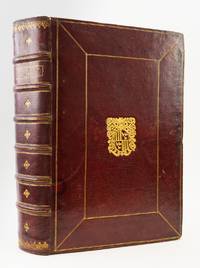
1597réf. ST19351Frankfurt: heirs of Andreas Wechel Claude de Marne & Johann Aubry 1597. Fourth Complete Greek Bible printed in Germany. 388 x 258 mm. 15 1/8 x 10 1/8". 4 p.l. 1 blank leaf attached to backing of folio :4 1098 2 pp. VERY STATELY 17TH CENTURY RED MOROCCO covers with mitered gilt frame gilt supralibros of Baderon de Maussac Olivier 745 at center raised bands spine panels with gilt flower gilt lettering all edges gilt. Printer's Pegasus device on title and final page. Front flyleaf with ink inscription recording the purchase on 24 February 1680 at Toulouse for 24 livres. Darlow & Moule 4653; VD16 B 2578; Adams B-979. ◆Three minute dents to front board a hint of wear to bands and corners isolated faint foxing blank recto of frontispiece leaf and blank verso of final leaf with faint blue shadow from endpapers but all of these quite trivial and otherwise A BEAUTIFUL COPY--fresh clean and bright internally with very wide margins and strong impressions of the plates and in a lustrous binding showing few signs of use. This handsome and remarkably well-preserved tall folio Greek Bible from a distinguished German printing firm comes in a shiny armorial binding with aristocratic French provenance. Darlow & Moule assigns the editing of this issue to Franciscus Junius François du Jon or Friedrich Sylburg noting that the Old Testament "is based on the Basel edition of 1545 . . . with correction from the Complutensian text and useful notes." The New Testament follows the text of Robert Estienne's 1568-69 edition. The Wechel family had a long tradition of humanist printing with an emphasis on Greek texts beginning with the press of Christian Wechel fl. 1520-54 in Paris and continuing after his son Andreas d. 1581 fled to Frankfurt to escape the persecution of Protestants in France. Andreas' descendants carried on the business through the first quarter of the 17th century. Olivier's "Reliures Armoriées Françaises" 1926 pl. 745 offers three possible attributions for the supralibros here all from the Languedoc region during the first half of the 17th century: Jean de Baderson; Jacques de Baderon seigneur de Maussac a member of the Parlement of Toulouse; and Jacques de Baderon de Maussac seigneur de Montagnac et de Corneillan and commandant of the city of Collioure. The inscription on the flyleaf here indicating that the book was purchased in Toulouse perhaps supports the case for the member of the Parlement in that city. The 24 livres paid for our imposing volume in 1680 would have represented as much as two months' wages for a worker in the region of its purchase. heirs of Andreas Wechel, Claude de Marne & Johann Aubry unknown
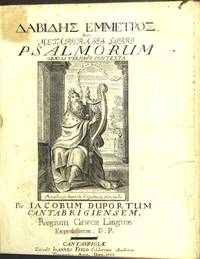
1666réf. 25559Cantabrigiæ: excudit Ioannes Field 1666. 4to pp. 72 431; inserted engraved vignette title-p.; parallel text in Greek and Latin; 2 short tears in fore-edge of title-p. not touching any letterpress worm track occasionally touching letters in first 60 leaves; stains on G2-G4; lacking the portrait of Charles II; contemporary calf-backed marbled boards red morocco label on spine; minor rubbing and wear small cracks starting at the extremities of the joints else generally a very good copy. Paraphrase in Homeric language and verse and its translation in Latin prose on opposite pages with a prefatory treatise on the ancient versions of the Old Testament. Translated by Jacob Duport. "Immediately after the Restoration he was made one of the king's chaplains and reinstated in the possession of his prebend at Lincoln but not of the archdeaconry of Stow as he preferred holding his fellowship and vice-mastership in Trinity College. Widdrington was now dispossessed of the Greek professorship and Duport restored to it but he resigned the chair the same year in favour of his pupil Isaac Barrow. On 19 July 1660 he was by royal mandate with many other learned divines created D.D. at Cambridge Kennett p. 251. He was installed dean of Peterborough 27 July 1664. In 1668 on the death of Dr. John Howorth master of Magdalene College Duport was recalled to Cambridge and appointed by James earl of Suffolk possessor of Audley End to fill the vacant headship. In the following year Duport was elected vice-chancellor of the university. Bishop Monk says that Duport 'appears to have been the main instrument by which literature was upheld in this university Cambridge during the civil dissensions in the seventeenth century and though seldom named and little known at present he enjoyed an almost transcendent reputation for a great length of time among his contemporaries as well as in the generation which immediately succeeded" DNB. Wing B2739a. excudit Ioannes Field unknown
1986Very light edgewear. Scholar's bookplate to inner cover (G. P. Goold). ; Bibliotheca Scriptorum Graecorum Et Romanorum Teubneriana TEUBNER; 403 pages
1904Pages tanned. Corners and spine ends edgeworn. Minor crease to first few pages. Staining to rear board. ; Text and preface are in Latin; cxxxv, 358 ; Bibliotheca Scriptorum Graecorum Et Romanorum Teubneriana TEUBNER; Vol. 1; 12mo 7" - 7½" tall; 215 pages
1912Scholar's name to ffep (T. J. Dunbabin). Book has been rebound in blue buckram with gilt title to spine- Fasc I & II bound together. Spine and top edges of boards a bit sunned. Minor shelfwear. Some foxing to endpapers. Some pencil underlining and notes. ; Text in latin; Apparatus in Latin. Fasc I. (edition stereotypa) : (1912) Xii, 243 pp + Fasc II: (1890) xv, [244]-415 pp ; Bibliotheca Scriptorum Graecorum Et Romanorum Teubneriana TEUBNER [2 Vols in 1]; Vol. 4.1-2; 8vo 8" - 9" tall; 415 pages
1931Scholar's name to titlepage (T. J. Dunbabin) and one other name in ink. Spine sunned. Minor shelfwear. Light foxing. Minor pencil underlining and notes. ; Text in latin; Apparatus in Latin. Xvi, 112 pp ; Bibliotheca Scriptorum Graecorum Et Romanorum Teubneriana TEUBNER [2 Vols in 1]; Vol. 3.3; 8vo 8" - 9" tall; 415 pages
1915Corners have edgewear. Endpapers lightly tanned. Head and heel of spine has chipped off. Small pieces of front board to lower corner have also chipped off. ; Text in latin; Apparatus in Latin. Pp 355-585 ; Bibliotheca Scriptorum Graecorum Et Romanorum Teubneriana TEUBNER; Vol. 2.3; 8vo 8" - 9" tall; 230 pages
1930Light discoloration to Spine. Light edgewear to corners and spine ends. Light bumping to upper corners. Some foxing. Minor pencil. Scholar's name to ffep (T. J. Dunbabin). ; Text and preface are in Latin; Xx, 244 + xvi, 110; Bibliotheca Scriptorum Graecorum Et Romanorum Teubneriana TEUBNER; Vol. 4; 12mo 7" - 7½" tall; 354 pages
1971Some Pages unopened. Spine sunned. Minor shelfwear. ; Parallel text in French and Latin. Xcii, 233 pp ; Collection Des Universités De France. Association Guillaume Budé; 233 pages
réf. 109385Paris, Les Belles Lettres, 1965.
1936réf. ROD0108728H. DESSAIN. 1936. In-12. Broché. Etat d'usage, Tâchée, Dos abîmé, Intérieur acceptable. 74 pages. Quelques illustrations en noir et blanc dans texte.. . . . Classification Dewey : 480-Langues helléniques. Grec
réf. 201218967Paris, Les éditions de l'école, 1967 ; grand in-12, br. Classe de seconde.
1885pp. lxiv + 385 + Plus 24 plates in Color Chromolithography (some folding) + A folding map and four plans. 188 woodcuts in the text. Tall 8vo. 268 mm. Original gilt decorated cloth binding, worn at extremities. Very XLib with a couple of unsightly repairs, but really a sound and attractive copy. Hardbound. Very good. First American Edition. Heinrich Schliemann (1822-1890) was born in Neubukow, Mecklenburg-Schwerin (Germany) but was a world-traveler as a treasure hunter and pioneer archaeologist. An advocate of the historical reality of places mentioned in the works of Homer, he became the first important excavator of Troy and of the Mycenaean sites Mycenae and Tiryns. Schliemann brought dedication, enthusiasm, conviction a large fortune, and a great deal of luck to the work. His personal history is quite fascinating. At the Tiryns excavation he worked with Wilhelm Dorpfeld (1853-1940) a German architect, best known for his contributions to classical archaeology, and the wonderful drawings in this volume. **PRICE JUST REDUCED! W112
réf. 50378Athens 1913.
réf. 104596N.Y., Arno Press, 1976.
2017New Turkish Paperback. Pbo. Roy. 8vo. (24 x 17 cm). In Turkish. 180 p., color ills. Tire Müzesinden seçme eserler. Selected pieces from Tire Museum Collection.
1998A children's tale of fantasy and intrigue which calls upon the reader to appreciate the difficult choices Timothy makes in the pursuit of his dream, and ultimately those choices we make for ourselves. 96p. illus.[B&W] The author is a professor of Medicine at the University of Toronto. [NO copies found in WorldCat] Book
1989Faint crease to first few pages. Scholars' bookplate to inner cover. Spine very lightly sunned. Minor shelfwear. ; Classical and Byzantine Monographs Vol. VI; 183 pages
1903Pages slightly tanned. Light edgewear to spine ends. Minor browning to boards. Minor shelfwear. ; In Greek; editorial matter in German; 126 pages
1974DJ is price-clipped. Light spotting to DJ. Slight sticker remnants to back panel. Very light foxing to textblock. ; 246 pages; Dispatched to Sicily in 344 BC as an elderly man at the head of a small, motley band of mercenaries, Timoleon had no experience of the island. Yet, in less than eight years Timoleon overthrew tyrants, expelled the Carthaginians, and introduced peace, prosperity and constitutional government to an area which for decades had known only disorder. The peace he had brought was broken after his death, and tyranny returned in 317 BC; but the prosperity which he had set in motion continued to increase well into the third century. Dr Talbert has deliberately avoided the temptation to write a biography, and has confined himself to coverage of those aspects of Timeleon's work for which some evidence survives. He examines closely the uneven and frequently eulogistic accounts left by ancient writers. He also discusses fully the light thrown on Timoleon's revival by the discovery of numerous silver coin hoards in Sicily, and by archaeological excavations undertaken there since the Second World War. His studies add up to a most thorough investigation of Timoleon's work.
1952Endpapers browned. DJ has 2 tears and is browned with a bit of staining. ; Ix, 63pp. It has long been recognised that the ancient authorities for Timoleon's achievement in suppressing tyranny in fourth-century Sicily are biased in his favour. Examines the origins and effects of this bias and discusses the relations of Timoleon with each of his opponents. ; Publications of the Faculty of Arts of the University of Manchester No. 5; 63 pages