23 400 résultats
réf. 97788Paris, Auguste Picard, Editeur, 1943. 14 x 23, 168 pp., broché, bon état.
réf. 47059P., Picard, 1918, in 8° broché, XII-98- 8 pages ; carte dépliante.
réf. 47060P., Picard, 1914, in 8° broché, paginé 99 à 260 et 16 pages de table.
1966réf. 45692Picard Paris, Picard 1966. In-8 broché de 149 pages. Bon état
1939réf. 99915193Picard Picard 1939, In-8 broché, 161 pages. Bon état.
1924réf. 112229Picard Broché Picard 1924, In-8 broché. 150 pages. Bon état.
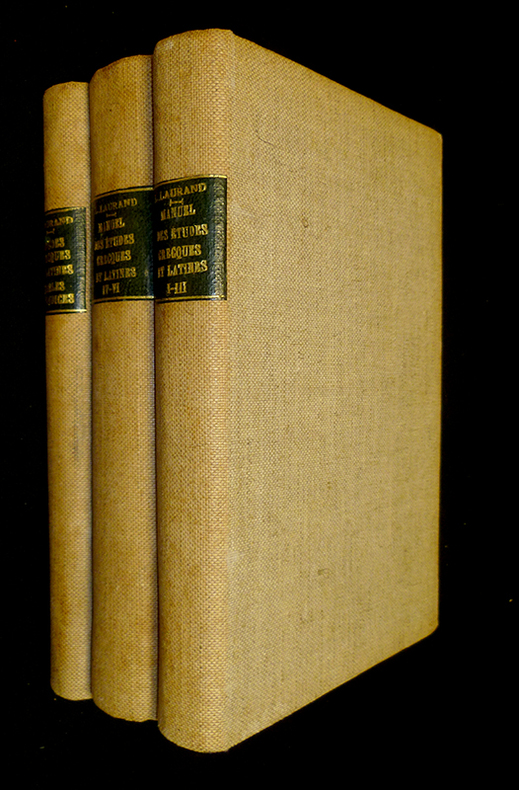
réf. fe859Auguste Picard Relié Trois volumes in-8 (14.5 x 22.5 cm), reliés pleine toile, volume 1 : 378 pages +24, volume 2 : paginé de 379 à 741 + 42 à 48, volume 3: paginé de 879 à 933, 51 pages +7, paginé de 53 à 123 + 15, cet ensemble comprend 6 fascicules + le n°8 comprenant les tables générales + 4 appendices (fascicule n°7 manquant): 1. Géographie, Histoire, Institution grecques (1913) / 2.Littérature Grecque (1914) / 3. Grammaire historique grecque (1914) / 4. Géographie, Histoire, Institutions romaines (1917)/ 5. Littérature latine (1918)/ 6. Grammaire historique latine (1918)/ 8. Tables Générales (1921) / Appendice n°1. Les Sciences dans l'Antiquité (1923) / Appendice n°2 à 4 : l'Art oratoire des anciens, l'Enseignement du grec et du latin, Lectures de littérature grecque et latine (1929) ; dos et bords des plats insolés, des taches d'usage à la couverture, ex-libris en début d'ouvrage, rousseurs éparses, par ailleurs intérieur frais, assez bon état. Livraison a domicile (La Poste) ou en Mondial Relay sur simple demande.
réf. 57985Paris, Auguste Delalain 1820, 215x130mm, VIII- 310pages, Etiquette de titre imprimée au dos. Traces d’anciennes écritures sur le parchemin. Plats un peu défraîchis. Intérieur très propre avec de très rares rousseurs. Bon état.
réf. 001435Anonyme [M.D.T.], fin 18ème, 2p in-4. Poème grec avec sa traduction française en regard, publié en 1791 dans L'Almanach des Muses de 1791 et dans L'Esprit des Journaux d'avril 1791, signé M.D.T. (Monsieur de T*** ?). Il est alors titré : L'avare bon calculateur. Un avare explique à son fils pourquoi il ne faut pas donner d'argent au curé : s'il est condamné, c'est « argent perdu », s'il est sauvé, c'est un « secours de trop ». « Mais supposons enfin le Purgatoire, mon père [réponds le fils]. Oh dans ce cas, dans ce cas j'attendrais ». Sous le texte grec, quelques notes du traducteur. Premier feuillet sali. Ce texte sera à nouveau publié en 1848 (Petit trésor de poésie récréative) et en 1876 (L'aimable compagnon).
1963réf. R200038641LIBRAIRIE C. KLINCKSIECK. 1963. In-8. Broché. Etat d'usage, Couv. légèrement passée, Dos frotté, Intérieur frais. 187 pages. Quelques annotations au crayon à papier à l'intérieur du texte.. . . . Classification Dewey : 480-Langues helléniques. Grec
réf. 64893P., Klincksieck, 1963, in 12 broché, 195 pages.
réf. 99640Paris, Picard, 1939.
réf. 99641Paris, Picard, 1954.
réf. 38908Turnhout, Brepols, 1989 Paperback, 17 p., + 3 microfiche, 140 x 215 mm. ISBN 9780888448521.
réf. 38910Turnhout, Brepols, 1992 Paperback, 78 p., + 4700 p. on 17 microfiche, 140 x 215 mm. ISBN 9780888448545.
réf. 82140Paris, Hachette, 1883. 13 x 22, 2 tomes en 1 volume, 380 + 310 pages, reliure pleine toile, couvertures partiellement conservées, bon état (4 dernières pages abîmées).
1998Pages unopened. Some minor creasing to front wrap and first few pages. Small chip to head of spine. ; Collection Latomus Volume 242; 458 pages
1998Pages unopened. Very minor shelfwear. Else fine. ; Collection Latomus Volume 242; 458 pages
1993No marks or inscriptions. No creasing to covers or to spine. A very clean very tight copy with bright unmarked boards, minor traces of storage and no bumping to corners. 973pp. Fifth edition of the standard work from Dornbusch and Fischer. All text in Greek. Very scarce.
2000Light pencil marginalia. Gift inscription from author to R. E. Fantham on ffep. 1 corner bumped. DJ spine slightly sunned with some light edgewear and shelfwear. ; 148 pages; Study establishes a critical perspective for understanding the kind of comedy Menander wrote, his roots, the theatrical effects he sought, and the extent of his achievement. Chapters on the major plays analyse their techniques of construction and characterization, suggesting both the strengths and the limitations of Menander's comic tradition. An introductory chapter places the tradition of New Comedy in the history of drama and also draws modern parrallels, making it useful for students of drama aswell as classicists. ; Signed by Author
2000Minor rubbing to DJ. ; 148 pages; Study establishes a critical perspective for understanding the kind of comedy Menander wrote, his roots, the theatrical effects he sought, and the extent of his achievement. Chapters on the major plays analyse their techniques of construction and characterization, suggesting both the strengths and the limitations of Menander's comic tradition. An introductory chapter places the tradition of New Comedy in the history of drama and also draws modern parrallels, making it useful for students of drama aswell as classicists.
2007Very light shelfwear. ; Making Mockery explores the dynamics of comic mockery and satire in Greek and Roman poetry, and argues that poets working with such material composed in accordance with shared generic principles and literary protocols. It encourages a synoptic, synchronic view of such poetry, from archaic iambus through Roman satire, and argues that if we can appreciate the abstract poetics of mockery that governs individual poets in such genres, we can we better understand how such poetry functioned in its own historical moment. Rosen examines in particular the various strategies deployed by ancient satirical poets to enlist the sympathies of a putative audience, convince them of the justice of their indignation and the legitimacy of their personal attacks. The mocking satirist at the height of his power remains elusive and paradoxical--a figure of self-constructed abjection, yet arrogant and sarcastic at the same time; a figure whose speech can be self-righteous one moment, but scandalous the next; who will insist on the "reality" of his poetry, but make it clear that this reality is always mediated by an inescapable movement towards fictionality. While scholars have often, in principle, acknowledged the force of irony, persona-construction and other such devices by which satirists destabilize their claims, very often in practice--especially when considering individual satirists in isolation from others--they too succumb to the satirist's invitation to take what he says at face value. Despite the sophisticated critical tools they may bring to bear on satirical texts, therefore, classicists still tend to treat such poets ultimately as monochromatically indignant, vindictive individuals on a genuine self-righteous mission. This study, however, argues that that a far subtler analysis of the aggressive, poeticized subject in Classical antiquity--its target, and its audience--is called for. ; Classical Culture and Society; 312 pages