Muraoka, TAntiquariat.de
Studies in Ancient Hebrew Semantics. Edited by T. Muraoka. (= Abr-Nahrain Supplement Series, Volume 4).
1995réf. 3126758Louvain: Peeters Press 1995. VII, 107 Seiten. 4° (25-35 cm). Orig.-Broschur. [Softcover / Paperback].
317 résultats
1943réf. 017740Chicago: Institute of General Semantics 1943. Compiled and edited by M. Kendig. xxiv 579p. b/w illus. original cloth. Contains the 79 congress papers in philsophy psychology and education theory. Institute of General Semantics unknown books
1995réf. 3126758Louvain: Peeters Press 1995. VII, 107 Seiten. 4° (25-35 cm). Orig.-Broschur. [Softcover / Paperback].
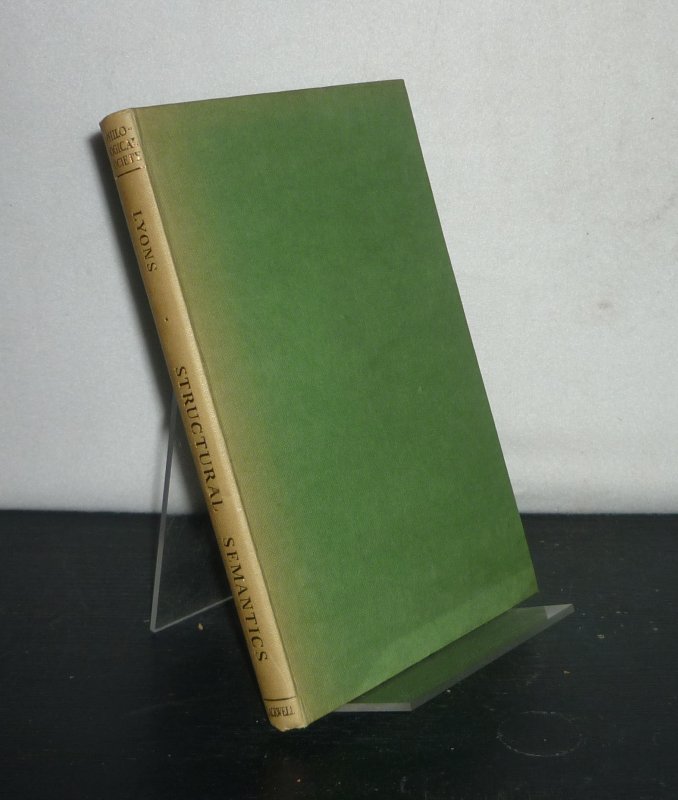
1963réf. 3119895Oxford: Basil Blackwell 1963. (8), 237 Seiten. 8° (17,5-22,5 cm). Orig.-Pappband mit goldgeprägtem Rückentitel. [Hardcover / fest gebunden].
1935réf. IC10-922Chicago, 1935. original Broschur, gr.-8?, 57 p.
1977réf. 3081904Nijmegen: Dekker & van de Vegt 1977. XIII, 196 Seiten. Gr. 8° (22,5-25 cm). Orig.-Broschur. [Softcover / Paperback].
1992réf. ZB1289836Prentice Hall 1992. 238 pp. Hardcover previous owner's name to front free endpaper several page corners bent minor underlining and marginalia to about 10 pages else good. - If you are reading this this item is actually physically in our stock and ready for shipment once ordered. We are not bookjackers. Buyer is responsible for any additional duties taxes or fees required by recipient's country. Photos available upon request. Prentice Hall hardcover
réf. 19785857-nnew. unknown
1959réf. 46888No place The Association for Symbolic Logic 1959. 8vo. Wrappers blank with printed title on spine. Entire issue No. 1 of vol. 24 offered. Fine and clean. The seminal first printing of Kripke's debut article which provided the basis for his logic and for the model theory for modal logic in general. The work constitutes the very beginning of Kripke Semantics often called possible world semantics. Kripke's works in general are rare in fist editions. Many of them remain unpublished and are only known in privately circulated manuscripts.The American philosopher Saul A. Kripke born 1940 is an exceedingly important logician and philosopher of language and one of the most powerful and influential thinkers of analytic and Anglo-American philosophy. He is considered the greatest living philosopher and perhaps the greatest since Wittgenstein. In 2001 he was awarded the Schock Prize in Logic and Philosophy which is considered the philosopical equivalent of the Nobel Prize.Kripke who grew up in Omaha in a religious Jewish family was somewhat of a prodigy child. During grammar school he got intimately acquainted with and mastered to perfection algebra geometry and calculus and very early on he took up philosophy which later became his career. Still a teenager in high school he wrote a work that was to change the face of philosophical logic forever namely the groundbreaking paper "A Completeness Theorem for Modal Logic" which was printed a few years later in 1959 in the Journal of Symbolic Logic while he was in his first year at Harvard University. This seminal debut work proposed what later came to be known as Kripke models for modal logic. The story goes that the paper earned a letter from the department of mathematics urging Kripke to apply for a job there to which he is said to have written an answer explaining "My mother said that I should finish high school and go to college first."In 1962 he graduated from Harvard University where he remained until 1968 first as a member of the Harvard Society of Fellows and then as a lecturer. During these years he developed the logical theories founded in the "Completeness Theorem" further and made seminal contributions to the field of logic and semantics. Kripke Semantics is a formal semantics for non-classical logic systems that Kripke began developing in his teenage years first published something on in 1959 the present work and further developed in the 60'ies and. The development of Kripke Semantics was no less than a breakthrough in the making of non-classical logics of which no model theory existed before Kripke's. With this work Kripke laid the foundation for proving completeness theorems for modal logic and for identifying the weakest normal modal logic which is now named K after him. unknown
réf. AR-3-1039495996Very Good. 1984 Paperback first edition Author inscribed signed and personalized. Barely used. paperback
réf. 19785857like new. unknown
réf. __3111264203Mouton De Gruyter 1900. Hardcover. New. 509 pages. German language. 9.06x6.10x9.61 inches. Mouton De Gruyter hardcover
réf. Ph657-BCSLI 1998. Hbk 363pp no dj as issued excellent clean tight unmarked as new. CSLI, 1998, hardcover
réf. Lin147-BMIT Press 2000. hbk 166pp ISBN: 026208287X no dj sl shelf wear to . MIT Press, 2000, hardcover
1972réf. 13Seuil 1972 453 pages PARIS. 1 VOL. in8. 1972. RELIE CARTONNE AVEC JAQUETTE. 453 pages.
1983réf. 3608Presence 1983 275 pages in8. 1983. broché. 275 pages.
1904réf. 3650Bibliothèque-Charpentier 1904 374 pages in12. 1904. broché. 374 pages.
1990réf. 5358Editions d'Organisation 1990 141 pages 15 4x1 4x23 8cm. 1990. broché. 141 pages. Ce livre est un manuel de référence sur la création de logos abordant des aspects techniques comme la typologie la sémantique le graphisme la typographie et la législation. La deuxième édition rénovée et augmentée s'adresse à la fois aux débutants et aux professionnels souhaitant s'initier ou se perfectionner
1962réf. 7241Presses Universitaires de France 1962 collection que sais je n° 655. poche. 1962. broché. La Sémantique de Pierre Guiraud est un ouvrage académique publié en 1959 par les Presses universitaires de France traitant de l'étude scientifique du sens dans le langage
1976réf. 7580Presses Universitaires de France 1976 collection que sais je n° 270. poche. 1976. broché. Ouvrage de lexicologie française qui décrit les structures formelles et sémantiques du vocabulaire français contemporain. Publié dans la collection encyclopédique 'Que sais-je ?' il sert d'aide-mémoire sur la formation et l'évolution des mots
2000réf. 8160Armand Colin 2000 192 pages 13 4x1 4x22 2cm. 2000. broché. 192 pages. Cet ouvrage de Jacques Moeschler (avec Antoine Auchlin) est un manuel d'introduction à la linguistique contemporaine présenté comme un bon ouvrage de vulgarisation offrant une vue d'ensemble de la discipline. Il est particulièrement utile pour les étudiants et universitaires bien qu'il puisse nécessiter des lectures complémentaires pour des recherches plus approfondies. Le livre retrace l'évolution de la linguistique notamment le passage de la linguistique structurale aux approches formelles et cognitives
1977réf. 13898NATHAN INFORMATION FORMATION 1977 181 pages in8. 1977. broché. 181 pages. Cet ouvrage de Jacqueline Picoche publié chez Nathan en 1977 est un manuel de référence en lexicologie française. Il aborde les critères de délimitation des unités lexicales les champs sémantiques et propose des applications pédagogiques pour l'étude et l'enseignement du vocabulaire
réf. 33844Turnhout, Brepols, 1979 Paperback, VII+417 p., 165 x 240 mm. ISBN 9789070419028.
réf. 019907Michel Bréal (1832-1915), linguiste, fondateur de la sémantique moderne. C.A. + enveloppe, 13 novembre [1881?], 7 lignes. A l'écrivain Alfred Marchand (1842-1895). « Avec tous mes remerciements pour ce volume, qui me rappelle des temps où nous valions mieux qu'aujourd'hui. Ayant connu Maurice Hartmann, sa biographie m'intéresse tout spécialement. Mais j'aurais grand plaisir à connaître aussi les autres ». Il s'agit de poète allemand Moritz Hartmann (1821-1872) dont Marchand parle dans son livre sur Les Poètes lyriques de l'Autriche. [475]
réf. 019908Michel Bréal (1832-1915), linguiste, fondateur de la sémantique moderne. L.A.S., Paris, 6 février 1900, 2p in-8. A l'historien et sociologue Edouard Petit (1858-1917). « Cher Monsieur, Je viens de lire votre très clair et très bienveillant article sur ma Sémantique. Il n'était pas aisé d'expliquer ce genre de recherches à la masse des lecteurs : il me semble que vous y avez parfaitement réussi. A certains indices, notamment à la citation de Ludwig, je vois que les matières vous sont familières. On sent, en même temps, que vous y avez du plaisir. Cela peut faire espérer un nouveau sémantiste. Il y a encore tant à trouver, surtout si on quitte les sillons déjà creusés et si l'on défriche les terres vierges : sauf un peu les langues indo-européennes, tant le reste est encore en friche. Je suis un abonné du Siècle, de sorte que je pourrai continuer à vous lire. Je me permettrai de vous envoyer dans quelques jours un tirage à part d'un article que j'ai publié dans une revue. Il touche au même ordre d'étude. Recevez, monsieur, avec tous mes remerciements, l'assurance de mes sentiments très distingués. Michel Bréal ». Petite déchirure au pli central. Belle lettre. [475]
réf. 019909Michel Bréal (1832-1915), linguiste, fondateur de la sémantique moderne. L.A.S., 22 octobre 1898, 1p 1/2 in-8. A l'historien et sociologue Edouard Petit (1858-1917). « Cher Monsieur, Merci pour vos Etudiants populaires. Vous faites ce qu'en d'autres temps j'aurais voulu faire. Gardez cette ardeur et ne vous laissez pas décourager par les difficultés, car il y en aura. La récompense ne manquera pas non plus : elle est dans les faits comme ceux que vous citez p.129. Connaissez-vous les Lectures militaires d'Adam (l'ancien proviseur de Buffon). C'est une lecture qui rentre dans votre plan. Bien à vous et bon succès. Michel Brial ». Le titre précis est Chez les étudiants populaires. [475]