203 résultats
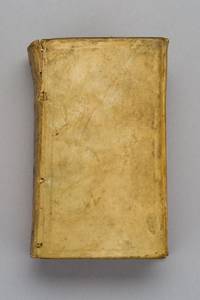
1696réf. 15588Parma: Alberto Pazzoni e Paolo Monti 1696. First Edition. 12mo 16cm. Contemporary vellum over boards; inked spine title; 48 406 26pp. Chafing and perforation to vellum along front joint but holding strong; pencilled note to rear endpapers; text fresh tight and clean; Very Good. A manual of letter-writing illustrated throughout with examples chosen from the author's apparently very large oeuvre. The examples are on a variety of subjects mainly chosen to illustrate the changes in tone and style of address to be used in addressing correspondents of varying stations. Fontana was of a prominent family of Parma and apparently wrote most of these letters while a resident in the estate of his patron Count Alessandro Sanvitale. Rare; OCLC gives four locations of which only one in the U.S. Stanford. From the library of artists Ben and Bernarda Bryson Shahn with estate bookplate inside front cover. Alberto Pazzoni e Paolo Monti unknown books
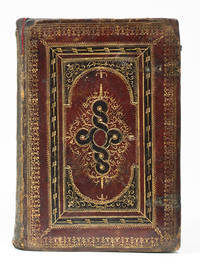
1688réf. 254004Napoli Naples: Carlo Porpora 1688. Second edition. Engraved title. xx 229 3 pp. 4to. Mid-eighteenth century Italian polychrome enameled binding of full brown calf covers with two gilt-rolled panells central strap and scroll device built up from gouges surrounded by pointellé flowers with remnants of blue and red enamel edges gilt guaffered and painted with floral and hare design front free endpaper removed bookplate. Second edition. Engraved title. xx 229 3 pp. 4to. A history of ancient sport and games in Italy first printed in 1641. This copy in an elaborate eighteenth-century Neopolitan enameled binding with all edges gilt gauffered and painted. Graesse IV p. 113 Carlo Porpora unknown books
1618réf. 254275Venetiis Venice: Juntas 1618. Title with engraved border 11 full-page engravings black chant notation on red four-line staves lxiii i 557 3; 24; 14 pp. text in double columns printed in red and black. 8vo. Bound in contemporary maroon morocco richly gilt black morocco inlaid panel border surrounding central inlaid entrelac design rebacked preserving original spine lacking clasps and catches a.e.g. joints rubbed front joint starting some light foxing throughout contemporary and early ownership notes to endpapers. Title with engraved border 11 full-page engravings black chant notation on red four-line staves lxiii i 557 3; 24; 14 pp. text in double columns printed in red and black. 8vo. Juntas unknown books
1610réf. 001421Venetia: Antonio Pinelli 1610. Full Vellum. Very Good. 8 8 615 pp. 8vo 8.25 by 6.25 inches 21 by 16 cm. Considered one of the most significant pieces of literature from the Middle Ages and a seminal work of literature written in the French language. Also a milestone in historiography as the most important account of the first and second crusades and especially the latter for which William of Tyre was a contemporary witness. The author produced this work at the request of Almaric I in about 1170 and he continued to work on it until 1183. The work was indeed accepted as unquestioned fact for many centuries and only recently have biases been discerned owing from William's entanglement in the political disputes of the day. Antonio Pinelli hardcover books
1696réf. 15588Parma: Alberto Pazzoni e Paolo Monti 1696. First Edition. 12mo 16cm. Contemporary vellum over boards; inked spine title; 48 406 26pp. Chafing and perforation to vellum along front joint but holding strong; pencilled note to rear endpapers; text fresh tight and clean; Very Good. A manual of letter-writing illustrated throughout with examples chosen from the author's apparently very large oeuvre. The examples are on a variety of subjects mainly chosen to illustrate the changes in tone and style of address to be used in addressing correspondents of varying stations. Fontana was of a prominent family of Parma and apparently wrote most of these letters while a resident in the estate of his patron Count Alessandro Sanvitale. Apparently rare; OCLC gives four locations of which only one in the U.S. Stanford. From the library of artists Ben and Bernarda Bryson Shahn with estate bookplate inside front cover. Alberto Pazzoni e Paolo Monti unknown
1688réf. 254004Napoli Naples: Carlo Porpora 1688. Second edition. Engraved title. xx 229 3 pp. 4to. Mid-eighteenth century Italian polychrome enameled binding of full brown calf covers with two gilt-rolled panells central strap and scroll device built up from gouges surrounded by pointellé flowers with remnants of blue and red enamel edges gilt guaffered and painted with floral and hare design front free endpaper removed bookplate. Second edition. Engraved title. xx 229 3 pp. 4to. A history of ancient sport and games in Italy first printed in 1641. This copy in an elaborate eighteenth-century Neopolitan enameled binding with all edges gilt gauffered and painted. Graesse IV p. 113 Carlo Porpora unknown
1618réf. 254275Venetiis Venice: Juntas 1618. Title with engraved border 11 full-page engravings black chant notation on red four-line staves lxiii i 557 3; 24; 14 pp. text in double columns printed in red and black. 8vo. Bound in contemporary maroon morocco richly gilt black morocco inlaid panel border surrounding central inlaid entrelac design rebacked preserving original spine lacking clasps and catches a.e.g. joints rubbed front joint starting some light foxing throughout contemporary and early ownership notes to endpapers. Title with engraved border 11 full-page engravings black chant notation on red four-line staves lxiii i 557 3; 24; 14 pp. text in double columns printed in red and black. 8vo. Juntas unknown
1663réf. PAO-1663-043Amsterdam: Chez Jean de Ravestein 1663 1663. Hardcover. Good. A 17th-century French translation of the life of Paolo Sarpi Père Paul the Venetian Servite friar theologian historian and one of the most politically significant intellectual figures of early modern Europe. Sarpi was a central figure in the conflict between the Republic of Venice and the Papacy acting as theological and legal defender of Venetian sovereignty against papal authority. His writings and influence placed him at the heart of the struggle between church and state during a critical moment in European history. This work presents a contemporary biographical account reflecting both the intellectual admiration and political importance Sarpi commanded across Europe particularly among Protestant and anti-papal circles who viewed him as a champion of civil authority over ecclesiastical power. Binding & Condition Contemporary full vellum binding Handwritten spine title: La Vie du Père Paul Structurally sound though with visible wear and age toning Spine worn with minor splitting but holding Boards slightly warped typical of vellum bindings Internally toned with light spotting Early ownership markings and annotations to title Institutional bookplate and stamp: Maryland Episcopal Library dated 1879 Provenance Maryland Episcopal Library 19th-century institutional ownership Earlier manuscript ownership markings present Story Paolo Sarpi is one of those figures who sits quietly beneath the surface of European intellectual history yet his influence is profound. He was: A theologian A political advisor A defender of Venetian independence against Rome At a time when the balance between secular and religious power was still violently contested Sarpi stood at the intersection of both worlds. This biography printed in Amsterdam a major centre of free thought and publishing reflects how his reputation spread beyond Italy into the broader European intellectual sphere. Why This Matters Early biographical account of a major churchstate figure Printed in Amsterdam a key hub of 17th-century intellectual freedom Strong crossover appeal: theology political history and early modern Europe Retains contemporary vellum binding increasingly desirable in the market This is not a decorative vellum piece alone it is a historically grounded work tied directly to one of the defining ideological conflicts of early modern Europe. Offered by Atlas Rare Books specialists in rare and antiquarian books. Amsterdam: Chez Jean de Ravestein, 1663 hardcover
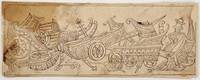
1690réf. 25011690. Good. Pen and brown ink on cream laid paper 3 x 8 inches 76 x 230 mm the full sheet. In good condition with some edge wear and losses at all but the lower right corner. Adhered to a 19th century laid paper matrix at the corners. On the verso is a similar decorative design in brown ink. This work is a classic example of an "apparato" design. In the 16th and 17th centuries artists were frequently commissioned to design ephemeral architecture and "festival machines" for royal entries weddings or religious processions. These festival machines were often made of temporary materials like wood plaster and gilded papier-mâché to be used once during a city-wide celebration and then dismantled. This image may also be a pattern sheet for an engraver. unknown
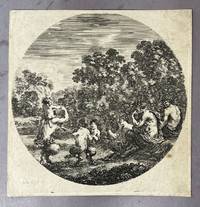
1643réf. 0071411643. No Binding. Very Good. Original etching on laid paper circular composition ca. 1643-48. Sheet size approx. 145 x 140 mm. A spirited etching of Bacchanalian Scene with Satyrs and Musicians by Stefano della Bella depicting a lively bacchanalian scene with satyrs and children engaged in music and dance within a wooded landscape. The animated figures fluid movement and delicately balanced composition exemplify della Bella's characteristic lightness of touch and his gift for narrative charm. The circular format enhances the sense of intimacy and rhythmic motion while the fine controlled line work reflects the artist's mastery of engraving and etching. Della Bella was one of the most accomplished printmakers of the Italian Baroque admired for his imaginative pastoral and mythological scenes and influential in both Italy and France. Good overall condition for 17th century print. Light even toning consistent with age and paper type. Minor surface soling and faint scattered foxing primarily in the margins. No major tears or losses. The impression remains clear with well-preserved detail and plate mark unknown
1610réf. 001421Venetia: Antonio Pinelli 1610. Full Vellum. Very Good. 8 8 615 pp. 8vo 8.25 by 6.25 inches 21 by 16 cm. Considered one of the most significant pieces of literature from the Middle Ages and a seminal work of literature written in the French language. Also a milestone in historiography as the most important account of the first and second crusades and especially the latter for which William of Tyre was a contemporary witness. The author produced this work at the request of Almaric I in about 1170 and he continued to work on it until 1183. The work was indeed accepted as unquestioned fact for many centuries and only recently have biases been discerned owing from William's entanglement in the political disputes of the day. Antonio Pinelli unknown
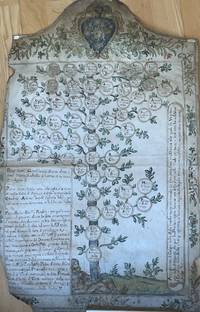
1700réf. 2280Written and illuminated in Italy 1700. . On large vellum upper edge arched. Written in brown and illuminated in green blue and red ink. The family tree emerges from the lap of a forefather figure ruled with floral frames on each side and crowed with a coat of arms in floral decoration notes in two text boxes. Traces of old restoration. The left edge and lower corner are partly missing and burnt. Traces of old folding. With a few wormholes. Overall in good condition. A large and decorative Italian genealogical tree of the Stella Della-Scorzosi family. An early 18th-century Italian genealogical tree of the Stella Della-Scorzosi family the descendants of the Sienese Pietro Scotti who became privileged and donated with Monticchiello Monte Suchiello in 1397. Other sources describe that Monticchiello during a conflict with Florence and Montepulciano was sold to Florence for 2000 florin and remained under their control until 1401 when due to a peace treaty it returned into the possession of Siena Repetti 1839. Members of the family originated from or spread to Murello Florence and Arezzo. Literature: Repetti E.: Dizionario geografico fisico storico della Toscana. 3 M-O. Firenze: Presso l'autore e editorei 1839. p. 564. unknown
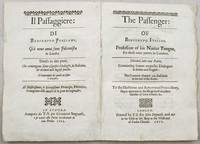
1612réf. ST13801London: printed by Thomas. Snodham. for Iohn Stepneth and are to be sold at his shop at the west-end of Paules Church 1612. FIRST EDITION. 205 x 155 mm. 8 x 6". 18 p.l. 611 1 pp. 601-08 misnumbered 561-68 8 leaves. New unlettered limp vellum by Courtland Benson in imitation of the original binding. STC 1896; ESTC S124314. ◆Half a dozen gatherings a little browned occasional mild foxing or small rust spots additional trivial imperfections otherwise an excellent copy clean and very fresh in a pleasing new binding. This conversation manual by an Italian teacher based in London offers an intriguing glimpse into the lives and concerns of the wealthier classes in 17th century Europe. An early effort to teach language through dialogue the book is part cultural history part guide to better health and it is clear evidence of the importance of the study of Italian in Elizabethan and Jacobean England. The seven dialogues cover subjects from health to travel to servants with Italian and English text on facing pages. Many of the dialogues begin with phrases that will be familiar to all beginning language students: greeting others selecting items of clothing asking prices or directions ordering food. As the conversations progress they explore various topics that one might expect to encounter in polite society. An early morning exchange between master and servant evolves into a discussion of the importance of sleep the optimal amount of sleep for good health and the significance of dreams. A dialogue that begins with ordering meals leads to an involved colloquy about the benefits and disadvantages of fasting and abstinence; the virtues and defects of bread butter meat dairy and eggs; diet recommendations for the healthy and the sick; the best diet for each season; and the importance of a walk after dinner. Other dialogues include advice for travellers observations on the political situation and life at court and finally a discussion of that most eternally fascinating topic: love. This work is of continuing interest and value to linguists as it documents the Benevento Italian dialect which is in need of preservation. It's an extraordinarily rare book probably because it was the sort of volume subjected to hard use: in addition to ours we could trace only two copies in ABPC and RBH since 1948. printed by T[homas]. S[nodham]. for Iohn Stepneth, and are to be sold at his shop at the west-end of Paules Church unknown
1673réf. 0009013Venetia: Gio. Giacomo Herz 1673. First edition. Hardcover. Good. 12mo xxiv 168 pages 19th century quarter calf marbled boards inked name and stamp of Novaria Giuseppe. Charles Patin was a French physician devout numismatist and smuggler of books prohibited on the Index. Caught and sentenced to life as a galley slave Patin fled France eventually settling in Italy as chief of the medical faculty at the University of Padua. Gio. Giacomo Herz hardcover
1700réf. 37167BBAmsterdam, J. Wolters 1700. 8°. 12 n.n. Bl., 250 S., 7 n.n. Bl., Titel in Rot und Schwarz gedruckt und mit einer gestochenen Titelvignette. Pergamentband der Zeit mit blindgeprägtem Deckelmedaillon, goldgeprägtem Bibliotheksnummer auf dem Vorderdeckel und handschriftlichem Rückentitel.
1615réf. 53650BBLyon, Pierre Rigaud 1615. 12°. 6 n.n. Bl., 597 S.,12 n.n. S. Index. Mit gestochenem Titelblatt. Pergamentband der Zeit.
1621réf. 23114Edizioni d'Arte Lo Scarabeo / Sergio Bonelli Editore 1991. Fascicule hors commerce agrafé de 16 pages au format 21 x 16 cm. Couvertures illustrées. Plats et intérieur frais. Textes en italien de Alfredo Castelli accompagnés de cartes de tarot dessinées en noir de Giancarlo Alessandrini. Supplément hors commerce offert avec le jeu de cartes illustrés. Rare édition originale en superbe état général proche du parfait. Epuisé.
1617réf. 94581617 Stampata Per Giuseppe Pavoni ad inflanza di Bernardo Castello, in Genova, l'Anno MDCXVII (1617) ; in-folio, plein maroquin rouge de l'époque, double encadrement de triples filets dorés sur les plats avec fleurons d'angle, armoiries dorés au centre des plats, dos à nerfs très orné de multiples petits fers dorés , titre doré, roulette intérieure, tranches dorées. (8) ff.,255pp. (dont 1 blanche), 72pp., 36pp., (2)ff. Exemplaire réglé en sépia. Illustré de deux titres-frontispices allégoriques dont un avec le portrait du Tasse en médaillon et en arrière-plan le port de Gênes, et l'autre avec le portrait de Charles-Emmanuel I de Savoie en médaillon, 20 gravures à pleine page par Agostino Carracci et Giacomo Franco d'après les dessins de Bernardo Castello. 20 vignettes à mi-page en entête de chaque chant, culs de lampe et lettres ornées. Très belle édition illustrée de la Jérusalem délivrée. (cf.Brunet V-666). Exemplaire aux armes de Jean du Bouchet (cf. Olivier-Hermal-Roton pl. 1706).
1678réf. 109071678 Amsterdam, Stamperia del S. D. Elsevier, Et in Parigi si vende Appresso Thomaso Jolly, 1678 ; 4 volume in-32°, plein maroquin rouge, triple filet doré encadrant les plats avec petite rosace d'angle,dos à nerfs orné de petits fers dorés, titre et tomaison dorés, tranches dorées, roulette sur les coupes, gardes et contre-plats de papier bleu. Tome I : 373pp. (dont titre-frontispice et titre). Tome II : 301pp. Tome III : 357pp. Tome IV : 310 pp - (13) ff. Illustré d'1 titre-frontispice et de 20 gravures hors texte par Sébastien Le Clerc.
1624réf. 125401624 Venetia, per Bartolemeo Fontana, 1624; grand in-8° (22 x 16,4 cm) de (20) ff. - 306pp. (1)f. (marque de l'imprimeur); vignette au titre, lettrines et bandeaux. Plein parchemin ivoire de l'époque. Edition originale italienne.
1619réf. 116001619 Un volume, reliure d'époque, janséniste en vélin ivoire parcheminé petit in-quarto (jansenist's binding full vellum in-quarto, titre manuscrit à l'encre brune sur le dossur le dos (handwritten title on the spine), plats muets (cover without text), toutes tranches lisses (all smooth edges), orné d'une Suite de quarante et une estampes hors-texte (full page engraving), y compris le titre, gravé au burin en noir en Premier Etat par Jacques CALLOT (seul la gravure-titre est du 3ème état voir explication ci-dessous ) d'après les grands artistes florentins : frontispice, du dessin de Mathieu Rosselli, 6 de Mascagni, 2 de Pomerance,, 4 de Tempeste et 1 de Fabrizio Boschi,1 de Jean Bilivert, léger manque de papier en marge et sans toucher la gravure-titre elle-même, légères taches brunes en marge sur quelques pages, petites restauration anciennes au dos de quelques gravures mais très légères, dédicace + 254 pages + les tables, 1619 Firenze P. Cecconcelli Editeur (seul la gravure titre est de 1636),
1686réf. 8469Amsterdamo, Pitre & Abramo van Someren, 1686. 5 volumes in-12 de [12]-524; [2]-574; [2]527; [2]-648; [2]-576 pages, plein vélin ivoire, dos lisses, titre incsrit à l'encre, tranches teintées. Papier légèrement bruni, quelques petites rousseurs, très pâle auréole d'humidité à un volume. Signature biffée répété sur chaque page de titre, et quelques annotations anciennes à l'encre.
1638réf. 12411In Siena, appresso il Bonetti, nella Stamperia del Publico, 1638. Petit in-8 de 143-[9] pages, sous couverture d'attente muette (dos anciennement renforcé de papier). Quelques rousseurs, auréole d'humidité au coin inférieur des feuillets du dernier tiers de l'ouvrage, une page déchirée avec manque au texte, certains coins avec petit pli.
1649réf. 12412In Pistoia, nella stamperia di Pier' Antonio Fortunati, 1649. 2 volumes in-8 de 685 et 461-[2] pages, demi-vélin blanc à coins, dos lisses avec titre manuscrit, tranches rouges. Tampon ancien aux pages de titre, quelques feuillets un peu brunis.
1642réf. 16045in Venetia, Apresso I Giunti, 1642. In-8 de [8]-207-[3] pages, plein vélin ivoire, dos à nerfs, tranches jaunes. Auréole sur le premier plat. Rousseurs.