1961 risultati
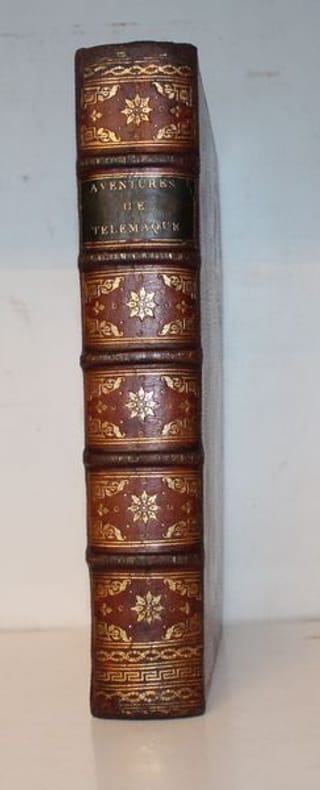
1809rif. ST14310fLondon: J. Hatchard 1809. 210 x 133 mm. 8 1/4 x 5 1/4". xvi 291 pp.Translated by Louisa A. Marshall. Contemporary dark blue straight-grain morocco covers bordered with gilt rule flat spine with simple gilt rules and titling gilt-ruled turn-ins all edges gilt and WITH A FINE FORE-EDGE PAINTING OF A SCENIC RIVER VIEW FEATURING CHRIST CHURCH PRIORY in Hampshire. Front free endpaper with owner signature of E. A. Fetherston. Slight variation in color of boards half title with one inch trimmed away at head probably removing owner inscription leaves a shade less than bright occasional minor foxing or offsetting in the text bed but still an excellent copy the text clean and fresh the pleasant binding entirely sound and the lovely fore-edge painting very well preserved. The typically bucolic fore-edge scene here--boat in tranquil water stately building occupying center stage trees all around puffy clouds--stands out for the level of achievement in execution by the artist. The clouds are painted in a delicately applied range of shades so that they are very convincing; there is considerable architectural detail visible on the side of the church; and it seems as if one can almost see individual leaves in the trees. These features are all hallmarks of the work of the so-called "Dover Painter" the name given by Jeff Weber to the artist who produced very high quality painted fore edges in the 1920s and 1930s. He did work for the famous London bookseller Marks & Company for Dawson's Bookshop in Los Angeles and for J. W. Robinson Company the Los Angeles department store. Estelle Doheny 1875-1958 whose library comprised one of the great collections of the 20th century bought actively from Dawson's and Weber estimates that approximately half of the very considerable number of especially fine fore-edge paintings in the Doheny collection in Camarillo California were done by the Dover Painter. As the fore-edge painting here evokes a feeling of serenity so too does the content religious meditations by François Fénélon 1651-1715 priest writer and tutor to King Louis XIV's grandson for whom he composed his best-known work "The Adventures of Telemachus.". J. Hatchard unknown books
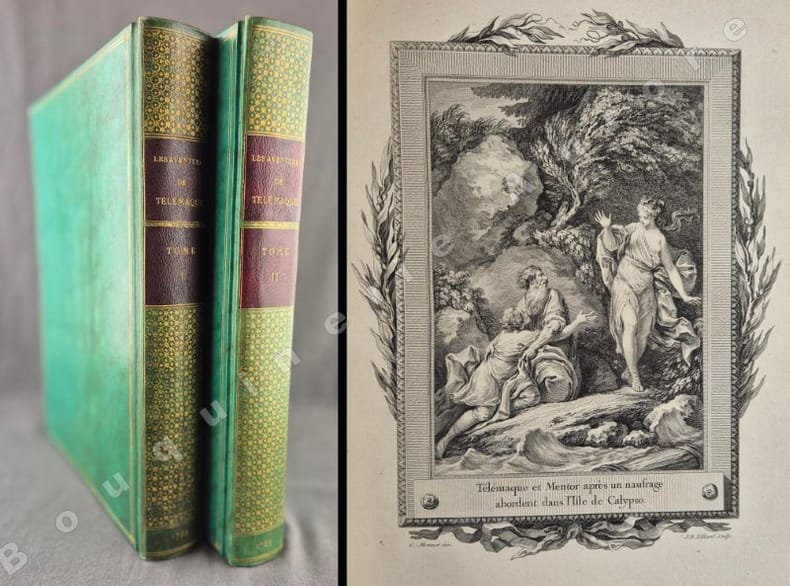
1783rif. 143731783 P., de lImprimerie de P. A. Didot laîné ; 1783, 2 vol. in-4° (325 x 235 mm) reliés à la Bradel plein vélin teinté vert, dos lisse très richement orné, date en pied dorée, pièces de titre et de tomaison en maroquin bordeaux, double filet doré en encadrement des plats avec petit fer de fleur en écoinçons, têtes dorées (VERMOREL), de (4) ff. - pp. 1 à 312 ; (2) ff. pp. 313 à 613.Quelques rousseurs essentiellement marginales, très bel exemplaire non rogné par ailleurs dans une très belle reliure pastiche de Vermorel.
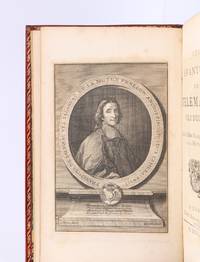
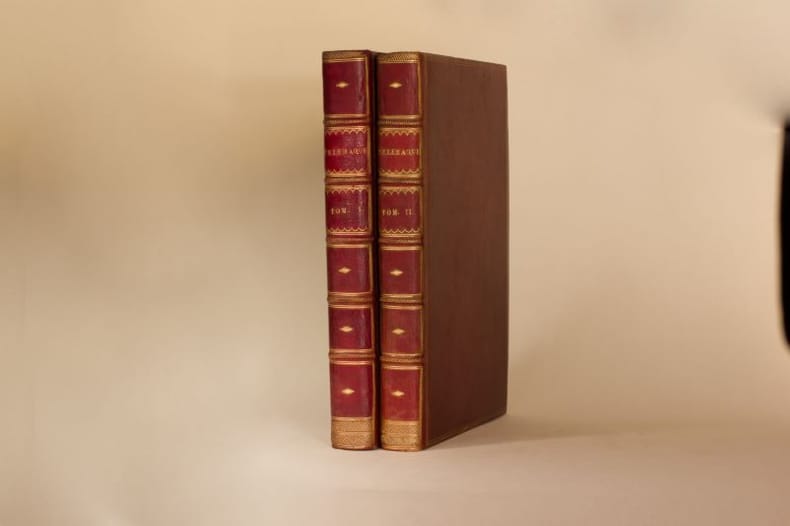
1738rif. 92484London: R. Dodsley 1738. Fine. R. Dodsley London 1738 12.6 x 19.1 cm Relié Edition illustrated with two frontispieces one of them a portrait of Fénelon and twenty-four full-page plates one for each of the twenty-four books of the Avantures de Telemaque. Copy printed on thick Dutch laid paper. Bound in full red straight-grain morocco covers framed with dotted borders smooth spines decorated with seven dotted fillets gilt titles and volume numbers dotted rule on board edges gilt inner roll-tooled borders marbled paper pastedowns all edges gilt. Some very slight rubbing and soiling to bindings spines sunned some foxing offsetting from the plates onto the half-titles. Bookplate of Thomas Pares 1716-1805 a lawyer in Leicester and owner of Hopwell Hall a Derbyshire country house since demolished. A handsome illustrated edition printed on thick laid paper of very fine quality. This luxury edition of the Avantures de Télémaque published in London by Robert Dodsley reproduces on a reduced scale the illustrations of the folio edition issued in 1734 in Amsterdam and Rotterdam by Wetstein Smith Chatelain and Hofhout. The compositions by Vivien Picart Debrie and Dubourg were re-engraved for it by Scotin and Fourdrinier to suit a more manageable format. Charles Nodier praised it in his Description raisonnée d'une jolie collection de livres notably for the elegance of its plates and the quality of its paper which he describes as ""firm elastic crisp"". Long read as a critique of Louis XIV's exercise of power Fénelon's work was already regarded as a satirical allegory of his reign even before it appeared in print manuscript copies having circulated in court circles from the autumn of 1698. This political reading owes much to the circumstances of its publication: Fénelon had just been condemned in Rome on 12 March 1699 at the close of a long theological controversy with Bossuet over the doctrine of the pure love of God and was then in disgrace exiled to Cambrai. A more neutral reading sees it rather as a classic of didactic narrative: originally conceived for the education of the Duke of Burgundy grandson of Louis XIV to whom Fénelon was tutor the voyage of the son of Ulysses inspired by the Odyssey conveys an art of government and a moral teaching of universal scope. The work was first printed without the author's consent in 1699; copies were withdrawn from sale and the publisher's privilege revoked though this did not prevent the text from spreading rapidly. In great demand it was the subject of several pirated editions before its first official publication in 1717. A very attractive copy of this compact luxury edition bound in straight-grain morocco. R. Dodsley unknown
rif. 2340in 12 plein maroquin rouge à nerfs,titre,filets,palmette dorés,roulette dorée intérieure et sur les coupes,filets dorés en encadrement sur les plats avec petits fers aux angles;Titre en rouge et noir avec monogramme gravé de l’éditeur.1 feuillet de table des matières 275 pages,6 pages de privilège,1 page d’errata,3 pages de catalogue, tranches dorées,Pierre Auboin Pierre Emery et Carles Clousier 1687 Edition originale rare avec les caractéristiques du premier tirage à savoir manque de pagination pages 193 à 198,la page 163 marquée par erreur 103,page 275 omise dans l’errata mais non corrigée.Très bon exemplaire "Premier ouvrage de Fénelon qui contribua à sa réputation. Composé à la demande de la duchesse de Beauvilliersqui réclamait un guide pour l’éducation de ses enfants,ce livre est devenu une référence.Fénelon prend ouvertement le parti d’une instruction mesurée,mais réelle,à l’encontre d’une conception réductrice,cantonnant les filles et les femmes dans l’ombre de l’origine du péché originel"
1734rif. 22235Amsterdam & Rotterdam: J. Wetstein & G. Smith & Zacharie Chatelain; Jean Hofhout 1734. Nouvelle Edition. leather_bound. Contemporary full mottled calf. Aeg. Very good/Near fine. 2 X XVII 424 pages. 28.5 x 23 cm. Folding map 24 plates engraved by Balthasar Bernaerts Philipp Van Gunst Louis Surugue and Jacob Folkema after Louis Fabricius Dubourg Bernard Picart and Guillaume-François-Laurent Debrie with 22 engraved tail pieces. There was also a 1734 folio edition of this work limited to 150 copies. The engravings of the two editions are similar. Our copy contains the suppressed "Ode" last six pages of the text. First edition published 1699: it was also considered an attack on the divine right of absolute monarchy and the the most popular book of its time. BRUNET. p.1214 calls it a "belle edition." GORDON N. RAY. p.8: depicts frontispiece herein. Bookplate of Armand-Jules de Rohan Archbishop of Reims. Raised bands spine panels in gilt floral arabesques triple gilt border panels marbled endpapers spine ends conserved. J. Wetstein & G. Smith, & Zacharie Chatelain; Jean Hofhout unknown
1734rif. 22235Amsterdam & Rotterdam: J. Wetstein & G. Smith & Zacharie Chatelain; Jean Hofhout 1734. Nouvelle Edition. leather_bound. Contemporary full mottled calf. Aeg. Very good/Near fine. 2 X XVII 424 pages. 28.5 x 23 cm. Folding map 24 plates engraved by Balthasar Bernaerts Philipp Van Gunst Louis Surugue and Jacob Folkema after Louis Fabricius Dubourg Bernard Picart and Guillaume-François-Laurent Debrie with 22 engraved tail pieces. There was also a 1734 folio edition of this work limited to 150 copies. The engravings of the two editions are similar. Our copy contains the suppressed "Ode" last six pages of the text. First edition published 1699: it was also considered an attack on the divine right of absolute monarchy and the the most popular book of its time. BRUNET. p.1214 calls it a "belle edition." GORDON N. RAY. p.8: depicts frontispiece herein. Bookplate of Armand-Jules de Rohan Archbishop of Reims. Raised bands spine panels in gilt floral arabesques triple gilt border panels marbled endpapers spine ends conserved. J. Wetstein & G. Smith, & Zacharie Chatelain; Jean Hofhout unknown books
1783rif. 113161Paris De l'imprimerie de Franç. Ambr. Didot l'Aîné, "Collection des auteurs classiques français et latins" 1783 2 vol. Relié 2 vol. in-4, plein maroquin grenat, dos à nerfs guillochés, caissons encadrés de filets dorés et en pointillé avec losanges dorés au centre, triple filet doré en encadrement des plats, roulette intérieure dorée, double filet doré sur les coupes, coiffes guillochées, tranches dorées, 4 (p.) + 613 (pagination continue). Superbe édition typographique "imprimée par ordre du Roi pour l'éducation de Monseigneur le Dauphin", avec cette justification à la fin du second volume : "Cette édition in-4° dont le prix est de 48 liv. le vol. broché en carton, a été imprimée au nombre de 200 exemplaires, avec les nouveaux caractères de Didot l'Aîné, sur papier-vélin grand raisin de France, de la fabrique de Matthieu Johannot, d'Annonai en Vivarais". Rappelons que ce roman d'apprentissage destiné au dauphin était paru anonymement en 1699. Il avait valu à Fénelon d'être éloigné de la cour, le roi y ayant vu une critique de la monarchie absolue. On cite souvent Fénelon comme précurseur des Lumières, et Télémaque fut pendant plus de deux siècles un ouvrage de référence pour l'apprentissage du français. Très légers frottements et une petite tâche d'encre au plat supérieur du premier volume, mais exemplaire très frais, recouvert d'élégantes reliures du temps dans le style de Dérôme le jeune.
1783rif. 113161Paris De l'imprimerie de Franç. Ambr. Didot l'Aîné, "Collection des auteurs classiques français et latins" 1783 2 vol. Relié 2 vol. in-4, plein maroquin grenat, dos à nerfs guillochés, caissons encadrés de filets dorés et en pointillé avec losanges dorés au centre, triple filet doré en encadrement des plats, roulette intérieure dorée, double filet doré sur les coupes, coiffes guillochées, tranches dorées, 4 (p.) + 613 (pagination continue). Superbe édition typographique "imprimée par ordre du Roi pour l'éducation de Monseigneur le Dauphin", avec cette justification à la fin du second volume : "Cette édition in-4° dont le prix est de 48 liv. le vol. broché en carton, a été imprimée au nombre de 200 exemplaires, avec les nouveaux caractères de Didot l'Aîné, sur papier-vélin grand raisin de France, de la fabrique de Matthieu Johannot, d'Annonai en Vivarais". Rappelons que ce roman d'apprentissage destiné au dauphin était paru anonymement en 1699. Il avait valu à Fénelon d'être éloigné de la cour, le roi y ayant vu une critique de la monarchie absolue. On cite souvent Fénelon comme précurseur des Lumières, et Télémaque fut pendant plus de deux siècles un ouvrage de référence pour l'apprentissage du français. Très légers frottements et une petite tâche d'encre au plat supérieur du premier volume, mais exemplaire très frais, recouvert d'élégantes reliures du temps dans le style de Dérôme le jeune.
1699rif. 30837Bruxelles Fr. Foppens 1699. Small 8vo 12mo. Bound in a beautiful later full calf ca. 1800 w. five raised bands on back. Gilt back and blindstamped ornamental borders on boards. All edges of boards gilt and gilt borders on inside of boards. Hinges cracked and boards loosening inner hinges crudely repaired. A bit of brownspotting but internally a very nice copy. The very rare Bruxelles-edition published same year as the first edition Paris Barbin. Fénelon's main work written when he was a tutor to the Duke of Burgundy in order to hold up Ulysses as an example for the young prince. Fénelon was a leader of the Quetism heresy and in 1699 the year Télemaque appeared Pope Innocent XII condemned his writings. The true first edition of Fénélon's Télemaque appeared in one volume in 1699 under the title "Suite du quatrième livre de l'Odyssée d'Homère ou les Aventures de Télémaque fils d'Ulysse" and containing only half of what we consider Télémaque today. According to Brunet the first edition was suppressed and Moetjens printed a pirate-edition called the second edition in Haag with the same year and date June and a bit later the same year the second part appeared. Several editions appeared the same year and Brunet mentions one without printer or Place but Paris and the Liége- and Bruxelles-editions. "Dans les différentes éditions que nous venons de décrire dans lesquelles il le soit sont celles de LIÉGE 1699 et de BRUXELLES FR. FOPPENS même date l'une et l'autre impr. en France en 2 vol. in-12 et en dix livres." Brunet II:1212. Foppens also printed an edition in Bruxelles 1700 but that is divided into 16 books. All early editions of this work are scarce and the first edition is almost impossible to get a hold of. This main work of French literature has been printed numerous times after the author's death 1715 and editions printed before his death are a great rarity. The later editions were corrected and divided into numerous books not intended in the original manuscript."Une autre circonstance allait aggrever la situation de l'archevêque de Cambray. Peu de temps après sa condemnation parut le livre qui l'a rendu le plus populaire et qui après la "Bible" et l'"Imitation de Jésus-Christ" est un de ceux qui ont eu plus d'éditions: "Les Aventures de Télémaque". N.B.G. 17:328. The controversial but highly popular work was among other things accused of satirically portraying Louis XIV and thereby publicly humiliating him -this was probably not the intention but there is no doubt that the work was critical towards the reigning regime and put forth many ideas not previously heard of. In true utopian political manner Fénélon warns against overgrowth of the metropolis and preaches groundbreaking doctrines like free trade international arbitration etc. He actually foresees the French Revolution as a result of the flourishing despotism so visible in France at the time. Lamartine in his "Life of Fénélon" describes the saintly poet as the first Radical and the first communist of his century though not to his own knowledge and he directly traces the Utopias which produced the revolutions of 1793 and 1848 to his groundbreaking work "The Adventures of Telemachus". Especially the part "Voyage en Salente" is considered very important for the study of utopian literature but the entire work is characterized by the attempt to represent people as they might have behaved and might still be were they governed by sages and saints and according to the laws of God. The work represents a religious ideal where God is always higher than man; it is greatly political greatly influenced by the appreciation of ancient Greek life and is designed to evoke the feeling of honour responsibility and religion in the young prince. See Brunet II: 1210-1212. Graesse 2:563-64 Paris- and La Haye-editions. hardcover
1823rif. 84888Chez Aime Payen Libraire. As New. Hardcover. FREE UPGRADE to Courier/Priority Shipping Upon Request - IN STOCK AND IMMEDIATELY AVAILABLE FOR SHIPMENT - AS NEW THE TEXT BLOCK IS PRISTINE CLEAN UNMARKED AND IN EXCELLENT CONDITION - - Text in French 283 pages; on the lives of the most illustrious philosophers of antiquity concise / abridged edition . Includes 26 illustrations. -- with a bonus offer-- . 1823. Chez Aime Payen, Libraire hardcover
1995rif. 74616Le Cateau-Cambresis Nord France: Musee Matisse. New. Paperback. FREE UPGRADE to Courier/Priority Shipping Upon Request - IN STOCK AND IMMEDIATELY AVAILABLE FOR SHIPMENT - FLAWLESS COPY PRISTINE NEVER OPENED -- with a bonus offer--; T-CARTIER; Musee Matisse Musee Departemental Palais Fenelon Le Cateau-Cambresis Nord Matisse Par Cartier-Bresson - 20 May - 30 October 1995 - Musee Matisse Musee Departemental Palais Fenelon Le Cateau-Cambresis Nord . 1995. 2907545175 . Musee Matisse paperback
rif. 22136S.l., Imprimerie de Monsieur, 1785. Deux tomes en un volume grand in-4, illustrés d'un titre-frontispice gravé par Montulay, daté de 1773 (Paris, chez l'auteur), des armes de Monsieur gravées sur bois d'après Choffard sur le titre, de 72 tailles-douces d'après Charles Monnet gravées par Jean-Baptiste Tilliard, et 24 planches ornées pour les Sommaires. Intérieur frais malgré quelques rousseurs éparses. Plein maroquin rouge, dos à nerfs orné, pièces de titre de maroquin vert, roulette dorée sur les plats, roulette intérieure, tranches dorées . Habiles restaurations (coiffes, coins). Reliure étrangère de l'époque.
1796rif. 78565Reliure d'époque plein veau blond. Dos lisse avec galons dorés et décorés en lace des nerfs, joli fer doré représentant Éros et son arc près d'un char antique, frappé entre les faux-nerfs, pièces de maroquin rouge dont une écussonnée de maroquin vert sur fond or pour la tomaison. Filets au pointillé et petite dentelle. Coupes décorées. Toutes tranches dorées. Avec 24 figures (Avant-lettre) par MARILLIER, gravées par Baquoy, Dambrun, Dupréel, Delvaux, de Ghendt, Langlois jeune, Masquelier, Patas, Pauquet et Ponce, plus un portrait par Vivien, gravé par Hubert.
1717rif. TS368Rotterdam: Jean Hofhout 1717. Nouvell Edition: Augmentee & Corrigee . Hardback. Fine. 12mo. Composees par feu Messire Francois de Salignac De la Motte Fenelon.THE RARE RE-ISSUE BY THE AUTHOR'S FAMILY. 2 volumes bound in one with two titles-pages printed in red and black. French text. lxvii xv folding map finely engraved showing Telemaques voyage around the Mediterranean. 525pp xxiii Odes and table i errata. 10 engraved plates all fine. MAINLY ENGRAVED BY D. COSTER. The 2 pp advertment is SIGNED at the foot by the publisher Jean Hofhout. Later nineteenth century full polished calf binding with gilt. dec. single borders to the boards and a fine spine with raised bands and gitl title and decoration. PLEASE EMAIL FOR PHOTOGRAPHS OF THE BINDING AND SIGNATURE.The title was first published in 1699. This rare edition is the corrected and increased post-humous edition was the second edition correctly published after several 'pirated' editions were sold after the first edition of 1699. The author's family led by his nephew published this edition in French at Rotterdam and Amsterdam in 1717. PLEASE EMAIL FOR PHOTOS. 165x95 mm Jean Hofhout hardcover
1764rif. ST15125Augustae Vindelicorum Augsburg: Conradum Henricum Stage 1764. Second Edition in Latin. 208 x 160 mm. 8 1/8 x 6 1/4". 9 p.l. 262 pp.Translated from French into Latin by Joseph Claude Destouches. VERY ATTRACTIVE LATE 18TH CENTURY ETRUSCAN CALF IN THE STYLE OF EDWARDS OF HALIFAX covers with gilt border central panel framed by stencilled palmettes within double gilt rules an Etruscan-style vase at center within a stencilled sunburst raised bands spine panels with blind-stamped Etruscan vase black morocco label gilt-rolled turn-ins all edges gilt. With printer's elaborate engraved device on title page engraved portrait of Elector Maximilian-Joseph of Bavaria at the head of the dedication to him engraved allegorical headpiece at the opening of Book I wood-engraved tailpieces at end of each section. Small wormhole near head of front joint two corners a bit bumped minor foxing to title and final page other trivial imperfections but QUITE A FINE WIDE-MARGINED COPY clean fresh and bright internally and in a binding with only minor defects. This beautifully preserved and attractive Neoclassical binding is a fitting cover for a Latin edition of Fénelon's Homeric coming-of-age tale. Edwards of Halifax is credited with developing the process of acid staining calf by using stencils a method known most notably to produce as here their so-called Etruscan calf bindings after the Etruscan vase decoration they resembled. The process was also adopted by binders on the Continent and became a fashionable choice for bindings in the late 19th century when the present binding was surely produced. It is difficult to say whether this binding was done by the Edwards firm or by an imitator but in any case the quality of execution is very high. The popularity of Fénelon's account of the adventures of the son of Odysseus also spread in this case beyond his native France and it became a favorite of schoolboys far removed from the young Dauphin for whom it was originally composed. First printed in 1759 our Latin translation offered an opportunity for young men to practice reading that classical language. The engravings here were newly designed and executed for this edition by German painter and engraver Georg Sigmund Rösch d. 1766. Conradum Henricum Stage unknown
1764rif. ST15125Augustae Vindelicorum Augsburg: Conradum Henricum Stage 1764. Second Edition in Latin. 208 x 160 mm. 8 1/8 x 6 1/4". 9 p.l. 262 pp.Translated from French into Latin by Joseph Claude Destouches. VERY ATTRACTIVE LATE 18TH CENTURY ETRUSCAN CALF IN THE STYLE OF EDWARDS OF HALIFAX covers with gilt border central panel framed by stencilled palmettes within double gilt rules an Etruscan-style vase at center within a stencilled sunburst raised bands spine panels with blind-stamped Etruscan vase black morocco label gilt-rolled turn-ins all edges gilt. With printer's elaborate engraved device on title page engraved portrait of Elector Maximilian-Joseph of Bavaria at the head of the dedication to him engraved allegorical headpiece at the opening of Book I wood-engraved tailpieces at end of each section. Small wormhole near head of front joint two corners a bit bumped minor foxing to title and final page other trivial imperfections but QUITE A FINE WIDE-MARGINED COPY clean fresh and bright internally and in a binding with only minor defects. This beautifully preserved and attractive Neoclassical binding is a fitting cover for a Latin edition of Fénelon's Homeric coming-of-age tale. Edwards of Halifax is credited with developing the process of acid staining calf by using stencils a method known most notably to produce as here their so-called Etruscan calf bindings after the Etruscan vase decoration they resembled. The process was also adopted by binders on the Continent and became a fashionable choice for bindings in the late 19th century when the present binding was surely produced. It is difficult to say whether this binding was done by the Edwards firm or by an imitator but in any case the quality of execution is very high. The popularity of Fénelon's account of the adventures of the son of Odysseus also spread in this case beyond his native France and it became a favorite of schoolboys far removed from the young Dauphin for whom it was originally composed. First printed in 1759 our Latin translation offered an opportunity for young men to practice reading that classical language. The engravings here were newly designed and executed for this edition by German painter and engraver Georg Sigmund Rösch d. 1766. Conradum Henricum Stage unknown books
1796rif. 75221796 A Paris: De l'imprimerie de Crapelet, An IV (1796). Complet en 2 vol. in-8: 15 x 22.5 cm. I/ 2 ff. de faux-titre et titre, 1 portr., lxxix pp. d'éloge et de tables (tables rel. avant l'éloge), 320 pp. de texte (Livres I à X) et notes + 10 pl. grav.; II/ 2 ff. de faux-titre et titre, 441 pp. de texte (livres XI à XXIV) + 14 pl. grav. Édition illustrée d'un portrait de Fénelon par Vivien gravé par Hubert en frontispice et de 24 figures par Marillier, ici avant la lettre, gravées par Baquoy, Dambrun, Dupréel, Delvaux, de Ghendt, Langlois, Masquelier, Patas, Pauquet et Ponce. Un des précieux 200 exemplaires sur grand papier vélin renfermant lees avant-lettre. (Cohen, 387-388). Précédé de l'Éloge de Fénelon par Jean-François de La Harpe. Reliure strictement de l'époque en veau. Dos lisses avec pièces de titre de maroquin rouge et pièces de tomaison de maroquin vert mine, caissons aux petits fers ornés d'urnes. Roulettes géométriques en encadrement des plats, filet aux coupes et roulettes aux chasses. Toutes tranches dorées. Gardes recouvertes de papier moucheté bleu. Quelques piqûres. Un mors légèrement frondu.
1790rif. ST20479Paris: De l'imprimerie de Monsieur i.e. P. Didot jeune 1790. 243 x 154 mm. 9 1/2 x 6 1/4". Two volumes. LOVELY DARK BLUE STRAIGHT GRAIN MOROCCO BY BOZERIAN JEUNE stamp-signed at foot of Tome I spine covers with pretty gilt frame enclosed by double gilt rule raised bands spine gilt in panels with large millepoint ornament with floral tools emanating from a central circle gilt lettering turn-ins with Greek key roll marbled endpapers all edges gilt. With frontispiece and six engravings by Cochin and Moreau as called for all before letters and EXTRA-ILLUSTRATED with 24 engravings by Marillier here in proofs before the letter and with three versions of the portrait of Fénélon by Vivien engraved by Hubert Figuet and Savart. Cohen-de Ricci col. 386-87 noting the addition of the Marillier plates to some copies; Graesse II 565; Brunet II 1215-16. Spine evenly a little sunned Marillier plates with minor marginal foxing isolated small smudges to the very generous margins one quire a little yellowed a couple of leaves with small holes to a margin due to paper flaws but AN ESPECIALLY FINE COPY--clean fresh and bright in a most appealing binding with almost no signs of wear. Our copy of Fénélon's political allegory featuring the son of Odysseus is a very fine example of French Rococo book production with printing illustration and binding by leading practitioners of those arts. Scion of a printing dynasty Pierre-François Didot jeune 1732-95 sought to improve the family's productions by founding a factory to product the luxurious papers that characterize Didot editions as well as by making improvements in type-founding to refine their always-admired font. Ray considers illustrators Cochin and Moreau le jeune part of the Rococo pantheon of greats headed by Boucher Gravelot and Eisen. He praises Cochin’s "mastery of outline and firmness of composition" as well as his "acute observation and unpretentious humor." Ray was also impressed with Moreau's keen eye for detail and agreed with the Goncourt brothers that "the grace and charm of his drawing . . . brought about 'a renaissance in the rococo style.'" Forced by financial necessity to take up book illustration Pierre-Clémént Marillier 1740-1808 soon earned what Ray called "a position in the front rank of book artists" with his skill and energy. Ray deems Marillier "among the most accomplished" illustrators of the century and he says that "nearly all of his designs are characterized by grace liveliness and firmness of drawing”—a fitting description for the plates in our volumes. François Bozerian generally called Bozerian jeune was active in Paris from just after the turn of the century until 1818 and for much of that time he worked with his elder brother Jean-Claude 1762-1840. The Bozerian workshop produced many fine bindings for clients that included the emperor Napoleon I as well as leading bibliophiles of the day. Their works are valued today especially for their technical achievement and refinement of design. Our two volumes are especially elaborate--even for Bozerian work--and the precision of the faultless finishing here leaves a very strong impression of rigorous order. De l'imprimerie de Monsieur [i.e., P. Didot jeune] unknown
1790rif. ST20479Paris: De l'imprimerie de Monsieur i.e. P. Didot jeune 1790. 243 x 154 mm. 9 1/2 x 6 1/4". Two volumes. LOVELY DARK BLUE STRAIGHT GRAIN MOROCCO BY BOZERIAN JEUNE stamp-signed at foot of Tome I spine covers with pretty gilt frame enclosed by double gilt rule raised bands spine gilt in panels with large millepoint ornament with floral tools emanating from a central circle gilt lettering turn-ins with Greek key roll marbled endpapers all edges gilt. With frontispiece and six engravings by Cochin and Moreau as called for all before letters and EXTRA-ILLUSTRATED with 24 engravings by Marillier here in proofs before the letter and with three versions of the portrait of Fénélon by Vivien engraved by Hubert Figuet and Savart. Cohen-de Ricci col. 386-87 noting the addition of the Marillier plates to some copies; Graesse II 565; Brunet II 1215-16. Spine evenly a little sunned Marillier plates with minor marginal foxing isolated small smudges to the very generous margins one quire a little yellowed a couple of leaves with small holes to a margin due to paper flaws but AN ESPECIALLY FINE COPY--clean fresh and bright in a most appealing binding with almost no signs of wear. Our copy of Fénélon's political allegory featuring the son of Odysseus is a very fine example of French Rococo book production with printing illustration and binding by leading practitioners of those arts. Scion of a printing dynasty Pierre-François Didot jeune 1732-95 sought to improve the family's productions by founding a factory to product the luxurious papers that characterize Didot editions as well as by making improvements in type-founding to refine their always-admired font. Ray considers illustrators Cochin and Moreau le jeune part of the Rococo pantheon of greats headed by Boucher Gravelot and Eisen. He praises Cochin’s "mastery of outline and firmness of composition" as well as his "acute observation and unpretentious humor." Ray was also impressed with Moreau's keen eye for detail and agreed with the Goncourt brothers that "the grace and charm of his drawing . . . brought about 'a renaissance in the rococo style.'" Forced by financial necessity to take up book illustration Pierre-Clémént Marillier 1740-1808 soon earned what Ray called "a position in the front rank of book artists" with his skill and energy. Ray deems Marillier "among the most accomplished" illustrators of the century and he says that "nearly all of his designs are characterized by grace liveliness and firmness of drawing”—a fitting description for the plates in our volumes. François Bozerian generally called Bozerian jeune was active in Paris from just after the turn of the century until 1818 and for much of that time he worked with his elder brother Jean-Claude 1762-1840. The Bozerian workshop produced many fine bindings for clients that included the emperor Napoleon I as well as leading bibliophiles of the day. Their works are valued today especially for their technical achievement and refinement of design. Our two volumes are especially elaborate--even for Bozerian work--and the precision of the faultless finishing here leaves a very strong impression of rigorous order. De l'imprimerie de Monsieur [i.e., P. Didot jeune] unknown books
1796rif. 232357Paris: Didot l'aîné 1796. First edition with these illustrations one of 200 printed on GRAND PAPIER VELIN. Engraved portrait after Vivian engraved by Gaucher and 24 plates after drawings by Lefebvre engraved by Delvaux Godefroy Simonet Thomas and Trière. 4 vols. 18mo. Full early 20th-century dark brown morocco richly gilt marbled endpapers. Spines very slightly faded otherwise a beautiful set complete with all half-titles immaculate text and plates with the original tissue guards. First edition with these illustrations one of 200 printed on GRAND PAPIER VELIN. Engraved portrait after Vivian engraved by Gaucher and 24 plates after drawings by Lefebvre engraved by Delvaux Godefroy Simonet Thomas and Trière. 4 vols. 18mo. Cohen: 388-89 "charmantes figures par Lefebvre" Didot l'aîné unknown
1796rif. 232357Paris: Didot l'aîné 1796. First edition with these illustrations one of 200 printed on GRAND PAPIER VELIN. Engraved portrait after Vivian engraved by Gaucher and 24 plates after drawings by Lefebvre engraved by Delvaux Godefroy Simonet Thomas and Trière. 4 vols. 18mo. Full early 20th-century dark brown morocco richly gilt marbled endpapers. Spines very slightly faded otherwise a beautiful set complete with all half-titles immaculate text and plates with the original tissue guards. First edition with these illustrations one of 200 printed on GRAND PAPIER VELIN. Engraved portrait after Vivian engraved by Gaucher and 24 plates after drawings by Lefebvre engraved by Delvaux Godefroy Simonet Thomas and Trière. 4 vols. 18mo. Cohen: 388-89 "charmantes figures par Lefebvre" Didot l'aîné unknown books
rif. 6370Paris, Jacques Estienne, 1718. In-12 (91 x 163 mm), 4 ff. n. ch., 419 pp. chiffrées 409, 1 f. n. ch., 1 f. bl. Maroquin rouge, filet d'encadrement à froid sur les plats, dos à nerfs, caissons à froid, titre doré, roulette intérieure et sur les ocupes, tranches dorées sur marbrure (reliure de l'époque).
rif. 22947Paris De l'imprimerie de François-Ambroise Didot; puis de l'imprimerie de Pierre Didot l'aîné, 1787-1792 1787 in 4 (31x23) 9 volumes reliures plein veau porphyre de l'époque, dos à nerfs très ornés, caissons dorés, pièces de titre de maroquin rouge, pièces de tomaison de maroquin vert, triple filet doré d'encadrement sur les plats, roulette dorée sur les coupes, roulette dorée intérieure, tranches teintées bleu. Avec un portrait de Fénelon, et de Louis de France, duc de Bourgognebon gravés par A. de Saint-Aubin d'après J. Vivien. Des feuillets sont uniformément jaunis, et quelques rares rousseurs éparses. Tchemerzine, III, pages 240. Première édition des Oeuvres, publiée par l'abbé Gallard et le P. de Querbeuf, auteur de la Vie de Fénélon, l'adresse porte le nom de Pierre Didot l'aîné., 1792, à partir du tome 6. Approbation datée du 17 janvier 1787. François de Salignac de La Mothe Fénelon, 1651-1715, Précepteur des Enfants de France, Archevêque-Duc de Cambrai. Première édition des Oeuvres, celui-ci un des rares exemplaires tirés en grand papier. Superbe exemplaire, reliures très fraiches ( Photographies sur demande / We can send pictures of this book on simple request )
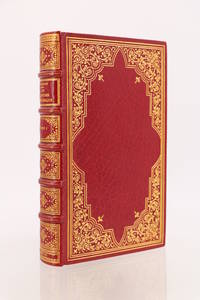
1717rif. 92333Paris: Florentin Delaulne 1717. Fine. Sumptuous Chambolle-Duru red morocco binding with doublure Florentin Delaulne Paris 1717 10.2 x 16.5 cm Relié First complete edition. It is illustrated with two frontispieces twenty-four full-page engravings and a folding map of Telemachus's travels. The portrait of Fénelon serving as frontispiece to the first volume is signed Baillieul and Duflos; the second frontispiece together with the plates is signed Bonnart fils and Giffart while the map is drawn by Rousset and engraved by Berey. A few head-pieces bandeaux and ornamental initials. Bindings in full red morocco signed Chambolle-Duru richly decorated covers spine with five raised bands ruled in gilt gilt panels and fleurons between the bands author title volume number place and date lettered in gilt on the spines doublures in Prussian-blue morocco gilt borders combed marbled paper endpapers gilt edges slipcase. A few instances of light foxing and soiling to the leaves. Signed autograph note and stamps of Gustave Mouravit 1840-1920. Long read as a critique of the power of Louis XIV the work was already regarded as a satirical allegory of the reign even before its printed publication several manuscript copies having circulated among courtiers as early as the autumn of 1698. This political reading owes much to the context of its publication: Fénelon had just been condemned in Rome on 12 March 1699 at the end of a long theological controversy with Bossuet over the question of pure disinterested love of God and was then in disgrace and exiled to Cambrai. A more neutral reading might instead see it as a classic of pedagogical literature: originally conceived for the education of the Duke of Burgundy grandson of Louis XIV and Fénelon's pupil Telemachus conveys through the journey of Ulysses's son inspired by the Odyssey an art of governance and a message of universal significance. Victim of an uncontrollable success the work was first printed without the author's consent in 1699; copies were withdrawn from sale and the privilege granted to the publisher was revoked though this did not prevent the rapid spread of the text. In great demand the work was subject to several piracies notably by the Dutch publisher Adrian Moetjens before being officially published in 1717 under the direction of the Marquis de Fénelon the author's great-nephew. Based on the original manuscript recovered after Fénelon's death this richly illustrated edition offers a corrected and completed text. First edition in accordance with Fénelon's manuscript here richly bound in red morocco. Florentin Delaulne hardcover
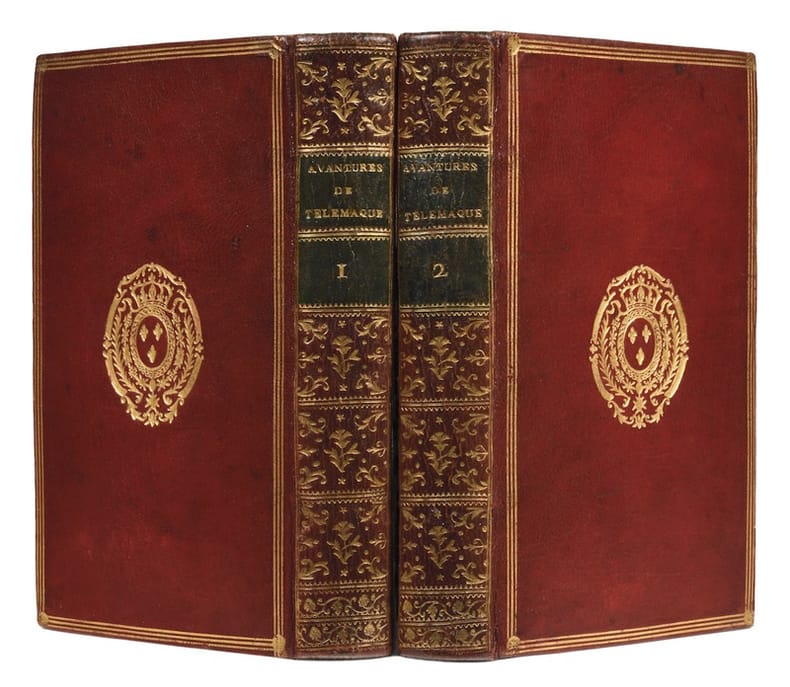
rif. 9385Paris, de l’imprimerie de Didot l’aîné, 1784. Deux volumes petit in-8 (182 x 110 mm), 6 ff. n. ch., 453 pp.; 2 ff. n. ch., 438 pp., 1 f n. ch. Maroquin vieux rouge, triple filet doré en encadrement sur les plats, armes au centre, dos lisse orné de caissons de fleurons dorés, pièces de titre et de tomaison vert foncé, coupes filetées, roulette intérieure, tranches dorées, quelques feuillets légèrement brunis dans le second volume (reliure de l’époque).