836 résultats
réf. 88264Amsterdam Pierre Mortier 1716. 8vo. Engr. front. 14 159 pp. Title printed in ed and black. Foxing. Bound together with: Le politique du temps. Ou discours necessaire dans la conjoncture presente pour avoir une juste idée de la puissance de l’autorité & du devoir des princes; de la diversité des gouvernemens & jusqu’où l’on doit supporter la tyrannie. No place 1704. 8vo. 8 150 2 pp. Somewhat worn contemporary full calf gilt spine with raised bands and beige label defective at head of spine. From the library of Biby mansion in Södermanland Sweden. ”Histoire des Oracles” by Fontenelle was originally published in 1687 and re-issued in several editions. Together with van Dale in ”De oraculis veterum ethnicorum dissertationes” 1683 Fontanelle claimed that the ancient oracle answers were given neither by the supernatural agency of demons nor the Devil and also that they did not cease with the birth of Jesus. A view that stirred up oppositon in the church. The ”Le politique du temps” is a new edition of ”Le politique du temps; ouvrage qui traite de la puissance authorité et du pouvoir des princes” published in Paris 1650 which is a reprint of a pamphlet published in 1574. It is sometimes attributed François Davesne. hardcover
1732réf. 69103à Paris: Chez Jean-Baptiste Coignard 1732. Fine. Chez Jean-Baptiste Coignard à Paris 1732 26 x 40 cm 2 volumes reliés New edition corrected and expanded by Fontenelle. Volume I extends from A to L volume II from M to Z. 2 title vignettes and engraved initials by Mariette. Title pages in red and black. Printed in 2 columns. Armorial copy with arms completely scraped away. One can still distinguish an anchor in the shield and a shell at the upper right of the anchor. Contemporary full brown calf binding. Spine with raised bands richly decorated with central fleuron and scattered stars. Title and volume labels in garnet morocco. Split headcaps. Joints cracked at head and foot. Corners very bumped and worn. Lacks to edges along the raised bands. This dictionary of terms used in the sciences and arts originally appeared in 1684. Fontenelle corrected numerous errors and approximations in it notably due to a certain lack of knowledge of the origin of words particularly Greek ones. Fontenelle further extended the dictionary to other fields natural sciences with birds fish but also religious and military orders certain words from old French. His work ranks him among the first encyclopedists of the 18th century. Chez Jean-Baptiste Coignard hardcover
réf. 4241126 189 pag. geheel leer. Geillustreerd met frontispice en twee uitslaande gravures van het heelal en van de maan door J. van Solingen. Drempelgedichten van A. de Zoete en Joh. v.d. Brouke. unknown
1640réf. 51531640 1 f. bl. - 12 ff. - 87 ff. Paginés - 335 folios (670 pp.) - f. bl. Paris, Guillaume Pelé, 1640, fort in-8° relié plein vélin ép., titre manuscrit au dos, 2 cachets en page de titre. Malgré de petits manques au 2e plat, bel exemplaire grand de marges.
1796réf. YRG-436TRÈS GRANDES MARGES pour cet in-4 (36cm x 27.5) reliure d'époque plein veau blond, dos lisse, orné d'entrelacs dorés, pièce de titre en maroquin rouge et titre doré. Liserets et fleurons dorés sur les plats et gardes avants et arrières. Toutes tranches dorées. Frontispice peint par VOIRIOT, dessiné par FORTY et gravé par LANGLOIS l'an 5 (1796). Une gravure à pleine page. Manque de cuir au bas des plats avant & arrière, coiffe de pieds absente page 31 jaunie dans les marges, traces de tâches ancienne sur les plats. Cependant bel et luxueux ouvrage.
1727réf. 171224to. Cont. full calf. 5 raised bands and richly gilt compartments. Faint scratches on covers. Corners and edges a little rubbed. 2 small holes in leather at sides of upper compartment. (26),548 pp. and 1 folded engraved plate. Engraved vignette. On good paper.
1727réf. 171224to. Cont. full calf. 5 raised bands and richly gilt compartments. Faint scratches on covers. Corners and edges a little rubbed. 2 small holes in leather at sides of upper compartment. 26548 pp. and 1 folded engraved plate. Engraved vignette. On good paper. First edition of the well-known French philosopher and mathematician's main mathematical work. Fontenelle author of "The Plurality of Worlds" claims here that Geometry is entirely intellectual and independent of the actual decription and existence of figures following more the conceptions of Descartes than those of Newton. hardcover
réf. 57794EB. Very Good. Hardcover. Leather. 12mo. Chez les Libraires Associés Paris. 1766. 11 volumes. Illustrated with 8 frontispieces including a portrait by H. Rigaud after Dolsier. Seven other frontispieces are found in the remaining volumes those by Clavaro A. Coipel Gravelot and Pilart. Four of the five engravings throughout the set are by B. Pilart and Clavaro after Duflos. Bound in calf leather with gilt titled spine labels present to the spine and gilt decoration present to the boards. Leather lightly rubbed and worn along the extremities. No ownership marks present. Text is clean and free of marks binding tight and solid. A beautiful and complete eleven-volume set of the works of the brilliant French polymath Bernard de Fontenelle 1657 - 1757. Many of the characteristic ideas of the French Enlightenment are found in their earliest form in Fontenelles works. His writings are valuable to scholars to this day Raman Variety in Religion and Science 122. Fontenelle is remembered by historians as an erudite scholar brilliant wit and an effective exponent of science. He fostered enlightened thinking using enjoyable language. Fontenelle warned that people would reject science as useless if they didnt understand it. He was so impressed with the power of mathematics that he said even a work of morality politics criticism will be more elegant other things being equal if it is shaped by the hand of geometry. He felt the joy that mathematics can give saying: Nothing probes more clearly that the mind seeks truth and nothing reflects more glory upon it than the delight it takes sometimes in spite of itself in the driest and thorniest researches of algebra Raman Variety in Religion and Science 122. It is particularly interesting to note that Fontenelle foresaw that science would rise to great heights but he also feared humanity was too weak to look at truth straight in the eye Fontenelle was one of the spirits that inspired the French Encyclopedie and the associated Enlightenment which were to significantly affect the course of human history ibid. Voltaire described Fontenelle as having the most universal mind produced by the era of Louis XIV. This set includes Fontenelles enormously popular Entretiens sur la Pluralité des Mondes a utopian analysis of the universe that took Europe by storm and was precursor and inspiration to scores of imitations. It was first published in 1686 and first translated into English by Aphra Behn only two years later. Although the Entretiens clearly owes a tremendous debt to the astronomical traditions of Galileo and Brahe Fontenelle's sensational tale of the inhabitants in 'other planets in other galaxies and even on comets could hardly fail to captivate' Nina Rattner Gelbart Introduction to the Conversations on the Plurality of Worlds . In the form of an elegant dialogue between a scientist and a Marquise Entretiens sur la Pluralité des Mondes takes as its starting point that 'Toute la philosophie n'est fondée sur deux choses: sur ce qu'on a l'esprit curieux et les yeux mauvais': that is that if we had a perfect understanding we would not need science because all would be spontaneously revealed. Meant as a quick summation of scientific discovery but also as pure speculation on the possibilities of the universe Entretiens sur la Pluralité des Mondes suggests that as it has taken six millennia for Europeans to cross the Atlantic Ocean to America it may take a little longer for the inhabitants of other worlds to cross the far greater expanses of space. Fontenelle also explains his theories on astronomical systems the moon other planets and coments. This set also includes other writings on science and mathematics as well as Dialogues des Morts anciens and Histoire des Oracles' works which exemplify Fontenelle's desire to propagate philosophical thinking. EB; 8vo 8" - 9" tall . hardcover
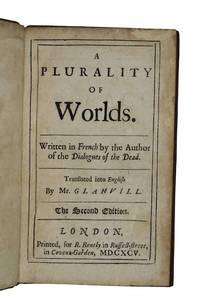
1695réf. AQ26436London: Printed for R. Bently 1695. 12 152pp. Without initial two blank leaves. Contemporary blind-tooled mottled calf. Lightly rubbed and marked some loss to head of spine. Without pastedowns later armorial bookplate of John Jones of Llanarth Court Monmouthshire to verso of upper board small worm-track to foot of text-block touching text in places. The second English edition translated by poet John Glanvill 1663/4-1735 of Fontenelle's popular cosmographical discourse; an early and significant Enlightenment work and the first example in French of a learned work directed at an educated but non-specialised public. First published in 1686 the book was promptly translated to numerous languages with the first edition in English appearing in 1687. ESTC R212866 Wing F1417. Second edition. 12mo. Printed, for R. Bently unknown
réf. 27181Une page in-12.En 1692, Huet est nomm vque Avranches et y restera jusqu'en 1699. Dans cette lettre, probablement crite durant cette priode puisqu'il s'adresse Monseigneur, Fontenelle le remercie pour l'ouvrage qu'il vient de recevoir: & Si j'tais cartsien je serais bien fch que ce livre ft crit aussi vivement et aussi agrablement qu'il l'est et je ne sais pas comment je ferais pour m'empcher de le goter... D'aprs cette subtile rponse, il ne peut s'agir que de deux ouvrages rdigs par Huet; le premier publi en 1680 et intitul Censure de la Philosophie cartsienne, le second publi en 1692 sous le titre Nouveaux Mmoires pour servir l'histoire du cartsianisme.
réf. 21420P., Imprimerie Royale, 1727, un volume grand in 4 (26 cm x 19,5 cm) relié en plein veau marbré, dos orné de fers dorés, tranches rouges (reliure de l'époque), (13), 548pp., 1 PLANCHE DEPLIANTE
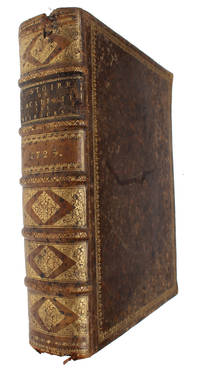
1727réf. 59036Paris, L'Imprimerie Royale, 1727. 4to. Fine contemp. full calf. Raised bands. Richly gilt spine. Tome- and titlelabels with gilt lettering. Gilt borders on covers. A small nick in leather at upper compartmen. Light wear to foot of spine. (26),548, pp., 1 folded engraved plate. Clean and fine. The offered item includes the entire volume of ""Histoire de L'Academie Royale des Sciences. Années MDCCXXV. Paris, L'Imprimerie Royale, 1727"", of which the memoir of Fontenelle is printed as a ""suite"". With the engraved frontispiece. (6),154,354,(2) pp., 14 partly folded engraved plates. (Original papers by: Maraldi, Petit, Nicole, Winslow, du Fay, Pitot, Delisle d'Aine, Geoffroy le Cadet, Reaumur, Nicole, Cassini, de Mairan, Saurin, de Lagny, Fizes).
1727réf. 59036Paris L'Imprimerie Royale 1727. 4to. Fine contemp. full calf. Raised bands. Richly gilt spine. Tome- and titlelabels with gilt lettering. Gilt borders on covers. A small nick in leather at upper compartmen. Light wear to foot of spine. 26548 pp. 1 folded engraved plate. Clean and fine. The offered item includes the entire volume of "Histoire de L'Academie Royale des Sciences. Années MDCCXXV. Paris L'Imprimerie Royale 1727" of which the memoir of Fontenelle is printed as a "suite". With the engraved frontispiece. 61543542 pp. 14 partly folded engraved plates. Original papers by: Maraldi Petit Nicole Winslow du Fay Pitot Delisle d'Aine Geoffroy le Cadet Reaumur Nicole Cassini de Mairan Saurin de Lagny Fizes. First edition. "In 1727 as a "Suite des mémoires de l’Académie royale des sciences" he published the Élémens de la géométrie de l’infini. Some doubted whether it was really the work of a mathematician but the author believed it was and attached great value to it. He had worked on it for a long time probably since the period of his preface to the Analyse des infiniment petits. The term élémens is to be understood in the sense of "first principles." According to Fontenelle none of the geometers who had invented or employed the calculus of infinity had given a general theory of it; that is what he proposed to do. The work is divided into a preface relating the history of this branch of calculus and into two main parts: "Système général de l’infini" and "Différentes applications ou remarques." The author discusses "the infinite in series or in progressions of numbers" and then examines "the infinite in straight and curved lines" in the words of the Abbé Terrasson who reviewed the work in the Journal des sçavans July-October 1728." There was a great deal of discussion in the scientific community about this work in which mathematicians found numerous paradoxes. Johann I Bernoulli for example in his correspondence with Fontenelle allowed his criticisms to show through his praise: he did not understand what was meant by finis indéterminables. Fontenelle attempted to defend his theory and above all his distinction between metaphysical infinity and geometric infinity: one must ignore the metaphysical difficulties in order to further geometry and the finis indéterminables ought to be considered "as a type of hypothesis necessary until now in order to explain several phenomena of the calculus" letter to Johann I Bernoulli 29 June 1729. "The orders of infinite and indeterminable quantities like the magnitudes that they represent are only purely relative entities hypothetical and auxiliary. The subject matter of mathematics is only ideal" according to the terms of a "Projet de rapport" of Dortous de Mairan to the Academy on this work." DSB. hardcover
1960réf. 99923541Les centraux bibliophiles Les Centraux Bibliophiles 1960. In-folio en feuillets, sous chemise avec titre contrecollé et double emboîtage. 22 illustrations en couleurs de CHAPELAIN-MIDY gravées sur bois dans l'atelier de Théo SCHMIED et tirées sur ses presses ainsi que la typographie en Garamond. 185 pages. Préface d'André Maurois. Exemplaire enrichi d'une suite des gravures sur Japon nacré, d'une gouache originale signée avec collage du titre (Second soir. Que la lune est un terre habitée), et de deux menus de la soirée de présentation, illustrés par CHAPELAIN-MIDY et signés. Tirage limité à 175 exemplaires sur papier Vélin d'Arches.Celui-ci n° 46 imprimé nominativement. Très bel exemplaire.
1727réf. RW1716Paris:: L'Imprimerie Royale 1727. 1727. 4to. xxvi 548 pp. Title-page vignette tailpieces headpieces 1 engraved chapter vignette 1 engraved initial 1 engraved folding plate occasional light foxing or browning. Full contemporary mottled calf blind-ruled covers raised bands red and brown leather spine labels gilt decorated spine all edges red marbled end papers leather separation at top of spine all edges red marbled end-papers; leather separation at top of spine hint of worming but strong lightly rubbed. A very clean and tight copy. Fine. FIRST EDITION of an extensive treatise on the principles of calculus by Bernard Fontenelle the distinguished French philosopher and scientist who is famous for his book on the plurality of worlds. Through his friend Varignon Fontenelle made the acquaintance of the Parisian scientific circle and became friends with Nicolas de Malezieu and l'Hopital. Fontenelle wrote the preface to l'Hopital's Analyse des infiniment petits pour l'intelligence des lignes courbes 11690. "In it he displayed his interest in the notion of infinity and his talent as a historian; in a few pages he retraces the history of the mathematical study of curved lines from Archimedes to Newton and Leibniz . . . In 1727 he published his Elements de la geometrie de l'infini which he had worked on for a long time probably since the period of his preface to the Analyse des infiniment petits . . . According to Fontenelle none of the geometers who had invented or employed the calculus of infinity had given a general theory to it; that is what he proposed to do. The work is divided into a preface relating to the history of this branch of calculus and into two main part . . . 'the infinite series or in progression of numbers' and then examines 'the infinite in straight and curved lines . . . " DSB. / Bernard Fontenelle was born at Rouen and pursued a literary career. Fontenelle dabbled in poetry and writing for the stage but it is better known for his work as secretary to the Academy of Sciences. Among his published works are Entretiens sur la pluralite des mondes 1686 the Histoire du renouvellement de l'Academie des Sciences 1708-1722 and a number of eloges of the members. REFERENCES: DSB V pp. 57-63; Poggendorf 1 col. 770 Zeitlinger 1360. L'Imprimerie Royale, 1727. hardcover
1727réf. RW1716Paris:: L'Imprimerie Royale 1727. 1727. 4to. xxvi 548 pp. Title-page vignette tailpieces headpieces 1 engraved chapter vignette 1 engraved initial 1 engraved folding plate occasional light foxing or browning. Full contemporary mottled calf blind-ruled covers raised bands red and brown leather spine labels gilt decorated spine all edges red marbled end papers leather separation at top of spine all edges red marbled end-papers; leather separation at top of spine hint of worming but strong lightly rubbed. A very clean and tight copy. Fine. FIRST EDITION of an extensive treatise on the principles of calculus by Bernard Fontenelle the distinguished French philosopher and scientist who is famous for his book on the plurality of worlds. Through his friend Varignon Fontenelle made the acquaintance of the Parisian scientific circle and became friends with Nicolas de Malezieu and l'Hopital. Fontenelle wrote the preface to l'Hopital's Analyse des infiniment petits pour l'intelligence des lignes courbes 11690. "In it he displayed his interest in the notion of infinity and his talent as a historian; in a few pages he retraces the history of the mathematical study of curved lines from Archimedes to Newton and Leibniz . . . In 1727 he published his Elements de la geometrie de l'infini which he had worked on for a long time probably since the period of his preface to the Analyse des infiniment petits . . . According to Fontenelle none of the geometers who had invented or employed the calculus of infinity had given a general theory to it; that is what he proposed to do. The work is divided into a preface relating to the history of this branch of calculus and into two main part . . . 'the infinite series or in progression of numbers' and then examines 'the infinite in straight and curved lines . . . " DSB. / Bernard Fontenelle was born at Rouen and pursued a literary career. Fontenelle dabbled in poetry and writing for the stage but it is better known for his work as secretary to the Academy of Sciences. Among his published works are Entretiens sur la pluralite des mondes 1686 the Histoire du renouvellement de l'Academie des Sciences 1708-1722 and a number of eloges of the members. REFERENCES: DSB V pp. 57-63; Poggendorf 1 col. 770 Zeitlinger 1360. L'Imprimerie Royale, 1727. hardcover books
1736réf. 38571736 La Haye: Antoine van Dole, 1736. Complet en 5 vol. in-12: 10 x 17cm. I/ 342-156pp. + 138-180pp. + 332pp. + 346pp. + 355pp. Reliure en pleine basane havane. Dos à 5 nerfs, richement orné de motifs dorés. Pièce de titre foncée, tomaison en lettres dorées. Plats encadrés d'un filet doré, orné d'un fer à chaque coin. Roulette pressée à froid sur les coupes. Tranches rouges. Illustré de deux frontispices et d'une gravure dépliante. Quelques défauts, pièce de tomaison frottées (voir photographies) sinon très bel exemplaire.
1790réf. 3002018Paris: Jean-Francois Bastien 1790. One or two joints slightly weak. Eight volumes octavo engraved portrait frontispiece in volume 1 and a folding plate in vol. 2; a fine set in contemporary French polished marbled calf; flat spines ornately gilt with double red labels. A very attractive set of Fontenelle's works including his enormously popular Entretiens sur la Pluralité des Mondes: this utopian analysis of the universe took Europe by storm and was precursor and inspiration to scores of imitations. It was first published in 1686 and first translated into English by Aphra Behn only two years later. Although the Entretiens clearly owes a tremendous debt to the astronomical traditions of Galileo and Brahe Fontenelle's sensational tale of the inhabitants in "other planets in other galaxies and even on comets could hardly fail to captivate" Nina Rattner Gelbart Introduction to the Conversations on the Plurality of Worlds. In the form of an elegant dialogue between a scientist and a Marquise it takes as its starting point that "Toute la philosophie n'est fondée sur deux choses: sur ce qu'on a l'esprit curieux et les yeux mauvais": that is that if we had a perfect understanding we would not need science because all would be spontaneously revealed. Meant as a quick summation of scientific discovery but also as pure speculation on the possibilities of the universe it suggests that as it has taken six millennia for Europeans to cross the Atlantic Ocean to America it may take a little longer for the inhabitants of other worlds to cross the far greater expanses of space. This set also includes "Dialogues des Morts anciens" and "Histoire des Oracles" works which exemplify Fontenelle's desire to propagate philosophical thinking. Voltaire described Fontenelle as having the most universal mind produced by the era of Louis XIV. . Jean-Francois Bastien unknown
1715réf. 1008F35London: A. Bettesworth; E. Curll 1715 . First edition. Leather. Good. 6.5" by 4.5". Not Stated. The very scarce first William Gardiner English language translation of Fontenelle's important early work of astronomy which speculates on the possibility of extra-terrestrial life. First published in French in 1686 this is the very scarce first English language translation of this work from William Gardiner.Illustrated with a frontispiece.ESTC T137582A6 B-I12. Collated complete.Bernard le Bovier de Fontenelle expresses support for cosmic pluralism and discusses the topic of astrobiology in this work while also speculating on the existence of Venusians as a species of extra-terrestrial life.It helped popularise the theories of Rene Descartes and Nicolas Copernicus taught through constructive conversations between a philosopher and a Marquise. In a full calf binding. Loss to back strip tail. Joints starting rear board firmly held and front board just a touch tender. Internally firmly bound. Pages lightly age toned due to paper type but generally clean and bright with the odd handling mark and light tide marks to perimeters of six leaves towards the rear. Good A. Bettesworth; E. Curll hardcover
1752réf. 8548Chez Hippolyte-Louis Guérin 10 x 16,5 Paris 1752 In-12, reliure plein veau raciné de l'époque, dos à cinq nerfs orné de cinq grenades dorées encadrées de filets dorés, pièce de titre de maroquin lavallière, titre doré, tranches rouges, roulette dorée sur les coupes, XXXI-[1]-215-[5] pp. Edition originale sans nom d'auteur. Fontenelle a 95 ans lorsqu'il commet sa "Théorie des tourbillons cartésiens." Il apparait en 1752 comme un des derniers défenseurs de la thèse que Descartes avait exposée près d'un siècle plus tôt dans "Les principes de la philosophie", parus en 1644-1647, à savoir que "la matière du ciel est liquide" et que "Les planètes tournent sans cesse en rond ainsi qu'un tourbillon qui aurait le soleil en son centre". Fontenelle avait participé dès 1686 à la diffusion du cartésianisme. Le frontispice de ses "Entretiens sur la pluralité des mondes" présentait un système solaire environné de multiples tourbillons. Or au même moment (1687) paraissaient à Londres les "Principia" de Newton (1643-1727) qui démontraient de manière rigoureuse l'attractivité universelle des corps et l'incompatibilité de la théorie des tourbillons avec les lois de Kepler. Dans les années 1720-1740, le cartésianisme fait toujours la loi en France, malgré la lente diffusion des théories de Newton, à laquelle participa Voltaire par ses "Eléments de la philosophie de Neuton" parus en 1738. Pour mémoire la première traduction française à partir du texte latin des "Principia" par Emilie du Chatelet date de 1759. Fontenelle en 1752, sous couverture de l'anonymat, descend à nouveau dans l'arène, qui oppose à l'époque "cartésiens" et "newtoniens", "impulsionnistes" et "attractionnistes." Le petit volume se présente comme une synthèse. Son angle d'attaque, en s'appuyant sur Kepler et la force centrifuge de Huguens [Huygens], est contenu en fait dans la deuxième partie du titre "avec des réflexions sur l'attractivité", qui occupent le dernier chapitre (p. 185). Newton a expliqué les phénomènes célestes par la force de la gravitation, mais il est accusé (cf. la préface de l'éditeur écrite par un des proches de Fontenelle, Camille Falconet) de revenir aux "qualités occultes" de la scholastique pour expliquer la cause de cette gravitation. Coiffe supérieure abimée, coins légèrement émoussés, dos agréable, intérieur frais, bon exemplaire. Peu fréquent.(Bbis6) PHOTOS NUMERIQUES DISPONIBLES PAR EMAIL SUR SIMPLE DEMANDE-DIGITAL PHOTOGRAPS MAY BE AVAILABLE ON REQUEST
1929réf. 81907Nonesuch Press. As New. Paperback. FREE UPGRADE to Courier/Priority Shipping Upon Request - IN STOCK AND IMMEDIATELY AVAILABLE FOR SHIPMENT - AS NEW THE TEXT BLOCK IS PRISTINE CLEAN UNMARKED AND IN EXCELLENT CONDITION - - x 138 pages. -- with a bonus offer-- . 1929. Nonesuch Press paperback
réf. 200918195A La Haye, Chez GOSSE & NEAULME , 1708 ; in-folio, 376-440-434 pp., cartonnage de l'éditeur. Les 2 volumes. Nouvelle edition, augmentée & enrichie de figures gravées par Bernard PIcard Le Romain - exemplaire ayant été mouillé, PLEIN VEAU dos a nerfs bien orné manque la coiffe du bas sur le tome 1, coins un peu écrassés, un manque millieu du dos du tome 2.
réf. 17113Paris, Les Centraux bibliophiles, 1960. In-folio, 185 pp., maroquin indigo d'O. Solin, premier plat orné d'un décor céleste estampé à froid et doré, dos à nerfs orné de filets à froid, du nom de l'auteur, de l'artiste et du titre dorés, large encadrement intérieur de même maroquin orné d'un filet doré et un filet à froid, doublures et gardes d'agneau velours jaune, tête doré, couverture conservée, chemise de demi-maroquin indigo, rabats de même maroquin, étui bordé de même (légère insolation du dos de la chemise, petits frottements de l'étui, décharges).
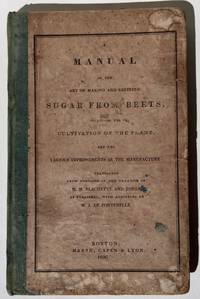
1836réf. 1727Boston: March Capen & Lyon 1836. First American edition. In publisher’s half cloth with printed panels. Binding rubbed stained. Pages discolored except for the first and last quires. Otherwise in fine condition. First American edition. In publisher’s half cloth with printed panels. 2 151 1 p. and 1 large folding plates. First American edition of this uncommon book about beet sugar manufacturing. A translation of L.-J. Blachette and Frédéric Salvator Zoéga’s Manuel du fabricant de sucre et du raffineur Paris 1826. The large folding engraved frontispiece contains 12 views of the technical apparatus used in beet sugar manufacture. Scarce on the market Rarebookhub shows only two records Charles Wood: 1969; 1982 WorldCat locates 3 copies worldwide. . March, Capen & Lyon unknown