2.813 Ergebnisse
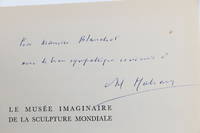
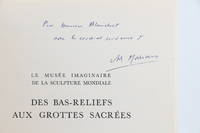
1954Best.-Nr. 80045Paris: Gallimard 1954. Fine. Gallimard Paris 1954 18 x 23.50 cm reliure de l'éditeur The first edition of which there were no deluxe copies. Publisher's full cream cloth binding complete with its illustrated dust jacket. Spine of dust jacket sunned and with two small stains on the back panel Precious signed autograph inscription from André Malraux to Maurice Blanchot. While they knew each other at the NRF it was primarily through several major articles by Blanchot devoted to Malraux that the two men ""encountered"" each other. After the war Blanchot published in Bataille's ephemeral review 'Actualité' an article on l'Espoir that allowed him ""to visibly inscribe his political reversal"". In 1950-51 in his double article on ""Le Musée imaginaire"" he formalized his own theory of the image that would permeate his future work. Confronting these two visions of art Henri Godard writes: ""Through the constancy and radicalism of its reference to death to absence to nothingness Blanchot's thought is one pole of our reflection on art of which Malraux could well incarnate the other"" In ""L'Expérience existentielle de l'art"". A polarity that could only bind Blanchot to Malraux whose tutelary figure would be invoked one final time at the end of his last narrative ""l'Instant de ma mort"": ""Later having returned to Paris he met Malraux. The latter told him that he had been taken prisoner without being recognized that he had managed to escape while losing a manuscript. What does it matter! Only the feeling of lightness remains which is death itself or to put it more precisely the instant of my death henceforth always pending."" Rich iconography. Spine of dust jacket slightly sunned as is often the case and with two marginal stains at the head of the back panel. Gallimard hardcover
1976Best.-Nr. 80029Paris: Gallimard Bibliothèque de La Pléiade 1976. Fine. Gallimard Bibliothèque de La Pléiade Paris 1976 10.50 x 17.50 cm 2 volumes en reliures de l'éditeur sous étui cartonné Definitive edition from the Bibliothèque de La Pléiade printed on Bible paper. Publisher's bindings in full brown grained sheep orange top edges smooth spines decorated with gilt fillets. Fine complete set with its protective jackets dust jackets and its fawn felt-covered slipcase. Gallimard, Bibliothèque de La Pléiade unknown
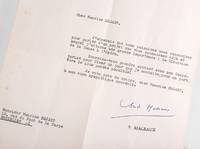
1974Best.-Nr. 80215Paris: Gallimard 1974. Fine. Gallimard Paris 1974 14.50 x 20.50 cm broché First edition a Service de Presse advance copy. Iconography at rear. Precious autograph inscription signed by André Malraux to the diplomat and great resistance fighter faithful among the faithful of General De Gaulle Gaston Palewski to whom this work is dedicated below the printed dedication: ""C'est pour vous distraire. Vous recevrez vos exemplaires convenables la semaine prochaine"" ""This is to entertain you. You will receive your proper copies next week"". Â Gallimard unknown
1954Best.-Nr. 79898Paris: Gallimard Galerie de La Pléiade 1954. Fine. Gallimard Galerie de La Pléiade Paris 1954 18 x 23.50 cm reliure de l'éditeur First edition one of the numbered copies the only printing. Richly illustrated. Publishers binding in full boards designed after Paul Bonets original model. Joints of the upper cover skillfully restored. Precious signed presentation inscription from André Malraux to Maurice Blanchot. Gallimard, Galerie de La Pléiade hardcover
Best.-Nr. 39221484-6Holt & Company Henry. Used - Good. Former library copy. Pages intact with minimal writing/highlighting. The binding may be loose and creased. Dust jackets/supplements are not included. Includes library markings. Stock photo provided. Product includes identifying sticker. Better World Books: Buy Books. Do Good. Holt & Company, Henry unknown
1948Best.-Nr. 76640Genève Geneva: Skira 1948. Fine. Inscribed to his friend the french resistant Brigitte Friang Skira Genève Geneva 1948 23 x 29.50 cm reliure de l'éditeur New edition with no deluxe copies printed. Richly illustrated. Slight sunning to spine. With a precious signed autograph inscription from André Malraux to his friend the prominent Gaullist resistance fighter Brigitte Friang: Pour Brigitte. A. Malraux. Oct 1948. accompanied by an original coloured drawing depicting the famous ""dyable"" walking in profile sketched in red and blue pencil used for the eye and bristling hair Brigitte Friang joined the Resistance at the age of 19 and quickly became a key operative in charge of coordinating parachute drops in the western region. She was arrested by the Gestapo after attempting to help her friend Pierre Brossolette escape from Rennes prison. She later confessed: I knew all the landing and drop zones I knew the real names of many agents because I had transmitted them in code to London for registration. Seriously wounded she was deported to Ravensbrück then to the Sudeten commando camps. She managed to escape from the transport heading to Dachau by hiding in straw. In 1946 she co-founded the Rassemblement du Peuple Français in support of De Gaulles return to power after his resignation and became part of the small circle of close associatesalongside André Malrauxwho drafted the foundational Strasbourg speech in 1947. Following the dissolution of the R.P.F. she turned to frontline journalism covering the wars in Indochina Suez the Six-Day War and Vietnam and later became André Malrauxs press officer. This marked the beginning of a long friendship with Malraux who spoke of their closeness in Antimémoires referring affectionately to his Brigitte. In return Brigitte Friang would recount their thirty-year friendship in two works Un autre Malraux and Petit tour autour de Malraux both offering a poignant yet candid portrait of the writer and statesman. Skira unknown
1955Best.-Nr. 73497Paris: Ecole Estienne 1955. Fine. Ecole Estienne Paris 1955 17.50 x 22.50 cm broché Privately printed first edition limited to 200 numbered copies. Illustrated with 6 photographs. A rare and appealing copy of this work entirely produced by the students of the prestigious École Estienne. Ecole Estienne unknown
1971Best.-Nr. 73726Paris: Gallimard 1971. Fine. Enter here Jean Moulin! Gallimard Paris 1971 14.50 x 20.50 cm broché First edition one of 80 numbered copies on Holland paper the deluxe issue. A fine copy. Oraisons funèbres brings together the major addresses delivered by André Malraux then Minister of Cultural Affairs at official ceremonies:The commemoration of the Liberation of Paris 1958Tribute to Greece 1959To Save the Monuments of Upper Egypt 1960The centenary of the Alliance Israélite Universelle 1960The funeral of Georges Braque 1963 The commemoration of the death of Joan of Arc 1964The funeral of Le Corbusier 1965 The transfer of Jean Moulins ashes to the Panthéon 1964. The address on Jean Moulin culminating in the celebrated apostrophe « Entre ici Jean Moulin ! » remains one of the most famous examples of French political oratory of the twentieth century. Gallimard unknown
Best.-Nr. 180691-6Used - Good. Pages intact with minimal writing/highlighting. The binding may be loose and creased. Dust jackets/supplements are not included. Stock photo provided. Product includes identifying sticker. Better World Books: Buy Books. Do Good. unknown
1967Best.-Nr. GB00329CUHMI4N00Bantam 1967. Mass Market Paperback. Very Good. Disclaimer:A copy that has been read but remains in excellent condition. Pages are intact and are not marred by notes or highlighting but may contain a neat previous owner name. The spine remains undamaged. At ThriftBooks our motto is: Read More Spend Less.Dust jacket quality is not guaranteed. Bantam paperback
2006Best.-Nr. 69594Paris: Gallimard 2006. Fine. Gallimard Paris 2006 17.50 x 23 cm broché First edition one of 60 numbered copies on pur fil paper the only deluxe copies. Handsome copy. Gallimard unknown
1936Best.-Nr. 19366New York: Random House. Very Good. First American Edition. Hardcover. Boards with light rubbing to extremities. A very handsome copy!; 12mo 7" - 7½" tall; 174 pages . 1936. Random House hardcover
1933Best.-Nr. 69839Paris: Nrf 1933. Fine. Nrf Paris 1933 12 x 19 cm broché First edition one of 339 numbered copies on ""pur-fil"" paper only deluxe copies ""grand papier"" after 1 China and 39 laid ""pur-fil"" paper reimposed. Very nice copy. Half morocco binding. Nrf unknown
1934Best.-Nr. HALL508959Hardback. 1934. 348pp Methuen London 1934. 1st English edition. Neat ownership name on endpaper. Printed 'Colonial Edition' at bottom of rear board. A very good copy without dust jacket which is believed not to have been issued. . hardcover
1947Best.-Nr. 81936Albert Skira. Very Good with no dust jacket. First Edition Thus. Softcover. Light toning and foxing a few short tears lacking original glassine dust jackets bookplates on front wrapper versos name stamp and ink on the front pastedown of Musee 1947 several pages uncut of Creation 1948. Two of 3 volume set French language. International shipping billed at cost. International shipping billed at cost. Photos upon request. Please note that the buyer is responsible for any customs duties tariffs or import fees levied by the destination country.; 4to 11" - 13" tall . 1947-48. Albert Skira paperback
1969Best.-Nr. 653521969. Fine. 29 janvier 1969 21 x 27 cm une feuille filigranée Guerimand Voiron Letter typed and signed from André Malraux to Maurice Béjart. One leaf headed by the Ministre d'Etat chargé des Affaires Culturelles Ministry of Culture bearing a stamp from 29 January 1969. André Malraux hopes to place choreographer Maurice Béjart in charge of the Ballet de l'Opéra in Paris. Béjart was at the time very well established in Brussels as part of his troop Ballet du XXe siècle performing at the Théâtre de la Monnaie led by his friend Maurice Huismans. Following a report by Jean Vilar to reform the Opéra in Paris Malraux takes the decision to call Béjart back to France: J'aimerais que nous puissions nous rencontrer pour parler d'un projet que vous connaissez déjà et auquel j'attache une grande importance : la Direction de la Danse à l'Opéra I would like us to be able to meet to talk about a project that you already know and to which I attach a great significance: the Management of Dance at the Opéra. Malraux's idea was to name Boulez and Jean Vilar alongside him thus forming a solid avant-garde resolutely oriented towards the future of the arts. The choreographer declined the offer and continued his creations in Belgium. He becomes no less an admirer of Malraux to whom he will dedicate fifteen years later a ballet using Beethoven's music which he entitled Malraux ou la métamorphose des dieux. This letter is the only testimony existing to Malraux's request to the choreographer which remained controversial. This nomination was not accepted by Béjart who stayed in Belgium for ten years before heading to Lausanne. Provenance: Maurice Béjart's personal archives. unknown
1933Best.-Nr. 65787Paris: Nrf 1933. Fine. Nrf Paris 1933 12 x 19 cm broché First edition one of 339 numbered copies on pur fil the only large paper copies after 1 Chine and 39 vergé pur fil re-imposed. A very nice copy. Nrf unknown
1967Best.-Nr. GB00329CUHMI3N00Bantam 1967. Mass Market Paperback. Good. Disclaimer:Pages can have notes/highlighting. Spine may show signs of wear. ~ ThriftBooks: Read More Spend Less.Dust jacket quality is not guaranteed. Bantam paperback
1928Best.-Nr. 61400Paris: Nrf 1928. Fine. Nrf Paris 1928 18.50 x 24 cm broché First edition one of 23 numbered copies on Hollande paper this one not numbered but justified ""copy on Hollande paper"" to foot of lower cover the tirage de tête after 13 Japon. A nice copy despite the spine very slightly faded as usual. Nrf unknown
1928Best.-Nr. 59307Paris: Grasset 1928. Fine. Grasset Paris 1928 12 x 18.50 cm broché First edition one of 13 numbered copies on Or Turner paper large paper copy the fewest copies. Rare and nice copy with double cover. Grasset unknown
1930Best.-Nr. 55710Paris: Grasset 1930. Fine. Grasset Paris 1930 11.50 x 18.50 cm relié First edition of 62 numbered copies on Madagascar the tirage de tête. Contemporary half blue morocco over marbled paper boards by Robinson gilt date to spine gilt fillet frame to covers endpapers and pastedowns of light green paper double covers and double spines preserved top edge gilt. A very good copy in a nice binding. Grasset hardcover
1950Best.-Nr. 58197Paris: Gallimard 1950. Fine. Gallimard Paris 1950 22.50 x 29 cm reliure de l'éditeur First edition. Publisher's binding over flexible paper boards. Handsome autograph inscription from one ""Compagnon de la Libération"" to another : ""Pour Rémy son ami André Malraux."" Illustrations. Spine sunned copy retaining its dustjacket. One spot to the spine. Gallimard hardcover
Best.-Nr. 25854Skira éditeur 1948. In/4 cartonnage éditeur illustrations en noir in-texte et en couleur contrecollées 155 pages. Deuxiéme volume des essais de Psychologie de lart. Le musée a imposé une relation nouvelle avec l'oeuvre d'art. C'est un phénomène récent qui date de la période de la Renaissance et qui n'existe qu'en Europe. Cette relation nouvelle délivre les uvres de leur fonction ce que Malraux appelle une métamorphose. Un crucifix n'est plus d'abord un crucifix un portrait n'est plus un portrait de quelqu'un ; l'uvre d'art avait toujours été une image. Or pour le musée il n'y a plus ni vénération ni ressemblance ni imagination décor ou possession mais des images qui diffèrent des choses et qui se trouvent confrontées en tant que telles. Pour Malraux l'homme recrée le monde face à Dieu et conquiert par l'art le sens de sa vie contre l'oubli et la mort. Un musée est un résultat de hasards c'est un possible mutilé. Le voyage d'art repose sur la mémoire optique qui n'est pas infaillible. Mais aujourd'hui grâce à la photographie il est possible d'avoir à disposition les uvres de toutes les civilisations. Il devient donc possible de confronter toutes les uvres. unknown
1967Best.-Nr. 51263Paris: Gallimard 1967. Fine. Gallimard Paris 1967 14.50 x 20.50 cm broché First edition one of 80 numbered copies on Hollande paper the deluxe issue. Fine copy. Gallimard unknown
Best.-Nr. 7867Skira éditeur 1947. In/4 cartonnage éditeur illustrations en noir in-texte et en couleur contrecollées 155 pages. Premier volume des essais de Psychologie de lart. Le musée a imposé une relation nouvelle avec l'uvre d'art. C'est un phénomène récent qui date de la période de la Renaissance et qui n'existe qu'en Europe. Cette relation nouvelle délivre les uvres de leur fonction ce que Malraux appelle une métamorphose. Un crucifix n'est plus d'abord un crucifix un portrait n'est plus un portrait de quelqu'un ; l'uvre d'art avait toujours été une image. Or pour le musée il n'y a plus ni vénération ni ressemblance ni imagination décor ou possession mais des images qui diffèrent des choses et qui se trouvent confrontées en tant que telles. Pour Malraux l'homme recrée le monde face à Dieu et conquiert par l'art le sens de sa vie contre l'oubli et la mort. Un musée est un résultat de hasards c'est un possible mutilé. Le voyage d'art repose sur la mémoire optique qui n'est pas infaillible. Mais aujourd'hui grâce à la photographie il est possible d'avoir à disposition les uvres de toutes les civilisations. Il devient donc possible de confronter toutes les uvres. unknown