(MANN, Thomas)ABAA

824 resultados
1930ref. 470136Stockholm: Imprimerie Royale. P. A. Norstedt & Soner 1930. Softcover. Fine/Near Fine. First edition. Octavo. Illustrated reproducing photographic portraits of Thomas Mann and the other Nobel Laureates. White printed wrappers. Text in Swedish French and English. A fine partially unopened copy in original very good or better unprinted glassine dust jacket with light wear and tanning on spine. Includes the address by Fredrik Book awarding Thomas Mann the 1929 Nobel Prize in Literature "1929 Ars Nobelpris I Litteratur" and Thomas Mann's acceptance speech. Also prints a brief biographical essay about Mann. The other Nobel Laureates for that year were Prince Louis-Victor de Broglie Arthur Harden Hans von Euler-Chelpin Frederick Gowland Hopkins and Christiaan Eijkman also printing remarks by each of the scientists during "Les conferences Nobel." Mann was awarded the 1929 Nobel Prize in Literature principally for his novel Buddenbrooks which is now recognized as one of the classic works of 20th century literature. Very scarce. OCLC appears to locate a single copy in Sweden. Imprimerie Royale. P. A. Norstedt & Soner unknown books
1942ref. 15626Los Angeles: Plantin Press 1942. Original edition of the first book published by the Pazifische Presse. The Pazifische Presse was the sole representative on the west coast of the United States of those publishers who left Germany and Austria following the rise to power of National Socialists in 1933. Many European refugees came to America and though most settled in New York a large number did go to Los Angeles which became an important center of German-speaking immigration. Artists authors and intellectuals such as Thomas Mann Theodore W. Adorno Bertolt Brecht Fritz Lang and Arnold Schoenberg were but a few who represented the community of Germans exiled from their native land and who produced major works to address the world crisis. The Pazifische Presse was founded by Ernst Gottlieb and Felix Guggenheim both of whom had emigrated to the west coast in around 1939. The publisher “afforded its participants an arena for presenting the best of Weimar culture not only for the emigree community but for their American friends and colleagues” Jaeger p. 9. They announced the initial publication of seven volumes by distinguished authors who themselves had immigrated to the United States. These included Thomas Mann the Nobel Laureate for literature in 1929 Franz Werfel Bruno Frank Leonhard Frank Alfred Neumann Fredrich Toberg Alfred Döblin and Lion Feuchtwanger. Many of these renowned writers continued to publish during their exile; some even went on to screen writing positions in Hollywood. Most of the authors were selected based upon a personal relationship between them and the publishers. Gottlieb and Guggenheim worked with Saul and Lillian Marks of the renowned Plantin Press of Los Angeles to print their material. Founded in 1931 and named after Christopher Plantin the famous sixteenth century printer from Antwerps the Marks built a strong reputation as printers of artistic and beautiful works. Each of the first seven volumes of a total of eleven books ultimately released were printed at the Plantin Press in a run of 250 copies; the first 150 copies were the “Subscriber editions” signed by the author and bound in half-leather. The remaining 100 copies were a more simply bound unsigned trade edition. “The novella Thamar is a partial pre-printing of the fifth section of Joseph der Ernährer Joseph the Provider; consequently the volume is the German first printing of this part of the text. The first edition of the complete text of Joseph der Ernährer Joseph und seine Brüder. Der vierte Roman was later published in December 1943 at the Bermann-Fischer Verlag Stockholm Potempa D8.1 . . . As part of Joseph’s legend this excerpt depicts the story of the young woman Thamar and her education by Jacob” Jaeger p. 25. Thomas Mann 1875-1955 was probably Germany’s most influential author of the twentieth century receiving the Nobel Prize in Literature in 1929. He lived in Munich where he wrote some of his most successful novels like Buddenbrooks 1901 Death in Venice 1912 and The Magic Mountain 1924. After the Nazi takeover his family emigrated to Switzerland then to Princeton before settling in Southern California where he finished his great tetralogy Joseph and His Brothers in 1942. Thomas Thedoe Heine 1867-1948 was recognized as one of Germany’s most talented illustrators. Plantin Press unknown books
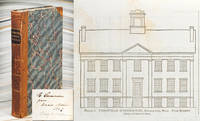
1816ref. 013667Dedham: H. Mann and Company 1816. Title continues; "Also an appendix comprising a dissertation on dysentery. and observations on thre winter epidemic 1815-16 denominated peripneumonia notha." Rebacked with original paper labels laid-down. Label chipped with three letters MED missing from title. Original blue paper-covered boards printed front and rear covers. Hinges rather crudely repaired long ago. Top of covers water-stained as well as top edge. Fore-edge untrimmed. Cover printing is readable but faded a bit. See photos. Many pages are browned at periphery some foxing and staining. Owner's embossed stamp at foot of front free endpaper of Ira M. Rutkow M.D. noted bibliographer of military history. The author was an Army surgeon during the American Revolution and also served during the War of 1812. According to Rutkow GS4 this is probably the best and most vivid picture of early 19th century American military life. Garrison and Morton 2161.1 calls it "the primary record of medicine during the War of 1812". 318pp. First Edition. Quarter Cloth Printed Boards. General Cover Wear and Soiling/No Jacket. Tall Octavo. H. Mann and Company Hardcover books
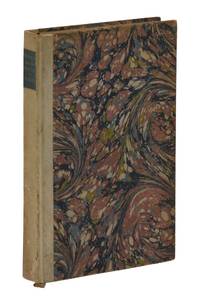
1898ref. 178388Berlin: Fischer 1898. First. hardcover. very good. Small 8vo 3/4 suede over mottled bronze paper boards. Berlin: S. Fischer 1898. First Edition. A collection of six short stories. His first published book written when Mann was twenty three years old. The binding is unlettered and worn with dust soiling to suede; internally fine aside for light foxing on last several pages and one or two spots on preliminary pages. A very good copy. Ownership signature of art historian Meyer Schapiro. Fischer unknown books
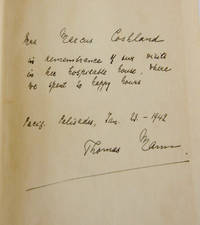
1941ref. 021753New York: Alfred A. Knopf 1941. First American Edition. Hardcover. Very Good in a Very Good dustwrapper. INSCRIBED and SIGNED by the Nobel Prize-winning author on the front endpaper: "Mrs. Marcus Cashland/in remembrance of our visits/in her hospitable house where/we spent so happy hours/Pacif. Palisades Jan. 23 - 1942/Thomas Mann." A fine inscription. Alfred A. Knopf hardcover books
1921ref. 022063Munich: Phantasus 1921. First Edition. Hardcover. Owner's 1922 inscription on the front pastedown; spine of book and slipcase professionally repaired. Theodor Thomas Heine. Striking pictorial green boards 8" x 10-1/2" in red paper slipcase; text in German. One of 530 numbered copies this copy not numbered SIGNED by both author and artist in pencil on the colophon page. First edition of one of Thomas Mann's most controversial works with 12 ORIGINAL LITHOGRAPHS and 20 text illustrations and initials by Theodor Thomas Heine. The text which satirizes Richard Wagner's DIE WALKÜRE was originally intended to be published in 1906 but was withdrawn by Thomas Mann before publication. Phantasus hardcover books
1939ref. 140941406New York: Alfred A. Knopf 1939. First One-Volume Edition. Very Good. First one-volume edition. Signed by Thomas Mann on the front free endpaper. Bound in publisher's original green cloth; lacking the dust jacket. Very Good with some nibbling at the top of the spine spine toned. Front inner hinge started and tender foxing to endsheets and textblock edge. A monumental novel and a towering literary achievement of the 20th century. Alfred A. Knopf unknown books
1934ref. 543240New York: Alfred A. Knopf 1934. Hardcover. Near Fine. First American edition. Translated from the German by H.T. Lowe-Porter. Bookplate on front pastedown else about fine lacking the dust jacket. Signed by the author on a cancel leaf presumably as issued by the publisher. Alfred A. Knopf hardcover books
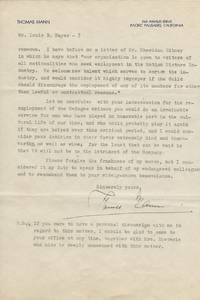
1941ref. 020957Pacific Palisades CA 5 October 1941. Letter. Light creases from mailing. Near Fine. A superb three-page TYPED LETTER SIGNED TLS on Mann's personal stationery to Louis B. Mayer president of MGM Studios commending Mayer for the Studios' contracting of 5 refugee writers in order to allow their immigration to the United States to escape death during World War II: Alfred Doeblin Alfred Polgar Hans Lustig Wilhelm Speyer and Walter Mehring. In part: "It is not my custom to interfere in matters which do not directly concern me; however I should like to take the liberty of presenting to you with confidence a matter which is close to my heart and which is a source of worry for me as well many other well-meaning people. It was one of the finest and most meritorious deeds during these turbulent years which destroyed so much life and happiness a deed which will certainly never be forgotten when the fantastic tale of the emigration of European culture is told that two great Motion Picture Companies in Hollywood decided to give emergency contracts to a number of German and Austrian writers which not only enabled these men to immigrate into the United States but also secured if only for a certain time a basis for their existence." Mann spends most of the letter arguing for the rehiring of these writers for another year not "for unproductive and merely humanitarian purposes" but because "the value of the agreement for the Company has already been demonstrated." An important letter revealing Mann's solidarity with refugee writers during the rise of Fascism in Europe. Mann himself emigrated to the United States in 1939 following the German occupation of Czechoslovakia. The outbreak of World War II on 1 September 1939 prompted Mann to offer anti-Nazi speeches in German to the German people via the BBC and in October 1940 Mann began monthly eight-minute broadcasts recorded in the U.S. and broadcast by the BBC to Germany condemning Hitler and the Nazis. In doing so he was one of the few publicly active opponents of Nazism among German expatriates in the United States. unknown books
1811ref. 79039London: John Booth 1811. First Edition. hardcover. good. With fine folding colored map as frontispiece but lacking the other 4 color plates. Offsetting on the title page otherwise a nice clean copy. Rebound in the early 1900s in 3/4 leather over marbled boards; corners bumped spine worn Joints cracked but have been repaired. London: John Booth 1811. First Edition. A good copy of this scarce book. John Booth unknown books
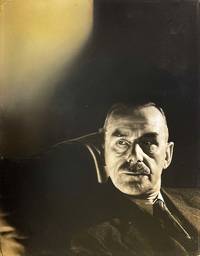
1934ref. 2522New York: n.p. 1934. Very Good. POWERFUL STEICHEN PORTRAIT OF THOMAS MANN FROM CHANCE MEETING IN NEW YORK. Edward Steichen was one of the early pioneers of photographic art leading the movement of photography from its established position as a utilitarian medium to a mode of creative expression. As a major contributor to Alfred Stieglitz's Camera Work magazine in the first decades of the twentieth century Steichen had cemented his reputation as a new kind of photographer enjoying both artistic and commercial success-working as chief photographer for Condé Nast and later heading the Met's photography department. In 1959 having completed the first decade in his tenure as director of the Museum of Modern Art's photography division Steichen was approached by Tas Toth about curating a new display to serve as a counterpart to Steichen's astronomically successful The Family of Man-a MoMA exhibition that would become and remains to-date the most-viewed photographic exhibition. Toth's exhibition to be called Das menschliche Antlitz Europas The Human Face of Europe would mirror The Family of Man's thematic emphasis on shared humanity principally by showcasing images by distinguished figures including Cartier-Bresson Boubat Brassai and Doisneau alongside works by lesser-known artists. Initially the renowned artists were hesitant to contribute towards this unique concept and it was only after Steichen endorsed Toth by allowing him to exhibit his portrait of Thomas Mann that a large number of eminent photographers agreed to contribute to the group exhibition. Steichen's impactful photograph is the work present here. Steichen had taken the image in the United States where Mann would emigrate in 1939 to avoid mounting persecution in his native Germany and where Mann would remain until 1952. It was in 1934 that Mann to promote his Jospeh series made his first journey to America- embarking on RMS Volendam and arriving in New York to great fanfare-"scarcely dreaming" writes biographer Nigel Hamilton "he would one day become an American citizen" p. 283. The image of Mann follows in a line of portraits by Steichen of leading world figures from Churchill and FDR to Chaplin and Gershwin. Furthermore the present photograph preserves in addition to Mann's likeness the providential meeting of two of the most impactful twentieth century creatives who would both make their homes in the New World. Provenance: -Donated by Steichen to the original owner when he worked on the organization of the exhibition 'Das Menschliche Antlitz Europas'. -Christie's lot 218 Sale 7415 21 Nov. 1996 Exhibited: 'Das Menschliche Antlitz Europas' Municipal Museum of Munich 1959. STEICHEN EDWARD. Thomas Mann New York 1934. Gelatin silver print before 1959. 23.8 x 18.8 cm 9 ⅜ x 7 ⅜ in. Mounted on paperboard signed on the reverse in what does not appear to be Steichen's hand: "Edward Steichen" and numbered in pencil. With a tiny amount of touch-up at extreme top corner almost entirely beneath the matte. Handsomely framed. References: Hamilton Nigel The Brothers Mann New Haven: Yale University Press 1979 Steichen Edward A Life in Photography New York: Bonanza 1984. n.p. unknown books
1937ref. 218960New York 1937. Bust portrait of the author with building in background. Vintage gelatin silver print. Verso docketed with holograph notations in pencil giving the name of the sitter date of the photograph and Van Vechten's reference to negative and print "XXIV K". 1 vols. 13-7/8 x 10-7/8 inches. Matted and framed. Bust portrait of the author with building in background. Vintage gelatin silver print. Verso docketed with holograph notations in pencil giving the name of the sitter date of the photograph and Van Vechten's reference to negative and print "XXIV K". 1 vols. 13-7/8 x 10-7/8 inches. Published in Portraits: The Photography of Carl Van Vechten 1978 edited by Saul Mauriber. Provenance: The estate of Saul Mauriber Van Vechten's assistant and executor of Van Vechten's photography estate and the compiler of Portraits: The Photography of Carl Van Vechten 1978 unknown books
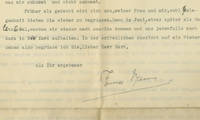
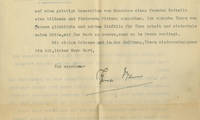
1935ref. 2132622/04/1935. This letter was acquired from the family of the recipient and has never been offered for sale before In 1900 at the age of 25 Thomas Mann wrote and in 1901 published Buddenbrooks chronicling the decline of a wealthy north German merchant family over the course of four generations. Mann drew deeply from the history of his own family the Mann family of Lübeck and their times. It was Mann’s first novel and it made him a major literary figure. The work led to a Nobel Prize in Literature for Mann in 1929; although the Nobel award generally recognizes an author’s body of work the Swedish Academy’s citation for Mann identified “his great novel Buddenbrooks” as the principal reason for his prize. Mann began writing the book in October 1897 when he was twenty-two years old. Henry Hart was an American publisher who worked mainly for Scribner’s in New York. He was working with Mann on the publication of English-language versions of his works including Nocturns. The League of American Writers was established by the First American Writers Congress a gathering held from April 26–28 1935. It was an association of American novelists playwrights poets journalists and literary critics launched by the Communist Party USA in 1935. The group included Communist Party members and so-called ""fellow travelers"" who closely followed the Communist Party's political line without being formal party members as well as individuals sympathetic to specific policies being advocated by the parrty. In 1933 after the takeover of the Nazi party while travelling in the South of France Mann heard from his eldest children Klaus and Erika in Munich that it would not be safe for him to return to Germany. The family except these two children emigrated to Küsnacht near Zürich Switzerland but received Czechoslovak citizenship and a passport in 1936. Typed letter signed April 22 1935 to Hart his publisher. ""It is not easy for me to answer your suggestion in regards to this business news. I have read very carefully the appeal of the American writer’s congress. However I have unsurmountable concerns about contributing a statement to the congress. In the second half of the appeal there is mention of ‘civil liberties’. It stands in logical contradiction to all previous statements which have a purely communist character. A telegram on my part as you have asked me to send would be a clear support of communism which I am not able to force myself to give. I have a true love of civil liberties as much as I am against fascism and war. I much prefer the communist revolution to that of the fascists. Nevertheless the wording of this appeal and the political orientation it lends to this congress does not allow me to follow your wishes to send a note of unrestricted sympathy to the congress. I beg you to understand and not interpret my position as a lack of courage. It is an act of good conscience of what is my duty and what is not. ""Earlier than planned my wife and I will have the opportunity to see you again. In June a little bit later than last time we will come to America and stay for a short while in New York."" This letter was acquired from the family of the recipient and has never before been offered for sale. unknown books
1913ref. 140945995Berlin: S. Fischer Verlag 1913. First Trade Edition. Near Fine. First German trade edition first printing. 145 3 pp. Publisher's half vellum over marbled paper-covered boards spine label blocked in turquoise lettered in gilt. Text in the original German. Near Fine with slight rubbing and slight soiling to binding spine darkened. Owner name to front free endpaper; contents lightly tanned. Thomas Mann's best-known works with strong homoerotic themes. S. Fischer, Verlag unknown books
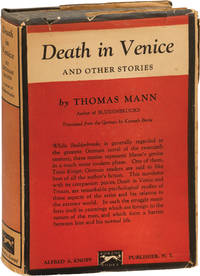
1925ref. 156516New York: Alfred A. Knopf 1925. First American Edition preceding the British edition by three years. The title story is the basis for the 1971 film directed by Luchino Visconti starring Dirk Bogarde and Marissa Berenson. Very Good plus in a Very Good or better example of the rare dust jacket. Light foxing affecting the page block and last few leaves. Jacket is lightly edgeworn along the top edge with the usual toning on the spine panel and a shallow chip at the crown. In a custom maroon quarter-leather clamshell box. Alfred A. Knopf unknown books
1842ref. 1071951842. Boston: Fowle and Capen 1842. 8vo iv 390 pp. Old half calf marbled boards joints cracked text block sound but quite foxed especially at the front and back. Inscribed by the author and with the later signature of Mary C. Chapman on front pastedown. § Volume 4 of this series; this copy inscribed by Horace Mann: "C. Sumner from Horace Mann 1847." Horace Mann inscriptions are uncommon and this is a superb association. "Charles Sumner January 6 1811 - March 11 1874 was an American politician and senator from Massachusetts. As an academic lawyer and a powerful orator Sumner was the leader of the antislavery forces in Massachusetts and a leader of the Radical Republicans in the United States Senate during the American Civil War working to destroy the Confederacy free all the slaves and keep on good terms with Europe. During Reconstruction he fought to minimize the power of the ex-Confederates and guarantee equal rights to the freedmen." Mary Chapman was involved with the Boston Female Anti-Slavery Society and was a friend of poet Julia Ward Howe and close friend of Charles Sumner and Horace Mann. unknown books
1604ref. 1818816/04/1936. An incredibly rare and unpublished letter relating to his perhaps most famous work 1936 was a momentous year for Mann. That year his escalated attacks on the Nazi government led to his German citizenship being revoked. He traveled to Argentina his maternal homeland for a PEN International Conference which was organized to bring peace and understanding between cultures using literature. In 1900 at the age of 25 Thomas Mann wrote and in 1901 published Buddenbrooks chronicling the decline of a wealthy north German merchant family over the course of four generations. Mann drew deeply from the history of his own family the Mann family of Lübeck and their times. It was Mann's first novel and it made him a major literary figure. The work led to a Nobel Prize in Literature for Mann in 1929; although the Nobel award generally recognizes an author's body of work the Swedish Academy's citation for Mann identified ""his great novel Buddenbrooks"" as the principal reason for his prize. Mann began writing the book in October 1897 when he was twenty-two years old. The novel was completed three years later in July 1900 and published in October 1901. Henry Hart was an American publisher who worked mainly for Scribner's in New York. He was working with Mann on the publication of English-language versions of his works including Nocturns. Typed letter signed in German to Hart April 16 1936. ""I am hurrying to acknowledge receipt of your check from August 25th and am happy that sales of the “Nocturnes” are gradually progressing. ""You have added some very personal notes to your letter hat I would like to address with a few words. The trip to Moscow I will definitely make but will have to postpone it for now since I have travel plans to Vienna and Budapest in the immediate future. For the summer I have agreed to travel to Bueno Aires for the PEN Club Congress. I had committed to this trip a while ago and therefore have to travel there first. This trip is especially enticing to me since it will take me to Rio de Janeiro. It is the home of my mother who often told me about the beauty of the coast when I was a child. ""I was very touched about what you told me regarding your repeated studies of the novel of my youth. I finished it when I was 25 years old. The young man who wrote that book in his solitude could not have dreamed that it would be his calling in life to influence the intellectual life of people in a foreign continent in a educating and encouraging way. From the bottom of my heart I wish you have happy and beautiful ideas for your work and am repeating my request to please send me a copy your book once it is printed."" unknown books
1836ref. 007789London: Ackermann and Co. Printed by Hillmandel 1836. Half Calf. Very Good. Truly scarce set of hand-colored plates with not a single copy reflected on OCLC First Search nor in bibliographic bibles for color plate and sporting books Tooley and Schwerdt respectively. Oblong 28.5 by 38cm. Six hand-colored lithographic plates Original wraps bound in. Ackermann and Co. Printed by Hillmandel unknown books
ref. 397987Unbound. Near Fine. A single octavo leaf approximately 6" x 7.75" written on both sides from the Diary of George Combe Mann. One margin a little irregularly cut affecting a few letters but not affecting the readability of the leaf old folds near fine. Both Horace Jr. and George were the sons of Horace Mann died 1859 the Father of American Education and Mary Peabody Mann one of the illustrious Peabody Sisters a reformer teacher and founder of a successful school for young children her sister Elizabeth Putnam Peabody was a reformer and pioneer in the creation of kindergartens and her other sister Sophia Peabody was a painter and the wife of Nathaniel Hawthorne. Horace and Mary Mann had three sons: Horace Mann Jr. George Combe Mann and Benjamin Pickman Mann. The eldest Horace Mann Jr. was an accomplished botanist who studied and traveled with Henry David Thoreau. Mann also studied zoology with Louis Agassiz and was responsible for discovering over 100 plants species in Hawaii. Mann was named to head the botanical gardens at Harvard but died of tuberculosis at age twenty-four before he could fill the position. His personal herbarium of approximately 12500 sheets was purchased in 1869 by Andrew Dickson White as the first accession into the Cornell University Herbarium. The diary leaf in the 22-year-old George Mann's hand covers two sides of one leaf begins on November 11 1868 the day of his brother's death and continues on the other side with entries through November 18th the entry for the 18th may be incomplete. Mann's entry for November 11th in a clear and readable hand is exceedingly poignant: "At a few minutes before 2 p.m. Horace coughed a little harder than usual and mother spoke to him. He answered 'I was trying to stop a hiccough' adding immediately 'in the eastern provinces they say that is death.' She went out a minute and returned to find him with his eyes fixed gasping for breath. She called me who tried to raise him a little but he gasped five or six times at intervals of a few seconds and ceased to breathe. He had been comfortable all day. After his drain was driven out this morning he said he almost wished he had it to drive out again it felt so deliciously. He wanted mother to be with him all the time kept repeating how comfortable he was and wanted to continue just as he was. He enjoyed the day it seemed as much as any one in his life so perfectly calm and tranquil was he. But it was the calm which he now enjoys in full. His temperament made living hard even in health - an invalid intolerable. But he lived better than we realized and in his death I find an untold loss!" On the 13th he notes: "We had service here at 4 o'clock. Dr. Peabody officiated and Mrs. Gould and Dr. & Mrs. Vaughan sang. Brigham staid here last night." On the 14th: "We went to Providence at 11 o'clock - mother Aunt Lizzie Mary Peabody Dr. Gould Ben and I - where we found Aunt Lydia the Messers and Arthur Knapp. It was a beautiful day and the short service at the grave was very satisfactory. We dined at Aunt Lydia's and returned at 4 getting home at 7 p.m. Everything was calm and quiet. It is all over!" On the 16th: "Mother's 62nd birthday. Went in to Mr. Brigham's office again." On the 17th: "Attended to Horace's accounts in the evening." The entry on the 18th is truncated: "Snow in the night and rain all day - Read 150pp. of Greenleaf on Evidence." Unique primary source material on the death of a promising young botanist. From the estate of Horace Mann III died 1978 the son of George Combe Mann. unknown books
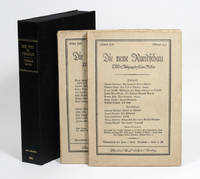
1912ref. 2495Berlin: S. Fischer Verlag 1912. First edition. Original wrappers. Very Good. FIRST PRINTING IN EXCEEDINGLY SCARCE ORIGINAL WRAPPERS of arguably Thomas Mann's most celebrated work. "At the beginning of 1911 Mann's health was poor and his development sluggish. Nothing he had published since Buddenbrooks had been received with such universal acclaim. He had planned but abandoned several long works and had published chiefly short stories. Convinced that he needed to make a mark with a new piece that would appeal to current tastes he poured all his mastery into Death in Venice . The story was written between July 1911 and July 1912 . Mann had intended it for S. Fischer's magazine by that time merely called Die Neue Rundschau but was uncharacteristically hesitant about submitting it once it was done-it was too innovative and personal. His wife convinced him to send it in. It was first published in the October and November 1912 issues" S. Appelbaum. The publication in the October and November issues of Die Neue Rundschau preceded the rare limited edition printed by Hans von Weber. In: Die neue Rundschau October and November issues 1912; pp. 1368-1398; 1499-1526. Berlin: S. Fischer Verlag 1912. Octavo original publisher's printed wrappers; custom box. Minor foxing to text block edges very light edgewear to wrappers. SCARCE IN THE ORIGINAL WRAPPERS. S. Fischer Verlag unknown books
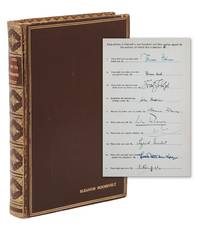
1944ref. 140949367New York: Simon and Schuster 1944. Limited Edition. Very Good. Limited edition. Eleanor Roosevelt's copy #6 of 150 copies signed by each of the ten authors on the limitation page tipped in at front: Thomas Mann Rebecca West Sigrid Undset Andre Maurois and six others. xiii 1 488 pp. Custom bound in chestnut polished calf stamped in gilt on spine boards and turn-ins; Roosevelt's name stamped on front board. Not signed or inscribed by her though. All edges gilt maroon morocco title label to spine printed endpapers maroon ribbon marker. Very Good with light rubbing to extremities and heavy chipping to title label; front joint starting at upper end. Light scattered stains to fly-leaves; contents overall clean binding firm. Buergin 568. In the summer of 1942 the Austrian refugee and music publisher Armin L. Robinson invited ten prestigious writers to work on a new project: an anti-fascist propaganda film that would demonstrate that Nazi ideology violated each of the Ten Commandments. The deal with Metro-Goldwyn-Meyer fell through so Robinson decided to continue the project as a collection of ten novellas. Each writer took one amendment with Thomas Mann leading the charge: 1. Thou shalt have no other gods before me. Thomas Mann. 2. Thou shalt not make unto thee any graven image. Rebecca West. 3. Thou shalt not take the name of the Lord thy God in vain. Franz Werfel. 4. Remember to keep the sabbath day to keep it holy. John Erskine. 5. Honour thy father and thy mother. Bruno Frank. 6. Thou shalt not kill. Jules Romains. 7. Thou shalt not commit adultery. Andre Maurois. 8. Thou shalt not steal. Sigrid Undset. 9. Thou shalt not bear false witness against thy neighbor. Hendrik Willem Van Loon. 10. Thou shalt not covet. Louis Bromfeld. The book was published in December 1943. Reviewers felt that the collection was uneven and overly long but still found much to praise particularly in Mann's contribution. They all felt the moral imperative of anti-Nazi writing: "Here the world's pen is raised against the sword of the super-race" wrote the New York Times. Four years into the war it had become clear that Hitler's conquest of Europe went well beyond territorial expansion and was an assault on civilization itself. It is no surprise that Eleanor Roosevelt should own a copy of this limited edition the text of which is taken from the third trade printing. Apart from being married to Hitler's chief opponent Eleanor was an activist whose positive newspaper review of Mann's 1938 book The Coming Victory of Democracy had aided its success with the American public. The Roosevelts received Thomas Mann and his wife at the White House in 1941 and Mann who admired the President's values and speechmaking gave a speech on behalf of his reelection campaign in 1944. This copy of The Ten Commandments bound for the First Lady's personal library is a tribute to the shared principles of those towering figures. Simon and Schuster unknown books
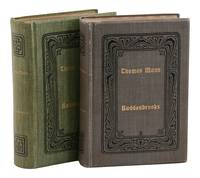
1901ref. 140948424Berlin: S. Fischer 1901. First Edition. Near Fine. First edition first printing. Two volumes. 566; 539 9 pp. with 8 advertising pages at rear of second volume. Text in German in Fraktur type. Bound in publisher's green or gray linen over beveled boards stamped in black and gilt top edge gilt patterned endpapers ribbon bookmarks. Near Fine with light rubbing to cover extremities light soiling and light toning and occasional thumbing to contents. Hinges on Volume I are a little tender binding exposed at p. 385 bookseller ticket to back free endpaper verso. Inner hinges exposed and tender on Volume II rubber ownership stamp to third page subtle repair to cloth at tail. A very pretty set in Jugendstil binding. Jacob 2. The first edition of Thomas Mann's family saga his most famous novel and the primary reason for his 1929 Nobel Prize win. The ownership stamp is that of Paula and Victor Asriel in Vienna. Paula Asriel who was predeceased by her husband killed herself to avoid deportation in the Holocaust though she managed to get her son out of the country on a Turkish passport. Thomas Mann targeted by the Nazis for his politics rather than his religion was deprived of his German citizenship in 1936 and never lived in his home country again. S. Fischer unknown books
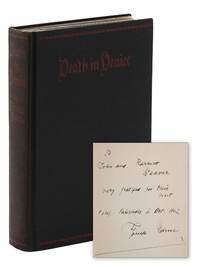
1925ref. 140949042New York: Alfred A. Knopf 1925. First American Edition. Near Fine. First American edition first printing. Association copy signed by Thomas Mann on the fly-leaf and inscribed to John and Harriet Weaver "very grateful for their visit. Pacific Palisades 6. October 1942." 284 pp. plus 2 advertising pages at rear. Bound in publisher's black cloth stamped in dark red black topstain patterned endpapers; lacking the dust jacket. Near Fine with sunned spine and light rubbing to extremities and topstain. Bookseller ticket to front free endpaper light toning to contents. A beautiful signed copy of the Nobel laureate's novel about an older man's self-destructive obsession with an adolescent boy. The journalists John Downing Weaver and Harriet Sherwood Weaver moved to Los Angeles from Kansas City in 1940. John wrote articles fiction and history famously clearing the names of 167 Black soldiers falsely accused in 1906 of complicity in the death of a White man while Harriet crusaded for better management of the hills sounding the city. Thomas Mann settled in Los Angeles in 1941 and built his "Seven Palms" house in the Pacific Palisades the following year. Here he wrote his anti-Nazi broadcasts for the BBC and here he inscribed this book to two fellow members of the Los Angeles literary scene. Alfred A. Knopf unknown books
1846ref. 3983351846. Unbound. Near Fine. A remarkable group of 10 portraits of Horace Mann and his family featuring a unique and previously undiscovered cased sixth plate daguerreotype of Mann the great architect of the American system of popular education. The photos were preserved by the Mann family and all are housed in a circa 1950s cardboard box with the typed ownership label of Horace Mann III Mann’s grandson of Southwest Harbor Maine. The box has some internal repair and chipping. The photos are overall very good with general wear and light spotting to two; the daguerreotype has a few scratches at neck level and a couple of mild abrasions but else near fine. unknown books