Petrarca FrancescoBiblio.com
2 261 résultats
1528réf. 32165Venegia: Maestro Bernardino de Vidali 1528. A very early Edition of the Vellutello Petrarca. With fine heraldic ownership label. Illustrated with the rare two page view of the Valchiusa. This copy with the Babylonian Sonnets 165 ff not censored and still included in the text. Rare thus. 4to mm. 190 x 140 handsomely bound in fine full vellum of the period. 11ff 185 ff 51 ff Del Triumpho pp. A contemporarily bound copy in a pleasing state of preservation generally crisp and clean throughout some interesting notes in very early hands to the pastedowns a few here and there in the margins of the text-block interesting notes concerning prohibition to the leaves that contain the Babylonian verses the back sometime strengthened the vellum binding strong and in good order. A FINE AND VERY EARLY PRINTING OF THE VELLUTELLO PETRARCA. The volume was dedicated to Carlo Grotta Chancellor to Cardinal Cristofor Madruzzo Principe Vescovo of Trent and organizer of the Council of Trent. This edition of Petrarca with the commentary of Vellutello is considered the most important. Especially important is the celebrated commentary on the Canzoniere out of the edition of 1525. Also important is the biography of the poet. This copy contains the Babylonian Sonnets which were generally censored and seldom included in copies of Petrarca's writings. These Babylonian sonnets a group of three poems that criticized the Avignon Papacy were initially banned because they were included in a prohibited Protestant work. In 1557 Pier Paolo Vergerio wrote Alcuni importanti luochi an attack against the Church that emphasized those three sonnets from Petrarch. Many clerics denounced the greed and corruption of the Avignon papacy. In the 1340s Petrarch wrote “I am living in the Babylon of the West” comparing Avignon to the biblical city of vice and corruption. He went on to condemn the habits of prelates who feasted at “licentious banquets” and rode white horses “decked in gold fed on gold and soon to be shod in gold if the Lord does not check this slavish luxury” Petrarch in Tuchman p. 29. His disgust found fuller expression in several sonnets among them Sonnet 138 which he addressed to the papal court at Avignon: “O foundry of deceits cruel prison where good dies and evil is / created and nourished a hell for the living: it will be a great / miracle if Christ does not finally show his anger against you” The Canzoniere poetic “songbook” is also known as the Rime Sparse “scattered rhymes”. The work is a series of erotic poems that Petrarch wrote in the Italian vernacular about his love for the mysterious beauty “Laura” whom he first encountered on April 6 1327 at the church of St. Clare. Apparently in 1348 Laura and Cardinal Colonna both succumbed to the Black Death the bubonic plague that was ravaging Europe. Petrarch himself escaped the plague though he recorded these devastating personal losses in the Canzoniere; Laura’s death in particular shaped the resolution of the sequence of poems. Tiring of Church politics Petrarch left Avignon in 1353 and spent his remaining years in various Italian provinces. He continued work on the Canzoniere sorting and arranging its poems until his death in 1374. Although Petrarch was best known among contemporaries for his Latin writings his vernacular works especially the Canzoniere are now regarded as his masterpieces. His exploration of the emotional states of love yearning and spiritual aspiration in this work would have a major influence on future generations of poets. Maestro Bernardino de Vidali hardcover
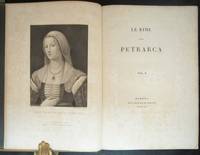
1819réf. 32220Padova: Nella Tipografia del Seminario 1819-1820. 2 volumes. The especially handsome folio edition of Petrarca and Marsand. This Copy on Large and Grand paper the best of the editions. Volume I with the very fine portraits beautifully engraved on copper by Raffaello Morghen and Mauro Gandolfi. The text in a fine and handsome Bodoniesque typography. Two engraved plates showing a view of Valchiusa engraved by Federico Lose the other showing a facsimile of the celebrated words of the poet handwritten on the Virgilian manuscript and another five plates depicting landscapes and the monument of Petrarca. Folio 33 by 23 cm very handsomely bound in full dark green grained morocco the spines with raised bands ruled in gilt the compartments with gilt panels formed by concentric squares tooled in gilt lettered in gilt in two compartments the covers and turnovers multi-ruled in gilt at the borders dark green endleaves all edges gilt. lix 375; 2 444 pp. A very regal and handsome set the bindings elegant with some unobtrusive age mellowing to the vellum and textured cloth the leather labels a bit rubbed. Internally both volumes are sound and sturdy the hinges fine and tight. The text with some light spotting to which the paper is prone this copy less than is typical and always quite mild. ONE OF THE FINEST PRINTINGS OF THE GREAT ITALIAN POET THIS REMINISCENT OF THE GREAT BODONI PRINTINGS The work is a connoisseur's and bibliophile's treasure printed in a small number of copies on large paper. Published with the valuable work and study of Antonio Marsand and the true reference edition for all later publications. Notable for its refinement and typographic elegance comparable to Bodoni's editions and for the scrupulous attention paid to the critical analysis of texts. At the end of the book a rich and accurate bibliography of all the previous editions of Pertrarca's works. One of the "great triumvirate" of Italian poets Francesco Petrarch's sonnets were admired and imitated throughout Europe during the Renaissance and they served as the model for nearly all later Western lyrical poetry. He was also the first true reviver of learning in Medieval Europe. He was a great student of the classical works-- histories poetry law and orations and he included in his studies many ancient books and manuscripts that the medieval period had ignored for nearly a millennium. He also closely followed the politics and learning of his own age. It was with Petrarca that the ancient and the modern eras met together and a new stadium for the Human spirit that which we are wont to style Renaissance was opened. Many have stated that the book is as beautiful as a Bodoni printing. Brunet IV 556. Graesse V 229. Marsand p. 126. Hortis 232. Fiske p. 125. Bellini "storia della tipografica del Seminario di Padova Nella Tipografia del Seminario hardcover
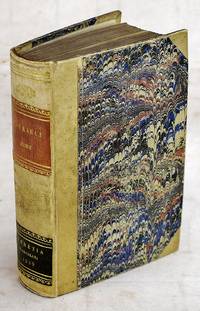
1539réf. 2109100001Venetia : Stampato per Francesco Marcolino 1539. Hardcover. Very Good. Early Italian Emblem Book 2 volumes bound as one. Octavo 15 cm. Bound in later 1/2 vellum over marbled boards. Leather spine labels. Good binding and cover. 4 354 18 pages 180 leaves. Architectural title vignette with portrait of Petrarch. Engraved printer's device at end of first volume. Second volume has an engraved title with a portrait of Alunno. Provenance: From Professor John MacQueen's library of Scotland. Includes related ephemera associated with Renaissance studies. "It is appropriate that Petrarch be printed in Italics a type invented in 1501 by the famous Venetian printer Aldus Manutius was said to have adopted Petrarch's own handwriting for . creating the new type." - Note inside front cover. Refs: Fiske / Fowler 97; Ley 159-161; Brunet III 477. Venetia : Stampato per Francesco Marcolino hardcover
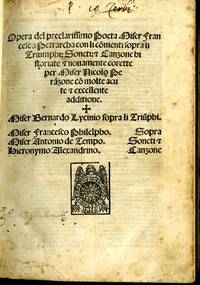
1512réf. 047500Venice: Angelo Scinzenzeler 1512. Early Edition. Hardcover Full Leather. Good Condition. Rebound in modern tooled leather. With the Opera bound before the Sonnets - with only 3 of the 6 engravings otherwise complete. Lacking the leaves at g5 i4 and q7 each with an engraving on the verso. 10 125 of 128; 116pp. With some mispagination and a switch to Arabic numerals from 89 but mispaginated 69 to 96. Modest foxing throughout lighter and heavier in spots first and lst pages worn. Old ink stains to Triumph of Time plate. and a few other stray old ink drops. Still very good or better overall save for the missing leaves. A rare edition a reimpression of Scinzenzeler's 1507 edition and with fine engravings by an unknown artist from the 1494 edition. Size: Folio. 2-volume set complete. Quantity Available: 1. Shipped Weight: Under 1 kilo. Category: Poetry; Inventory No: 047500. Angelo Scinzenzeler hardcover
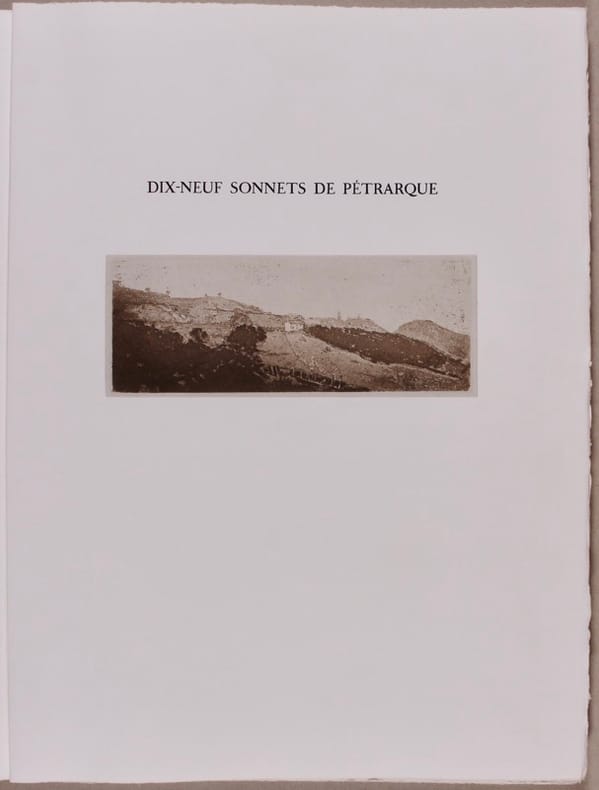
2005réf. 4059Meaux, Editions de la Revue Conférence, 2005. Un volume grand in-4 (281 x 380) en feuilles de 44 pages non chiffrées. Couverture blanche rempliée, sous emboîtage pleine toile brune. Parfaite condition.
1549réf. 75611549 In Vinegia : Per Pietro & Gioanmaria fratelli de Nicolini da Sabio, ad instanza di M. Giombattista Pederzano libraro al segno della Torre appresso il ponte di Rialto & compagni, 1549. In-8: 16x21,5 cm, 1 f. de titre avec «A gli Studiosi del Petrrarcca Giovanbattista» au vo., 11 ff. n. chiff. dintroduction et «Tavola dei Sonetti», 237 ff. Chiff. 1 à 237 pour les Sonetti et la Canzoni, 3 ff. n. chiff des «Altri sonetto del detto» et dachevé d'imprimer. Précieuse édition XVIe des oeuvres de Pétrarque (1304-1374) établie par léditeur vénitien Giovanni Antonio de Nicolini da Sabio et enrichie dune page de titre entièrement gravée avec les portraits du poète et de Laura en médaillon, de six figures sur bois à demi-page et de nombreuses lettrines initiales historiées. Une édition très correcte qui contient un texte très pur. (Graesse, V, 227). Il sagit de la deuxième édition, très augmentée et illustrée des six bois gravés pour les Trionfi, de lédition de 1541 du Canzoniere établie par Giovanni Antonio de Nicolini da Sabio, accompagnée des commentaires de Bernardino Daniello repris des notes de Trifone Gabriele. Lédition de 1549 « est plus belle et plus soignée que la précédente». (Brunet, IV, 550). «Fu fatta con molta diligenza, e nitidezza de caratteri; e graziose pur sono le stampe dintaglio, che adornano i Trioni». (Marsand, Biblioteca petrarchesca, pp. 57-58). Reliure en vélin. Dos à cinq nerfs avec titre et fleuron manuscrits à lencre noir. Tranches bleues. Ex-libris: André Gutzwiller. En excellent état avec un papier particulièrement frais et blanc.
15331533 (Stampato in Vinegia per Giouann'Antonio di Nicolini & fratelli da Sabbio, 1533 del mese di Luglio) Pergamena marezzata seicentesca con tassello con titolo al dorso (mm. 205 x 148) cc. [23], 1 bianca, CCCLXXXIIII, [4]; [79] La seconda parte contiene: I Triomphi del Petrarcha colla spositione di misser Giouanni Andrea Gesualdo da Traetto Ottimo esemplare completo anche delle pagine 194/196, che in molti esemplari vennero tolte per censura: Già Roma hor Babilonia falsa... O fucina d'inganni... Putta sfacciata.. Prima edizione di Rime accompagnata dal commento di Giovanni Andrea Gesualdo . Il Canzoniere è dedicato alla marchesa della Palude [sic per Padula], Maria Cardona. I Trionfi sono dedicati a Suzanna Gonzaga. Antonio Minturno, in una celebre lettera a Camillo Scorziati, del 15 ottobre 1538, definì il commento di Gesualdo un "parto elefante" per la sua grandezza. Convinto che il Petrarca non raccolse mai i suoi componimenti in un corpus unico (e dunque sostenitore dell'autonomia tra cronologia interna ed esterna all'opera), il G. giustifica la sua fedeltà all'ordine vulgato con la volontà di non sconvolgere inutilmente la tradizione, sottolineando come la struttura dei Fragmenta ricordi più le raccolte innografiche ed elegiache classiche, prive di un ordine interno, che l'organismo simmetrico del poema. Nasce così la seconda redazione della Spositione, rivisitata alla luce dell'opera del Vellutello e terminata negli anni 1529-30, ma non immediatamente pubblicata: il manoscritto venne dapprima affidato all'editore veneziano M. Sessa e poi trasferito per intervento del tipografo T. Giunti, amico del Minturno, nella bottega del Niccolini da Sabbio. La scelta di Venezia, resasi necessaria per la diffusa crisi dell'editoria napoletana e per la ricerca di approvazione e di confronto con l'autorità letteraria veneta, fu la causa del lungo stallo editoriale, conclusosi solo dopo le numerose sollecitazioni del duca di Monteleone Ettore Pignatelli, viceré di Sicilia e protettore del Minturno, e la dichiarazione di conformità del manoscritto, emessa da P. Bembo e da F. Vallaresso. Al di là dei risultati della disputa editoriale, il commento del G. ebbe maggiore fortuna dei lavori del Fausto e del Venafro - solo fino al 1852 se ne ebbero altre otto edizioni - ed è considerato come uno dei più ricchi e utili commenti cinquecenteschi al Canzoniere. Bibl: Brunet, IV, 549 - Marsand, 44 - Hortis, 56 - Fiske, 31 - Olschki, 27 - Fowler, p. 95-96 - Balsamo, Pétrarque, 1533 (cinque esemplari censiti in Francia) - Ascarelli/Menato, p. 354 - Ley, 113 (censisce 25 esemplari) - Edit16 (25 esemplari).
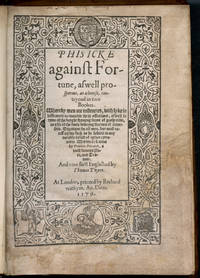
1579réf. 384London: Richard Watkyns 1579. First Edition. Very Good. Small 4to; 7 1/2 x 5 5/8 in. 190 x142 mm; pp. 4 xiv 1-152 First Booke Physicke for Fortune: 153-343 Second Booke Phisicke against Fortune vi table of contents 2. Each book with Epistolary preface by Franucis Petrarche. Translated into English from Latin by Thomas Twyne whose introduction dedicates the work to "Richard Bertie Esquier." Title within woodcut decorative border woodcut decorative initials set in gothic and latin type lacking sig.B and final blank lower corner of title torn and repaired with loss supplied first gathering lower corners repaired some dampstaining and toning throughout but sheets supple and intact. 19th century calf gilt panels from early English blind-stamped binding laid down on covers corners worn rubbed. Front pastedown with small engraved bookplate with initials "I N" Title page reads: «Physicke against Fortune as well prosperous as adverse contained in two Bookes Whereby men are instructed with lyke in differencie to remedie theyr affections aswell in tyme of the bright shyniyng sunne of prosperities as also of the foule lowiyng stonnes of adversities. Expedient for all men but most necessary for such as be subiect to any notable insult of eyther extremities. Written in Latine by Francis Petrarch a most famous Poet and Oratour. And now first Englished by Thomas Twyne.» STC 19809; ESTC S114602. This is the first edition in English of "De Remediis Utriusque Fortunae" "Remedies for Fortune Fair and Foul" written in Latin by the Humanist Francesco Petrarca 1304-1374 commonly known as Petrarch a collection of 254 dialogues mostly drawn from classical sources which seeks to instruct on moral philosophy and show how thought and deed can generate happiness on the one hand or sorrow and disillusionment on the other. It touches on a number of diverse subjects including dancing ball games gambling wrestling hunting and hawking alchemy libraries schoolmasters spectacles toothache lechery gout blindness and deafness. In a recurring theme throughout the dialogues Petrarch advises humility in prosperity and fortitude in adversity. It remained a popular book in Europe over the ages and was translated into English by the Elizabethan physician Thomas Twyne 1543-1613. "Latin work by Petrarch begun in 1354 but completed between 1360 and 1366 on how to deal with both good and bad fortune. The first of its two parts contains 122 dialogues between Ratio Gaudium and Spes and deals with how one should behave at times of good fortune; the second contains 131 dialogues between Ratio Dolor and Timor and deals with the behaviour appropriate to adverse fortune. It is a practical manual of moral philosophy and was widely read until the 17th c." Oxford Companion to Italian Literature. Richard Watkyns unknown
1579in-12 (mm.130x65), ff. 164, 5 di indice n.n. e 1 bianco, (numerazione errata all'inizio del Trionfo del Tempo: 142-145 ripetuta ai ff. M10-N1 e N2-N5). La paginazione delle due opere di Sannazaro è pp. 287; 96. In una magnifica rilegatura in marocchino rosso con ricchissima decorazione con volute, uccellini e stelline e mascherone barbuto a figura intera; ricchi fregi al dorso a 4 nervi, tagli riccamente cesellati, dorati e goffrati. Molto particolare è il ferro delle due mani che si stringono, che compare su entrambi i piatti della legatura e che possiede una valenza allegorica: il simbolo, derivato dai sarcofagi nuziali romani ("Fidei simulacrum"), sta a significare fedeltà. Compare prevalentemente su legature italiane e francesi del Cinquecento, come fregio singolo oppure a ripetizione, attorno a un cartiglio, al centro dei piatti. La bella edizione è illustrata dal ritratto di Petrarca e Laura sul verso del frontespizio; iniziali, fregi e 6 vignette in xilografia ad adornare i Trionfi. Contiene anche dal f. N11v: Capitolo di m. Francesco Petrarca, che fu da lui stesso rifiutato in vita da e altre poesie. Lo splendido volume riunisce Petrarca e Sannazaro, due poeti spesso affiancati: comprende i Sonetti in vita e quelli in morte, i Trionfi; e poi l'Arcadia e le Rime. Un importante saggio di Dionisotti del 1963, ha ben spiegato che "la divisione (tra le due opere di Sannazaro) non si modella in alcun modo su quella che attraversa il Canzoniere di Petrarca, e per contro sostiene che a rigore non si tratta neppure di una divisione, dato che solo la seconda parte avrebbe andamento di canzoniere, mentre la prima raccoglierebbe in maniera disorganica una serie di testi sparsi". Bell'esemplare ottimo anche internamente, nota mss. cancellata a inchiostro al titolo; abile integrazione con carta dell'epoca al margine bianco del f.7. Entrambe le edizioni del Sannazaro non sono comuni, ma quella di Petrarca è piuttosto rara: è conservata in 8 biblioteche pubbliche italiane (di cui 2 mutili) e manca alla collezione Speck. . Per il fregio delle mani cfr. Biblioteca Digitale Archiginnasio di Bologna; Hobson, The Origins and Diffusion of the Humanistic Bookbinding... 1989, p. 176..
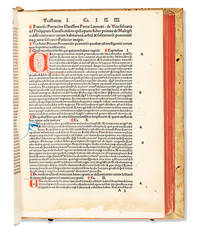
1496réf. 28938Basel: Johann Amerbach 1496. 1496. The first edition of Petrarch's collected works. ISTC ip00365000; Goff P-356; BMC III 757; Fowler Catalogue of the Petrarch Collection Cornell University Library pages 1-2. Margin of the first leaf trimmed and window-mounted at an early period surrounded by relevant marginalia dated 1743; first five gatherings with the bottom margins repaired with occasional trimming type; next four gatherings with lower margin chipped and slightly damp-stained a few other similar repairs throughout including repair to corners of final few gatherings; binding a little soiled and rubbed with early manuscript labels at the head and foot of the spine. Folio 26 x 18.7 cm 18th century blind-stamped pigskin over wooden beveled boards all edges stained red. 388 leaves; without the final blank. Lacking clasps and catch-plates. Decorated initials in red and blue. An important early collection of the letters dialogues tracts and poetry of Francesco Petrarch 1302-74 in Latin with many individual pieces appearing in print for the first time including most notably Secretum Francisci Petrachæ his famous dialogue with Saint Augustine. The text was edited by Sebastian Brant 1458-1521 who was employed by printer Johann Amerbach for whom Brant edited numerous scholarly works. Provenance: Franciscan Minorites dissolved in 1802 Cologne with their bookplate on the front paste-down; in the margins around the mounted first leaf are annotations by F. Adamus Putz dated 1743 about the binding and life of Petrarch; Gymnasium-Bibliothek of Cologne with their duplicate release stamp; collector Estelle Getz 1880-1943 her sale American Art Association November 1936 lot 1255. [Basel: Johann Amerbach, 1496.] unknown
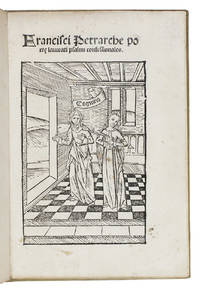
1514réf. ABC_47804Deventer 1514. 8vo. Albert Pafraet Later sheepskin parchment with the title lettered in gold on the spine. With 2 allegorical woodcut illustrations. The first on the title-page shows "Cognitio" leaving the room to go inquire who wounded the Daughter of Zion. The second on the last page shows "Spes" "Fides" and "Cognitio" comforting the Daughter of Zion who is lying in bed. 6 ff Exceptionally rare one of two known copies of the Psalmi confessionales attributed to Francesco Petrarca and printed in Deventer the Netherlands at the beginning of the 16th century. Not to be confused with Petrarca's Psalmi penitentiales a translation of 7 penitential psalms. In several manuscripts and print editions the present text in 9 parts often follow Petrarca's 7 penitential psalms which led many to attribute the Psalmi confessionales to him as well. M. Vattasso in a study of Petrarca codices and H. Cochin in his 1929 French edition of the penitential psalms both suggest that while the present 9 psalms were written in the style of Petrarca but that they are not authentic. Cochin also suggests that they could be imitations made in the sphere of influence of the Carthusians and Ludolphus de Saxonia.The present work starts with an introductory psalm in which the author - while luckily still alive - calls upon God's mercy and wishes to confess his sins. Seven psalms follow the introduction - one for each deadly sin: "superbia" "avaricia" "luxuria" "invidia" "gula" "ira" and "accidia" - in which the author analyses his own shortcomings. The main text ends with one last psalm starting with "Miserias tibi domine decantavi." and is followed by Rudolf van Langen's Carmen de Septem peccatis capitalibus.The woodcuts can be attributed to the Dutch Bellaert Master. A set of 9 allegorical woodcuts were used to illustrate the mystical text in the incunable edition of Vander dochtere van Syon "Of the Daughter of Zion" printed in Antwerp in 1492 by G. Leeu. Several of these woodcuts were reused at the beginning of the 16th century in the Northern Netherlands and 2 of them can be found in the present work. Our attribution of the publication and printing of this work to Albert Pafraet in Deventer ca. 1514-1517 we owe to J. Machiels and his 1985 analysis of the Psalmi confessionales.With contemporary manuscript annotations in the text in brown ink in Latin and on the verso of the title-page the woodcut illustration of the wounded Daughter of Zion is partially traced in brown ink. The binding is very slightly dust-soiled minor foxing to the margins of the leaves and the last page. Overall in very good condition.l Machiels Een Petrarca-druk van Albert Pafraet in: liber amicorum Leon Voet 1985 pp. 273-283; Stadbibliothek Trier 1 copy; STCN 107511010 Picarta old record and USTC 420737 refer to the present copy described by Machiels from a Belgian private collection without seeing it; cf. Pétrarque Les psaumes pénitentiaux ed. H. Cochin Paris 1929; Vattasso M. I codici Petrarcheschi della Biblioteca Vaticana Roma 1908 Appendice III Un opuscolo poco conosciuto attribuito al Petrarca p. 197-206; WorldCat 1143220557 1 copy 1542 ed.; not in Cornell Petrarch cat. EARLY PRINTING & MANUSCRIPTS RELIGION & DEVOTION Bibles Liturgy & Devotional Works Early Printing - 16th century Religion 16th Century unknown