Poe, Edgar AllanBiblio.com

4 612 résultats
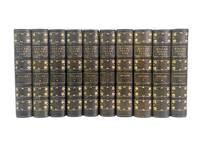
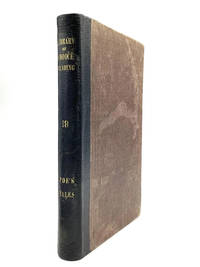
1903réf. 147348New York and Pittsburgh: The Colonial Company Limited 1903. Limited manuscript edition of the complete works of Edgar Allan Poe. Octavo ten volumes bound in full crushed levant morocco by The Monastery Hill Bindery with gilt titles and ruling to the spine in four compartments within gilt raised bands gilt turn-ins top edge gilt watered silk endpapers three tissue guarded frontispieces in each volume illustrated with tissue guarded engravings. One of only thirty copines printed on Japan vellum and signed by editors Edmund Clarence Stedman and George Edward Woodbury on the verso of the title page. In near fine condition. An exceptional set. Best known for his tales of mystery and the macabre American Romantic writer and poet Edgar Allan Poe is credited with inventing the genre of detective fiction and contributing to the genre of science fiction only just emerging at the turn of the 20th century. Poe was the first well-known American writer to earn a living through writing alone resulting in a financially difficult life and career and his works influenced literature around the world as well as specialized fields such as cosmology and cryptography. Poe's most memorable tales include: The Black Cat The Cask of Amontillado The Gold-Bug The Pit and the Pendulum The Premature Burial and The Tell-Tale Heart. The Colonial Company, Limited hardcover
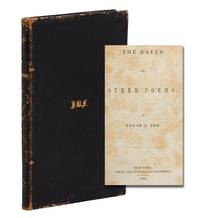
1845réf. 140946420New York: Wiley and Putnam 1845. First Edition. Very Good. First edition first printing of "The Raven" by Edgar Allan Poe printed on pp. 143 under the pseudonym "Quarles." Bound in contemporary quarter leather over marbled boards. Very Good with wear soiling and staining to binding. Contemporary ownership on title page tide mark and foxing throughout. Marginal chip to pp. 3/4. This volume also includes Poe's story "Some Words with a Mummy" pp. 363-370 and his poems "The Valley of Unrest" and "The City in the Sea" pp. 392-3 which unlike "The Raven" appear under Poe's name. Wiley and Putnam unknown
1845réf. 140946420New York: Wiley and Putnam 1845. First Edition. Very Good. First edition first printing of "The Raven" by Edgar Allan Poe printed on pp. 143 under the pseudonym "Quarles." Bound in contemporary quarter leather over marbled boards. Very Good with wear soiling and staining to binding. Contemporary ownership on title page tide mark and foxing throughout. Marginal chip to pp. 3/4. This volume also includes Poe's story "Some Words with a Mummy" pp. 363-370 and his poems "The Valley of Unrest" and "The City in the Sea" pp. 392-3 which unlike "The Raven" appear under Poe's name. Wiley and Putnam unknown books
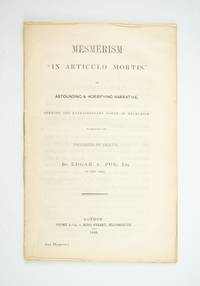
1846réf. ST21119London: Short & Co 1846. First Separate Edition. 211 x 135 mm. 8 1/4 x 5 3/8". 16 pp. Pamphlet unbound as issued stitched together with thread. In a slightly rubbed early 20th century blue buckram portfolio gilt lettering to spine. Inside front cover of portfolio with bookplate of American book collector Edward Hubert Litchfield. Heartman & Canny p. 111; Robertson II 234-35. Very small split to tail edge of fold outer bifolium only a hint of yellowing to edge of leaves but still A VERY FINE COPY entirely clean and fresh. From the collection of a notable American bibliophile this is an extremely well-preserved copy of Poe's goriest foray into science fiction. The final of three short stories on the theme of mesmerism composed by Poe in 1844-45 and first published as "The Facts in the Case of M. Valdemar" in "The American Whig Review" in December 1845 the present piece is the first separately issued story by Poe to be published in Europe following "The Murders in the Rue Morgue" and "The Gold-Bug" in 1843 in Philadelphia. The story follows Valdemar a man dying of tuberculosis who is placed in a mesmeric trance that suspends him "in articulo mortis" "at the point of death". This is done as an experiment conducted by a mesmerist identified only as "P" to determine if a mesmeric trance at that threshold between life and death can prolong one's time among the living. The outcome is a partial--but horrifying--success: Valdemar's body ceases to function but his mind remains alive trapped for seven long months until it is determined that he should be "awakened." At that moment his body rapidly decomposes into "a nearly liquid mass of loathsome--of detestable putridity." Robertson calls the work Poe's "most grotesque conception" with its vivid detail about the partially animated corpse with for example eyes producing a "profuse out-flowing of a yellowish ichor from beneath the lids of a pungent and highly offensive odor." The story is presented as a first-person scientific narrative and there was a great deal of public speculation about its veracity at the time of its publication. Poe apparently delighted by the response to his writing coyly wrote that it "has given rise to some discussion--especially in regard to the truth or falsity of the statements made. It does not become us of course to offer one word on the point at issue. We leave it to speak for itself." Our copy was owned by important American collector Edward Hubert Litchfield 1879-1949 whose library featured American and English first editions incunabula and antiquarian science and the occult. The sale of his collection in 1951 at Parke-Bernet Galleries in New York was a major bibliophilic event. From an immensely wealthy family made rich through railroad and real estate development Litchfield was among the highest of high society indulging in big-game hunting at home and abroad and hosting extravagant parties at the palatial Litchfield Castle on his 50000-acre estate in the Adirondacks. Short & Co unknown
1846réf. ST21119London: Short & Co 1846. First Separate Edition. 211 x 135 mm. 8 1/4 x 5 3/8". 16 pp. Pamphlet unbound as issued stitched together with thread. In a slightly rubbed early 20th century blue buckram portfolio gilt lettering to spine. Inside front cover of portfolio with bookplate of American book collector Edward Hubert Litchfield. Heartman & Canny p. 111; Robertson II 234-35. Very small split to tail edge of fold outer bifolium only a hint of yellowing to edge of leaves but still A VERY FINE COPY entirely clean and fresh. From the collection of a notable American bibliophile this is an extremely well-preserved copy of Poe's goriest foray into science fiction. The final of three short stories on the theme of mesmerism composed by Poe in 1844-45 and first published as "The Facts in the Case of M. Valdemar" in "The American Whig Review" in December 1845 the present piece is the first separately issued story by Poe to be published in Europe following "The Murders in the Rue Morgue" and "The Gold-Bug" in 1843 in Philadelphia. The story follows Valdemar a man dying of tuberculosis who is placed in a mesmeric trance that suspends him "in articulo mortis" "at the point of death". This is done as an experiment conducted by a mesmerist identified only as "P" to determine if a mesmeric trance at that threshold between life and death can prolong one's time among the living. The outcome is a partial--but horrifying--success: Valdemar's body ceases to function but his mind remains alive trapped for seven long months until it is determined that he should be "awakened." At that moment his body rapidly decomposes into "a nearly liquid mass of loathsome--of detestable putridity." Robertson calls the work Poe's "most grotesque conception" with its vivid detail about the partially animated corpse with for example eyes producing a "profuse out-flowing of a yellowish ichor from beneath the lids of a pungent and highly offensive odor." The story is presented as a first-person scientific narrative and there was a great deal of public speculation about its veracity at the time of its publication. Poe apparently delighted by the response to his writing coyly wrote that it "has given rise to some discussion--especially in regard to the truth or falsity of the statements made. It does not become us of course to offer one word on the point at issue. We leave it to speak for itself." Our copy was owned by important American collector Edward Hubert Litchfield 1879-1949 whose library featured American and English first editions incunabula and antiquarian science and the occult. The sale of his collection in 1951 at Parke-Bernet Galleries in New York was a major bibliophilic event. From an immensely wealthy family made rich through railroad and real estate development Litchfield was among the highest of high society indulging in big-game hunting at home and abroad and hosting extravagant parties at the palatial Litchfield Castle on his 50000-acre estate in the Adirondacks. Short & Co unknown books
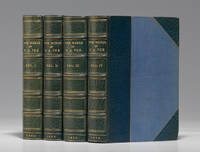
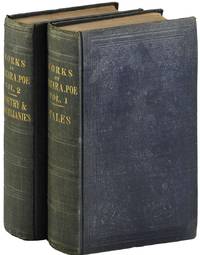
1850réf. 1307211850. First Edition. POE Edgar Allan. The Works of the Late Edgar Allan Poe: with Notices of His Life and Genius. New York: J.S. Redfield 1850 1856 Volume IV. Four volumes. Octavo mid-20th-century three-quarter teal morocco gilt raised bands top edges gilt. $6000.First collected edition of Poe's complete works published one year after his death with steel-engraved portrait of Poe in Volume I. This set includes the separately published third and fourth volumes which includes the first edition in book form of Poe's The Literati his essays on contemporary authors Volume III and Rufus Griswold's notorious ""Memoir of the Author"" a smear penned by Poe's ill-chosen executor.""Poe was the founder of the modern detective storyÉ as well as the ablest critic of his time in America. In verse he achieved incomparable melodic effectsÉ His influence has been incalculable in both verse and prose on later writersÉ 'This finest of finest of artists' Bernard Shaw has called him"" Kunitz & Haycraft 625. This four-volume set the first collected edition of Poe's works includes Poe's tales poems literary criticism and miscellaneous works. This collection was edited by N.P. Willis James Russell Lowell and Poe's rather ill-chosen executor Rufus Griswold and includes in Volume III Griswold's notorious ""Memoir of the Author."" ""For decades after Poe's death his reputation suffered from the smears of the editor Rufus Griswold. Over the years the two men had developed an outwardly respectful relationship with undercurrents of mutual fear envy and loathing. In a scurrilous obituary article and a late memoir of Poe included here in Volume III Griswold alleged or implied that his competitor had been expelled from the University of Virginia had deserted the army and had tried to seduce John Allan's second wife. Although many of Poe's admirers defended him in print against Griswold nothing has spoken so convincingly for his importance as has the influence of his works. His detective fiction and his macabre treatment of the uncanny and the disgusting pervade 20th-century popular culture. Among the foundations of modernism is the analytic attitude he brought to literature his determined separation of the man who suffers and the artist who creates"" ANB. Publisher Redfield clearly intended to publish only two volumes of Poe's Works as indicated on the first two title pages ""In Two Volumes."" These first two volumes contain the Tales Poems and some miscellaneous prose. Volume III published separately later in 1850 is titled The Literati: Some Honest Opinions about Autorial Merits and Demerits and collects Poe's essays on contemporary authors marking the first edition in book form; Volume IV published in 1856 includes Poe's long story ""Narrative of A. Gordon Pym"" along with further miscellaneous prose works. Volume I is the second printing with preliminary matter ending on page xx and no statement ""Was published on the First of April"" on the last page of advertisements; Volume II is the first printing with the ""r"" in ""choir"" missing in the first line of the third stanza on page 46. Volume III is the second printing state listed by BAL with ""1"" signature mark on page 1. BAL 16158 16159 16161. Scattered light foxing and smudging contents overall clean; spines evenly toned. A handsome set. hardcover
1850réf. 1307211850. First Edition. POE Edgar Allan. The Works of the Late Edgar Allan Poe: with Notices of His Life and Genius. New York: J.S. Redfield 1850 1856 Volume IV. Four volumes. Octavo mid-20th-century three-quarter teal morocco gilt raised bands top edges gilt. $6000.First collected edition of Poe's complete works published one year after his death with steel-engraved portrait of Poe in Volume I. This set includes the separately published third and fourth volumes which includes the first edition in book form of Poe's The Literati his essays on contemporary authors Volume III and Rufus Griswold's notorious ""Memoir of the Author"" a smear penned by Poe's ill-chosen executor.""Poe was the founder of the modern detective storyÉ as well as the ablest critic of his time in America. In verse he achieved incomparable melodic effectsÉ His influence has been incalculable in both verse and prose on later writersÉ 'This finest of finest of artists' Bernard Shaw has called him"" Kunitz & Haycraft 625. This four-volume set the first collected edition of Poe's works includes Poe's tales poems literary criticism and miscellaneous works. This collection was edited by N.P. Willis James Russell Lowell and Poe's rather ill-chosen executor Rufus Griswold and includes in Volume III Griswold's notorious ""Memoir of the Author."" ""For decades after Poe's death his reputation suffered from the smears of the editor Rufus Griswold. Over the years the two men had developed an outwardly respectful relationship with undercurrents of mutual fear envy and loathing. In a scurrilous obituary article and a late memoir of Poe included here in Volume III Griswold alleged or implied that his competitor had been expelled from the University of Virginia had deserted the army and had tried to seduce John Allan's second wife. Although many of Poe's admirers defended him in print against Griswold nothing has spoken so convincingly for his importance as has the influence of his works. His detective fiction and his macabre treatment of the uncanny and the disgusting pervade 20th-century popular culture. Among the foundations of modernism is the analytic attitude he brought to literature his determined separation of the man who suffers and the artist who creates"" ANB. Publisher Redfield clearly intended to publish only two volumes of Poe's Works as indicated on the first two title pages ""In Two Volumes."" These first two volumes contain the Tales Poems and some miscellaneous prose. Volume III published separately later in 1850 is titled The Literati: Some Honest Opinions about Autorial Merits and Demerits and collects Poe's essays on contemporary authors marking the first edition in book form; Volume IV published in 1856 includes Poe's long story ""Narrative of A. Gordon Pym"" along with further miscellaneous prose works. Volume I is the second printing with preliminary matter ending on page xx and no statement ""Was published on the First of April"" on the last page of advertisements; Volume II is the first printing with the ""r"" in ""choir"" missing in the first line of the third stanza on page 46. Volume III is the second printing state listed by BAL with ""1"" signature mark on page 1. BAL 16158 16159 16161. Scattered light foxing and smudging contents overall clean; spines evenly toned. A handsome set. hardcover books
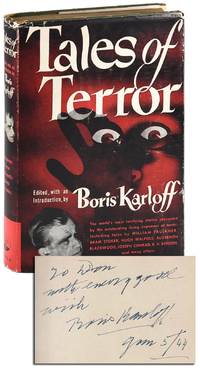
1943réf. 8614Cleveland and New York: The World Publishing Company / Tower Books 1943. First Edition. First Printing. Octavo 21cm; dark sage green paper-covered boards with titling and publisher's logo stamped in black on spine; dustjacket; 89-3173pp. Inscribed by Karloff on the front endpaper: "To Don / with every good wish / Boris Karloff / Jan 5/44." Some external wear shallow chipping to crown hint of sunning to spine with some mild bubbling to paper and lower front cover offsetting and some mild discoloration to endpapers and the usual tanning to the text edges; Very Good. Dustjacket is edgeworn with corresponding tears and creasing to upper spine panel a few tiny nick and tears and a small splash mark to upper front flap; Very Good or better. Offered together with a three-page ALS from Karloff to Dr. E.M. Sheare the publisher of this volume composed in black pen on three sheets of Arsenic and Old Lace letterhead measuring ca.8.5" x 11" and dated about five months prior to publication May 20 1943; 49 lines 280 words signed "as ever Boris." Two old folds from mailing smoothed out some very subtle toning to extremities else Fine together with the original mailing envelope. All housed in a custom quarter-morocco drop-backed clamshell case. Scarce first printing of this cheaply-manufactured wartime anthology of "terror stories" all selected by Karloff who has written a generous six-page introduction. The contents include contributions by Bram Stoker "The Judge's House" Ambrose Bierce "The Damned Thing" William Faulkner "The Hound" Edgar Allan Poe "The Tell-Tale Heart" Algernon Blackwood "The Willows" and Oliver Onions "The Beckoning Fair One" among others. The letter to his editor is particularly insightful showing Karloff's strong opinions regarding what merited inclusion: "I am quite firm against Dunsany's "Where the Tides Ebb and Flow." It is beautiful and imaginative and all that but it no in sic sense fits our patterns.For reasons of space I think we could omit I Dunsany II Woman at Seven Brothers III Shipment or Mute Fate or IV Breakdown / which is interesting but not terror. Hugh Binson's tale I consider a must also The Waxwork - I've had three invitations to dinner without points on the telling of that one! I am enclosing the amended list for your consideration. By all means "The Beckoning Fair One" should be in last place in the book on the score of length and excellence." Uncommon inscribed with a lengthy contemporary ALS. 8614. The World Publishing Company / Tower Books unknown
1902réf. 8550New York. George D. Sproul Company. 1902. Lavishly bound in Publisher's Deluxe custom 3/4 burgundy crushed morocco and marbled boards. Gilt-tooled spine compartments with fleural motifs.Gilt-tooled raised bands. Marbled endsheets. t.e.g. 8vo. 5.5" x .25". The Monticello Edition. This Edition Limited to only 1000 numbered sets of which this is #330. Illustrated throughout with delightful tissue-guarded monochrome plates Editied by renowned Poe scholar James A. Harrison the Monticello Edition of Poe's Works is one of the scarcest of early compilations with no complete set appearing at auction in more than thirty years.The 17 Volumes are comprised of: Tales Poems Biography Literary Criticism Essays Miscellanies Literati Autography Marginalia Eureka and Letters. Spines delicately and evenly sunned with first 2 volumes slightly less so. A number of volumes uncut. A Fine greatly appealing very rare set. George D. Sproul Company. hardcover
1902réf. 8550New York. George D. Sproul Company. 1902. Lavishly bound in Publisher's Deluxe custom 3/4 burgundy crushed morocco and marbled boards. Gilt-tooled spine compartments with fleural motifs.Gilt-tooled raised bands. Marbled endsheets. t.e.g. 8vo. 5.5" x .25". The Monticello Edition. This Edition Limited to only 1000 numbered sets of which this is #330. Illustrated throughout with delightful tissue-guarded monochrome plates Editied by renowned Poe scholar James A. Harrison the Monticello Edition of Poe's Works is one of the scarcest of early compilations with no complete set appearing at auction in more than thirty years.The 17 Volumes are comprised of: Tales Poems Biography Literary Criticism Essays Miscellanies Literati Autography Marginalia Eureka and Letters. Spines delicately and evenly sunned with first 2 volumes slightly less so. A number of volumes uncut. A Fine greatly appealing very rare set. George D. Sproul Company. hardcover books
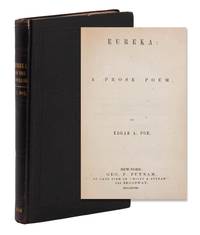
1848réf. 62003New York: Geo. P. Putnam Of Late Firm of "Wiley & Putnam" 155 Broadway 1848. First edition of the last book by Poe published in his lifetime. 12mo. 143 pp. 16-page publisher's catalogue at rear. BAL 16153. Binding A no review of Eureka in the ads. Front endpaper replaced faint signs of bookplate removal from front pastedown rather persistent foxing through the text; still a very good copy the cloth quite clean and bright. Original black cloth joints with several short splits with some professional repair a little wear to spine ends including a small chip at the head gilt spine title. Housed in a custom brown quarter-morocco and cloth slipcase with chemise gilt spine title. 9770. Geo. P. Putnam, Of Late Firm of "Wiley & Putnam," 155 Broadway unknown
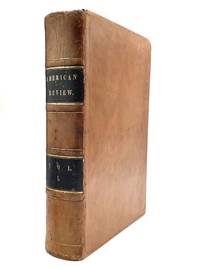
1845réf. 78226New York: Wiley and Putnam 1845. First Edition. Hardcover. Very good. The first printing of "The Raven" by Edgar Allan Poe 1809-49. Among the most famous works in American literature the poem tells of a raven's mysterious visit to a distraught lover tracing the man's slow descent into madness. It appears anonymously on p.143-145 as "by --- Quarles." The first appearance of "The Raven" is something of a bibliographical dispute. Heartman and Canny consider this form to be the first printing maintaining that the January 29 1845 appearance in The Evening Mirror is not the first. The American Review had announced that "No. II will bear date Feb. 1845 but will be issued early in January" thus unless the publishers were unable to issue the work by the date promised the present version clearly predates the late January appearance in The Evening Mirror. Octavo: ii iv 656 pp. with a frontispiece portrait of Henry Clay. This volume contains other work by Poe including the first printing of "Some Words with a Mummy" p.363 as well as "Valley of Unrest" p.392 and "The City in the Sea" p.393. Original calf binding with black morocco spine labels gilt-stamped titles and decorations four raised bands blind-stamped borders and marbled endpapers. Scattered light foxing to the contents with a previous owner's pencil inscription to a prefatory blank leaf. The bookplate of American botanist and horticulturalist Ulysses Prentiss Hedrick appears on the front pastedown. Some general edgewear more so to the corners and tips with a bit of rubbing along the joints; otherwise very good. Heartman and Canny p.100; Tane 177. Wiley and Putnam hardcover
1848réf. 62003New York: Geo. P. Putnam Of Late Firm of "Wiley & Putnam" 155 Broadway 1848. First edition of the last book by Poe published in his lifetime. 12mo. 143 pp. 16-page publisher's catalogue at rear. BAL 16153. Binding A no review of Eureka in the ads. Front endpaper replaced faint signs of bookplate removal from front pastedown rather persistent foxing through the text; still a very good copy the cloth quite clean and bright. Original black cloth joints with several short splits with some professional repair a little wear to spine ends including a small chip at the head gilt spine title. Housed in a custom brown quarter-morocco and cloth slipcase with chemise gilt spine title. 9770. Geo. P. Putnam, Of Late Firm of "Wiley & Putnam," 155 Broadway unknown books
1850réf. 8535New York: J.S. Redfield 1850. First Editions. First Printings with final page of ads in Vol.1 printing "Was published on the First of April" beneath American Drawing-Book and in Vol.2 there is no "r" in "choir" on p.46 third stanza line 1. Two 12mo. volumes 19.75cm; Blanck's A binding in publisher's blue cloth spines blind-stamped with simple rules with gilt-stamped rules between volume number and title on spines and covers with embossed corner and centerpieces within a triple blind-ruled frame; peach endpapers; xxii1-483484 4pp ads with inserted tissue-guarded portrait frontispiece; vi7-495496-498pp. In Vol.1 the first leaf a blank is not excised as is found in some copies. Both volumes bear the early ink signature of Samuel E. Perkins of Bangor Maine a druggist with his circular business label on preliminary blank Vol.1 and front pastedown Vol.2. Some very mild softening to spine ends spines gently sunned with sprinkled foxing to text; Vol.1 slightly over-opened at gutter following front endpaper with some light rubbing to covers on Vol.2; a uniformly Near Fine set without repair with the gilt bright and unrubbed. The first collected edition of Poe's works part of what would become a four-volume set with the third published later in 1850 and the fourth volume appearing in 1856. These volumes were published roughly six months after Poe's death; Volume I contains biographical matter and a notice of Poe's death followed by his Tales. Considerable material appears here for the first time in book form including "The Balloon-Hoax" "Mellonta Tauta" "A Tale of the Ragged Mountains" and "The Unparalleled Adventure of One Hans Pfaall sic. Uncommon in the first printings particularly in matched condition. A Haycraft-Queen Cornerstone. BAL 16158; Sabin 63570. 8535. J.S. Redfield unknown
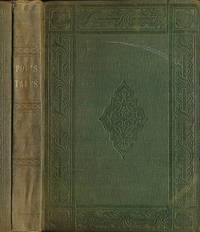
1846réf. poe46London: Wiley & Putnam. G : in good condition. Cover rubbed and marked. Spine faded. Some foxing. 1846. First UK Edition. Green hardback cloth cover. 190mm x 130mm 7" x 5". 228pp. Includes 'The Fall of the House of Usher' and The Murders in the Rue Morgue' &c. . Wiley & Putnam hardcover
1979réf. 40489SUCHIER RALPH 1979. 1. hardcover. Phantastische und unheimliche Geschichten SUCHIER, RALPH hardcover
1902réf. 3520New York and London: G.P. Putnam's Sons 1902. Tamerlane Edition. Leather Bound. Very Good. Frederick Simpson Coburn. Frederick Simpson Coburn. Tamerlane Edition. Leather Bound. 10 vols. Edgar Allan Poe The Complete Works of Edgar Allan Poe. Tamerlane Edition printed on Ruisdael hand-made paper limited to 300 numbered sets of which this is no. 10. Illustrated with gravure plates from paintings and drawings by Frederick Simpson Coburn each imprinted in two states including hand-colored frontisplates. With a critical introduction by Charles F. Richardson. Bound beautifully in oublisher's deluxe Art Nouveau style full dark green crushed levant Morocco leather with gilt frames and floral embellishment on covers and spine panel compartments. Gilt lettering on spine raised bands on spine. Top edges gilt. Suede doublures and endpapers. Published New York and London: G.P. Putnam's Sons 1902. H: 9 1/2" W: 6 3/3" D: 2". G.P. Putnam's Sons unknown
1845réf. 140947352New York: Wiley and Putnam 1845. First Edition. Very Good. First edition. vi 91 1 pp. Bound in a mourning binding contemporary black pebble calf double ruled in blind with gilt stamped monogram "J.B.F." Jessie Benton Fremont on upper board; spine lettered in gilt with blind ruled bands. All edges gilt with green nonpareil marbled endpapers. Very Good with moderate rubbing to extremities gnawing to bottom edge of textblock gift inscription from Jessie Fremont to her husband John C. at first blank "To Mr. Fremont / from his wife Jessie - / in memory of August 1847. / August 1848." Numerous literary notations in Fremont's hand throughout the endsheets contents moderately foxed and toned with spots of age staining. Page 5 is torn with loss at bottom edge and abbreviated quote from The Raven written at bottom margin "And my heart from out that shadow shall be lifted - nevermore." Chip with loss to top edge affecting 89-91 pp. Three leaves of mourning paper with various literary quotations one a full transcript of Dinah Maria Mulock Craik's "Philip My King" in Benton Fremont's hand. Lacking half-title. The much sought-after first book appearance of the iconic titular poem as well as others such as "Lenore" "Eulalie" and "To Helen." Called "the most important volume of poetry that had been issued up until that time in America" by Hervey Allen in his Poe biography Israfel vol. 2 p. Specially bound in a black mourning binding with provenance of Fremont 1824-1902. She was a woman of letters and writer whose work primarily focused on the American West. She was heavily active in politics and was an outspoken opponent of slavery. She was the wife of John C. Fremont 1813-1890 a United States Army Officer who commanded the West during the Civil War under President Abraham Lincoln. Jessie gifted this to her husband directly after the birth of their first son Benton Fremont b. July 24 1848 who sadly died a year later. She likely had this bound later in memoriam of her son as most of the notations written in her hand on the endsheets are almost all quotations relating to and about death and tragedy. BAL 16147. Wiley and Putnam unknown
1845réf. 140947352New York: Wiley and Putnam 1845. First Edition. Very Good. First edition. vi 91 1 pp. Bound in a mourning binding contemporary black pebble calf double ruled in blind with gilt stamped monogram "J.B.F." Jessie Benton Fremont on upper board; spine lettered in gilt with blind ruled bands. All edges gilt with green nonpareil marbled endpapers. Very Good with moderate rubbing to extremities gnawing to bottom edge of textblock gift inscription from Jessie Fremont to her husband John C. at first blank "To Mr. Fremont / from his wife Jessie - / in memory of August 1847. / August 1848." Numerous literary notations in Fremont's hand throughout the endsheets contents moderately foxed and toned with spots of age staining. Page 5 is torn with loss at bottom edge and abbreviated quote from The Raven written at bottom margin "And my heart from out that shadow shall be lifted - nevermore." Chip with loss to top edge affecting 89-91 pp. Three leaves of mourning paper with various literary quotations one a full transcript of Dinah Maria Mulock Craik's "Philip My King" in Benton Fremont's hand. Lacking half-title. The much sought-after first book appearance of the iconic titular poem as well as others such as "Lenore" "Eulalie" and "To Helen." Called "the most important volume of poetry that had been issued up until that time in America" by Hervey Allen in his Poe biography Israfel vol. 2 p. Specially bound in a black mourning binding with provenance of Fremont 1824-1902. She was a woman of letters and writer whose work primarily focused on the American West. She was heavily active in politics and was an outspoken opponent of slavery. She was the wife of John C. Fremont 1813-1890 a United States Army Officer who commanded the West during the Civil War under President Abraham Lincoln. Jessie gifted this to her husband directly after the birth of their first son Benton Fremont b. July 24 1848 who sadly died a year later. She likely had this bound later in memoriam of her son as most of the notations written in her hand on the endsheets are almost all quotations relating to and about death and tragedy. BAL 16147. Wiley and Putnam unknown books
1845réf. 78404New York: Wiley and Putnam 1845. First Edition. Hardcover. First edition third issue with the three-line copyright notice naming Wiley and Putnam and the Library of American Books half-title. Octavo: vi 228 4 ads pp. In the publisher's black gilt-stamped black morocco over plum cloth binding which has been expertly rebacked. The contents are clean and bright. Some general toning and minor staining to the cloth; otherwise very good. BAL 16146. ".the first important book of detective stories the first and greatest the cornerstone of cornerstones.the highest of all high spots.contains for the first time in book form all three Dupin stories" Queen's Quorum 1. While the tales herein were not selected by Poe and he expressed reservations about the editor "whose taste does not coincide with my own" they are in the end perhaps the single best representation of his broad range and lasting influence. The 1845 Tales contains not only the invention of modern detective fiction but also his supreme handling of psychological horror and contributions to both science fiction and the adventure story. Wiley and Putnam hardcover
1848réf. 140948979New York: George P. Putnam 1848. First Edition. Very Good. First edition first issue of the famous American author's take on physics and cosmology that preceded the Big Bang Theory by nearly a century. 143 15 1 pp. Bound in publisher's straight-grained black cloth stamped in blind and spine lettered in gilt with Eureka having no reviews at p. 2 of advertisements. Very Good with slight lean to binding minor loss of cloth at crown and corners with crimping at foot. Light soiling and staining to cloth with faint scuffing and wear; small nick to top edge of front board. Modest foxing to peach endpapers tiny nick to rear endpaper with associated staining to rear blank. A rather odd deviation from his poetical oeuvre that followed a serious illness related in part to alcoholism the death of his wife and thoughts of his own mortality Poe turned to the heavens for consolation. Adapted from a lecture and written from intuition the book presents his theory of the universe's creation and destiny proposing that all matter originated from a single point and will eventually return to it driven by forces of attraction and repulsion. An eerily prescient book that predicted several modern theories of physics. While riddled with scientific errors it includes one of the first credible solutions to Olbers' paradox anticipating Kelvin. Rare to market as it is one of only 500 copies published by Putnam due in part to its peculiar subject matter just a year before the author's puzzling death. BAL 16153. George P. Putnam unknown
1848réf. 37022New York: George P. Putnam 1848. First edition first issue of Poe's classic work. Duodecimo original publishers blind stamped black cloth with gilt lettering to the spine. First issue without the review for Eureka on page 2 of the 16 page catalogue at the end of the book but reads simply: “Poe. — Eureka A Prose Poem: Or the Physical and Metaphysical Universe. By Edgar A. Poe Esq.” In very good condition with some light rubbing to the extremities contemporary inscription to the front free endpaper. Housed in a custom clamshell box. An exceptional example of this rare and important text. Poe considered Eureka his magnum opus but Putnam only agreed to publish 500 copies due to the unique nature of the material. Eureka has often been misunderstood and ridiculed but it is in fact a remarkable precursor of several modern theories of physics and a powerful essay on the material and spiritual universe. Poe hypothesized that the universe began at a set point in the past and was finite rather than infinite. In arguing that the Universe of Stars must be finite he appeals to the evidence of observed experience. Poe wrote “Were the succession of stars endless then the background of the sky would present us an uniform luminosity like that displayed by the Galaxy–since there could be absolutely no point in all that background at which would not exist a star. The only mode therefore in which under such a state of affairs we could comprehend the voids which our telescopes find in innumerable directions would be by supposing the distance of the invisible background so immense that no ray from it has yet been able to reach us at all. That this may be so who shall venture to deny I maintain simply that we have not even the shadow of a reason for believing that it is so.” BAL 16153. George P. Putnam hardcover
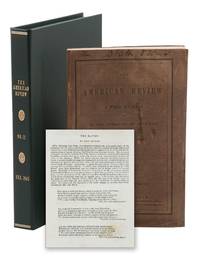
1845réf. 140947477New York: Wiley and Putnam 1845. First Edition. Very Good. First edition first printing of "The Raven" by Edgar Allan Poe printed in the February 1845 issue of The American Review under the pseudonym "Quarles." BAL 16147. iv 113 - 220 pp. "The Raven" pp. 143 - 145. Bound in scarce original printed wraps rebacked with repaired edges. Very Good with heavy toning to covers several closed tears to front cover of which two are repaired with rice paper to verso. Previous owner inscription in an old hand to upper margin of front cover. Light scattered foxing throughout light waterstaining to upper right margin pages 137 - 144 roughly opened resulting in minor chipping. Minimal toning to pages; paper is near-white. Housed in a custom clamshell case dark green cloth with gilt stamping to spine. The very first printing of the poem that made Poe famous though he signed it with a pseudonym in accordance with The American Review's policy. The editors of the Whig-aligned magazine which was published monthly from 1844 to 1852 state in the introduction to "The Raven" that the lines "appear to us one of the most felicitous specimens of unique rhyming which has for some time met our eye. Wiley and Putnam unknown
1848réf. 140948979New York: George P. Putnam 1848. First Edition. Very Good. First edition first issue of the famous American author's take on physics and cosmology that preceded the Big Bang Theory by nearly a century. 143 15 1 pp. Bound in publisher's straight-grained black cloth stamped in blind and spine lettered in gilt with Eureka having no reviews at p. 2 of advertisements. Very Good with slight lean to binding minor loss of cloth at crown and corners with crimping at foot. Light soiling and staining to cloth with faint scuffing and wear; small nick to top edge of front board. Modest foxing to peach endpapers tiny nick to rear endpaper with associated staining to rear blank. A rather odd deviation from his poetical oeuvre that followed a serious illness related in part to alcoholism the death of his wife and thoughts of his own mortality Poe turned to the heavens for consolation. Adapted from a lecture and written from intuition the book presents his theory of the universe's creation and destiny proposing that all matter originated from a single point and will eventually return to it driven by forces of attraction and repulsion. An eerily prescient book that predicted several modern theories of physics. While riddled with scientific errors it includes one of the first credible solutions to Olbers' paradox anticipating Kelvin. Rare to market as it is one of only 500 copies published by Putnam due in part to its peculiar subject matter just a year before the author's puzzling death. BAL 16153. George P. Putnam unknown books
1845réf. 140947477New York: Wiley and Putnam 1845. First Edition. Very Good. First edition first printing of "The Raven" by Edgar Allan Poe printed in the February 1845 issue of The American Review under the pseudonym "Quarles." BAL 16147. iv 113 - 220 pp. "The Raven" pp. 143 - 145. Bound in scarce original printed wraps rebacked with repaired edges. Very Good with heavy toning to covers several closed tears to front cover of which two are repaired with rice paper to verso. Previous owner inscription in an old hand to upper margin of front cover. Light scattered foxing throughout light waterstaining to upper right margin pages 137 - 144 roughly opened resulting in minor chipping. Minimal toning to pages; paper is near-white. Housed in a custom clamshell case dark green cloth with gilt stamping to spine. The very first printing of the poem that made Poe famous though he signed it with a pseudonym in accordance with The American Review's policy. The editors of the Whig-aligned magazine which was published monthly from 1844 to 1852 state in the introduction to "The Raven" that the lines "appear to us one of the most felicitous specimens of unique rhyming which has for some time met our eye. Wiley and Putnam unknown books