POE, Edgar AllanBiblio.com
5 836 résultats
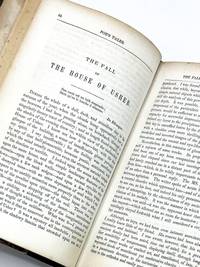
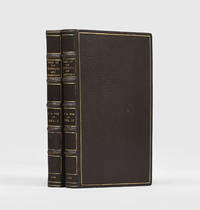
1839réf. 180683Philadelphia: Lea and Blanchard 1840 1839. The first collection of his famous tales First edition. Poe's influential first collection of tales gathers all 25 stories he had produced to date. They include two of his best-known stories "Fall of the House of Usher" and "MS. Found in a Bottle" along with the first known appearance in print of "Why the Little Frenchman Wears His Hand in a Sling". The popularity of the magazine appearance of "Fall of the House of Usher" convinced the publisher Lea and Blanchard to publish a collection on condition that Poe would retain the copyright and receive 20 copies in lieu of royalties. Poe revised the stories for book publication in a "bid for fame and while the volumes were favourably reviewed they did not sell rapidly. Yet they contained some of the greatest short stories in the literature of the world" Quinn p. 290. Though his originality divided contemporary opinion some reviewers recognised his "power for vivid description an opulence of imagination a fecundity of invention and a command over the elegances of diction which have seldom been displayed" Tasistro. Nevertheless the book proved a commercial failure which did not sell out during his lifetime and some copies sold in later years were reissued with a cancel title page. Poe's offer to the publisher in 1841 to produce an expanded second edition again forfeiting royalties was quickly declined. The publishers wrote to Poe on 28 September 1839 stating they would "print a Small Ed. say 1750 copies". However in 1880 the publisher's son Henry Charles Lea discovered that "a reference to memoranda of that time shows that the Edition consisted of but 750 copies" Quinn p. 287. BAL notes that Volume II Signature 20 occurs in several states due to the progressive loosening of type during the course of a single printing. In this copy page 213 is correctly numbered and page 219 still has the proper alignment of the "i" in "ing" line 13 up and the hyphen at the end of line 6 up. There is no priority of issue. 2 vols duodecimo in half-sheets. Publisher's 4-page adverts bound at front of vol. II. Early 20th-century brown pigskin spines lettered and framed in gilt covers ruled in gilt floral gilt roll on turn-ins patterned endpapers edges gilt. Scattered light foxing vol. I pp. 33-44 toned a couple of tears to end blanks of vol. I. A very good copy. BAL 16133; Barron 2-77; Bleiler 1313; Heartman & Canny pp. 49-54. Arthur Hobson Quinn Edgar Allan Poe: A Critical Biography 1998; Louis F. Tasistro New York Mirror 28 Dec. 1839. unknown
1845réf. 47445New York: Wiley and Putnam 1845. First edition. Very good plus. Rare first printing of this selection of Poe's tales including "The Fall of the House of Usher" and "The Murders in the Rue Morgue." Included in these twelve tales are the pieces that are often anointed as the first modern detective stories: "The Murders in the Rue Morgue" "The Mystery of Marie Roget" and "The Purloined Letter" all featuring his famed character C. Auguste Dupin. It is item number 1 in QUEEN'S QUORUM which spares no fanfare: "the first important book of detective fiction the first and the greatest the cornerstone of cornerstones in any readers' or collectors' guide the highest of all highspots." The works were selected out of Poe's various magazine publications for printing as the second number in Wiley & Putnam's Library of American Books. Despite the author's private complaints and general grumbles Poe lamented the number of "analytic" stories in the collection as unrepresentative of his full capacities Wiley reader Evert Duyckink's astute choices contributed to the volume's relative success. These include "The Fall of the House of Usher" "The Black Cat" and "The Gold-Bug" along with a few philosophical dialogues and the lesser-known "Lionizing" - "perhaps as a concession to Poe's unfounded sense of himself as a humorist" Silverman. Immensely influential: one of the most important short story collections published in the United States. 7'' x 4.75''. Modern half brown goatskin with contemporary marbled boards sympathetically rebacked to style spine ruled and lettered in bright gilt. With half-title "Wiley and Putnam's Library of American Books / Poe's Tales"; bound without advertisements. Imprint of T.B. Smith and H. Ludwig on copyright page. 6 228 pages. Housed in custom quarter green goatskin slipcase and green cloth chemise. Ownership signatures of Charles L. Swasey to front free endpaper dated 1849 with shelfmark in same hand; and to title page. Some edgewear and rubbing to boards. Mild foxing to endpapers and some margins. Wiley and Putnam unknown
1845réf. 47445New York: Wiley and Putnam 1845. First edition. Very good plus. Rare first printing of this selection of Poe's tales including "The Fall of the House of Usher" and "The Murders in the Rue Morgue." Included in these twelve tales are the pieces that are often anointed as the first modern detective stories: "The Murders in the Rue Morgue" "The Mystery of Marie Roget" and "The Purloined Letter" all featuring his famed character C. Auguste Dupin. It is item number 1 in QUEEN'S QUORUM which spares no fanfare: "the first important book of detective fiction the first and the greatest the cornerstone of cornerstones in any readers' or collectors' guide the highest of all highspots." The works were selected out of Poe's various magazine publications for printing as the second number in Wiley & Putnam's Library of American Books. Despite the author's private complaints and general grumbles Poe lamented the number of "analytic" stories in the collection as unrepresentative of his full capacities Wiley reader Evert Duyckink's astute choices contributed to the volume's relative success. These include "The Fall of the House of Usher" "The Black Cat" and "The Gold-Bug" along with a few philosophical dialogues and the lesser-known "Lionizing" - "perhaps as a concession to Poe's unfounded sense of himself as a humorist" Silverman. Immensely influential: one of the most important short story collections published in the United States. 7'' x 4.75''. Modern half brown goatskin with contemporary marbled boards sympathetically rebacked to style spine ruled and lettered in bright gilt. With half-title "Wiley and Putnam's Library of American Books / Poe's Tales"; bound without advertisements. Imprint of T.B. Smith and H. Ludwig on copyright page. 6 228 pages. Housed in custom quarter green goatskin slipcase and green cloth chemise. Ownership signatures of Charles L. Swasey to front free endpaper dated 1849 with shelfmark in same hand; and to title page. Some edgewear and rubbing to boards. Mild foxing to endpapers and some margins. Wiley and Putnam unknown books
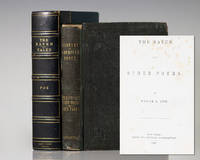
1845réf. 139816New York: Wiley and Putnam 1845. Rare first editions of Poe's two great collections of stories and poems bound together in the original publisher's cloth. Octavo original publisher's dark green cloth elaborately stamped in blind with gilt titles to the spine publisher's advertisements at rear of each volume which are most often lacking with both volumes bound together. Wiley and Putnam issued both titles separately in paper wrappers but bound the two together for additional appeal to readers. The Raven is bound first in this copy the order varies; that work is arguably the widest read and best-known in the American canon. Tales includes "The "The Black Cat" "The Fall of the House of Usher" "The Descent Into the Maelstrom" and other tales of horror and adventure as well as the three Dupin stories contained here for the first time in book form and considered "the first important book of detective stories the first and greatest the cornerstone of cornerstones.the highest of all high spots" Queen's Quorum 1. In very good condition. Tales bears the third issue of the copyright notice. Housed in a custom half morocco and folding chemise slipcase. Rare and desirable in the original publisher's cloth. The Raven and Other Poems “was published at one of the low ebbs of Poe’s fortunes when his Broadway Journal was about to expire and is thus characterized by his biographer Hervey Allen: The most important volume of poetry that had been issued up to that time in America… In this little volume the weary wayworn wanderer had successfully reached his own native shore in the realm of imagination” Grolier 100 American 56. Poe considered “The Raven” to be his finest poem—indeed he was quoted as saying it was the finest poem ever written. Dedicated to Elizabeth Barrett Barrett and first published by Wiley & Putnam in November 1845 in an edition of roughly 750 copies The Raven and Other Poems "made Poe's name known both in America and England and brought him an immortality that by no other means could he have attained" Robertson 224. Wiley and Putnam hardcover
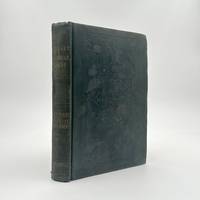
1845réf. 368340New York: Wiley and Putnam 1845. First editions of both titles. Raven with name of stereotyper T. B. Smith on the title verso; both half titles present: "Wiley and Putnam's Library of American Books. Tales: viii 1-228; Raven: i-viii 1-91 92 blank 93-96 ads. 1 vols. 8vo. Original blue green cloth spine titled in gilt boards stamped in blind endpapers stamped in stars and dots pattern. Recased with expert conservation repair to spine ends and corners paper repair to binder's blank. Manuscript identification of poem To - on p. 87 of the Raven. In custom clamshell box. First editions of both titles. Raven with name of stereotyper T. B. Smith on the title verso; both half titles present: "Wiley and Putnam's Library of American Books". Tales: viii 1-228; Raven: i-viii 1-91 92 blank 93-96 ads. 1 vols. 8vo. Students all over the world know of the title poem and many know others as well: "The Conqueror Worm" "Eulalie" "Leonore" "To Helen" etc. "The most important volume of poetry that had been issued up to that time in America." - Grolier American 56 A choice set of the major books published during Poe's lifetime BAL's "reissue B" issued by Wiley and Putnam in April 1846 comprising the first edition sheets of The Raven and The Tales in either second or third printing here in BAL's third printing distinguishable by the three-line copyright notice. BAL notes that "impressions from the plates of several pages vary in an anomalous way. For instance the first three letters of the last three lines of p. 160 appear both battered and intact within the three printings." All three are intact here; the battered running heads on p. 187 and 224 conform with BAL. A MAJOR WORK BY POE IN ORIGINAL CLOTH. BAL 16146 16147; Heartman & Canny 92-94 97-108; Grolier American 56 Wiley and Putnam unknown
1845réf. 368340New York: Wiley and Putnam 1845. First editions of both titles. Raven with name of stereotyper T. B. Smith on the title verso; both half titles present: "Wiley and Putnam's Library of American Books. Tales: viii 1-228; Raven: i-viii 1-91 92 blank 93-96 ads. 1 vols. 8vo. Original blue green cloth spine titled in gilt boards stamped in blind endpapers stamped in stars and dots pattern. Recased with expert conservation repair to spine ends and corners paper repair to binder's blank. Manuscript identification of poem To - on p. 87 of the Raven. In custom clamshell box. First editions of both titles. Raven with name of stereotyper T. B. Smith on the title verso; both half titles present: "Wiley and Putnam's Library of American Books". Tales: viii 1-228; Raven: i-viii 1-91 92 blank 93-96 ads. 1 vols. 8vo. Students all over the world know of the title poem and many know others as well: "The Conqueror Worm" "Eulalie" "Leonore" "To Helen" etc. "The most important volume of poetry that had been issued up to that time in America." - Grolier American 56 A choice set of the major books published during Poe's lifetime BAL's "reissue B" issued by Wiley and Putnam in April 1846 comprising the first edition sheets of The Raven and The Tales in either second or third printing here in BAL's third printing distinguishable by the three-line copyright notice. BAL notes that "impressions from the plates of several pages vary in an anomalous way. For instance the first three letters of the last three lines of p. 160 appear both battered and intact within the three printings." All three are intact here; the battered running heads on p. 187 and 224 conform with BAL. A MAJOR WORK BY POE IN ORIGINAL CLOTH. BAL 16146 16147; Heartman & Canny 92-94 97-108; Grolier American 56 Wiley and Putnam unknown books
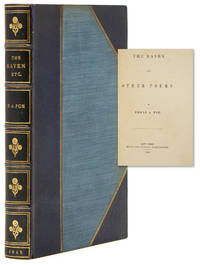
1845réf. 320399New York: Wiley and Putnam 1845. First editions of both titles. Raven with half title "Wiley and Putnam's Library of American Books" name of stereotyper T. B. Smith on the title verso; Tales third printing with three-line copyright. Raven: i-viii 1-91 92 blank 93-96 ads. Tales: i-v 1-228 229-232 ads. 1 vols. 8vo. Three quarter blue morocco gilt t.e.g. by Riviere & Son. Binder's endsheets with foxing text with slight toning and a few stray traces of foxing. First editions of both titles. Raven with half title "Wiley and Putnam's Library of American Books" name of stereotyper T. B. Smith on the title verso; Tales third printing with three-line copyright. Raven: i-viii 1-91 92 blank 93-96 ads. Tales: i-v 1-228 229-232 ads. 1 vols. 8vo. Students all over the world know of the title poem and many know others as well: "The Conqueror Worm" "Eulalie" "Leonore" "To Helen" etc. "The most important volume of poetry that had been issued up to that time in America." - Grolier American 56 A choice set of the major books published during Poe's lifetime BAL's "reissue B" issued by Wiley and Putnam in April 1846 comprising the first edition sheets of The Raven and The Tales in either second or third printing here in BAL's third printing distinguishable by the three-line copyright notice. BAL notes that "impressions from the plates of several pages vary in an anomalous way. For instance the first three letters of the last three lines of p. 160 appear both battered and intact within the three printings." This copy has slight battering to "I" and "o" on p. 160 while the "v" is intact. The E in the running head on p. 187 is broken here as in most copies of all printings. BAL cautions "It is possible that the printings designated below as second and third are in fact two states of the same printing." This copy is textually complete in both books including the integral ads; the volume has been rebound without the separate gatherings of advertisements that followed the text. BAL 16146 16147; Heartman & Canny 92-94 97-108; Grolier American 56 Wiley and Putnam unknown
1845réf. 320399New York: Wiley and Putnam 1845. First editions of both titles. Raven with half title "Wiley and Putnam's Library of American Books" name of stereotyper T. B. Smith on the title verso; Tales third printing with three-line copyright. Raven: i-viii 1-91 92 blank 93-96 ads. Tales: i-v 1-228 229-232 ads. 1 vols. 8vo. Three quarter blue morocco gilt t.e.g. by Riviere & Son. Binder's endsheets with foxing text with slight toning and a few stray traces of foxing. First editions of both titles. Raven with half title "Wiley and Putnam's Library of American Books" name of stereotyper T. B. Smith on the title verso; Tales third printing with three-line copyright. Raven: i-viii 1-91 92 blank 93-96 ads. Tales: i-v 1-228 229-232 ads. 1 vols. 8vo. Students all over the world know of the title poem and many know others as well: "The Conqueror Worm" "Eulalie" "Leonore" "To Helen" etc. "The most important volume of poetry that had been issued up to that time in America." - Grolier American 56 A choice set of the major books published during Poe's lifetime BAL's "reissue B" issued by Wiley and Putnam in April 1846 comprising the first edition sheets of The Raven and The Tales in either second or third printing here in BAL's third printing distinguishable by the three-line copyright notice. BAL notes that "impressions from the plates of several pages vary in an anomalous way. For instance the first three letters of the last three lines of p. 160 appear both battered and intact within the three printings." This copy has slight battering to "I" and "o" on p. 160 while the "v" is intact. The E in the running head on p. 187 is broken here as in most copies of all printings. BAL cautions "It is possible that the printings designated below as second and third are in fact two states of the same printing." This copy is textually complete in both books including the integral ads; the volume has been rebound without the separate gatherings of advertisements that followed the text. BAL 16146 16147; Heartman & Canny 92-94 97-108; Grolier American 56 Wiley and Putnam unknown books
1875réf. 48750Paris.: Richard Lesclide. 1875. Loose in the original publisher's portfolio the 'cartonnage illustré' of parchment with Manet's raven's head to front cover in black and the advertisements of Librairie de l'Eau-Forte to the rear the portfolio with later cloth backing and new ties. . Folio. 548 x 372 mm. Contents: 14 unnumbered leaves: six leaves of Hollande with printed title in red and black justification verso half-title and parallel text in English Poe and French Mallarmé's translation final leaf with 'achevé d'imprimer' dated 'le Vingt Mai Mil Huit Cent Soixante-Quinze' verso; four leaves of Hollande with Manet's monochrome lithographs printed recto only each signed 'E. M.' in the stone sheet size: c.545 x 355 mm. together with the suite of the same four lithographs on Chine and smaller loosely inserted parchment 'Ex Libris' leaf c.260 x 290 mm with monochrome printed text and lithograph raven in flight by Manet. Manet's illustrations for Mallarmé's translation of Edgar Allen Poe's 'The Raven' a stunning copy of 'Le Corbeau' in the original portfolio with a suite of Manet's illustrations on Chine and with the very rare 'affiche de librairie'. From the edition limited to 240 copies although only 150 were printed - see below with this copy signed by Manet and Mallarmé in ink to the justification with the additional suite of lithographs on Chine the original poster on papier parcheminé and in the original portfolio with Manet's raven's head to front cover and the list of publications to the rear.The copy presented here with the very rare suite the rarer original portfolio and the even rarer poster is a remarkable survival and represents one of the finest copies of the work to remain extant. Juliet Wilson-Bareau in her census see below records only six copies with the plates on both papers as here; she notes that of these four are in institutional collections.The large and striking 'Le Corbeau' is always cited as one of the high points of French book illustration. Considered 'an astonishingly modern illustrated book for 1875' The Artist and the Book 'Le Corbeau' represents a turning-point in the history of the illustrated book. Book illustration was subsequently 'liberated' from literal interpretation.The poster is printed with red text around a central raven's head as for the cover on papier parcheminé 524 x 358 mm and was designed by Mallarmé himself. As noted by Wilson-Bareau: 'The poster . gives equal prominence to the author 'Edgar POE' and the illustrator 'MANET' while Mallarmé as translator appears in a modestly smaller size of type . '. The poster lists copies as available at '25 FRANCS' copies with the additional suite as at '35 francs' while the 'cartonnage illustré' was an additional '5 francs'. The portfolio features Manet's raven's head to the front cover and advertisements for the Librairie de l'Eau-Forte to the rear. Among the advertisements are listings for Manet's earlier illustrated book 'Le Fleuve' 1874 and for Mallarmé's translation of Poe's poems.The technique used by Manet for the Corbeau plates was transfer lithography which 'was a method ideally suited to the brush-and-ink drawing style . Manet brushed in his designs with transfer ink on sheets of paper that Lefman the specialist printer for this technique then transferred to zinc plates for printing . '. Wilson-Bareau.'Whether one regards Le Corbeau as a work of its own time however or as a harbinger of the modern book it is one of the high points of French illustration.' Ray p. 369.'The last image is almost indecipherable in the density of its real and abstract references. The bottom of the door an empty chair and the shadows that menace like living evils spirits are brushed in with a suggestive force that defines description and is without analogy in other contemporary works'. Wilson-Bareau.It is documented in Lesclide's 'Déclarations d'imprimer' at the Dépôt légal de Paris on 14 June 1875 that apart from the few trial copies the publisher printed only 150 copies as opposed to the 240 announced on the justification. This copy is listed by Juliet Wilson-Bareau in her census 'T/H. P/H C' 'T/H. P/H C’ i.e. ’Text / Hollande Plates / Hollande Chine' and conforms to the first group published and issued numbered from 1 to 100. Wilson-Bareau records only six further copies with the text and plates as for the present example of which four are detailed as in institutional collections; she adds Mallarmé and Manet's own copies with additional material together with a copy that also featured the plates on Japon.Guérin 85 - 86; Harris 83; The Artist and the Book 178; Ray Art of the French Illustrated Book 277; Fischer 65 - 71; see Henri Mondor Vie de Mallarmé Paris 1941; see Wilson-Bareau Manet 1832- 1883 Metropolitan Museum of Art 1983. Richard Lesclide. hardcover
1844réf. 158o. Some minor occasional foxing. Engraved frontispiece additional title and 7 plates. Original publisher's plum cloth sides decorated in gilt and blind spine gilt-decorated edges gilt spine lightly sunned minor wear to extremities first gathering sprung. Provenance: THOMAS HOLLEY CHIVERS 1809-1858 poet and friend of Poe presentation inscription in pencil from Poe on title-page; J.H. Whitty Poe bibliographer and scholar ink provenance note laid in. FIRST EDITION PRESENTATION COPY INSCRIBED BY POE TO HIS FRIEND AND FELLOW-POET THOMAS HOLLEY CHIVERS on the title-page: "E.A.P. to T.H.C." Contains the first printing of Poe's sketch "Morning on the Wissahiccon" pp. 249-256 which was later renamed "The Elk" when republished after Poe's death. Thomas Holley Chivers was an American doctor-turned-poet from Georgia. Poe showed an interest in the young poet and encouraged his work. The first interaction between the two was in 1840 though they did not meet until 1845 in New York. "Chivers's own poetry at this time dwelt on shrouds coffins angels and celestial reunion with lost loved ones his The Lost Pleiad 1845 featuring sonnets with such titles as 'Death' 'The Grave' and 'On Hearing of the Death of my Mother.' Not surprisingly Poe praised the volume as 'the honest and fervent utterance of an exquisitely sensitive heart' and particularly admired a poem of Chivers whose refrain was 'She came from heaven to tell me she was blest.' He often recited it with tears in his eyes according to Muddy." Silverman Edgar A. Poe: Mournful and Never-Ending Remembrance 1991 p. 259. The two became friends and Chivers was willing to give Poe lifetime financial support if he moved to the South. Poe hoped Chivers would lend his wealth as a financial backer for The Stylus and possibly even serve as a co-editor in its early planning stages. Chivers considered Poe's proposal but was not able to accept because of the death of his three-year-old daughter just over a week later. Chivers spent the last few years of his life defending the reputation of Poe who had died in 1849 though he also thought Poe had been heavily influenced by his own poetry. A VERY FINE ASSOCIATION COPY. John C. Riker hardcover
1951réf. AUB-9508Ed. Gallimard (bibliothèque de la Pléiade) 1951. Bel exemplaire relié, jaquette et cartonnage conservés, 1171 pages + table.