Félice, Fortuné-Barthélemy de (Hrsg.)Antiquariat.de
887 resultados
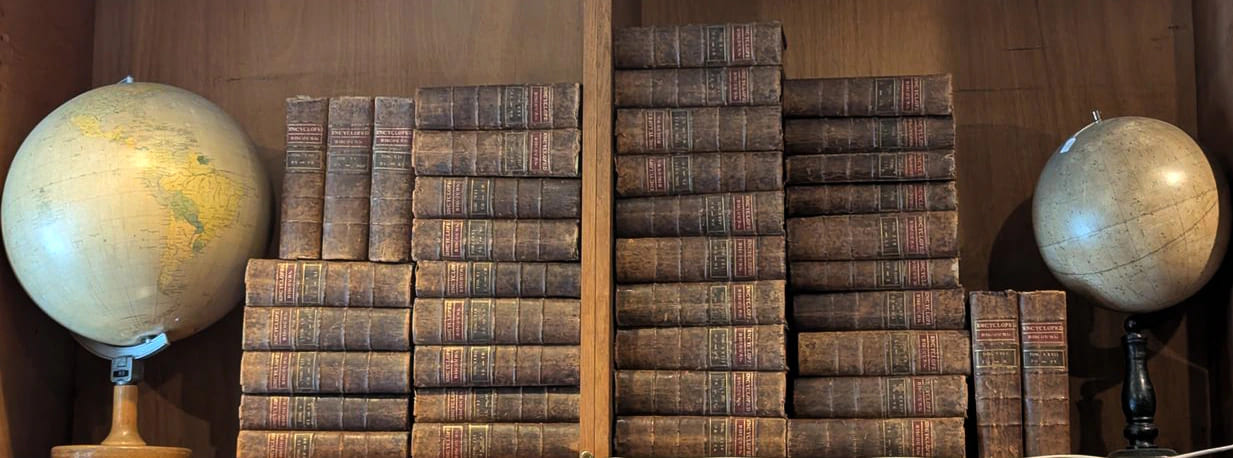
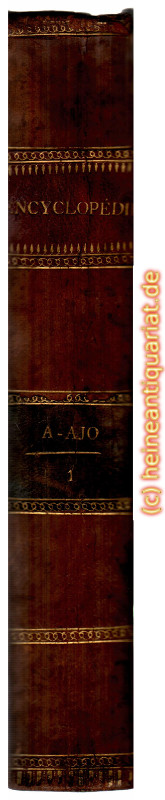
1770ref. a300110204Yverdon, 1770 - 1780. 57 (von 58) Bänden, der letzte reguläre Textband (Tome XLII/ 42) fehlt. 41 (von 42) Textbänden; 6 Supplemente (Text) jeweils mit meist mehr als 600 Seiten und 10 Tafelbände mit 1408 (von 1410) Kupfertafeln. Noch recht dekorative Halblederbände der Zeit mit etwas Rückenvergoldung und je einem roten und einem grünen Rückenschild, Schmuckpapierdeckelbezüge und Lederecken. Alters- und Gebrauchsspuren, Kapitale oft leicht beschädigt, Ecken und Kanten bestoßen, die Deckel berieben. Innen meist frisch, es kommen jedoch auch einzelne Lagen anderer Büttenqualität vor, die dann stärker gebräunt sind. Einige Büttenblätter in den breiten Rändern mit Produktionsfehlern. Anfangs und am Ende der Blöcke oft Abklatsch der noch feuchten Druckfarbe auf die gegenüberliegenden Seiten, dem Zeitdruck bei der Produktion geschuldet. (26,2 x 21 cm) 4°. [12 Warenabbildungen]
ref. 14710P., Jombert, 1758, un volume in 4 relié en pleine basane, dos orné de fers dorés, tranches rouges (reliure de l'époque), (habiles restaurations à la reliure, petit travail de vers sans gravité dans les marges inférieures de quelques feuillets), (6), 40pp., 272pp., 13pp., 5 planches dépliantes
1762ref. 27797A Paris: Chez Braisson David Le Breton Durand M. DCC. LXII. 1762 .- TOMO I Premiere Livraison: 2 h. 6 p. 18 p. 2 p. 21 p. 1 p. 19 p. 1 h. 1 h. 3 p. 7 p. 2 p. todas de texto 269 artísticas planchas magistralmente grabadas al cobre; en Gran Folio 405 x 17 cm; magnífica impresión sobre gran papel verjurado; Encuadernación en Media Piel época de color verde lomera de 6 nervios con título y hierros dorados cortes pintados en color granate tapas o planos en papel de aguas.- CONTIENE los siguientes oficios y profesiones: AGRICULTURE ET ECONOMIE RUSTIQUE: Labourage 5 planches Semoir 3 pl. Conservation des grains 2 pl. Moulins à vent et à l'eau pou lé blé 9 pl. Moulins à exprimer l'huile des fruits et des graines 4 pl. Fabrique de tabac 6 pl. Culture et travail du chanvre 2 pl. Culture et travail deu coton 5 pl. Culture de la vigne 2 pl. Pressoirs 4 pl. Pressoir à cidre 3 pl. Sucrerie et affinage 7 pl. Travail des sabots et des échalats 1 pl. Charbon de bois 4 pl. Jardinage 7 pl. Jardin potager 6 pl. Fontainier 4 pl. Mouches à miel 1 pl. Vers à foie 1 pl. Basse cour 1 pl. Laiterie de la meute 1 pl. Art de Faire èclóre les poulets 3 pl. AIGUILLIER: Le coupeur le perceur et Le empointeur 2 pl. AIGULLIER BONNETIER 1 pl. AMIDONNIER 1 pl. ANATOMIE 33 pl. ANTIQUITES 12 pl. ARCHITECTURE 86 pl. Moulin à scier les pierres 4 pl. MAÇONNERIE 14 pl. Tuilerie 3 pl. Couvreur et carreleur 3 pl. ARGENTEUR 2 pl. ARMURIER 2 pl. ARQUEBUSIER 7 pl. ART MILITAIRE 38 pl. ARTIFICIER 7 pl. EL INTERIOR EN PERFECTO ESTADO TANTO PARA EL TEXTO COMO PARA LAS LAMINAS GRABADAS. Encuadernación de la época con el lomo de piel algo rozado pero en muy buen estado general. Tapas restauradas de pequeñas faltas en las esquinas. Papel de aguas con diversas rozaduras. SOLO OFRECEMOS ESTE PRIMER VOLUMEN de "Recueil des Planches sur les Sciences les Arts.". La obra completa consta de 11 volúmenes los 17 volúmenes de "La Enciclopédie" a la que seguían. La estructura de la Encyclopedie tanto en su diagramación formato y por supuesto contenido ideológico dio respuesta al complejo entramado de variables que supuso ese proceso disparador de nuevas ideas inteviniendo intelectuales como Voltaire Buffon Montesquieu D'Alembert Quesnay Turgot d'Holbach Rousseau de Jacourt y por supuesto Diderot; proceso también rompedor de los secretos tecnológicos del cerrado universo de las corporaciones gremiales del modo feudal de producción. En este sentido la obra presenta dos núcleos entrelazados: el Diccionario y las Planchas. Sin embargo hay que reconocer que la potente originalidad está concentrada en "Recueil des Planches sur les sciences les arts liberaux et les arts mechaniques avec leur explication" en que se despliega a través de descripciones gráficas y de textos aclaratorios una impresionante cascada de datos sobre la situación fundamentos y perspectivas de las técnicas oficios y talleres. EN DEFINITIVA OFRECEMOS EL PRIMER VOLUMEN DE "RECUEIL DES PLANCHES." SIN DUDA LA MAS GRANDE Y AMBICIOSA PRODUCCIÓN EDITORIAL DE LA FRANCIA DE LA ILUSTRACION. EN CONJUNTO CONTIENE 296 IMPRESIONANTES PLANCHAS GRABADAS AL COBRE POR LOS MEJORES ARTISTAS DEL MOMENTO ALGUNAS A DOBLE PAGINA. TODAS ELLAS CONSERVADAS PERFECTAMENTE. "Todavía no se ha hecho ni durante mucho tiempo se hará una colección tan considerable y tan hermosa de máquinas" Diderot. FILOSOFÃA E HISTORIA DE LA CULTURA Livre en français Chez, Braisson, David, Le Breton, Durand hardcover
ref. 83060P., David, 1761-1780, 8 TOMES reliés en 4 volumes in 4, plein veau marbré, tranches rouges, dos ornés de fers et caissons dorés, étiquettes rouges et vertes, tranches rouges (reliures de l'époque), T. 1 : 14 pp., 1fff.n.ch. (table des mémoires), 303pp., (1pp.), 7 planches dépliantes, T.2 : 2 feuillets non chiffrés (titre + table des mémoires), 328pp., 2 feuillets non chiffrés (errata + privilège), 2 planches dépliantes, T.3 : 17pp., 420pp., 1 planche dépliante, T.4 : 16pp., 380pp., 1pp., 2 planches dépliantes, (le feuillet 7-8 de l'avertissement a été relié avant le feuillet 5-6), T.5 : 20pp., 520pp., 4 planches dépliantes, T.6 : 12pp., 443pp., (1pp.), 4 planches dépliantes, (habile restauration dans la marge supérieure de la page 132), T.7 : (2), 8pp., 397pp., (1pp.), 5 planches dépliantes, T.8 : (2), 4pp., 399pp., 5 planches dépliantes, (le carton Gii (51-52) du tome 8 annoncé dans l'avis au relieur au tome 7 semble n'avoir jamais été imprimé. En effet ce carton n'existe pas aux trois exemplaires que nous avons consultés)
1777ref. 103648Genève, chez Pellet, Imprimeur Libraire , Rue des Belles Filles, 1777-1779, , 39 volumes in-4 dont 36 volumes de texte et 3 volumes de planches, Demi-basane havane à coins de l'époque, dos à faux-nerfs, pièces de titre rouges, tomaisons dorées, plats couverts de papier à la cuve, tranches rouges, Troisième édition de cette monumentale entreprise, la première au format in-quarto et la plus aisée à consulter. Dans cette édition le tome 30 a été imprimé à Neufchatel, Chez la Société typographique, en 1779. Exemplaire qui comporte 447 planches gravées sur cuivre, 128 sont dépliantes dont 10 cartes, 31 planches sont à double page, 2 frontispices représentent les portraits en médaillon de Diderot et d'Alembert (dessinés par Cochin et gravés par Cathelin) sont reliés au premier volume de texte, 1 frontispice annonce la section Chirurgie au T. 2 du volume de planches. T. I : 140 pl. T. 2 : 169 pl. T. 3 : 135 pl. et 52 pages de tables géométriques. Le T. 3 correspond aux suppléments des 2 premiers tomes de planches. Ensemble en bon état en reliure uniforme d'époque, les coins sont usés, et les dos frottés par endroits, quelques mors fendus et certaines coiffes étêtées, néanmoins bel exemplaire aux planches, pour la plupart, bien encrées. Sans les six volumes de table qui manquent très souvent. Brunet, 700-701. Couverture rigide
1781ref. 400140Paris 1781. Fine. Folio. 12 laid paper leaves hand stitched paper spine. Title in manuscript on the first leaf followed by 21 manuscript pages foliated 1 2 2 3 – 10. In fine condition with light rubbing to the edges of the first leaf housed in a period-style quarter leather and cloth box with gilt-stamped rounded-spine and inner chemise. An original manuscript of this celebrated attack on French Finance Minister Jacques Necker arguably the most powerful man in France before the Revolution. Written surreptitiously by Philippe Henri de Grimoard an important military officer and trusted counselor to Louis XVI the letter was published in the guise of an open letter between two prominent intellectuals: from the anti-Enlightenment writer Louis-Antoine Caraccioli to Jean d’Alembert co-editor of the Encyclopédie. As Director-General of Finance from 1776-1783 Necker controlled all of France’s wealth. In February 1781 he published his famous work: Compte rendu au roi the first public accounting of the royal finances of the French monarchy. This along with his reforming policies made him many enemies including Marie Antoinette. The stage was thus set for this “witty and well informed” public attack in which Necker is made to appear as a kind of magician of politics and finance capable of “mystifying the whole French nation” and guilty of “suppressions without reimbursements reforms without profit loans without limit or measure … .” As to whether this is the original manuscript or a compositor’s copy we cannot say with certainty. It is neatly written in a beautiful hand on the most expensive paper of the day. We know of only one record of the manuscript in an 1880 Index to the Catalogue of Additions to the Manuscripts in the British Museum. An historically important manuscript housed in a handsome drop-spine box. unknown books
1781ref. 400140Paris 1781. Fine. Folio. 12 laid paper leaves hand stitched paper spine. Title in manuscript on the first leaf followed by 21 manuscript pages foliated 1 2 2 3 – 10. In fine condition with light rubbing to the edges of the first leaf housed in a period-style quarter leather and cloth box with gilt-stamped rounded-spine and inner chemise. An original manuscript of this celebrated attack on French Finance Minister Jacques Necker arguably the most powerful man in France before the Revolution. Written surreptitiously by Philippe Henri de Grimoard an important military officer and trusted counselor to Louis XVI the letter was published in the guise of an open letter between two prominent intellectuals: from the anti-Enlightenment writer Louis-Antoine Caraccioli to Jean d’Alembert co-editor of the Encyclopédie. As Director-General of Finance from 1776-1783 Necker controlled all of France’s wealth. In February 1781 he published his famous work: Compte rendu au roi the first public accounting of the royal finances of the French monarchy. This along with his reforming policies made him many enemies including Marie Antoinette. The stage was thus set for this “witty and well informed” public attack in which Necker is made to appear as a kind of magician of politics and finance capable of “mystifying the whole French nation” and guilty of “suppressions without reimbursements reforms without profit loans without limit or measure … .” As to whether this is the original manuscript or a compositor’s copy we cannot say with certainty. It is neatly written in a beautiful hand on the most expensive paper of the day. We know of only one record of the manuscript in an 1880 Index to the Catalogue of Additions to the Manuscripts in the British Museum. An historically important manuscript housed in a handsome drop-spine box. unknown
1762ref. 16111762, chez Briasson, David, Le Breton, Durand, in-folio plein cuir de 6+18 pages + 269 planches noir et blanc, dos à 6 nerfs, titrage doré, pages de garde marbrées. Première livraison, avec leurs explications : agriculture et économie rustique (83 planches), aiguillier (2 planches), aiguillier-bonnetier (1 planche), amidonnier (1 planche), anatomie (33 planches), antiquités (12 planches), architecture et parties qui en dépendent (81 planches), maçonnerie (13 planches), argenteur (2 planches), armurier (2 planches), arquebusier (7 planches), art militaire (38 planches), artificier (7 planches) planches doubles comptant pour deux. | Etat : Etat général moyen, rousseurs, coins, coiffes et mors écorchés, accrocs sur les plats, grosse tache sur le 1er plat, champs usés, le tiers inférieur de la planche XVIII d'Anatomie est déchiré entièrement (sans manque), complet de ses planches. (Ref.: MA14)
ref. 121993Paris Chez Briasson David Le Breton Durand Paris; Chez M.M. Rey Amsterdam; Chez Pancoucke Paris & Chez M.M. Rey Amsterdam 1751-1765; 1776-1777; 1776-1780. . 35 volumes including Supplements and Index; folio; engraved allegorical frontispiece after Cochin fils by Prevost engraved plates; contemporary mottled calf some restoration to spines a very attractive set. The first edition of Diderot's crowning achievement. The finest most extensive and famous encyclopaedic work on the sciences arts and professions of the 18th century and arguably the most influential piece of French literature the Encyclopedie originated with the publisher's suggestion for a translation of Chambers Cyclopaedia into French. Diderot 1713-84 however persuaded him to undertake a new work along the same lines but greatly extended in size and scope which would employ all the active writers of its time all the new ideas and all the new knowledge circulating in the cultured class in France but needed further dispersal in order to be effective. The importance of this work is to be found in the contributions of over 200 philosophers writers scientists and jurists of the era of Enlightenment like Voltaire Montesquieu Rousseau Buffon Marmontel Necker Condorcet Turgot and others. The greater part of the 71818 entries however was written by the editors Diderot and d'Alembert 1717-1783 followed by Baron Holbach who contributed about 400 articles. Moreover the Encyclopedie is famous for its fine and accurate engravings. 'The purpose of an encyclopaedia is to assemble the knowledge scattered over the surface of the earth; to explain its general plan to the men with whom we live and to transmit it to the men who come after us; in order that the labours of centuries past may not be in vain during centuries to come; that our descendants by becoming better instructed may as a consequence be more virtuous and happier and that we may not die without having deserved well of the human race' Diderot quoted from the article on encyclopaedias in the present work. The Encyclopedie takes for granted the justice of religious tolerance and speculative freedom and asserts the democratic doctrine that the main concern of the nation's government should be the lot of the common people. It is also an exaltation of scientific knowledge on one hand and peaceful industry on the other. In 1759 the Encyclopedie was formally suppressed but work went on although D'Alembert withdrew leaving Diderot to work alone. Since it had a very large number of contributors there was no narrowly sectarian viewpoint although there was a convergence of aim. As an anthology of enlightened opinions on politics philosophy and religion the Encyclopedie is one of the most important works of modern thought. It is also remains a landmark in the history of massive publishing projects. The full set comprises 35 volumes published over almost 30 years. The first seven volumes with articles by Voltaire Rousseau Montesquieu and many other figureheads of the Enlightenment were published in Paris under a royal privilege which was however withdrawn in 1759 after which the project was closed down. With the help of Madam de Pompadour among others the remaining volumes were printed secretly with a fictitious imprint. The plate volumes have a different history since they were not considered subversive; they were were published in Paris between 1762-72. A full description is available upon request. PMM 200; Palgrave I 577; Brunet II 700. Paris, Chez Briasson, David, Le Breton, Durand, Paris; Chez M.M. Rey, Amsterdam; Chez Pancoucke, Paris & Chez M.M. Rey, Amsterda unknown
ref. 88723Briasson D. Le Breton Durand & Neuchatel Faulche Paris and MM Rey Amsterdam 1751-80. . 35 vols folio. Half-titles except in text vols 8-17 woodcut device on title-pages some woodcut initials head- and tailpieces 7 folding letterpress tables a few woodcut illustrations engraved frontispiece in volume 1 2796 engraved plates including some double-page or folding. Full contemporary calf. First edition of the finest most extensive and famous encyclopedic work on the sciences arts and professions of the 18th century a revolutionary monument in the history of European thought. The importance of the frequently republished but never surpassed first edition is to be found in the contributions of over 200 philosophers writers scientists and jurists of the era of Enlightenment like Voltaire Montesquieu Rousseau Buffon Marmontel Necker Condorcet Turgot and others. The greater part of the 71818 entries however was written by the editors Diderot 1713-84 and d'Alembert 1717-83 followed by Baron Holbach who contributed about 400 articles. Moreover the encyclopaedia is famous for its fine and accurate engravings and is still a primary source for the study of 18th century civilisation. It contains according to the number of plates given on the title-pages 3129 plates because double triple or quadruple folding plates are counted as 2 3 or 4 adding up to the amount of 2796 plates as in our copy. The first seven volumes with articles by Voltaire Rousseau Montesquieu and many other figureheads of the Enlightenment were published at Paris under a royal privilege which was however withdrawn in 1759 after which the project was closed down. The remaining volumes were printed secretly with a fictitious imprint. The plate-vols. have a different history since they were not considered being subversive; they were published in Paris between 1762-1772. The supplement volumes were published in one edition only but in two issues one with a Paris imprint the other with an Amst. imprint edited by Jean Baptiste Rene Robinet 1735-1820. The supplementary volume of plates has the imprint 'Amst. and Paris'. The two-vol. index was published in 1780 and edited by Pierre Mouchon 1733-1797. Briasson, D. Le Breton, Durand, & Neuchatel, Faulche, Paris and MM Rey, Amsterdam, 1751-80. unknown
1778In 8° i volumi di testo, in 4° i volumi di tavole. Splendida rilegatura coeva in piena pelle con titoli e motivi decorativi in oro al dorso. Ottimo stato di conservazione. L'opera si compone di 36 volumi di testo e 3 volumi di tavole incise di altissima qualità, il tutto per un totale di alcune decine di migliaia di pagine. Il primo volume presenta in antiporta una incisione con il ritratto di D'Alembert, mentre il secondo presenta una incisione col ritratto di Diderot. La presente edizione è una ristampa svizzera basata su quella pubblicata a Ginevra, e curata da Jean Leonard Pellet.
1778In 8°. Rilegatura in piena pelle coeva con nervature e titoli in oro su tassello al dorso. Stato di conservazione molto buono. Magnifica edizione svizzera della monumentale Enciclopedia di Diderot e D'Alembert, uno dei capisaldi del pensiero e della cultura umana, composta di 36 volumi di testo e di 3 volumi di splendide tavole incise. La presente edizione è la ristampa identica di quella curata alcuni anni prima da Pellet a Ginevra.