6 873 résultats
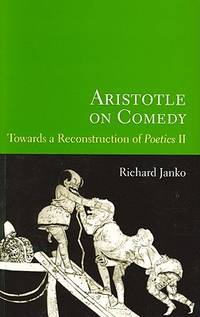
2003réf. 34966United Kingdom: Duckworth Pub. New. Paperback. FREE UPGRADE to Courier/Priority Shipping Upon Request – – IN STOCK AND IMMEDIATELY AVAILABLE FOR SHIPMENT - FLAWLESS COPY BRAND NEW PRISTINE NEVER OPENED - 320 pages; 5 3/8 x 8 1/2 inches -- In 1839 the Tractatus Coislinianus a summarised treatise on comedy was published from a tenth-century manuscript. Its discoverer suggested that it derived from the lost second book of Aristotle’s "Poetics" which inaugurated the systematic study of comedy but it was soon condemned as an ignorant compilation verging on forgery and thus matters stood until the first publication of "Aristotle on Comedy" in 1984. Richard Janko’s edition of the text is accompanied by a facing translation interpretive essays reconstruction and commentary. The book is now made available in paperback for the first time with a new Preface and additional bibliography. -- REVIEW: "This is a splendidly vigorous book. Janko presents his case with enthusiasm and panache. He is forthright in expressing his own views and in denouncing the errors of other scholars. His arguments some of them complex are invariably clear - and often deliciously clever. Whatever the truth about TC Tractatus Coislinianus Janko’s conclusions must be taken seriously. . No reader will be able to stay silent about this fascinating book." ----Jonathan Barnes "Phronesis" -- with a bonus offer--; 520-Janko; Aristotle ; Janko Richard translator Essay - facing translation interpretive essays reconstruction and commentary. Aristotle on Comedy: Towards a Reconstruction of "Poetics II" Purported In 1839 the Tractatus Coislinianus a summarised treati . 2003. 0715631691 . Duckworth Pub paperback
1969réf. 52182La Salle IL: Open Court Pub Co. As New. Hardcover. FREE UPGRADE to Courier/Priority Shipping Upon Request – – IN STOCK AND IMMEDIATELY AVAILABLE FOR SHIPMENT - Text pristine clean & unmarked - 160 pages. -- with a bonus offer-- . 1969. Open Court Pub Co hardcover
réf. 52382New York: Carlton House. As New. Hardcover. FREE UPGRADE to Courier/Priority Shipping Upon Request – – IN STOCK AND IMMEDIATELY AVAILABLE FOR SHIPMENT - Text pristine clean & unmarked tight to the spine - ND Circa1950 337 pages -- with a bonus offer-- . N.D. Carlton House hardcover
1961réf. 53801New York: Hafner Publishing Company. As New. Paperback. FREE UPGRADE to Courier/Priority Shipping Upon Request – – IN STOCK AND IMMEDIATELY AVAILABLE FOR SHIPMENT - Tight to spine - 233 pages -- with a bonus offer-- . 1961. Hafner Publishing Company paperback
1943réf. 13498Walter J. Black. As New. Hardcover. FREE UPGRADE to Courier/Priority Shipping Upon Request - IN STOCK AND IMMEDIATELY AVAILABLE FOR SHIPMENT - Book In fine Condition -- with a bonus offer--; 013498 . 1943. Walter J. Black hardcover
réf. 27542Modern Library. As New. Paperback. FREE UPGRADE to Courier/Priority Shipping Upon Request - IN STOCK AND IMMEDIATELY AVAILABLE FOR SHIPMENT - -- with a bonus offer--; T-ARISTOTLEMCK; Aristotle; Edited By McKeon Richard Introduction to Aristotle . 1947. 0394309731 . Modern Library paperback
réf. 14945The Library of the Liberal Arts / Bobbs-Merrill. As New. Paperback. FREE UPGRADE to Courier/Priority Shipping Upon Request - IN STOCK AND IMMEDIATELY AVAILABLE FOR SHIPMENT - AS NEW THE TEXT BLOCK IS PRISTINE CLEAN UNMARKED AND IN EXCELLENT CONDITION - - ND; c 1962 -- with a bonus offer--; 014945 . N.D. The Library of the Liberal Arts / Bobbs-Merrill paperback
1967réf. 14633Regnery Gateway. As New. Paperback. FREE UPGRADE to Courier/Priority Shipping Upon Request - IN STOCK AND IMMEDIATELY AVAILABLE FOR SHIPMENT - AS NEW THE TEXT BLOCK IS PRISTINE CLEAN UNMARKED AND IN EXCELLENT CONDITION - - -- with a bonus offer--; 014633 . 1967. Regnery Gateway paperback
réf. 14041New York: Heritage Press. As New. Hardcover. FREE UPGRADE to Courier/Priority Shipping Upon Request - AS NEW THE TEXT BLOCK IS PRISTINE CLEAN UNMARKED AND IN EXCELLENT CONDITION - . Decorated cover boards. -- with a bonus offer--; 014041 . 1964. 1199994448 . Heritage Press hardcover
réf. 14776Everyman's Library. New. Hardcover. FREE UPGRADE to Courier/Priority Shipping Upon Request - IN STOCK AND IMMEDIATELY AVAILABLE FOR SHIPMENT - Book In fine Condition. Copyright 1964. -- with a bonus offer--; 014776 . Everyman's Library hardcover
réf. 85189Mentor / New American Library. As New. Paperback. FREE UPGRADE to Courier/Priority Shipping Upon Request - IN STOCK AND IMMEDIATELY AVAILABLE FOR SHIPMENT - AS NEW THE TEXT BLOCK IS PRISTINE CLEAN UNMARKED AND IN EXCELLENT CONDITION - - Corresponds to: ISBN: 0451612175. 432 pages. -- with a bonus offer-- . 1963. 0451612175 . Mentor / New American Library paperback
réf. 52571Oxford At the Clarendon Press. As New. Hardcover. FREE UPGRADE to Courier/Priority Shipping Upon Request – – IN STOCK AND IMMEDIATELY AVAILABLE FOR SHIPMENT - TEXT PRISTINE TIGHT TO THE SPINE - Corresponds to ASIN: B000VMA58E -- with a bonus offer-- . Oxford At the Clarendon Press hardcover
2007réf. 91625Continuum. New. Hardcover. FREE UPGRADE to Courier/Priority Shipping Upon Request - IN STOCK AND IMMEDIATELY AVAILABLE FOR SHIPMENT - Flawless copy brand new pristine never opened -- 256 pages. Description: "The work of Aristotle 384-322 bc is considered to be one of the great achievements of the ancient world and is a foundation of both Western and Middle Eastern philosophy and science. Although Aristotle left significant material on almost all branches of learning what has survived is a somewhat disorganized collection of notes and lectures. Moreover the centuries of interpretation across various epochs and cultures tend to cloud our understanding of him. Thomas Kiefer breaks through this cloud of interpretation and provides an organized account of one key part of Aristotle's philosophy namely his theory of knowledge. This theory concerns what is knowledge what we can know and how we can do so. Kiefer's book is the first work that takes this theory as its sole focus and reconstructs it systematically. Kiefer's work throughout provides many new interpretations of key parts of Aristotle's philosophy including an unnoticed -but crucial- distinction between knowledge in general and knowledge for us the differences between his semantic and psychological requirements for knowledge and 'nous' which is perhaps the most obscure notion in Aristotle's work. He also concludes with a summary of Aristotle's theory in the terms and style of contemporary epistemology. Kiefer's work should be of interest to anyone involved in the history of philosophy or contemporary epistemology." -- with a bonus offer--; The work of Aristotle 384-322 BC is considered to be one of the great achievements of the ancient world and is a foundation of both Western and Middle Eastern philosophy and science. Although Aristotle left significant material on almost all branches of learning what has survived is a somewhat disorganized collection of notes and lectures. Moreover the centuries of interpretation across various epochs and cultures tend to cloud our understanding of him. Thomas Kiefer breaks through this cloud of interpretation and provides an organized account of one key part of Aristotle's philosophy namely his theory of knowledge. This theory concerns what is knowledge what we can know and how we can do so. Kiefer's book is the first work that takes this theory as its sole focus and reconstructs it systematically. Kiefer's work throughout provides many new interpretations of key parts of Aristotle's philosophy including an unnoticed -but crucial-distinction between knowledge in general and knowledge for us the differences between his semantic and psychological requirements for knowledge and 'nous' which is perhaps the most obscure notion in Aristotle's work. He also concludes with a summary of Aristotle's theory in the terms and style of contemporary epistemology. Kiefer's work should be of interest to anyone involved in the history of philosophy or contemporary epistemology. . 2007. 0826494854 . Continuum hardcover
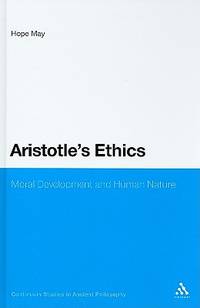
2010réf. 91615Continuum. New. Hardcover. FREE UPGRADE to Courier/Priority Shipping Upon Request - IN STOCK AND IMMEDIATELY AVAILABLE FOR SHIPMENT - Flawless copy brand new pristine never opened -- 204 pages. Description: "Aristotle's 'Nicomachean Ethics' is devoted to the topic of human happiness. Yet although Aristotle's conception of happiness is central to his whole philosophical project there is much controversy surrounding it. Hope May offers a new interpretation of Aristotle's account of happiness - one which incorporates Aristotle's views about the biological development of human beings. May argues that the relationship amongst the moral virtues the intellectual virtues and happiness is best understood through the lens of developmentalism. On this view happiness emerges from the cultivation of a number of virtues that are developmentally related. May goes on to show how contemporary scholarship in psychology ethical theory and legal philosophy signals a return to Aristotelian ethics. Specifically May shows how a theory of motivation known as Self-Determination Theory and recent research on goal attainment have deep affinities to Aristotle’s ethical theory. May argues that this recent work can ground a contemporary virtue theory that acknowledges the centrality of autonomy in a way that captures the fundamental tenets of Aristotle’s ethics." -- with a bonus offer--; Aristotle's Nicomachean Ethics is devoted to the topic of human happiness. Yet although Aristotle's conception of happiness is central to his whole philosophical project there is much controversy surrounding it. Hope May offers a new interpretation of Aristotle's account of happiness - one which incorporates Aristotle's views about the biological development of human beings. May argues that the relationship amongst the moral virtues the intellectual virtues and happiness is best understood through the lens of developmentalism. On this view happiness emerges from the cultivation of a number of virtues that are developmentally related. May goes on to show how contemporary scholarship in psychology ethical theory and legal philosophy signals a return to Aristotelian ethics. Specifically May shows how a theory of motivation known as Self-Determination Theory and recent research on goal attainment have deep affinities to Aristotle s ethical theory. May argues that this recent work can ground a contemporary virtue theory that acknowledges the centrality of autonomy in a way that captures the fundamental tenets of Aristotle s ethics. . 2010. 0826491103 . Continuum hardcover
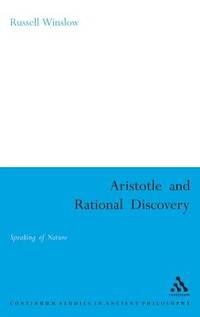
2007réf. 91624Continuum. New. Hardcover. FREE UPGRADE to Courier/Priority Shipping Upon Request - IN STOCK AND IMMEDIATELY AVAILABLE FOR SHIPMENT - Flawless copy brand new pristine never opened -- 160 pages. Description: "In this lively and original book Russell Winslow pursues a new interpretation of logos in Aristotle. Rather than a reading of rationality that cleaves human beings from nature this new interpretation suggests that for Aristotle consistent and dependable rational arguments reveal a deep dependency upon nature. To this end the author shows that a rational account of a being is in fact subject to the very same principle that governs the physical motion and generation of a being under inquiry. Among the many consequences of this argument is a rejection of both of the prevailing oppositional claims that Aristotle's methodological procedure of discovery is one resting on either empirical or conceptual grounds: discovery reveals a more complex structure than can be grasped by either of these modern modes. Further Winslow argues that this interpretation of rational discovery also contributes to the ethical debates surrounding Aristotle's work insofar as an ethical claim is achieved through reason but is not thereby conceived as objective. Again the demand for agreement in ethical/political decision will be disclosed as superseding in its complexity both those accounts of ethical decision as subjective for example 'emotivist' accounts and those as objective 'realist' accounts." -- with a bonus offer--; In this lively and original book Russell Winslow pursues a new interpretation of logos in Aristotle. Rather than a reading of rationality that cleaves human beings from nature this new interpretation suggests that for Aristotle consistent and dependable rational arguments reveal a deep dependency upon nature. To this end the author shows that a rational account of a being is in fact subject to the very same principle that governs the physical motion and generation of a being under inquiry. Among the many consequences of this argument is a rejection of both of the prevailing oppositional claims that Aristotle's methodological procedure of discovery is one resting on either empirical or conceptual grounds: discovery reveals a more complex structure than can be grasped by either of these modern modes. Further Winslow argues that this interpretation of rational discovery also contributes to the ethical debates surrounding Aristotle's work insofar as an ethical claim is achieved through reason but is not thereby conceived as objective. Again the demand for agreement in ethical/political decision will be disclosed as superseding in its complexity both those accounts of ethical decision as subjective for example "emotivist" accounts and those as objective "realist" accounts. . 2007. 0826496873 . Continuum hardcover
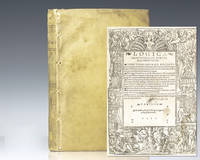
1545réf. D11150Venice: Hieronymus Scotus 1545. Hardcover. Very Good. 8vo 157 x 106mm. 8 307pp. 13 leaves including final blank. Woodcut printers device of Scotus with personification of globe and motto FIAT PAX IN VIRTUTE Peace be with thee. Latin translation by Theodore Gaza. 12-line woodcut historiated initials at beginning of first chapter and at beginning of the Universalis generationis partitio. p. 224 of heraldry. Few woodcut initials throughout. Contemporary vellum; worn; spine and covers darkened; scattered stains worming affecting title next leaf and last 3 leaves; edges stained brown and gauffered to floral pattern. Sound copy enhanced by Latin marginalia in an contemporary hand. The Renaissance public as a part of their reading system frequently engaged Aristotles natural writings. Even at the height of this period at a time when Theodore Gaza had already produced his celebrated versions of Aristotles zoological corpus these works obtained wide recognition. Aristotles zoological works edited by Theodore Gaza with Italian Renaissance commentary sparked on by the availability of Gazas text. Gazas version of the treatises were paraphrases of Aristotles zoological works but also included personal observations and information drawn from the other authors. Gaza in fact held a virtual monopoly on the biological works of Aristotle his translation completely overshadowing those before him and especially of his rival George of Trebizond. Gazas text had been used mainly as a source of quotations and only in philological and medical works such as Castigationes plinianae by Ermolao Barbaro or Benedettis Historia corporis humani. By 1521 starting with a course on the De Partibus animalium held in Bologna did the official Renaissance tradition of interpretation on Aristotles zoology take form. The Latin text which contributed to this renewed interest was none other than the elegant translation by Gaza. University Aristotelianism specifically that concerning the zoology was approached by the various interpreters in the context of systematic exploration of the encyclopedic work as a whole. The ample annotations of this volume showcase precisely this type of interaction with the evolving conversation. Gazas work throws light on Renaissance Aristotelianism carried out through the grid of scholastic commentary. Hieronymus Scotus hardcover
1545réf. D11150Venice: Hieronymus Scotus 1545. Hardcover. Very Good. 8vo 157 x 106mm. 8 307pp. 13 leaves including final blank. Woodcut printers device of Scotus with personification of globe and motto FIAT PAX IN VIRTUTE Peace be with thee. Latin translation by Theodore Gaza. 12-line woodcut historiated initials at beginning of first chapter and at beginning of the Universalis generationis partitio. p. 224 of heraldry. Few woodcut initials throughout. Contemporary vellum; worn; spine and covers darkened; scattered stains worming affecting title next leaf and last 3 leaves; edges stained brown and gauffered to floral pattern. Sound copy enhanced by Latin marginalia in an contemporary hand. The Renaissance public as a part of their reading system frequently engaged Aristotles natural writings. Even at the height of this period at a time when Theodore Gaza had already produced his celebrated versions of Aristotles zoological corpus these works obtained wide recognition. Aristotles zoological works edited by Theodore Gaza with Italian Renaissance commentary sparked on by the availability of Gazas text. Gazas version of the treatises were paraphrases of Aristotles zoological works but also included personal observations and information drawn from the other authors. Gaza in fact held a virtual monopoly on the biological works of Aristotle his translation completely overshadowing those before him and especially of his rival George of Trebizond. Gazas text had been used mainly as a source of quotations and only in philological and medical works such as Castigationes plinianae by Ermolao Barbaro or Benedettis Historia corporis humani. By 1521 starting with a course on the De Partibus animalium held in Bologna did the official Renaissance tradition of interpretation on Aristotles zoology take form. The Latin text which contributed to this renewed interest was none other than the elegant translation by Gaza. University Aristotelianism specifically that concerning the zoology was approached by the various interpreters in the context of systematic exploration of the encyclopedic work as a whole. The ample annotations of this volume showcase precisely this type of interaction with the evolving conversation. Gazas work throws light on Renaissance Aristotelianism carried out through the grid of scholastic commentary. Hieronymus Scotus hardcover books
1554réf. 1506230049Venice: Apud Hieronymum Scotum 1554-01-01. Hardcover. Good. Folio. Original vellum. Minor soiling to cover. Good binding and cover. Later leather binding straps. Later end pages. Printer's device on title page. Text generally clean a few lines of early marginal notation and underlining. Collated: A-L8 M-M6 N-N4 in 8's with the title as leaf A1. Faint stain on first few leaves. Edito princeps 1535. Refs: British Museum p. 44. STC Italy Vol I. p. 99; Not in Brunet. Johannes Philoponus John the Grammarian or John of Alexandria was an important Aristotelian commentator and Christian theologian. John's commentaries on Aristotle were influential on medieval and early modern thinkers in Europe such as Gianfrancesco Pico della Mirandola and Galileo. Philoponus has been seen as an important precursor to the establishment of empirical philosophy. In this book Philoponus comments on Aristotle's De Anima On the Soul and substantially modifies Aristotle's ideas. His commentary deals specifically with Aristotle's theory of light "Philoponus contends that Aristotle' view fails to account both for the laws of optics. Philoponus modifies the theory so as to save the phenomena he proceeds to re-interpret the term Energeia not as a state of actuality but rather as an 'incorporeal activity' which besides constituting the transparency of the medium is also capable of warming bodies.Due to this novel interpretation of Aristotle's terminology light is now understood not statically but as something dynamical." - Stanford Philosophical Encyclopedia. It should also be noted that since Michael Hayduck's edition Berlin 1897 it is generally assumed by scholars that the third book of the commentary that had been ascribed to John Philoponus wasoriginally written by Stephanus of Alexandria as is attested in the manuscript Parisinus gr. 1914 11th/12th cent. An important early work in physics and natural philosophy. Venice: Apud Hieronymum Scotum hardcover
1542réf. 1412010050Venetiis: Brandinus & Octavianus Scotus 1542-01-01. Hardcover. Good. 0x0x0. Folio. 2 85p 48p 1. Bound in modern leather. 4 raised bands. Gilt title to second compartment. Printers imprint to final leaf. Fine binding and cover. New FFEP. Marginal dampstain throughout. Otherwise clean unmarked pages. John Philoponus also known as John the Grammarian or John of Alexandria was a Christian and Aristotelian commentator and the author of a considerable number of philosophical treatises and theological works. A rigorous sometimes polemical writer and an original thinker who was controversial in his own time John Philoponus broke from the Aristotelian-Neoplatonic tradition questioning methodology and eventually leading to empiricism in the natural sciences. He established his own independent thinking in his commentaries and critiques of Aristotle's On the Soul and Physics. In the latter work Philoponus became one of the earliest thinkers to reject Aristotle's dynamics and propose the 'theory of impetus': i.e. an object moves and continues to move because of an energy imparted in it by the mover and ceases movement when that energy is exhausted an early that was the first step towards the concept of inertia in modern physics. His works were widely printed in Latin translations in Europe from the 15th century onwards. His critique of Aristotle in the Physics commentary was a major influence on Giovanni Pico della Mirandola and Galileo Galilei who cited Philoponus substantially in his works often citing him more than Plato. Philoponus' main significance in the history of science lies in his being at the close of antiquity the first thinker to undertake a comprehensive and massive attack on the principal tenets of Aristotle's physics and cosmology an attack unequaled in thoroughness until Galileo. LC: Adams P1058 Venetiis: Brandinus & Octavianus Scotus hardcover
1985réf. 27324Penguin Books. As New. 1985. Paperback. FREE UPGRADE to Courier/Priority Shipping Upon Request - IN STOCK AND IMMEDIATELY AVAILABLE FOR SHIPMENT - -- with a bonus offer-- . Penguin Books paperback
1531réf. 133411Parisiis: Petri Vidouei 1531. Rare 16th century French printing of Aristotle's third book of logic. Folio bound in full vellum elaborate woodcut vignette-border title-page illustrated with numerous in-text woodcut diagrams and woodcut initials. Ownership inscriptions including that of American philosopher Allan Gotthelf. Gotthelf received many honors for his work on Aristotle including in 2004 an international conference on "Aristotle on Being Nature and Life" held "in celebration of his contributions to the study of classical philosophy and science." In very good condition with some dampstaining and period marginalia throughout. Being one of the six extant Aristotelian writings on logic and scientific method The Prior Analytics was first composed around 350 BCE. The work represents the first formal study of logic where logic is understood as the study of arguments. In the Prior Analytics Aristotle identifies valid and invalid forms of arguments called syllogisms. A syllogism is an argument that consists of at least three sentences: at least two premises and a conclusion. Although Aristotle does not call them "categorical sentences" tradition does; he deals with them briefly in the Analytics and more extensively in On Interpretation. In the sixth century Boethius composed the first known Latin translation of the Prior Analytics. No Westerner between Boethius and Bernard of Utrecht is known to have read it. Petri Vidouei hardcover
1503réf. D20057Venice: Octaviani Scoti per Bonetus de Locatellis 1503. Hardcover. Very Good. Small folio printed in gothic type in two columns woodcut initials & text diagrams; woodcut printer's device on final leaf. Bound in modern half parchment with printed paper boards. A copy with significant contemporary marginal notes in several sections the annotations run tight up against the outer margin. Title page cut down by one inch at the foot; some scattered spotting & worming but generally a nice copy of an early and uncommon to the market post-incunable edition worthy of future study. A recent edition was published in 2024 by the Aquinas Institute. Beth Mortensen summarizes the significance of the text: "All of us living in this Cartesian age grow accustomed to thinking of our bodies as animated machinesmachines that function better or worse subject to innumerable material factors. De Anima On the Soul reminds us that the human person is one whole and the soul is actively making the body what it is. This means that among other things the quality of the bodys functioning does not determine a human beings 'quality of life' and it is completely irrelevant to that persons worth or dignity." see: aquinas institute - commentary on de anima. Octaviani Scoti per Bonetus de Locatellis hardcover
1549réf. 047FIRST EDITION of this translation the FIRST ITALIAN TRANSLATION OF THE POETICS a little minor spotting in places tiny worm track to blank area of first two leaves early ownership inscription Jacobi Peruli Vabmatis' to title page pp. xii 355 25 4to eighteenth-century Italian vellum spine lettered in ink all edges blue a few tiny wormholes to backstrip a very good copy house in a maroon clamshell case with a black morocco label. A nice clean copy of the first edition of this translation of Aristotle's Rhetoric and poetics into Italian by Bernardo Segni 1504-1558 the first translation of the Poetics and the second of the Rhetoric to be printed. there was enough demand that a second edition was printed two years later. Appresso Lorenzo Torrentino hardcover
1503réf. D20057Venice: Octaviani Scoti per Bonetus de Locatellis 1503. Hardcover. Very Good. Small folio printed in gothic type in two columns woodcut initials & text diagrams; woodcut printer's device on final leaf. Bound in modern half parchment with printed paper boards. A copy with significant contemporary marginal notes in several sections the annotations run tight up against the outer margin. Title page cut down by one inch at the foot; some scattered spotting & worming but generally a nice copy of an early and uncommon to the market post-incunable edition worthy of future study. A recent edition was published in 2024 by the Aquinas Institute. Beth Mortensen summarizes the significance of the text: "All of us living in this Cartesian age grow accustomed to thinking of our bodies as animated machinesmachines that function better or worse subject to innumerable material factors. De Anima On the Soul reminds us that the human person is one whole and the soul is actively making the body what it is. This means that among other things the quality of the bodys functioning does not determine a human beings 'quality of life' and it is completely irrelevant to that persons worth or dignity." see: aquinas institute - commentary on de anima. Octaviani Scoti per Bonetus de Locatellis hardcover books
1771réf. 002357Paris Saillant & Nyon, Desaint 1771