7006 risultati
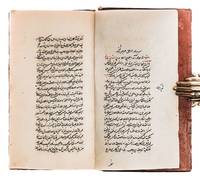
rif. 64949Timurid Persia circa 1500 AD. Arabic manuscript on paper 143 leaves plus 1 flyleaf 19 lines to the page written in black slanted naskh headings and important words in red occasional marginal commentary in a black gilt Safavid stamped binding with polychrome filigree doublures. An ownership note on folio 1A reads: The book Analut qiy which is the Book of the Syllogism authored by Aristotle and translated by Ibn al-Muqaffa' passed into the possession of the humblest servant Ibn Muhammad B qir Jaafar in the year nine hundred and eighty-one. The author: Ab al-Wal d Muhammad ibn Ahmad ibn Rushd 1126–1198 known in the Latin West as Averroes was one of the most influential thinkers of the medieval world. Born in Córdoba the great intellectual centre of al-Andalus he trained in law medicine theology and philosophy. His early career combined service as a jurist and physician with a deep engagement in the study of Aristotle whose works were being rediscovered and systematically commented upon across the Islamic world. Averroes' fame rests above all on his philosophical writings especially his vast series of commentaries on Aristotle for which he was hailed in Europe as The Commentator. These ranged from short epitomes to expansive line-by-line exegeses and together they provided the most comprehensive account of Aristotelian logic natural philosophy and metaphysics available in the Middle Ages. Translated into Hebrew and Latin from the thirteenth century onward his works shaped the course of scholastic philosophy influencing figures such as Thomas Aquinas Siger of Brabant and later Renaissance humanists. In the Islamic world Averroes stood at the intersection of philosophy law and theology. He defended the compatibility of reason and revelation in works such as Tah fut al-Tah fut The Incoherence of the Incoherence written in response to al-Ghaz l . He also contributed to medicine with his encyclopedic Kulliyy t the Colliget in Latin. His intellectual project reflected the dynamism of twelfth-century al-Andalus where Muslim Jewish and Christian scholars shared a common commitment to rational inquiry. Averroes' legacy embodies the transmission of Greek philosophy through the Islamic tradition into Europe making him a pivotal figure in the history of philosophy. The text: Talkh s Kit b al-Qiy s is Averroes' Middle Commentary on Aristotle's Prior Analytics the foundational treatise in which Aristotle first articulates the theory of the syllogism the core of ancient and medieval logical science and the starting point of the Organon. In the Middle Commentaries Averroes recasts Aristotle's arguments into a clear pedagogical style designed for teaching striking a balance between concise epitomes and exhaustive line-by-line exegesis. This tiered approach—short j mi' middle talkh s and long tafs r—is one of Averroes' major contributions allowing readers of different levels to engage systematically with Aristotelian logic and helping to establish his reputation as "The Commentator" in the Latin West. Aristotle's Prior Analytics holds a privileged position within the Organon laying out the rules by which valid conclusions necessarily follow from premises—the figures and moods of the syllogism. Because logic was regarded not as a science but as the instrument of all the sciences mastery of the Prior Analytics was essential for philosophical medical theological and legal reasoning throughout late antiquity and the medieval period. By reorganising and clarifying Aristotle's material Averroes ensured the continued vitality of the Organon-centred curriculum across Arabic Hebrew and Latin traditions keeping the art of demonstration central to intellectual life. The manuscript is especially valuable for its textual history. The opening folio attributes the work to the translation of Ibn al-Muqaffa d. c. 757 the celebrated Abbasid-era translator whose renderings of Greek philosophical texts—including the Organon—formed the earliest Arabic corpus of Aristotelian logic. This direct reference links the manuscript to a chain of transmission that stretches from early Abbasid translation efforts through Averroes' systematic commentaries to Timurid scribes who preserved the text for subsequent scholars. The influence of Averroes' logical writings was profound. From the thirteenth century his commentaries were translated into Hebrew and Latin and became core texts in universities such as Paris and Padua shaping scholastic debate and giving rise to the current of "Latin Averroism." Many scholastic philosophers including Thomas Aquinas encountered Aristotle primarily through Averroes' interpretative lens. Timurid Persia, circa 1500 AD. unknown
rif. LCS-1864053
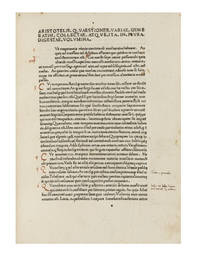
1472rif. 112Very rare first edition mentioned by Goff of the Introduction à la Philosophie de Platon by Alcinous his disciple. A superb and precious copy with huge margins ink rubricated initials and the first two letters illuminated the first one being enhanced in gilt. Very rare first incunabula edition of the Introduction à la philosophie de Platon by Alcinous. Given by Antoine Koburger. It is the only one mentioned by Goff. Goff A-365 ; Hain 620; Pellechet 419; Stillwell A-332 ; Proctor 1965 ; BMC II 412 ; Panzer p.9 ; Santander II n°58 ; A. A. Renouard Catalogue de la bibliothèque d'un amateur I p.174. A superb and precious copy with rubricated initials in red ink and the first two letters illuminated the first one being enhanced in gilt. "A rare piece." Renouard "First very rare edition printed on long lines with no distinction of chapter or sections and without numbers signatures or catchwords. The totality of this volume is of 22 printed leaves: at the beginning there is a dedication epistle by the bishop of Tropea Petrus Balbus Pisanus author of this Latin version of Alcinous to the cardinal Nic. De Cusa ; then comes the text at the end of which we can read this subscription: Epitoma Alcinoi in disciplinaru Platonis definit. Anno salutis. M. CCCC. LXXII. Die vero XXIIII. Mensis Novebris."Santander who lists this edition as being the first Antoine Koburger 1443-1515 a German editor bookseller and one of the most distinguished and active printers of the 15th century was renowned for the "Chroniques de Nuremberg" he published in 1493. Alcinous was popular in the 1st century CE. A student of the school of Alexandria and faithful to its spirit he was one of the first to start blending into Plato's doctrine Aristotle's opinions and some oriental ideas. There is sufficient proof of that in his Introduction à la philosophie de Platon a digest where he largely exposes this vast system while adding some foreign elements to it. For example when he speaks of spirits and demons he seems to know a lot more than Plato: to him some are visible and some invisible; he distributes them among all of the elements and tells us about their relationships their influence — before our eyes a complete demonology is born from which the only next step possible is towards magic." Dictionnaire des Sciences philosophiques pp.48-49 We know of Plato and some of his texts; but there are only a few who have an accurate and precise idea of the whole philosophical system of the prince of philosophers. Presenting to amateurs of philosophy a summarized tableau of what Platonism is was doing them a great favor. This is what the Platonist philosopher Alcinous undertook and executed in this book that we can consider like a lost pearl in the dust of the centuries. How intriguing it is to find gathered in a miniature frame a philosophical system that for so long sat at the highest level of the opinion especially nowadays when this kind of curiosity is hard to satisfy: for it is difficult to have in one's possession the complete works of Plato. Plato's texts are numerous and quite diverse but there is no order that links the different treaties between them. This reduced map of Platonism must be considered very precious as it gives the mind the ability to grasp this vast ensemble at first glance. J. J. Combes-Dounous This translation of Alcinous' text is due to the talent of Pietro Balbus. A superb and precious copy of this very rare incunabula edition with very wide margins height: 315 mm rubricated initials in red ink with the first two letters illuminated the first one being enhanced in gilt. The copy mentioned by BMC was only 303 mm high. Provenance : Library of Moreau 10 December 1934 n° 18. Antoine Koburger hardcover
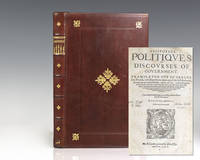
1598rif. 138658London: Adam Islip 1598. Rare first edition in English of one of the world’s most important and influential political texts “the most valuable work on that branch of philosophy that has descended to us from antiquity.” Small folio bound in full leather gilt titles and tooling to the spine front and rear panels. In near fine condition bookplate small name to the title page small paper repair to the first few pages. First editions are exceptionally rare. Aristotle’s Politics written circa 350 B.C. “is the most valuable work on that branch of philosophy that has descended to us from antiquity” McCulloch 356. It marks “a genuine attempt at political science. Aristotle shows the ways in which oligarchies fall and the variety of situations that may follow. He goes through the likely causes of revolution. He is conscious of classes and their interests” Levi 403. The work embodies “theories of perennial value and refutations of fallacies which are always re-emerging” Hazlitt 36. Aristotle’s history of mature Athenian democracy and the development of that city-state’s constitution greatly influenced modern political philosophy. Politics had a particularly profound effect on the formation of the United States government: Jefferson had a copy of LeRoy’s French translation in his library Sowerby 2347 and many of the basic tenets of the U.S. Constitution derive directly from Aristotle making him in some sense “the father of modern democracy” PMM 94. Title page with woodcut-engraved device woodcut-engraved initials head- and tailpieces. STC 760. Pforzheimer 10. Brueggemann 184-85. CBEL I:800. Cox I:59. Harris 14 Lowndes 68. Palmer 12. Smith 31. See PMM 38 94. Adam Islip hardcover
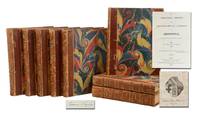
1812rif. 140947913London: Printed for the Translator by Robert Wilks 1812. First Edition in English. Very Good. First edition in English of the works of Aristotle one of 50 sets printed and boldly signed by the translator Thomas Taylor in ink at the end of the first volume. All volumes bear the armorial bookplates of noted bibliophile and Bronte family benefactor Frances Mary Richardson Currer 1785-1861. Incomplete set with eight of ten volumes present of the complete translation. Uniformly bound by "J. Mackenzie Binder to the King" in contemporary half morocco over French Curl marbled boards with spines lettered and tooled in gilt; all edges gilt 4to. Very Good with wear extremities rubbed sporadic foxing hinges slightly tender. Volumes include: 1. The Organon 1807. 2. The Treatises on the Soul 1808. 3.The History of Animals 1809. 4.The Treatises on the Parts and Progressive Motion on Animals etc. 1810. 5. The Rhetoric 1811. 6. The Great Edemian Ethics 1811. 7. A Dissertation on the Philosophy of Aristotle 1812.8. The Metaphysics first edition of 1801. The first collected English translations of Aristotle's works from Orphic fragments by Neoplatonist scholar Thomas Tyler 1758-1835. Provenance of famed bibliophile and collector Frances Mary Richardson Currer whose well-curated and respected library expanded to nearly 20000 volumes. Bibliographer Thomas Frognall Dibdin remarked that she was "the head of all female book collectors in Europe." Known for her philanthropic endeavors she donated a sum of 50 pounds to Patrick Bronte father of Charlotte Bronte when he was widowed in 1821. Currer also contributed an unknown amount to the Clergy Daughter's School that the Bronte sisters attended. Scholars postulate that Charlotte chose the non de plume of "Currer Bell" for her first published 1847 novel Jane Eyre in honor of Currer's philanthropy. A desirable set even without Currer's bookplate that seldom comes up for sale. Printed for the Translator by Robert Wilks unknown
1812rif. 140947913London: Printed for the Translator by Robert Wilks 1812. First Edition in English. Very Good. First edition in English of the works of Aristotle one of 50 sets printed and boldly signed by the translator Thomas Taylor in ink at the end of the first volume. All volumes bear the armorial bookplates of noted bibliophile and Bronte family benefactor Frances Mary Richardson Currer 1785-1861. Incomplete set with eight of ten volumes present of the complete translation. Uniformly bound by "J. Mackenzie Binder to the King" in contemporary half morocco over French Curl marbled boards with spines lettered and tooled in gilt; all edges gilt 4to. Very Good with wear extremities rubbed sporadic foxing hinges slightly tender. Volumes include: 1. The Organon 1807. 2. The Treatises on the Soul 1808. 3.The History of Animals 1809. 4.The Treatises on the Parts and Progressive Motion on Animals etc. 1810. 5. The Rhetoric 1811. 6. The Great Edemian Ethics 1811. 7. A Dissertation on the Philosophy of Aristotle 1812.8. The Metaphysics first edition of 1801. The first collected English translations of Aristotle's works from Orphic fragments by Neoplatonist scholar Thomas Tyler 1758-1835. Provenance of famed bibliophile and collector Frances Mary Richardson Currer whose well-curated and respected library expanded to nearly 20000 volumes. Bibliographer Thomas Frognall Dibdin remarked that she was "the head of all female book collectors in Europe." Known for her philanthropic endeavors she donated a sum of 50 pounds to Patrick Bronte father of Charlotte Bronte when he was widowed in 1821. Currer also contributed an unknown amount to the Clergy Daughter's School that the Bronte sisters attended. Scholars postulate that Charlotte chose the non de plume of "Currer Bell" for her first published 1847 novel Jane Eyre in honor of Currer's philanthropy. A desirable set even without Currer's bookplate that seldom comes up for sale. Printed for the Translator by Robert Wilks unknown books