7.090 Ergebnisse
Best.-Nr. 14945The Library of the Liberal Arts / Bobbs-Merrill. As New. Paperback. FREE UPGRADE to Courier/Priority Shipping Upon Request - IN STOCK AND IMMEDIATELY AVAILABLE FOR SHIPMENT - AS NEW THE TEXT BLOCK IS PRISTINE CLEAN UNMARKED AND IN EXCELLENT CONDITION - - ND; c 1962 -- with a bonus offer--; 014945 . N.D. The Library of the Liberal Arts / Bobbs-Merrill paperback
1967Best.-Nr. 14633Regnery Gateway. As New. Paperback. FREE UPGRADE to Courier/Priority Shipping Upon Request - IN STOCK AND IMMEDIATELY AVAILABLE FOR SHIPMENT - AS NEW THE TEXT BLOCK IS PRISTINE CLEAN UNMARKED AND IN EXCELLENT CONDITION - - -- with a bonus offer--; 014633 . 1967. Regnery Gateway paperback
Best.-Nr. 14041New York: Heritage Press. As New. Hardcover. FREE UPGRADE to Courier/Priority Shipping Upon Request - AS NEW THE TEXT BLOCK IS PRISTINE CLEAN UNMARKED AND IN EXCELLENT CONDITION - . Decorated cover boards. -- with a bonus offer--; 014041 . 1964. 1199994448 . Heritage Press hardcover
Best.-Nr. 14776Everyman's Library. New. Hardcover. FREE UPGRADE to Courier/Priority Shipping Upon Request - IN STOCK AND IMMEDIATELY AVAILABLE FOR SHIPMENT - Book In fine Condition. Copyright 1964. -- with a bonus offer--; 014776 . Everyman's Library hardcover
Best.-Nr. 85189Mentor / New American Library. As New. Paperback. FREE UPGRADE to Courier/Priority Shipping Upon Request - IN STOCK AND IMMEDIATELY AVAILABLE FOR SHIPMENT - AS NEW THE TEXT BLOCK IS PRISTINE CLEAN UNMARKED AND IN EXCELLENT CONDITION - - Corresponds to: ISBN: 0451612175. 432 pages. -- with a bonus offer-- . 1963. 0451612175 . Mentor / New American Library paperback

Best.-Nr. 52571Oxford At the Clarendon Press. As New. Hardcover. FREE UPGRADE to Courier/Priority Shipping Upon Request – – IN STOCK AND IMMEDIATELY AVAILABLE FOR SHIPMENT - TEXT PRISTINE TIGHT TO THE SPINE - Corresponds to ASIN: B000VMA58E -- with a bonus offer-- . Oxford At the Clarendon Press hardcover
2007Best.-Nr. 91625Continuum. New. Hardcover. FREE UPGRADE to Courier/Priority Shipping Upon Request - IN STOCK AND IMMEDIATELY AVAILABLE FOR SHIPMENT - Flawless copy brand new pristine never opened -- 256 pages. Description: "The work of Aristotle 384-322 bc is considered to be one of the great achievements of the ancient world and is a foundation of both Western and Middle Eastern philosophy and science. Although Aristotle left significant material on almost all branches of learning what has survived is a somewhat disorganized collection of notes and lectures. Moreover the centuries of interpretation across various epochs and cultures tend to cloud our understanding of him. Thomas Kiefer breaks through this cloud of interpretation and provides an organized account of one key part of Aristotle's philosophy namely his theory of knowledge. This theory concerns what is knowledge what we can know and how we can do so. Kiefer's book is the first work that takes this theory as its sole focus and reconstructs it systematically. Kiefer's work throughout provides many new interpretations of key parts of Aristotle's philosophy including an unnoticed -but crucial- distinction between knowledge in general and knowledge for us the differences between his semantic and psychological requirements for knowledge and 'nous' which is perhaps the most obscure notion in Aristotle's work. He also concludes with a summary of Aristotle's theory in the terms and style of contemporary epistemology. Kiefer's work should be of interest to anyone involved in the history of philosophy or contemporary epistemology." -- with a bonus offer--; The work of Aristotle 384-322 BC is considered to be one of the great achievements of the ancient world and is a foundation of both Western and Middle Eastern philosophy and science. Although Aristotle left significant material on almost all branches of learning what has survived is a somewhat disorganized collection of notes and lectures. Moreover the centuries of interpretation across various epochs and cultures tend to cloud our understanding of him. Thomas Kiefer breaks through this cloud of interpretation and provides an organized account of one key part of Aristotle's philosophy namely his theory of knowledge. This theory concerns what is knowledge what we can know and how we can do so. Kiefer's book is the first work that takes this theory as its sole focus and reconstructs it systematically. Kiefer's work throughout provides many new interpretations of key parts of Aristotle's philosophy including an unnoticed -but crucial-distinction between knowledge in general and knowledge for us the differences between his semantic and psychological requirements for knowledge and 'nous' which is perhaps the most obscure notion in Aristotle's work. He also concludes with a summary of Aristotle's theory in the terms and style of contemporary epistemology. Kiefer's work should be of interest to anyone involved in the history of philosophy or contemporary epistemology. . 2007. 0826494854 . Continuum hardcover
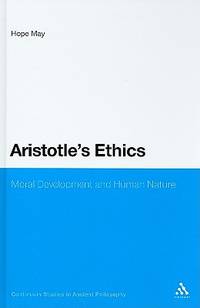
2010Best.-Nr. 91615Continuum. New. Hardcover. FREE UPGRADE to Courier/Priority Shipping Upon Request - IN STOCK AND IMMEDIATELY AVAILABLE FOR SHIPMENT - Flawless copy brand new pristine never opened -- 204 pages. Description: "Aristotle's 'Nicomachean Ethics' is devoted to the topic of human happiness. Yet although Aristotle's conception of happiness is central to his whole philosophical project there is much controversy surrounding it. Hope May offers a new interpretation of Aristotle's account of happiness - one which incorporates Aristotle's views about the biological development of human beings. May argues that the relationship amongst the moral virtues the intellectual virtues and happiness is best understood through the lens of developmentalism. On this view happiness emerges from the cultivation of a number of virtues that are developmentally related. May goes on to show how contemporary scholarship in psychology ethical theory and legal philosophy signals a return to Aristotelian ethics. Specifically May shows how a theory of motivation known as Self-Determination Theory and recent research on goal attainment have deep affinities to Aristotle’s ethical theory. May argues that this recent work can ground a contemporary virtue theory that acknowledges the centrality of autonomy in a way that captures the fundamental tenets of Aristotle’s ethics." -- with a bonus offer--; Aristotle's Nicomachean Ethics is devoted to the topic of human happiness. Yet although Aristotle's conception of happiness is central to his whole philosophical project there is much controversy surrounding it. Hope May offers a new interpretation of Aristotle's account of happiness - one which incorporates Aristotle's views about the biological development of human beings. May argues that the relationship amongst the moral virtues the intellectual virtues and happiness is best understood through the lens of developmentalism. On this view happiness emerges from the cultivation of a number of virtues that are developmentally related. May goes on to show how contemporary scholarship in psychology ethical theory and legal philosophy signals a return to Aristotelian ethics. Specifically May shows how a theory of motivation known as Self-Determination Theory and recent research on goal attainment have deep affinities to Aristotle s ethical theory. May argues that this recent work can ground a contemporary virtue theory that acknowledges the centrality of autonomy in a way that captures the fundamental tenets of Aristotle s ethics. . 2010. 0826491103 . Continuum hardcover
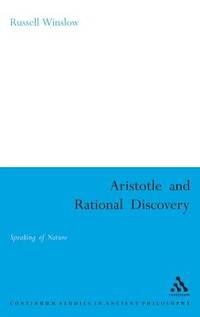
2007Best.-Nr. 91624Continuum. New. Hardcover. FREE UPGRADE to Courier/Priority Shipping Upon Request - IN STOCK AND IMMEDIATELY AVAILABLE FOR SHIPMENT - Flawless copy brand new pristine never opened -- 160 pages. Description: "In this lively and original book Russell Winslow pursues a new interpretation of logos in Aristotle. Rather than a reading of rationality that cleaves human beings from nature this new interpretation suggests that for Aristotle consistent and dependable rational arguments reveal a deep dependency upon nature. To this end the author shows that a rational account of a being is in fact subject to the very same principle that governs the physical motion and generation of a being under inquiry. Among the many consequences of this argument is a rejection of both of the prevailing oppositional claims that Aristotle's methodological procedure of discovery is one resting on either empirical or conceptual grounds: discovery reveals a more complex structure than can be grasped by either of these modern modes. Further Winslow argues that this interpretation of rational discovery also contributes to the ethical debates surrounding Aristotle's work insofar as an ethical claim is achieved through reason but is not thereby conceived as objective. Again the demand for agreement in ethical/political decision will be disclosed as superseding in its complexity both those accounts of ethical decision as subjective for example 'emotivist' accounts and those as objective 'realist' accounts." -- with a bonus offer--; In this lively and original book Russell Winslow pursues a new interpretation of logos in Aristotle. Rather than a reading of rationality that cleaves human beings from nature this new interpretation suggests that for Aristotle consistent and dependable rational arguments reveal a deep dependency upon nature. To this end the author shows that a rational account of a being is in fact subject to the very same principle that governs the physical motion and generation of a being under inquiry. Among the many consequences of this argument is a rejection of both of the prevailing oppositional claims that Aristotle's methodological procedure of discovery is one resting on either empirical or conceptual grounds: discovery reveals a more complex structure than can be grasped by either of these modern modes. Further Winslow argues that this interpretation of rational discovery also contributes to the ethical debates surrounding Aristotle's work insofar as an ethical claim is achieved through reason but is not thereby conceived as objective. Again the demand for agreement in ethical/political decision will be disclosed as superseding in its complexity both those accounts of ethical decision as subjective for example "emotivist" accounts and those as objective "realist" accounts. . 2007. 0826496873 . Continuum hardcover
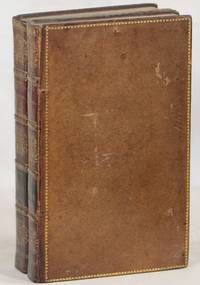
Best.-Nr. 121300London Printed for A. Strahan; and T. Cadell Jun. and W. Davies in the Strand 1797. . First edition; 2 vols in 1; 4to 29.5 x 23 cm; divisional title printed on blue tinted paper bookplate to front pastedown light spotting; contemporary mottled calf covers with decorative wheatsheaf roll rebacked preserving the original gilt spine which has been laid down sprinkled edges corners slightly bumped with minor loss very good; 3 vi-xv 1 416 3 'vi' 343 4pp. The first edition of this English language translation of the Nicomachean Ethics and Politics of Aristotle 384-322 BC. Although both works had previously appeared in English translation as The Ethiques of Aristotle by John Wilkinson in 1547 and John Dickenson's Aristotles Politiqves or Discovrses of Government in 1598 this edition by the Scottish historian John Gillies 1747-1836 marks the first occasion that both texts appear together in one composite translation which as Gillies explains in his preface is perhaps how Aristotle intended the works to be understood: 'The "Ethics of Nichomachus and the Politics" ought never to have been disjoined since they are considered by Aristotle himself as forming essential parts of one and the same work; which as it was the last and principal object of his studies is of all his performances the longest the best connected and incomparably the most interesting. The two treatises combined constitute what he calls his practical philosophy' i.e. that which concerns human nature. Gillies prefixed this work with a lengthy life of Aristotle and a 'New Analysis of Aristotle's Works' the latter coming under fire by the Platonist Thomas Taylor 1758-1835 who criticised Gillies' comments on the ordering of the books in Aristotle's treatise on metaphysics in the introduction to his English-language translation of this work which was published in 1801. This led in turn to a revised edition of Gillies' Ethics and Politics which came out in 1804 defending his work. Prior to the present work Gillies' principal contribution to academia was a history of ancient Greece that appeared in two parts the first printed in 1786 the second not appearing until 1807. On the strength of this Gillies was appointed Historiographer Royal for Scotland on the death of William Robertson in 1793 and devoted his attention to this translation of Aristotle's two major works of practical philosophy here first published. From the library of Sir John Swinburne 1762-1860 of Capheaton Hall with his bookplate to the front pastedown. Swinburne was elected Member of Parliament for Launceston in the Whig interest in 1788 and was a supporter of social reform including the abolition of the slave trade. ESTC T128120. London, Printed for A. Strahan; and T. Cadell Jun. and W. Davies, in the Strand, 1797. unknown
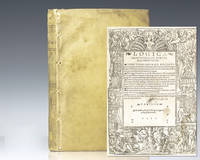
1554Best.-Nr. 1506230049Venice: Apud Hieronymum Scotum 1554-01-01. Hardcover. Good. Folio. Original vellum. Minor soiling to cover. Good binding and cover. Later leather binding straps. Later end pages. Printer's device on title page. Text generally clean a few lines of early marginal notation and underlining. Collated: A-L8 M-M6 N-N4 in 8's with the title as leaf A1. Faint stain on first few leaves. Edito princeps 1535. Refs: British Museum p. 44. STC Italy Vol I. p. 99; Not in Brunet. Johannes Philoponus John the Grammarian or John of Alexandria was an important Aristotelian commentator and Christian theologian. John's commentaries on Aristotle were influential on medieval and early modern thinkers in Europe such as Gianfrancesco Pico della Mirandola and Galileo. Philoponus has been seen as an important precursor to the establishment of empirical philosophy. In this book Philoponus comments on Aristotle's De Anima On the Soul and substantially modifies Aristotle's ideas. His commentary deals specifically with Aristotle's theory of light "Philoponus contends that Aristotle' view fails to account both for the laws of optics. Philoponus modifies the theory so as to save the phenomena he proceeds to re-interpret the term Energeia not as a state of actuality but rather as an 'incorporeal activity' which besides constituting the transparency of the medium is also capable of warming bodies.Due to this novel interpretation of Aristotle's terminology light is now understood not statically but as something dynamical." - Stanford Philosophical Encyclopedia. It should also be noted that since Michael Hayduck's edition Berlin 1897 it is generally assumed by scholars that the third book of the commentary that had been ascribed to John Philoponus wasoriginally written by Stephanus of Alexandria as is attested in the manuscript Parisinus gr. 1914 11th/12th cent. An important early work in physics and natural philosophy. Venice: Apud Hieronymum Scotum hardcover
1542Best.-Nr. 1412010050Venetiis: Brandinus & Octavianus Scotus 1542-01-01. Hardcover. Good. 0x0x0. Folio. 2 85p 48p 1. Bound in modern leather. 4 raised bands. Gilt title to second compartment. Printers imprint to final leaf. Fine binding and cover. New FFEP. Marginal dampstain throughout. Otherwise clean unmarked pages. John Philoponus also known as John the Grammarian or John of Alexandria was a Christian and Aristotelian commentator and the author of a considerable number of philosophical treatises and theological works. A rigorous sometimes polemical writer and an original thinker who was controversial in his own time John Philoponus broke from the Aristotelian-Neoplatonic tradition questioning methodology and eventually leading to empiricism in the natural sciences. He established his own independent thinking in his commentaries and critiques of Aristotle's On the Soul and Physics. In the latter work Philoponus became one of the earliest thinkers to reject Aristotle's dynamics and propose the 'theory of impetus': i.e. an object moves and continues to move because of an energy imparted in it by the mover and ceases movement when that energy is exhausted an early that was the first step towards the concept of inertia in modern physics. His works were widely printed in Latin translations in Europe from the 15th century onwards. His critique of Aristotle in the Physics commentary was a major influence on Giovanni Pico della Mirandola and Galileo Galilei who cited Philoponus substantially in his works often citing him more than Plato. Philoponus' main significance in the history of science lies in his being at the close of antiquity the first thinker to undertake a comprehensive and massive attack on the principal tenets of Aristotle's physics and cosmology an attack unequaled in thoroughness until Galileo. LC: Adams P1058 Venetiis: Brandinus & Octavianus Scotus hardcover
1985Best.-Nr. 27324Penguin Books. As New. 1985. Paperback. FREE UPGRADE to Courier/Priority Shipping Upon Request - IN STOCK AND IMMEDIATELY AVAILABLE FOR SHIPMENT - -- with a bonus offer-- . Penguin Books paperback
1531Best.-Nr. 133411Parisiis: Petri Vidouei 1531. Rare 16th century French printing of Aristotle's third book of logic. Folio bound in full vellum elaborate woodcut vignette-border title-page illustrated with numerous in-text woodcut diagrams and woodcut initials. Ownership inscriptions including that of American philosopher Allan Gotthelf. Gotthelf received many honors for his work on Aristotle including in 2004 an international conference on "Aristotle on Being Nature and Life" held "in celebration of his contributions to the study of classical philosophy and science." In very good condition with some dampstaining and period marginalia throughout. Being one of the six extant Aristotelian writings on logic and scientific method The Prior Analytics was first composed around 350 BCE. The work represents the first formal study of logic where logic is understood as the study of arguments. In the Prior Analytics Aristotle identifies valid and invalid forms of arguments called syllogisms. A syllogism is an argument that consists of at least three sentences: at least two premises and a conclusion. Although Aristotle does not call them "categorical sentences" tradition does; he deals with them briefly in the Analytics and more extensively in On Interpretation. In the sixth century Boethius composed the first known Latin translation of the Prior Analytics. No Westerner between Boethius and Bernard of Utrecht is known to have read it. Petri Vidouei hardcover
1549Best.-Nr. 047FIRST EDITION of this translation the FIRST ITALIAN TRANSLATION OF THE POETICS a little minor spotting in places tiny worm track to blank area of first two leaves early ownership inscription Jacobi Peruli Vabmatis' to title page pp. xii 355 25 4to eighteenth-century Italian vellum spine lettered in ink all edges blue a few tiny wormholes to backstrip a very good copy house in a maroon clamshell case with a black morocco label. A nice clean copy of the first edition of this translation of Aristotle's Rhetoric and poetics into Italian by Bernardo Segni 1504-1558 the first translation of the Poetics and the second of the Rhetoric to be printed. there was enough demand that a second edition was printed two years later. Appresso Lorenzo Torrentino hardcover
1771Best.-Nr. 002357Paris Saillant & Nyon, Desaint 1771
1526Best.-Nr. 5283(Am Ende): Venedig, de Sabio, 1526. 4 nn. Bll., 107 num. Bll. mit wdh. Druckermarke in Holzschnitt. Gr.-4°. HPgmt des 17. Jahrhunderts mit hs. Rückentitel (etw. bestoßen und fleckig).
1590Best.-Nr. 20050Lugduni (pour Genève), Apud Iacobum Bubonium [et] Apud Guillelmun Leamarium, 1590. Deux tomes en un volume in-folio de [20]-751 (chiffrées 1-430; 435-755) -[1] et [4]-595-[65] pages, plein vélin sur ai de bois, dos muet à 5 nerfs, plats bordés de plusieurs roulettes dont une large aux entrelacs végétaux, et deux autres aux portraits de figures historiques, motif central du plat supérieur aux armes du Saint Empire romain germanique et au plat inférieur celles du grand électeur de Saxe, fermoirs en laiton.
1810Best.-Nr. 000014035Oxonii = Oxford: E Typographeo Clarendoniano = At the Clarendon Press 1810. Later edition. Hardcover. Very Good. 2 vol. 8vo. 9 ii-cxi 2 2-373 3; 5 378-757 3 pp. Contemporary full calf with gold borders on each board spines in five compartments with a maroon and a black morocco label lettered in gold on each spine gold decorations and flourishes on each spine. Text in Greek and Latin with the notes and commentary in Latin. Edited and compiled by Friedrich Sylburg with the Latin translation by Dionysius Lambinius and with notes by Guillaume Du Val. Graesse 215. Moss 129. Sylburg received praise from both Moss and Dibdin for his scholarship on Aristotle's writings. Aristotle's Politics are sometimes regarded as the natural sequel to his Nicomachean Ethics: once one knows what it is for a human being to flourish one can consider how the laws of human society can best guide and promote said flourishing. Aristotle undertook a massive effort to examine dozens of Greek city-state constitutions and aimed to discern the best and the worst political principles within them. His Politics then stands as a sort of history of Greece and its political structures. The Politics also contains an examination of the theory behind various forms of government: monarchy aristocracy democracy etc. Aristotle's Economics contains a thorough examination of both macro and microeconomics in ancient Greece. The economics of a city-state a kingdom and of an individual's home are all dissected here and the philosophy behind good home and wealth management is discussed at length. Both his Politics and Economics were highly influential on medieval society and pre-1850 publications of these works have become difficult to find in commerce. A touch of rubbing to the extremities. An armorial bookplate on each volume's front pastedown very light occasional pencil marginalia. E Typographeo Clarendoniano [= At the Clarendon Press] hardcover
1619Best.-Nr. 9868Tolosae, Apud Dominicum & Petrum Bosc., 1619. In-folio de [32]-1248-[24] pages, plein veau fauve de l'époque, dos à 6 nerfs orné de fleurons, filets, roulettes et titre dorés, double filet doré encadrant les plats. Tampon de bibliothèque au titre.
Best.-Nr. ANAIS-0195305086Oxford University Press. hardcover. Good. 8.4x1x5.8. Buy with confidence. Excellent Customer Service & Return policy. Oxford University Press hardcover
Best.-Nr. STAN0061Paris Brumen 1577. 8°. 120 Bll. mit e. Druckermarke am Titelblatt Kopfleisten u. Initialen. - Und: ARISTOTELES. Aristotelis de Caelo Libri IIII. Ioachimo Perionio interprete: per Nicolaum Grouchium correcti & emendati. Parisiis Ex officina Thomae Brumennij 1577. 8°. 62 Bll. mit Druckermarke am Titelblatt u. Initialen. - Und: ARISTOTELES. Aristotelis Meteorologicorum libri Qvatuor. Ioachimo Perionio interprete : per Nicolaum Grouchium correcti & emendati. Parisiis Ex officina Thomae Brumennij 1577. 8°. 70 Bll. mit Druckermarke am Titelblatt Initialen u. einigen Skizzen in Holzschnitt. - Und: ARISTOTELES. Aristotelis de Ortu & Interitu Libri Dvo. Ioachimo Perionio interprete : per Nicolaum Grouchium correcti & emendati. Parisiis Ex officina Thomae Brumennij 1577. 8°. 36 Bll. mit Druckermarke am Titelblatt u. Initialen. - Und: ARISTOTELES. Aristotelis Libelli qui Parua naturalia Vvlgo Appelantvr. Ioachimo Perionio interprete : per Nicolaum Grouchium correcti & emendati. Parisiis Ex officina Thomae Brumennij 1577. 8°. Titelbl. Bl. 5-69 Bl. Bl. 72 1 nn. Bll. mit Druckermarke am Titelblatt Initialen u. einer Holzschnittskizze. - Und: ARISTOTELES. Aristotelis Liber de Mundo ad Alexandrvm Macedoniae Regem. Gulielmo Budaeo interprete. Parisiis Ex officina Thomae Brumennij 1577. 16 Bll. mit Druckermarke am Titelblatt u. Initialen. - Und: ARISTOTELES. Aristotelis de Animo Libri III. Ioachimo Perionio interprete : per Nicolaum Grouchium correcti & emendati. Parisiis Ex officina Thomae Brumennij 1577. 48 Bll. mit Druckermarke am Titelblatt u. Initialen. Lederband d. Zeit mit e. Rückenschildchen Streicheisenlinien u. kleinen Ziervignetten in abgeriebener Goldprägung am Rücken Einbanddeckel mit mehrfachen Streicheisenlinien gerahmt mit ausgefüllten Ecken mit Ziermotiven sowie jeweils einer medaillonartigen Verzierung in der Mitte in Goldprägung Lederüberzug schadhaft mit größeren Fehlstellen an den Ecken und am Rücken. Blätter gut erhalten nur wenig vergilbt oder fleckig teilw. schwach wasserrandig. Mit meist unkenntlich gemachten Besitzvermerken von verschiedenen alten Händen am ersten Titelblatt e. Schriftzug mit Bleistift am vorderen Innendeckel u. einer Anmerkung von alter Hand auf Bl. 15 des letzten Werks. Breitrandiger Druck. Pettegree French Books III11954677 54673 54680 54682 54675 u. 54670 Meteorologicorum libri quatuor nicht bei Pettegree Sammelband mit sieben außerordentlich seltenen Aristoteles-Drucken in der lateinischen Übersetzung durch Joachim Perion 1499-1559 bearbeitet von Nicolas de Grouchy 1510-1572 gedruckt in Paris bei Thomas Brumen 1532-1582. J. Perion Angehöriger des Benediktinerordens Doktor der Theologie und hervorragender Altphilologe und Romanist schuf mit seiner Übersetzung der Schriften des Aristoteles aus dem Altgriechischen einen wichtigen Beitrag zur Rezeption des altgriechischen Philosophen. Diese Ausgaben nicht bei BM French Books u. Adams. Paris, Brumen 1577. unknown
1602In-4°; pp.(16), 429, (35), al frontespizio emblema inciso su legno con motto “ex duobus unum”; all’ultima pagina colophon e marca tipografica incisa su legno; testatine e finalini tipografici; legatura coeva in piena prgamena con titolo manoscritto al dorso; piccoli sporadici marginali fori di tarlo passanti. Edizione originale. Scienziato, filosofo e medico, Fortunio Liceti (1577-1657), che fu poi amico anche di Galileo, pubblica qui una delle prime opere, in uno dei campi di suo interesse che fu la filosofia naturale o fisiologia; in particolare il De ortu tratta dei problemi relativi alla generazione, allo sviluppo e al momento in cui i tre aspetti dell’anima (vegetativa, sensitiva, razionele) vengono accolti nel feto. L’adesione alla filosofia aristotelica è assoluta. Krivatsy 6964
1616Due opere entrambe in edizione originale, buona copia. In -4°; pp. 119, (33) + pp. 78, (2 di 10, manca l’indice), ai frontespizi marca tipografica, al recto dell’ultima pagina non num. grande legno con l’emblema di Liceti e il motto Fortasse licebit, e il colophon excudebat Martinus. Leggere sporadiche bruniture. Krivatsy 6965 - 6954. Il De perfecta constituzione tratta delle questioni relative alla generazione, in special modo della formazione e sviluppo del feto: “A differenza di Aristotele, oltre al seme maschile egli ammette anche un seme femminile, che porta al feto l'anima vegetativa. Secondo il L. il seme è costituito da particelle provenienti da tutte le parti del corpo dei genitori, delle quali portano la forma. Questa teoria preformista, ben lontana dalle concezioni epigenetiche aristoteliche, fu utilizzata dal L. per spiegare lo sviluppo embrionale, la trasmissione ereditaria dei caratteri acquisiti, la produzione dei mostri e l'ibridismo interspecifico.” (DBI ad vocem). Il De coextensione tratta tra l’altro dell’anima delle piante e delle passioni dell’anima, un tema che sarà più tardi ripreso da Descartes. L’autore di riferimento è Aristotele.
1554In-folio, (6), 130pp, capilettera incisi; (2), 26, ritratto di Mose Finzio al frontespizio, capilettera incisi; (6), 84pp, marca tipografica al frontespizio e in fine. Legatura in pergamena contemporanea, nervature. In-folio, (6), 130pp, engraved drop caps; (2), 26, portrait of Mose Finzio on the title page, engraved initial letters; (6), 84pp, printer’s mark on the title page and at the end. Contemporary vellum binding, bands.