Kallis, Aristotle ABiblio.com
2002rif. DADAX0415243580Routledge 2002-12-12. 1. hardcover. New. 7.00x1.25x9.50. Buy with confidence. Excellent Customer Service & Return policy. Routledge hardcover
rif. 0267719698.Ghardcover. Good. Access codes and supplements are not guaranteed with used items. May be an ex-library book. hardcover
rif. 1330020235.Gpaperback. Good. Access codes and supplements are not guaranteed with used items. May be an ex-library book. paperback
rif. 1020683716.Ghardcover. Good. Access codes and supplements are not guaranteed with used items. May be an ex-library book. hardcover
rif. A9781163494950New. unknown
rif. B9781163494950New. unknown
rif. 0548191824.Ghardcover. Good. Access codes and supplements are not guaranteed with used items. May be an ex-library book. hardcover
rif. 116349495X.Ghardcover. Good. Access codes and supplements are not guaranteed with used items. May be an ex-library book. hardcover
1879rif. 215196Cambridge at the University Press 1879. Hardcover. Wear to the extremites top edge darkened minor moisture stains to endpapers else very good condition with text clean and binding tight. 125pp. Cambridge at the University Press hardcover
2007rif. DADAX0548191824Kessinger Publishing 2007-07-25. hardcover. New. 6.00x0.50x9.00. Buy with confidence. Excellent Customer Service & Return policy. Kessinger Publishing hardcover
rif. 45195016-nnew. unknown
rif. 3346166139.Gpaperback. Good. Access codes and supplements are not guaranteed with used items. May be an ex-library book. paperback
2009On the orders of his boyhood friend, now King Philip of Macedon, Aristotle postpones his dreams of succeeding Plato as leader of the Academy in Athens and reluctantly arrives in the Macedonian capital of Pella to tutor the kings adolescent sons. An early illness has left one son with the intellect of a child; the other is destined for greatness but struggles between a keen mind that craves instruction and the pressures of a society that demands his prowess as a soldier. Initially Aristotle hopes for a short stay in what he considers the brutal backwater of his childhood. But, as a man of relentless curiosity and reason, Aristotle warms to the challenge of instructing his young charges, particularly Alexander, in whom he recognizes a kindred spirit, an engaged, questioning mind coupled with a unique sense of position and destiny. Aristotle struggles to match his ideas against the warrior culture that is Alexanders birthright. He feels that teaching this startling, charming, sometimes horrifying boy is a desperate necessity. And that what the boy thrown before his time onto his fathers battlefields needs most is to learn the golden mean, that elusive balance between extremes that Aristotle hopes will mitigate the boys will to conquer. Aristotle struggles to inspire balance in Alexander, and he finds he must also play a cat-and-mouse game of power and influence with Philip in order to manage his own ambitions. As Alexanders position as Philips heir strengthens and his victories on the battlefield mount, Aristotles attempts to instruct him are honoured, but increasingly unheeded. And despite several troubling incidents on the field of battle, Alexander remains steadfast in his desire to further the reach of his empire to all known and unknown corners of the world, rendering the intellectual pursuits Aristotle offers increasingly irrelevant. Exploring this fabled time and place, Annabel Lyon tells her story in the earthy, frank, and perceptive voice of Aristotle himself. With sensual and muscular prose, she explores how Aristotle's genius touched the boy who would conquer the known world. And she reveals how we still live with the ghosts of both men" 284p, DJ ha3 red Giller Nominaton sticker. Book
2009On the orders of his boyhood friend, now King Philip of Macedon, Aristotle postpones his dreams of succeeding Plato as leader of the Academy in Athens and reluctantly arrives in the Macedonian capital of Pella to tutor the kings adolescent sons. An early illness has left one son with the intellect of a child; the other is destined for greatness but struggles between a keen mind that craves instruction and the pressures of a society that demands his prowess as a soldier. Initially Aristotle hopes for a short stay in what he considers the brutal backwater of his childhood. But, as a man of relentless curiosity and reason, Aristotle warms to the challenge of instructing his young charges, particularly Alexander, in whom he recognizes a kindred spirit, an engaged, questioning mind coupled with a unique sense of position and destiny. Aristotle struggles to match his ideas against the warrior culture that is Alexanders birthright. He feels that teaching this startling, charming, sometimes horrifying boy is a desperate necessity. And that what the boy thrown before his time onto his fathers battlefields needs most is to learn the golden mean, that elusive balance between extremes that Aristotle hopes will mitigate the boys will to conquer. Aristotle struggles to inspire balance in Alexander, and he finds he must also play a cat-and-mouse game of power and influence with Philip in order to manage his own ambitions. As Alexanders position as Philips heir strengthens and his victories on the battlefield mount, Aristotles attempts to instruct him are honoured, but increasingly unheeded. And despite several troubling incidents on the field of battle, Alexander remains steadfast in his desire to further the reach of his empire to all known and unknown corners of the world, rendering the intellectual pursuits Aristotle offers increasingly irrelevant. Exploring this fabled time and place, Annabel Lyon tells her story in the earthy, frank, and perceptive voice of Aristotle himself. With sensual and muscular prose, she explores how Aristotle's genius touched the boy who would conquer the known world. And she reveals how we still live with the ghosts of both men" 284. Signature on title page Book
2009A bold and captivating new novel of ancient Greece, from the celebrated, award-winning author of The Golden Mean. Pythias is her father's daughter, with eyes his exact shade of unlovely, intelligent grey. A slave to his own curiosity and intellect, Aristotle has never been able to resist wit in another--even in a girl child who should be content with the kitchen, the loom and a life dictated by the womb. And oh his little Pytho is smart, able to best his own students in debate and match wits with a roomful of Athenian philosophers. Is she a freak or a harbinger of what women can really be? Pythias must suffer that argument, but she is also (mostly) secure in her father's regard. But then Alexander dies a thousand miles from Athens, and sentiment turns against anyone associated with him, most especially his famous Macedonian-born teacher. Aristotle and his family are forced to flee to Chalcis, a garrison town. Ailing, mourning and broken in spirit, Aristotle soon dies. And his orphaned daughter, only 16, finds out that the world is a place of superstition, not logic, and that a girl can be played upon by gods and goddesses, as much as by grown men and women. To safely journey to a place in which she can be everything she truly is, Aristotle's daughter will need every ounce of wit she possesses, but also grace and the capacity to love. Book
2009A bold and captivating new novel of ancient Greece, from the celebrated, award-winning author of The Golden Mean. Pythias is her father's daughter, with eyes his exact shade of unlovely, intelligent grey. A slave to his own curiosity and intellect, Aristotle has never been able to resist wit in another--even in a girl child who should be content with the kitchen, the loom and a life dictated by the womb. And oh his little Pytho is smart, able to best his own students in debate and match wits with a roomful of Athenian philosophers. Is she a freak or a harbinger of what women can really be? Pythias must suffer that argument, but she is also (mostly) secure in her father's regard. But then Alexander dies a thousand miles from Athens, and sentiment turns against anyone associated with him, most especially his famous Macedonian-born teacher. Aristotle and his family are forced to flee to Chalcis, a garrison town. Ailing, mourning and broken in spirit, Aristotle soon dies. And his orphaned daughter, only 16, finds out that the world is a place of superstition, not logic, and that a girl can be played upon by gods and goddesses, as much as by grown men and women. To safely journey to a place in which she can be everything she truly is, Aristotle's daughter will need every ounce of wit she possesses, but also grace and the capacity to love.Signned book prize stickers on front cover. Book
1985rif. Q-0945159765The Great Books Foundation 1985-01-01. Paperback. New. In shrink wrap. Looks like an interesting title! The Great Books Foundation paperback
1995rif. RARIGRE00kwEaston 1995. Fine. Aristotle. The Great Philosophers. 12 vols. Plato; Kant Immanuel; Locke John; Descartes Rene; Kierkegaard Soren; de Spinoza Benedict; Nietzsche Friedrich; Hume David; Berkeley George; Mill John Stuart; Hegel Georg W. F. Norwalk: Easton 1995. 8vo. Book condition: Near fine. Easton Press Published expressly for the personal library of bookplate sticker laid in each vol. Easton unknown
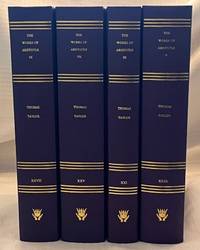
2002rif. 7893Guildford: The Prometheus Trust 2002. Cloth bound uniform with other titles in the series in fine condition. Thomas Taylor Series XXI; 390 pages. The Prometheus Trust unknown
rif. V15OS-00206The Great Books Foundation Chicago. Used - Good. Good condition. Vol. 4 spine splitting. Slipcase Good. 9 Volume set plato tolstoy shakespeare The Great Books Foundation Chicago unknown
1955rif. 1057758The Great Books Foundation Chicago 1955. Trade Paperback. Very Good. Box set is strong with heavy wear at corners and edges. Books themselves have some reading wear but unmarked. fmc2%262D. The Great Books Foundation Chicago paperback
1995rif. RARIGRE00kwEaston 1995. Fine. Aristotle. The Great Philosophers. 12 vols. Plato; Kant Immanuel; Locke John; Descartes Rene; Kierkegaard Soren; de Spinoza Benedict; Nietzsche Friedrich; Hume David; Berkeley George; Mill John Stuart; Hegel Georg W. F. Norwalk: Easton 1995. 8vo. Book condition: Near fine. Easton Press Published expressly for the personal library of bookplate sticker laid in each vol. Easton unknown books
2026rif. LRB83225Paris: Editions Recreasoft 2026 Language: English. Approximately 549 pages. English : Print-on-demand reprint. Original edition : 1840. This modern reproduction of The Grecian drama: a treatise on the dramatic literature of the Greeks. by Darley John Richard Bp. of Kilmore Elphin and Ardagh 1799-1884.; Twining Thomas 1735-1804 tr.; Aristotle makes an old or rare text available for consultation bibliographic research and specialized collections. Book images are non-contractual. Editions Recreasoft. Softcover. New. Editions Recreasoft paperback
rif. A9781169316478New. unknown
rif. B9781162666082New. unknown