1 881 résultats
1970réf. 14546Manchester University Press. As New in As New dust jacket. Hardcover. FREE UPGRADE to Courier/Priority Shipping Upon Request - IN STOCK AND IMMEDIATELY AVAILABLE FOR SHIPMENT - Book In fine Condition. -- with a bonus offer--; 014546 . 1970. Manchester University Press hardcover
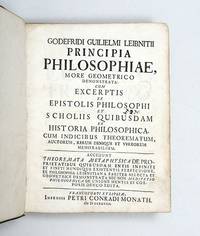
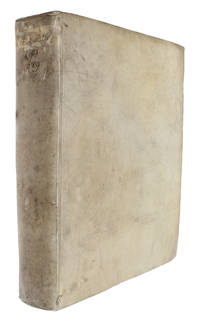
1728réf. 149331Frankfurt and Leipzig: Peter Conrad Monath 1728. An exposition of Leibnizianism First edition of this exposition on Leibniz's philosophy by a contemporary of the philosopher; including a Latin translation of Leibniz's Monadology. "Little is known of Michael Gottlieb Hansch. A theologian from Leipzig and adviser to the Emperor Charles VI he knew Leibniz personally from 1707 onwards. He was thus in an excellent position to acquaint himself with Leibnizian thought having been in correspondence with Leibiniz for five years prior to the writing of the Monadology 1707-13. The first 19 pages of the present work consisted of Hansch's Latin translation of Monadology. Then followed the geometrical demonstration of Leibniz's definitions 2 axioms and 114 theorems. Hansch's erudite commentary on the Monadology contains excerpts from Leibniz's letters and teems with references to the Leibniz-Clarke correspondence the Theodicy the Système nouveau Leibniz's reply to difficulties expressed by Bayle in his article Rosarius in tome II of the Receuil to the Oratio de Sinarum philosophica practica of Wolff. The book contributed to Condillac's understanding of Leibnizian thought" Hine pp. 94-95. Hansch is perhaps best known as the purchaser of and publisher of Kepler's letters a project in which Leibniz took great interest. Quarto 207 x 169 mm. Contemporary vellum manuscript title to spine orange speckled edges. Light discolouration to vellum else binding in nice shape contents browned; a very good wide-margined copy. Ravier 381. Ellen McNiven Hine A Critical Study of Condillac's "Traite des Systemes" 1979. hardcover
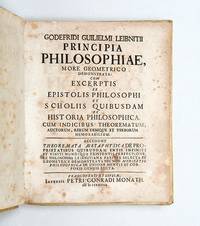
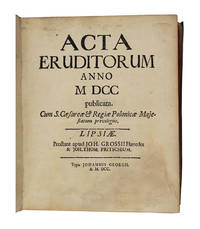
réf. 52885Lipsiae J. Grossius 1700. Small 4to 19.6 x 15.8 cm. pp. 198-208 in the complete volume for the year 1700 containing a total of 586 pp. and ten plates. Contemporary vellum binding with leather title label and gilt lettering. = Leibniz' reaction to Nicolas Fatio de Duillier at the height of the controversy between Leibniz and Newton over the invention of calculus. Up until 1693 the method of fluxions which had been invented by Newton and had been of great assistance to him in his mathematical investigations was still except to Newton and his friends a secret. Newton admirers in the Netherlands informed him that the method of fluxions had been introduced there under the name of Gottfried Leibniz's Calculus Differentialis. In 1699 Nicolas Fatio de Duillier published a tract in which he stated that Newton was by several years the first inventor of the calculus and insinuated that Leibniz had stolen the idea. It was the start of a serious controversy between Leibniz and Newton carried on by their followers for years after both famous mathematicians had died. In this article in the Acta Eruditorum Leibniz replied to Fatio de Duilleir by citing Newton's letters and the testimony that Newton had rendered to him in the Principia as proofs of his independent authorship of the method. A very good copy in contemporary vellum; ancient library stamp and superimposed cancellation stamp on verso of title small paper label with call number on bottom of spine and removed paste on inside cover. Vellum on covers discoloured first few pages age-toned but in general a nice clean copy. hardcover
1714réf. 1396A AMSTERDAM. CHEZ ISAAC TROYEL, LIBRAIRE. 1714. 2 VOLUMES IN-12 (10 X 16,5 X 5,5 CENTIMETRES ENVIRON) DE (36) + 386 PAGES ET (2) + 216 + 132 PAGES, RELIURE D'EPOQUE PLEIN VEAU BRUN, DOS A 5 NERFS ORNE DE CAISSONS A FLEURONS DORES, TITRE DORE SUR ETIQUETTE MAROQUIN HAVANE, TRANCHES MOUCHETEES ROUGES. RARE SECONDE EDITION DONT ON CONNAIT PEU D’EXEMPLAIRES. PETIT MANQUE DE PAPIER SANS MANQUE DE TEXTE EN MARGE INFERIEURE BASSE DU PREMIER FEUILLET DE PREFACE DU TOME I, PETITE ROUSSEUR AYANT CAUSE UN PETIT TROU SANS GRAVITE PAGES 11/12 ET 161/162 DU TOME I, QUELQUES PETITS DEFAUTS EXTERIEURS, SINON BON EXEMPLAIRE.
réf. 2083002115601918Kosaku-sha N.A. Soft Cover. Fine. Size: 22cm Kosaku-sha paperback
1690réf. NF2365REFLEXIONS SUR LES DIFFERENTS DE LA RELIGION troisiESme VOLUME. Ou Les chimEres de M. Jurieu RESPONSE GENERAL A SES LETTRES PASTORALES DE LA SECONDE ANNEE CONTRE LE LIVRE DES REFLEXIONS ET EXAMEN ABREGE DE SES PROPHETIES A Paris Chez Gabriel Martin 1690 first and only edition 12 mo 18 pp. 260 pp. 4pp. bound with DE LA TOLERANCE DES RELIGIONS. LETTRES DE M. DE LEIBNIZ ET RESPONSES DE M. PELLISON: OU QUARTRIEME PARITE DE REFLEXIONS SUR LES DIFFERENDS DE LA RELIGION A Cologne de l'Imprimerie d'Andre Pierrot 1692 206 pp. 2 pp. a tight vg copy bound in the publishers original vellum with the bookplate of Giorgio Di Veroli. Gabriel Martin & Andre Pierrot hardcover
1690réf. NF2365REFLEXIONS SUR LES DIFFERENTS DE LA RELIGION troisiESme VOLUME. Ou Les chimEres de M. Jurieu RESPONSE GENERAL A SES LETTRES PASTORALES DE LA SECONDE ANNEE CONTRE LE LIVRE DES REFLEXIONS ET EXAMEN ABREGE DE SES PROPHETIES A Paris Chez Gabriel Martin 1690 first and only edition 12 mo 18 pp. 260 pp. 4pp. bound with DE LA TOLERANCE DES RELIGIONS. LETTRES DE M. DE LEIBNIZ ET RESPONSES DE M. PELLISON: OU QUARTRIEME PARITE DE REFLEXIONS SUR LES DIFFERENDS DE LA RELIGION A Cologne de l'Imprimerie d'Andre Pierrot 1692 206 pp. 2 pp. a tight vg copy bound in the publishers original vellum with the bookplate of Giorgio Di Veroli. Gabriel Martin & Andre Pierrot hardcover books
1695réf. 42860Leipzig, Grosse & Gleditsch, 1695. 4to. Contemp. full vellum. Faint handwritten title on spine. A small stamp on titlepage and pasted library label to pasted down front free end-paper. In: ""Acta Eruditorum Anno MDCXCV"". (2), 560, (52) pp. + 10 plates. As usual with various browning to leaves and plates. The entire volume offered. Leibniz's papers: pp. 145-57" 184-185 310-316 369-372 493-495. Jacob Bernoulli's paper: pp. 537-553 + one folding table 65-66. Johann Bernoulli's: pp. 59-65" 374-376.
1695réf. 42860Leipzig Grosse & Gleditsch 1695. 4to. Contemp. full vellum. Faint handwritten title on spine. A small stamp on titlepage and pasted library label to pasted down front free end-paper. In: "Acta Eruditorum Anno MDCXCV". 2 560 52 pp. 10 plates. As usual with various browning to leaves and plates. The entire volume offered. Leibniz's papers: pp. 145-57; 184-185; 310-316; 369-372; 493-495. Jacob Bernoulli's paper: pp. 537-553 one folding table; 65-66. Johann Bernoulli's: pp. 59-65; 374-376. First printing of a series of influential papers by Leibniz Jacob Bernoulli and Johann Bernoulli.First publication of Jakob Bernoulli's famous and influential "Bernoulli Equation". In "Notatiuncula Constructiones Lineae" Bernoulli proposed a solution to non linear equations which today is one of the most common used solutions of the general fluid. Bernoulli equations are significant because they are nonlinear differential equations with known exact solutions. In the "Specimen dynamicum" Leibniz presents a conception of body and force which distinct between primitive and derivative forces and between active and passive forces. This article is regarded as being the clearest exposition of Leibniz' dynamics. DSB VII 151b."The first attempt at a detailed account of the dynamics was a long dialogue the "Phoranomus seu de potentia et legibus naturae" written in July 1689 while Leibniz was in Rome. This was quickly followed be the composition of the massive Dynamica de potential et legibus naturae corporeae 1689-90 . Though it was written with the intention of publication and though Leibniz work at publishing it he never considered it entirely finished and it remained unpublished during his lifetime.The later . he finally revealed some of the metaphysical foundations of the project in an essay the present paper." Garber Daniel. Leibniz: body substance monad. 2009. 132 p."Its title suggests a summary of or a selection from the earlier work . However it actually contains something in a way rather more interesting: a careful exposition of the metaphysical foundations of the new science something that is hard to find in the old Dynamica or any of the more Technical pieces." Garber Daniel. Leibniz: Body Substance Monad. 2009. 133 p. hardcover
1728réf. 149005Frankfurt and Leipzig: Peter Conrad Monath 1728. Leibnizianism outlined by a contemporary First edition of this exposition on Leibniz's philosophy by a contemporary of the philosopher; including a Latin translation of Leibniz's Monadology. "Little is known of Michael Gottlieb Hansch. A theologian from Leipzig and adviser to the Emperor Charles VI he knew Leibniz personally from 1707 onwards. He was thus in an excellent position to acquaint himself with Leibnizian thought having been in correspondence with Leibiniz for five years prior to the writing of the Monadology 1707-13. The first 19 pages of the present work consisted of Hansch's Latin translation of Monadology. Then followed the geometrical demonstration of Leibniz's definitions 2 axioms and 114 theorems. Hansch's erudite commentary on the Monadology contains excerpts from Leibniz's letters and teems with references to the Leibniz-Clarke correspondence the Theodicy the Système nouveau Leibniz's reply to difficulties expressed by Bayle in his article Rosarius in tome II of the Receuil to the Oratio de Sinarum philosophica practica of Wolff. The book contributed to Condillac's understanding of Leibnizian thought" Hine pp. 94-95. Hansch is perhaps best known as the purchaser of and publisher of Kepler's letters a project in which Leibniz took great interest. Quarto 199 x 153 mm. Contemporary calf tooled in compartments blind borders to covers marbled edges. Front endpapers with various ownership inscriptions and notes from 1759 to 1800 in Latin; twentieth-century ink stamp on title page of Samuel Zocha of Modra Slovakia. Extremities worn spine dulled light ring mark to front cover binding firm contents crisp and clean; a very good copy. Ravier 381. Ellen McNiven Hine A Critical Study of Condillac's "Traite des Systemes" 1979. unknown
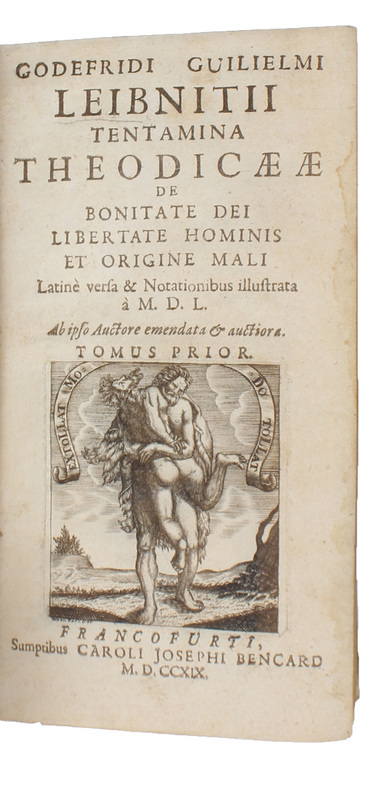
1719réf. 49802Franckfurt, Bencard, 1719. 8vo. Contemp. full vellum. A few small brownspots to covers. Large engraved titlevignette. (48),(40),408,(12) pp. 1 folded table (between p.48/49). Clean and fine.
1719réf. 49802Franckfurt Bencard 1719. 8vo. Contemp. full vellum. A few small brownspots to covers. Large engraved titlevignette. 484040812 pp. 1 folded table between p.48/49. Clean and fine. Extremely scarce first Latin edition of Leibniz's hugely influential work "Essais de Theodicée sur la Bonté de Dieu la Liberté de L'Homme et L'Origine du Mal" 1710. It is his importent treatise on the goodnes of God the free will of man and the causes of evil in the world The principal subject of the work being the problem of liberty and free will. It is the only larger philosophical work published by Leibnitz himself.The "Théodicée" was a response to skeptical Pierre Bayle who wrote in his work Dictionnaire Historique et Critique that after rejecting three attempts to solve it he saw no rational solution to the problem of evil.The work was composed at the instigation of Sophia Charlotte with whom Leibniz had conversed concerning the views of Bayle. In response to a request from Prince Eugene for an abstract of the Théodicée Leibniz in 1714 wrote the "Principes de la nature et de la grâce fondées en raison and the Monadologie".It is often the case that this Latin edition is followed by the small work "Causa Dei Asserta per Justitiam Ejus." 32 pp. This work is not withbound here.Ravier "Bibliographie des Oeuvres de Leibniz" No 344. - PMM 1710-edition. hardcover
réf. 59436Amsterdam et Leipzig: Chez Jean Schreuder 1765. FIRST EDITION THUS. Large 4to.26 x 19.5 cm. pp.xvi2 Table & Errata54016Table des Principales Matières. Contemporary full mottled calf sides ruled in blind spine with raised bands and gilt-decorated with floral motifs red morocco label lettered in gilt marbled endpapers and edges. Title-page printed in red and black. Engraved vignette to title-page by O. de Vries decorative woodcut head-pieces culs-de-lampe and initials throughout. Lightly rubbed a few tiny wormholes to foot of spine occasional browning and light spotting generally an excellent copy in a handsome contemporary binding. First edition thus being the first collected edition of Leibnitz' philosophical works in French and Latin and containing the FIRST PRINTING of one of Leibnitz' most important philosophical works his "Nouveaux essays sur l'entendement humain" a riposte to John Locke's "Essay on Human Understanding" which Leibniz had read in Pierre Coste's celebrated French translation of 1704. "The New Essays.are a detailed commentary on Locke's Essay and thus represent an almost unique case in which one major philosopher produces a paragraph-by-paragraph critique of the principal work of another. Leibniz had practically completed the manuscript by 1704 but after learning that Locke had died he apparently lost interest in publishing it. He put it aside and it did not appear in print until 1765 nearly fifty years after his death" Benson Mates. Written directly in French this extensive treatise pp.1-496 comprises most of this collection and also constitutes one of the largest and most important of Leibniz's philosophical contributions being in addition to the Theodicy one of only two full-length works which Leibniz ever produced. Like many philosophical works of the time it is written in dialogue form. The two speakers in the book are Theophilus "lover of God" who represents the views of Leibniz and Philalethes "lover of truth" who represents those of Locke. The famous rebuttal to the empiricist thesis about the provenance of ideas appears at the beginning of Book II: "Nothing is in the mind without being first in the senses except for the mind itself". All of Locke's major arguments against innate ideas are criticized at length by Leibniz who defends an extreme view of innate cognition according to which all thoughts and actions of the soul are innate. In addition to his discussion of innate ideas Leibniz offers penetrating criticisms of Locke's views on personal identity free will mind-body dualism language necessary truth and Locke's attempted proof of the existence of God. The Encyclopedia of Philosophy IV p. 431. Amsterdam et Leipzig: Chez Jean Schreuder, 1765. hardcover
1744réf. 149335Hanover & Leipzig: In Verlag sel. Nicol. Försters und Sohns Erben 1744. The first appearance of the standard text First Gottsched edition of the Théodicée first 1710 the version which remains the standard German text expanded with important additions. The Sprachreformer Johann Christoph Gottsched aimed at freeing the text from the inaccessibly convoluted metaphysical language of Richter's translation 1720. Fontenelle's eulogy to Leibniz introduces the text while addressing the Newton-Leibniz controversy over priority in the discovery of differential calculus. The appendix adds several short works by Leibniz relevant to the issues dealt with in the Théodicée; of those four appear here in German for the first time. The choice of essays reflected Gottsched's plan to integrate Leibniz's mathematical-scientific and metaphysical work: included in the selection are works on the binary system the fundamental and typographically complex Rechnung mit Null und Eins and the description of Leibniz's invention the first calculating machine capable of performing all four arithmetical operations accompanied by an engraved plate. Octavo 181 x 112 mm. With engraved portrait frontispiece by C. F. Boctius and engraved folding plate of the calculating machine. Twentieth-century sheep to style marbled and speckled edges. Light peripheral rubbing small chip to label lettered over light toning and sporadic foxing but contents generally crisp; a very good copy. Ravier 421; Fromm VI 28315; see Printing and the Mind of Man 177 first edition. unknown
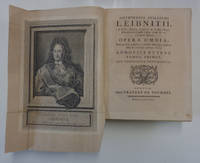
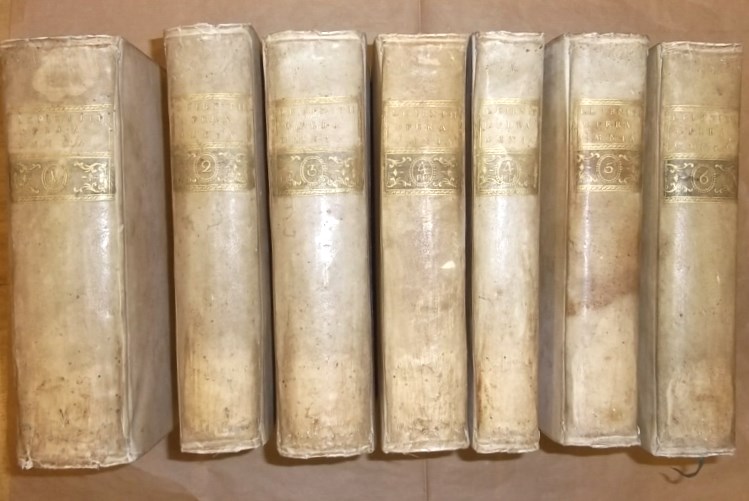
1768réf. 009245Genevae: Apud Fratres De Tournes 1768. Alla pagina di occhiello: "Gothofredi Guillelmi Leibnitii Opera omnia. In sex tomos distributa". Sei tomi in sette volumi 25x20 cm legatura coeva in mezza pelle con dorso ornato e dorato piatti in cartone marmorizzato con usure; un paio di volumi risultano incurvati qualche spellatura alla cerniera e al dorso di due volumi. Gora vistosa al tomo 1 da pag. C a 70 che ha increspato le pagine che poi sfuma in angolo. Gora al margine delle prime pp del tomo 2 fino a p. 18 e poi all'angolo superiore di p. 219-307. Foretto di tarlo senza gravità all'angolo inferiore delle pp 9-30 del tomo 3. Fioriture e tracce di antica umidità alle risguardie dei primi due tomi. 40 tavole in b/n ripiegate fuori testo altre figure e tabelle anche a piena pagina nel testo. Il legatore settecentesco ha scelto di dividere il tomo IV in due volumi numerati 4 e 5 al dorso con la conseguenza di far "slittare" anche i numeri degli ultimi due tomi numero 6 per il tomo V e numero 7 per il tomo VI. L'opera è così articolata: Volume 1: Tomus primus quo theologica continentur. 2-IV-CCXLIV-790 pagine antiporta incisa ripiegata con ritratto di Leibnitz. Segnatura: a-gg4 hh2; A-Ggggg4 - Volume 2: Tomus secundus in duas partes distributus quarum 1. Continet Logicam & Metaphysicam; 2. Physicam generalem Chymiam Medicinam Botanicam Historiam Naturalem Artes &c. 2-VIII-400-291-1 pagine 12 tavole ripiegate in fine. Segnatura: 2ast.4 A-Ddd4 Tomo II parte I; A-Nn4 Oo2 Tomo II parte II - Volume 3: Tomus tertius continens opera mathematica. 2-VIII-LV-1-663-1 pagine XXV tavole ripiegate in fine. Segnatura: piè di mosca4 a-Oooo4 - Volumi 4 e 5: Tomus quartus in tres partes distributus quarum 1. continet Philosophiam in genere & opuscula Sinenses attingentia. 2. Historiam & Antiquitates. 3. Jurisprudentiam. Volume 4: VIII-216-285 pagine; segnatura: 2piè di mosca4 A-Dd4 Tomo IV parte I; A-Nn4 Tomo IV parte II. Volume 5: 2-647-1 pagine; segnatura: A-Mmmm4 Tomo IV parte III - Volume 6: Tomus quintus continens opera philologica. VIII-632 pagine; segnatura: croce latina4 A-Kkkk4. Tra le pagine 512 e 513 è stata inserita dal rilegatore una tavola pertinente al Tomo IV l'esatta posizione è stata tagliata dalla rifilatura - Volume 7: Tomus sextus in duas partes distributus quarum 1. continet philologicorum continuationem 2. collectanea etymologica. VI-2-334 2-344 pagine; segnatura: 2croce latina4 A-Tt4 parte I A-Vv4 Parte II. Tra le pagine 88 e 89 è stata inserita dal rilegatore una tavola pertinente al Tomo IV parte II pagina 88. In lingua latina prima edizione delle opere di Leibniz. Peso: 9500 gr. Apud Fratres De Tournes
1691réf. 41859Leipzig, Grosse & Gleditsch, 1691. 4to. Contemp. full vellum. Faint handwritten title on spine. a small stamp on titlepage. In: ""Acta Eruditorum Anno MDCLXXXXI"". Leibniz' papers: pp.277-281 a. 1 plate, pp. 435-439. Johann Bernoulli: pp. 274-276 a. 1 plate. Huygens: pp. 281-282. - Jacob Bernoulli: pp. 282-290 a. 1 plate. Entire volume: (8), 590, (6) pp. and 13 (of 15) folded engraved plates - the two plates lacking are the first two of the volume and do not belong to the papers listed.
1691réf. 41859Leipzig Grosse & Gleditsch 1691. 4to. Contemp. full vellum. Faint handwritten title on spine. a small stamp on titlepage. In: "Acta Eruditorum Anno MDCLXXXXI". Leibniz' papers: pp.277-281 a. 1 plate pp. 435-439. Johann Bernoulli: pp. 274-276 a. 1 plate. Huygens: pp. 281-282. - Jacob Bernoulli: pp. 282-290 a. 1 plate. Entire volume: 8 590 6 pp. and 13 of 15 folded engraved plates - the two plates lacking are the first two of the volume and do not belong to the papers listed. First appearance of all five papers all being of extreme importance in the development of the Calculus. Leibniz' two papers on the catenary curve paper 1-2 offered here were written at the instigation of Jacques Bernoulli. Following the example of Blaise Pascal who had initiated in 1658 a contest for the construction of the cycloid Leibniz also provoked the geometers of his time by challenging them to submit at the fixed date of mid-1691 their geometric method for the construction of the catenary curve. Leibniz later provided the answer followed by Johann Bernoulli and Huygens.'These two papers are a historical account of the origin of the study of this transcendental curve and at the same time the first physical-geometric construction showing the species-relationship between the catenary and the logarithmic curves as two companion curves; one arithmetic the other geometric. All of the differentials of the catenary curve are arithmetic means of corresponding differentials of the logarithmic curve; and all of the differentials of the logarithmic curve are geometric means of the catenary.'"The Catenary is the form of a hanging fully flexible rope or chain the name comes from "catena" which means 'chain' suspended on two points. The interest in this curve originated with Galileo who thought that is was a parabola. Young Christiaan Huygens proved in 1646 that this cannot be the case. What the actual form was remained an open question till 1691 when Leibniz Johann Bernoulli and the then much older Huygens sent solutions to the problem to the "Acta" Jakob Bernoulli 1690 Johann Bernoulli 1691 Huygens 1691 and Leibniz 1691 - these 4 1691-papers offered here - in which the previous year Jakob Bernoulli had challenged mathematicians to solve it. As published the solutions did not reveal the methods but through later publications of manuscripts these methods have been known. Huygens applied with great paper 4 virtuosity the by then classical methods of 17th century infinitesimal mathematics and he needed all his ingenuity to reach a satisfactory solution. Leibniz the papers 1-2 and Bernoulli paper 3 applying the new Calculus found the solutions in a much direct way. In fact the catenary was a test-case between the old and the new style in the study of curves and only because the champion of the old style was a giant like Huygens the test-case can formally be considered as ending in a draw." Grattan-Guiness in "From the Calculus to Set Theory 1630-1910.".The paper by JACOB BERNOULLI no. 5 offered here is a milestone papers as it marks the invention of the "SYSTEM OF POLAR COORDINATES" with points located by reference to a fixed point and a line through that point. Although newton had earlier also devised such a coordinate system in 1671 his work was not known so that the credit for the discovery generally goes to Bernoulli. Parkinson Breakthroughs 1691.Further papers contained in this volume of Acta Eruditorum:DENYS PAPIN: Mecanicorum de Viribus Motricibus sententia asserta a D. Papino adversius C.G.G. L. Leibniz objectiones. pp. 6-13. The plate lacks. - and Dion. Papini Observationes quaedam circa materias ad Hydraulicam spectantes. Pp. 208-213 a. 1 plate. This importent paper is part of the LEIBNIZ-PAPIN-CONTROVERSY.JACOB BERNOULLI: Specimen Calculi Differentialis in dimensione Parabolæ helicoidis ubi de flexuris curvarum in genere carundem evolutionibus. Pp. 13-22. The plate lacks. - and J.B. Demonstratio Centri Oscillationis ex Natura Vectis reperta occassione eorum quæ super hac materia in Historia Literaria Roterodamensi recensentur articulo.Pp.317-321.LEIBNIZ: O.V.E. Additio ad Schediasma de Medii Resistentia publicatum in Actis mensis Febr. 1889. Pp. 177-178. and O.V.E. Quadratura Arithmetica Communis Sectionum Conicarum quæ centrum babent.Pp. 178-182 a. 1 plate.TSCHIRNHAUS: Singularia Effecta Vitri Caustici bipedalis quod omnia magno sumtu hactenus constructa specula ustoria virtute superat per D.T. Pp. 517-520 hardcover
1696réf. 32Hannov. et Gurlpherpit Hannover Wolfenbütte: Gothofredi Freytagii Gottfried Freytag 1696. First edition. Papered spine. Printer’s device on last page. In fine condition. First edition. Papered spine. Printer’s device on last page. 8º; a1–b8 c1–3 .; 37 1 p. Scarce pharmacological work on the ipecacuanha root that can be used as an emetic nauseant expectorant and diaphoretic. “Relatio ad inclytam Societatem Leopoldinam Naturae Curiosorum de novo antidysenterico Americano magnis successibus comprobato” Relation to the Illustrious Leopoldine Society of Naturalists Concerning the New American Anti-Dysentery Drug Attested with Great Success is Leibniz’s most comprehensive and influential contribution to the history of medicine and pharmacy. Leibniz wrote the treatise after he read the study on ipecacuanha root written by Willem Piso and Georg Marggraf published in Historia naturalis Brasilia 1648 and evidently after conducted experiences with the root himself. The root was made famous after it was used successfully to treat the King of France Louis XIV’s dysentery in 1672 by the Dutch physician John Frederick Helvetius 1625–1719. The work has been published in the same year as an appendix to Martin Lister’s “Sex exercitationes medicales de quibusdam morbis chronicis” Frankfurt and Leipzig 1696 and also to “Miscellanea curiosa sive Ephemeridum medico-physicarum Germanicarum” Nuremberg 1696. Lister’s work was printed by Freytag too the difference is merely the lack of the colophon on the “Lister-edition”. Ref.: Smith J. E. H.: Divine Machines. Leibniz and the Sciences of Life. Princeton University Press 2011.; Dutens II. 2. pp. 110–119.; Ravier 36. . Gothofredi Freytagii (Gottfried Freytag) unknown
1768réf. 13828Genf, de Tournes, 1768. 6 in 7 Bdn. 1 gefalt. Kupferporträt, 41 gefalt. Kupfertafeln und 1 gefalt. Tabelle. Kl.-4°. Pgmt. der Zeit mit Rückenschild (etw. verzogen, fleckig, bestoßen und wurmstichig).
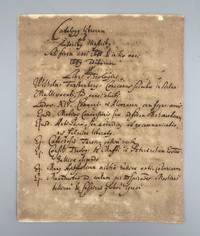
1700réf. 02965Germany 1700. A single quire unbound evidence of earlier sewing. LEIBNIZ’S CATALOG OF FIFTY-TWO IMAGINARY BOOKS satirizes European political and military maneuvering in 1688-9 at the outset of the Nine Years’ War. The text was printed in Latin this version and in Latin and German. Together three editions survive in four examples all in German-speaking countries. Leibniz 1646-1716 grouped the works into theology eighteen law eight medicine ten and philosophy fourteen and closed with two “forthcoming publications”. The titles’ scholarly veneer hardly disguises his harsh view of contemporary politics. This manuscript copy was likely made between 1691 and 1716 while Leibniz was librarian at Wolfenbüttel then the largest library north of the Alps. Browned the inner bifolium less so. unknown
1768réf. 115831768 Genève, Fratres de Tournes, 1768, 6 tomes en 12 vol. in 4 de 1f. blanc-IV-(2)-CCXLIV-296 pp. ; (2) blanc, (2)- p. 297 à p. 790 ; 1f. blanc-(2)-VIII-400 pp. ; 1 f. blanc-291 pp. ; 1 f. blanc-(2)-LV-272 pp. ; 1 f. blanc, (2)- p. 273 à p. 663 ; 1 f. blanc-VIII-285 pp. ; 1 f. blanc-VIII-352 pp. ; 1f. blanc-(2)-647 pp. ; 1 f. blanc-(2)-p. 353 à p. 632 ; 1f. blanc, VI-1 f. blanc-334 pp. ; 1 f. blanc-344 pp., rel. d'ép. demi-velin ivoire à coins, dos lisses ornés de fleurons et roulettes dorées, pièces de titres de maroquin vert et de tomaisons de maroquin rouge, plats recouverts de papier dominoté à motifs d'étoiles vieux rouge (orange), bel ex. non rogné.
1765réf. 38096Amsterdam et Leipzig, Chez Jean Schreuder, 1765. 4to. Uncut in the original marbled boards. Professionally rebacked preserving almost all of the original back. The fragile orginal binding is here preserved in its entirety, and it has quite a bit of overall wear. Apart from a small hole to two leaves in the index, affecting ab. one work on each of the four pages, it is internally nice and clean. Title-page printed in red and black. Beautiful eng. title-vignette and a few other woodcut vignettes and initials. (4), XVI, (2), 540, (18) pp.
1765réf. 38096Amsterdam et Leipzig Chez Jean Schreuder 1765. 4to. Uncut in the original marbled boards. Professionally rebacked preserving almost all of the original back. The fragile orginal binding is here preserved in its entirety and it has quite a bit of overall wear. Apart from a small hole to two leaves in the index affecting ab. one work on each of the four pages it is internally nice and clean. Title-page printed in red and black. Beautiful eng. title-vignette and a few other woodcut vignettes and initials. 4 XVI 2 540 18 pp. First edition thus being the first collected edition of Leibnitz' philosophical works in French and Latin and containing the FIRST PRINTING of one of Leibnitz' most important philosophical works his "Nouveaux essays sur l'entendement humain" New Essays on Human Understanding in which he attacks and refutes Locke and his "Essay on Human Understanding" and gives important testimony to his own philosophical ideas. With its 496 pages this extensive work takes up most of this collection of philosophical works and it also constitutes one of his largest and most important of his philosophical works. As explained by Raspe the editor in his preface to this publication "LES NOUVEAUX ESSAIS SUR L'ENTENDEMENT HUMAIN qui sont la partie principale de recueil sont connûs trés imparfaitement par l'histoire de la Philosophie de Leibnitz que Mr. Ludovici a publiée" p. X and the reason why the work was known even though it had not been published is because of a letter that Leibnitz had written in 1714 in which he explains why he did not wish to publish the work. Raspe quotes the letter p. X from which it becomes clear that Leibnitz had not wished to publish an attack on Locke and his work because Locke had died in 1704 the same year that Leibnitz had actually written the work and because Leibnitz was against publishing refutations of dead authors: "Mais je me suis degouté de publier des refutations des Auteurs morts quoiqu'elles dissent paroitre Durant leur vie & étre communiqués à eux memes". Raspe points to the nobleness of this decision but he also points to what could be other reasons for Leibnitz not wishing to publish his seminal work one of them being that towards the end of his life he died in 1716 he did not wish to enter into any more controversies with the British since he was already engaged in two very important ones that occuopied much of his time and energy: The first concerned the invention of the differential calculus the second was against Mr. Clarke on liberty and important metaphysical and theological questions. Another reason could also be that he did not want to begin controversies with the friends of Locke who at that time were many and important.Locke's "An Essay Concerning Human Understanding" which is the work here being refuted by Leibnitz became the crucial groundwork for the future empiricists with David Hume in the foreground and thus Leibnitz' work though published posthumously probably came to play a bigger role in the history of philosophy than it would have done had it been published just after he wrote it. Few philosophers of his time were susceptible to Leibnitz' ideas and his application of logic to the problems of metaphysics as most of them were far more receptive to Locke's empiricism. However when Leibnitz' "Nouveaux essays." was finally published here in his "Oeuvres philosophiques" in 1765 it became hugely influential and was also an important factor in the development of Kant's transcendental philosophy.The hugely famous work by Locke in which he stated his famous theory that the mind of the newborn is like a blank slate tabula rasa and concluded that all ideas come from experience and that there are no such things as innate principles was generally sharply criticized by the rationalists the most important of them being Leibnitz. Leibnitz' response his "Les nouveaux essays sur l'entendement humain" constitutes the most important of the rationalist responses and it is written in the form of a chapter-by-chapter refutation. He refutes the major premise of Locke's work that the senses are the source of all understanding primarily by adding to this "except the understanding itself" thus going on to distinguish between his three levels of understanding which are part of the centre of his philosophy.For Leibnitz as well as for Locke the great inspiration was Descartes but they chose two fundamentally different directions Locke the materialistic one and Leibnitz the idealistic one. The present work represents the greatest clash between the two giants of late 17th century philosophy. The effect of Leibnitz' work was enormous and among the Germans he invoked a great passion for philosophical studies. Leibnitz represents a striking contrast to both Locke with his empiricism and Spinoza. One earlier collection of some of Leibnitz' works had been printed before this one but it did not contain his "New Essays on Human Understanding" and only consisted of his "Smaller Philosophical Works". This is the German 1740-edition "Kleinere philosohische Schriften". The other writings contained in this publication are "Examen du sentiment du P. Malebranche que nous voyons tout en Dieu" ""Dialogus de connexione inter res & verba" "Difficultates quaedam Logicae" "Discours touchant la methode de la certitude & de l'art d'inventer" "Historia et commendatio charactericae universalis quae simul sit ars inveniendi".Graesse IV:152. hardcover
1689réf. 41661Leipzig Grosse & Gleditsch 1689. 4to. Contemporary full vellum. Faint hand-written title to spine. A small stamp on title-page. In: "Acta Eruditorum Anno MDCLXXXIX". 8 653 7 pp. and 15 engraved plates. As usual with various browning to leaves and plates. The entire volume offered. Leibniz's papers: pp. 36-38 a. 1 engraved plate; pp. 38-46; pp. 82-89 a. 1 engraved plate; pp. 195-198. First printing of these extremely important papers in which Leibniz claimed that he independently of Newton had discovered the principal propositions of his "Principia" and which present us with Leibniz's fundamental physico-mathematical theory his dynamics his concepts of force space and time. The "Tentamen." constitutes Leibniz's response to Newton's theories about the motion of the celestial bodies. Leibniz can be said to have anticipated the modern mathematical principle of relativity as it is his idea of individual co-ordinate systems and his practical rejection of the Galilean co-ordinate system that Newton adopted. Leibniz opposes Newton's ideas of attractions gravitational forces and calls them "occult qualities". The task of the "Tentamen." was to attain a theory mathematically equivalent to Newton's in accounting for planetary motion and especially for the inverse-square law of Kepler's laws but physically sound and capable of explaining the causes of phenomena.Newton attacked Leibniz's claim of priority in his anonymously published paper "Commercium epistolicum" Phil. Transactions 1714 and states that "in those tracts the principal propositions of that book are composed in a new manner and claimed by Mr. Leibniz as if he had found them himself before the publishing of the said book. But Mr. Leibniz cannot be a witness in his own cause. It lies upon him either to prove that he had found them before mr. Newton or to quit his claim." The features of Leibniz's mathematical representation of motion as put forward in "Tentamen." are see D.B. Meli: Equivalence and Priority. Newton versus Leibniz. pp. 90-91:- Empty space does not exist. The world is filled with a variety of fluids which are responsible for physical actions including gravity.- Living force and its conservation are the fundamental notion and principle respectively in the investigation of nature however they do not figure prominently in the study of planetary motion.- Finite and infinitesimal variables are regularly employed in the study of motion and of other physical phenomena. Living force and velocity are finite; solicitation and conatus are infinitesimal.- Accelerated motion whether rectilinear or curvilinear is represented as a series of infinitesimal uniform rectilinear motions interrupted by impulses. I call this 'polygonal representation'. Usually the polygon is chosen in such a way that each side is traversed in an equal element of time dt. In polygonal representations accelerations are reduced to a macroscopic phenomenon.- Propositions are often used to safeguard dimensional homogeneity. Constant factors - such as numerical factors mass and the element of time - are usually ignored in the calculations.Denys Papin's papers:1. Descriptio Torcularis cujus in Actis Anni 1688 pag. 646 mentio facta a suit. and 1 plate. Pp. 96-101.2. De Gravitatis Causa et proprietatibus Observationes. Pp. 183-188.3. Examen Machinæ Dn. Perrault. Pp. 189-195 a. 1 plate.4. Rotatilis Suctor et Pressor Hasciacus in Serenissima Aula Cassellana demonstratus & detectus. Pp. 317-322 a. 1 plate.5. In J.B. Appendicem Illam Ad Perpetuum Mobile Actis Novemb.A. 1688 p. 592.Pp. 322-324 a. 1 plate.6. Excerpta et Litteris Dn. Dion Papini ad --- de Instrumentis ad flammam sub aqua conservandam. Pp. 485-489 a. 1 plate.With the paper describing and depicting Papin's famous invention of the CENTRIFUGAL PUMP. Rotatilis Suctor et Pressor Hasciacus in Serenissima Aula Cassellana demonstratus & detectus. - The paper offered no.4.Jakob Bernoulli's papers:1. De Invenienda Cujusque Plani Declinatione ex unica observatione projectæ a flylo umbræ. Pp. 311-316 a. 1 plate.2. Vera Constructio geometrica Problematum Solidorum & Hypersolidorum per rectas lineas & circulos. Pp. 586-588 a. 1 plate.3. Novum Theorema Pro Doctrina Sectionum Conicarum. Pp. 586-588 a. 1 engraved plate. hardcover
1689réf. 41661Leipzig, Grosse & Gleditsch, 1689. 4to. Contemporary full vellum. Faint hand-written title to spine. A small stamp on title-page. In: ""Acta Eruditorum Anno MDCLXXXIX"". (8), 653, (7) pp. and 15 engraved plates. As usual with various browning to leaves and plates. The entire volume offered. Leibniz's papers: pp. 36-38 a. 1 engraved plate" pp. 38-46 pp. 82-89 a. 1 engraved plate" pp. 195-198.