4.802 Ergebnisse
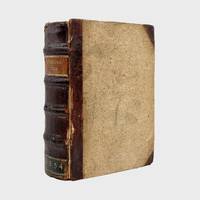
1725Best.-Nr. 1907Den Haag, Hagae, 1725. 6 Bl. Titulatur u. Einleitung (Berengarius), 163 S., mit 49 (von 50) Portraits und zahlreichen Schmuckinitialen, Schmuckvignetten (u.a. auf Titel) u. weiterem Buchschmuck. Unschöner Halbleinenband der Zeit mit handgeschriebenem Rückenschildchen. 4°.
1541Best.-Nr. 1903140038Basel: Westhemerus 1541. Hardcover. Good. 2nd ed. First published in 1538. Contemporary vellum-backed pasteboard binding. Solid binding some wear to cover extremities. All edges red. Printer's snake device verso colophon. Internally clean and unmarked. Early signature of Robert Guyard Roberti Guyardi and "Carmelus Cadomensis". A collection of Erasmus letters for the use in Latin schools. Refs: Index Aurel. 163.109 9. VD-16 E-2958. Vanderhaeghen I 101. Bezzel 1043. Cat. Rotterdam 121. De Reuck 220. Not in Adams. "Adiecimus in Calcem proverbiorum & graecarum vocum interpretationem floresq ; in elocutione latina selectissimos que omnia commentarii vice esse possunt ; opus novum et recens natum. Basel: Westhemerus hardcover
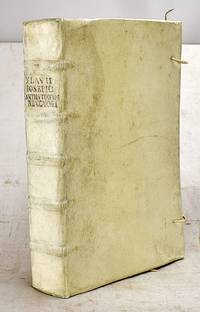
1559Best.-Nr. 1807040010Basel: Frobenium et Nicol. Episcopium Froben 1559. Hardcover. Good. Bound in contemporary 1/2 vellum. Worn cover edges. Collated: 10 of 12 preliminary pages 886 pages blank 16 leaves. Lacking 2nd preliminary leaf and top half of 3rd. Handsome Froben printer's device on title and final leaf. Internally clean. Larger figurative initials at the start of each section and smaller historiated initials throughout. All edges red. Not in Adams See Adams J 360 for first edition of 1534 De bello Judaico; Contra Apionem; De imperio rationis Later Latin edition of one of the main works of the ancient historian Flavius Josephus 38-100 on Roman-Jewish history. Basel: Frobenium et Nicol. Episcopium (Froben) hardcover
2008Best.-Nr. SONG16045022662008-05-01. 9th. paperback. Used: Good. 5.75x0.25x8.76. Buy with confidence. Excellent Customer Service & Return policy. paperback
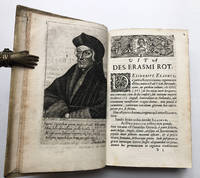
1676Best.-Nr. Flo430Very good copy of Erasmus of Rotterdam's Moriae Encomium In Praise of Folly the first edition with the marginal illustrations by Hans Holbein the Younger. Morias Enkomion. Stultitiae Laus. Des. Erasmi Rot. Declamatio Cum commentariis Ger. Listrii & figuris Jo. Holbenii. E codice Academiae Basiliensis. The illustrations were engraved by Caspar Merian after the marginal drawings in pen and ink by 18-year-old Hans Holbein in Oswald Myconius's copy of Erasmus' Encomium Moriae of 1515. The images show jesters with marottes kings and bishops nobles attacked by demons gluttons and drunks saints with monsters priests and monks in fools caps spinners astrologers etc. There is also an image of Erasmus before a lectern in his study. With three engraved full-page plates title-page portrait of Erasmus and Erasmus' memorial stone along with 78 engravings in the text 6 folding engravings mounted in the text as well as 6 decorative initials and 4 tailpieces. Lacking the portraits of Holbein the Elder and Holbein the Younger. In Praise of Folly is a satirical Latin essay by the Dutch humanist Erasmus written after a stay with Sir Thomas More in London. It was a surprising hit and was reprinted and translated into other languages throughout Europe. In contemporary vellum backed boards ivory vellum grubby and rubbed interior mostly clean with a few finger smudges all engravings bright and strong with good impressions of the woodcuts. Page 3 has a 5cm tear near the gutter with no loss of text. No markings apart from previous bookseller's pencil description on front endpaper. Very good 17th-century copy of a classic satire against the Church. Typis Genathianis hardcover
Best.-Nr. 27345Bâle, Johann Froben, 1526. 1 vol. in-folio, parchemin, dos à nerfs, titre écrit à la plume au dos, filets à froid soulignant les nerfs, double encadrement de triples filets à froid sur les plats reliés entre eux par des triples filets. Reliure du XVIIe siècle, coins usés, manques de peau le long des coupes en gouttière. Bon exemplaire. Ex-libris ms. (XVIIe s.) sur le titre et cachet du Grand Séminaire de Tours sur le titre. Titre orné de la grande marque de Froben gravée sur bois, répétée au v° du feuillet F8, premier feuillet de dédicace dans un encadrement de vignettes gravées sur bois, qq. belles lettrines ornées, (6) ff., 338 pp., (1) f. portant la marque de Froben, (6) ff. d'index. Signatures : [a-z]6 [A-E]6 F8 G6. Mouillures à partir de la p. 301 s'aggravant jusqu'à la fin du volume. Les ff. d'index ont particulièrement souffert de l'humidité, sont remmargés et présentent quelques lacunes. L'exemplaire est très frais par ailleurs. Quelques annotations marginales à l'encre dans une écriture du XVIe siècle.
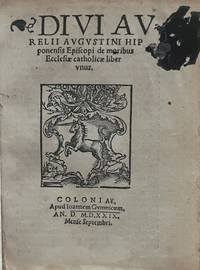
1529Best.-Nr. 3896Coloniae Köln: apud Ioannem Gymnicum Johann Gymnich I 1529. First Gymnich edition. Later paste-paper wrappers. Tinted edges. Title page with ink blot obscuring an early blind ownership stamp. Later manuscript annotation to the second leaf. Very good condition. First Gymnich edition. Later paste-paper wrappers. Tinted edges. ff. 39. A rare Cologne edition from Johann Gymnich's ambitious Augustinian publishing programme issued in the wake of Erasmus's Froben edition of Augustine. Issued in September 1529 the present edition belongs to Johann Gymnich's remarkable programme of Augustinian publications in Cologne. Between 1528 and 1533 he published sixteen editions representing fourteen different Augustinian works eight of them in 1529 alone. This publishing programme coincided with the appearance of Erasmus's monumental ten-volume edition of Augustine's Opera printed by Johann Froben at Basel between 1528 and 1529. While the Froben edition offered Augustine's complete works in an ambitious scholarly edition Gymnich issued individual treatises in inexpensive convenient format making them available independently of the costly collected Opera. By 1528 the first volumes of the Erasmian edition were already on the market and the enterprise was completed only in June 1529 a few months before Gymnich published the present work. Comparison with the contemporary Froben edition shows that Gymnich's De moribus was not conceived as an independent editorial undertaking. Adapted for publication as a separate treatise it prefixes the relevant extract from Augustine's Retractationes and employs a different system of chapter arguments while the text itself closely follows that of the contemporary Basel edition. Whether Gymnich worked directly from the Froben printing or from another witness of the same recension remains uncertain but the close chronological relationship between the two publishing programmes strongly suggests that Gymnich's Augustinian series was conceived in the context of the renewed demand generated by Erasmus's edition. Written shortly after Augustine's conversion De moribus ecclesiae catholicae is one of his earliest anti-Manichaean treatises. Addressed principally against the Manichaeans it defends the moral teaching and ascetic ideals of the Catholic Church while setting them against those of its rival. . apud Ioannem Gymnicum [Johann Gymnich (I)] unknown
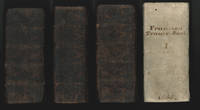
Best.-Nr. 0972-24Nürnberg Michael u. Johann Friedri. Endter 1665-1681. 4 vols. =complet. Deren etliche aus andren Sprachen übersetzt doch allhie mit unrer Teutschen Mutterzunge etwas umständlicher richtiger lehrreicher und völliger ausgesprochen und erzehlet. 8°. Jew. mit gest. Frontisp. Bd. 1: Pgmt.-Bd. d. Zeit mit handschriftl. Rückentitel u. blindgeprägtem Monogramm u. Jahreszahl "FVW SNC 1666". Bzw. restaurierte Ldr.-Bde. Leicht berieben erste u. letzte Ss. etwas gebräunt erste Lage bei Bd. 1 etwas gelockert sonst gut erhalten. Bde. 2-4: Ldr.-Bde. d. Zt. restauriert. Spiegel d. 1. Bd. mit Wappen-Exlibris. Frontisp. von Bd. IV alt ausgeschnitten und aufgeklebt. EA. VD17 1:069070M Bd. I; Faber du Faur I 737 - Seltene komplette Folge aller vier Teile der umfangreichen Reihe tragisch endender Biographien von Erasmus Francisci auch Finx 1627-1694 so etwa Thomas Morus Anne Boleyn Nicolaus Serini Miklós Zrínyi Jane Gray Ibrahim Bassa Paolo da Novi "Trauer-Geschichte von einem Türckischen Lehrer" oder Maria Stuart u. a. Francisci war ab 1657 Korrektor beim Endter Verlag. Das gekrönte Wappen-Exlibris in Bd. I mit Goldenem Vlies dürfte wohl aus dem Burgundischen Umfeld stammen. "Es gibt kaum ein Wissensgebiet auf dem er nicht seine Hand versucht hatte" Dünnhaupt 13.I.1-4. Kollation: Bd. 1: Titelkupfer Drucktit. 6 Bll. Vorrede 2 Bll. Ordnungs-Register 1173 S. 15 S. Inhalts-Register; - Bd. 2: Kupfertit. Drucktit. 10 Bll. Ordnungs-Register 1156 S. 1 S. Blat-Weiser 35 S. Inhalts-Register; - Bd. 3: Kupfertit. Drucktit. 9 S. Vorrede 3 S. Ordnungs-Register 1264 S. 19 Bll. Register 1 Bl. Errata; - Bd. 4: Kupfertit. Drucktit. 9 S. Vorrede 3 S. Ordnungs-Register 1234 S. 1 S. Anmerkungen 40 S. Regsiter. Nürnberg, Michael u. Johann Friedri. Endter 1665-1681. unknown
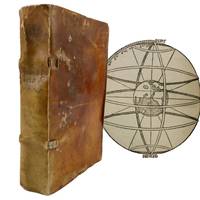
1558Best.-Nr. 800Wittenberg: Krafft 1558. Softcover. Fair. Misc. A remarkable survivor clearly a student's copy of Sacrobosco's Libellus de Sphaera printed in 1558 with the student's inscription at the bottom of the title page and a question and answer styled study guide bound at the rear 1560 by Hartmann Beyer. The shared shelfmark from the title page to the binding indicates the wallet-style binding may be contemporary to the book. Also this copy still retaining its broadside with the locations of the sun updated since the 365.25 days per calendar year causes yearly drift in the location of the sun by day since the true day is slightly shorter. Sacrobosco's work was first produced around 1230 a text book dedicated to spherical astronomy. Although Sacrobosco did use the Earth as central to all rotation his methods of finding the locations of stars the sun and moon based on elliptical patterns was fairly reliable and became the standard of students for centuries to come. He also correctly identified the world as a sphere. By 1558 the idea of the Earth as the center of the universe was largely dispelled but Sacrobosco's calculations and tables were so good that they were yet to be replaced so academies were updating to accommodate the new science. This copy has the commentary and editing of several 16th century scholars Philip Melanchthon and Erasmus Reinhold as well as a second book with commentary of Hartmann Beyer. The university usage of this copy is clear and to be noted. The scholar one Wolfgang notes at the bottom of the title page that he is studying physics. The 17th century date of study denotes that an older book was still acceptable in studies. Yet despite the later date the binding contains both the 1558 Sacrobosco and essentially a 1560 study guide posing the question ""Has this book been used for study before Wolfgang wrote in it"" A mystery is the Cistercian monastery also holding the work. Did they possess the book before or after Wolfgang Or was it from a different Cistercian monastery that was dissolved during the protestant reformation years leading up to Wolfgang's study Bibliographic Details - 1558 Sacrobosco - Universal Short Title Catalogue USTC number 668014 6 copies recorded in the world's libraries. 1560 Quaestiones. - Universal Short Title Catalogue USTC number 689026 5 copies recorded in the world's libraries and USTC 689025 recording four more copies. Physical Attributes - Measures approx. 15 x 9 x 3 cm. Vellum wallet-style wrapper. Spine with two bands. Spine with author/title in old hand. Sacrobosco's work is illustrated throughout some with diagrams that could be used as the base for moving parts. Sacrobosco - Pages - Not paginated Collation - A-R8 with last two blank leaves present. Collates complete. Beyer - Pages - xxxii 302 2 blank pages last leaf blank Collation - aa8 a8 b-u8 collates complete. Condition - See pictures. Wallet-style vellum binding with wear and cockling waviness. Bottom of flap corner chipped away. Top front strap missing from binding to text block causing looseness still connected in back. No pastedowns used. Matching library number to title page written on front board inner as well as bookseller notes of date/publication and ex libris of Gingerich. 1st gathering almost loose chipping to top edge. Title page heavily annotated with two ex libris. One is the library of a Cistercian monastery and the other is of an early 16th century student. The title page has heavy toning and some chipping along edges. Bottom corner of front of text block dog eared. Throughout text block there is use consistent with student usage. Occasional thumbing dog-eared corners annotations page-edge chips/tears fox spots candle ember marks etc. Occasional moisture mark from edge second half from upper corner worst at last page. Occasional faded page E gathering ink light. Krafft
1791Best.-Nr. 33222London: J. Johnson. Near Fine with no dust jacket. 1791. Second Edition. Hardcover. 4to 11" - 13" tall; 214 126 & 202 pages; Contemporary mottled calf with cracked covers both repaired. Small bookplate on inside front cover and old catalog description tipped in. 2nd edition of both parts with all plates. . J. Johnson hardcover
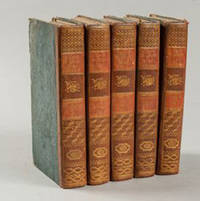
Best.-Nr. 51-4439Paris: F. Buisson An 7 de la République 1798-99. 5 vols. 12.5 x 19.5 cm. Contemporary qtr. roan very good slightly worn on edges. 39 plates including fold-out maps. Cordier Sinica 2384; OCLC Number: 551933808 lists vol 5 only. .CONTENTS:• Tome premier.• 1Front cover• 5Title page• 11Préface du traducteur.• 23Précis de l'histoire de la Chine.• 199Avertissement de l'auteur anglais.• 201Chapitre premier. Motifs qui ont déterminé la cour de Londres a envoyer und ambassade à la Chine.• 240Chapitre II. Préparatifs de l'ambassade.• 268Chapitre III. Passabe de Portsmouth à Madère. Observations sur cette isle.• 312Chapitre IV. Passage à Ténériffe et à Sant-Yago. Remarque sur ces isles.• 388Chapitre V. Le lion et l'Indostan passent la ligne. Navigation dans la mer atlantique. Port ville et pays de Rio-Janeiro.• 457Chapitre VI. Traversée dans la partie méridionale de la Mer Atlantique et de l'Océan Indien. vue des îles de Tristan d'Acunha dans la première de ces mers et de celles de Sain-Paul et d'Amsterdam dans la seconde.• 507Table of contents• 521Back cover• Tome second.• 523Front cover• 527Voyage dans l'intérieur de la Chine et en Tartarie. T. II.• 531Chapitre premier. Entrée dans le détroit de la sonde. Relache A Batavia dans l'esle de Java.• 603Chapitre II. Vue de l'extrémité méridionale de l'isle de Sumatra. Relache à Bantam. Passage dans le détroit de Banca. Arrivée à Pulo-Condor.• 654Chapitre III. Cochinchine.• 737Chapitre IV. Traverseée de la Cochinchine aux isles des Larrons près de Macao et de la a Chu-San. Observations sur ces diférens pays.• 811Chapitre V. Navigation dans la Mer Jaune. Entrée de l'ambassade dans la rivière qui conduit à Tien-Sing.• 850Chapitre VI. Entrée de l'ambassadeur dans la rivière qui conduit à Tien-Sing.• 919Chapitre VII. L'ambassade remonte la rivière Peiho pour se rendre dans la capitale de la Chine.• 940Table of contents• 955Back cover• Tome troisième.• 957Front cover• 961Title page• 965Chapitre premier. Continuation du voyage sur le Peiho. Les vaisseaux-anglais quittent le golfe de Pé-Ché-Lée.• 1012Chapitre II. Continuation du voyage sur le Peiho. Les vaisseaux anglas quittent le golfe de Pé-Ché-Lée.• 1058Chapitre II. =III. L'ambassade débarque près de Tong-Chou-Fou. Elle traverse Pékin pour se rendre dans un palais qui est au-dela. Elle retourne dans la capitale.• 1229Chapitre IV. L'ambassade anglaise arrive auprès de l'empereur de la Chine en Tartarie dans le palais ou ce prince fait sa résidence pendant l'été.• 1336Chapitre V. Retour à Pékin. Séjour de l'ambassade dans cette capitale et à Yuen-Min-Yuen. Observations qui y ont rapport.• 1387Table of contents• 1409Back cover• Tome quatrième.• 1411Front cover• 1415Title page• 1419Chapitre premier. Suite des observations qui ont rapport à Pékin et à la cour de la Chine.• 1455Chapitre II. Départ de Pékin. Voyage à Han-Chou-Fou fait en partie sur le canal impérial.• 1596Chapitre III. Vue de Han-Chou- Fou et voyage à Chu-San.• 1626Chapitre IV. Voyage de Han-Chou-Fou à Canton. Passage du lion et de l'Indostan de Chu-San à Canton.• 1720Chapitre V. Séjour de l'ambassade anglaise à Canton.• 1799Table of contents• 1817Back cover.Voyage dans l'intérieur de la Chine et en Tartarie fait dans les années 1792 1793 et 1794. Staunton George Leonard 1737-1801 - Sir Macartney George 1737-1806. Auteur Gower Erasmus 1742-1814 - Sir. Auteur Huttner Johann Christian 1766-1847. AuteurParis Buisson an 7 2e édition augmentée 5 volumes in-8 reliés demi-basane dos lisses ornés double pièce de titre. Illustrés de 39 planches dont 4 frontispices et 4 cartes.Cette seconde édition publiée un an après la première contient 32 nouvelles planches qui ont également été réunies dans un atlas pour les acquéreurs de la première édition. Macartney fut envoyé en Chine par George III pour établir un contact avec les élites de la dynastie Qing et en rapporter toutes les observations possibles tant sur le plan des moeurs de la nature que du commerce. Il fut le premier européen à naviguer sur la mer Jaune et fut reçu à la résidence de l'empereur avec les honneurs les plus extravagants.Expertise by F. Valleriaux Paris. Paris: F. Buisson, An 7 de la République (1798-99) unknown
1554Best.-Nr. 2212260023Basel: Froben 1554. First Edition. Hardcover. Acceptable. Opera of Josephus: Containing Sigmund Gelen and Erasmus's translations Folio. Bound in modern vellum with leather ties. Woodcut printer's device on title. 8 886 blank 24 of 32 pages. Lacking last 8 pages of the appendix. Some contemporary marginalia but generally sound. "De imperio rationis" is from Erasmus's 1517 translation. Hoffmann II:593. Not in Adams. Contents: 1. Antiquities of the Jews with Flavius's autobiography translated by the Czech philologist Sigmund Gelen 1497-1554; 2. the Jewish war; 3. Against Apion both in the late antique translation by Ruffinus of Aquilea 340-410 revised by Gelen; 4. a treatise on the martyrdom of the Maccabees edited by Erasmus. Froben hardcover
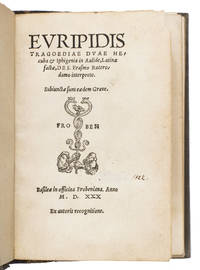
1530Best.-Nr. ABC_49914Basel 1530. 8vo 10.4 x 15.4 cm. Froben Office heirs of Johann Froben 19th-century half brown calf and grey paper sides. With a woodcut printer's device on the title page and final page and 7 decorated woodcut initials. 293 1 1 blank 1 pp. This volume brings together Erasmus renditions in Latin of two of Euripides most enduring tragedies titled Hecuba and Iphigenia in Aulis presented alongside the original Greek texts beginning on page 169. Euripides ca. 480-ca. 406 BCE was a Greek tragedian of classical Athens. He is one of only three Greek tragedians whose plays have survived in full the others being Aeschylus and Sophocles.Both plays in the present work explore the devastating costs of war through the eyes of women caught in its aftermath. In Hecuba the former queen of Troy endures unspeakable losses the sacrifice of her daughter Polyxena the murder of her son Polydorus and ultimately a brutal act of revenge that leads to her mythical transformation into a howling dog symbolising her complete descent into grief and rage.Iphigenia in Aulis is set on the eve of the Trojan War focusing on Agamemnons impossible decision to sacrifice his daughter Iphigenia to appease the goddess Artemis and allow the Greek fleet to sail. The play confronts themes of duty honour and the personal costs of collective ambition. These themes echo tragically in Hecuba which portrays the wars bitter consequences. Together these tragedies form a poignant narrative arc from the sacrifices made to start a war to the wreckage and human suffering left in its wake.With a partially erased manuscript note on the title page 1822. Some water staining in the margins and a few small holes in the inner margin not affecting the text. Otherwise in good condition.l Adams E 1042; BM STC German p. 289; De Reuck 425; Erasmus Online 4215; Vander Haeghen II 25; VD 16 E 4231; USTC 654881; not in Kossmann. unknown
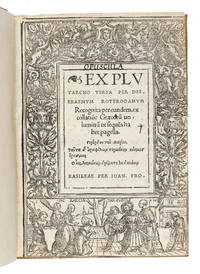
1520Best.-Nr. ABC_49876Basel: Johann Froben 1520. Modern gold-tooled half calf and marbled paper sides with the author title and year of publication lettered in gold on the spine red sprinkled edges. 4to. With the title set within an elaborate woodcut frame a smaller woodcut frame on the verso of the title page and the first page of the first text. Further with 9 woodcut decorated initials woodcut headpieces and a small woodcut illustration incorporating Frobens device on the last page. This finely printed 1520 Basel edition presents a collection of Erasmus earliest translations from the works of the Greek moral philosopher Plutarch. The volume presents eight of Plutarch's shorter treatises addressing themes such as friendship health and the nature of the human soul.One of the most notable inclusions is De discrimine adulatoris et amici How to tell a flatterer from a friend a treatise Erasmus translated during his time in Cambridge and dedicated to King Henry VIII. The text which explores the subtle art of distinguishing true friendship from sycophancy resonated in an era when rulers were often surrounded by flattering courtiers. With characteristic tact Erasmus hoped the work might serve both as philosophical instruction and as a gentle warning to the young English king particularly in light of those who had encouraged Henrys war with France.Furthermore the present work includes two of Plutarchs important medical treatises in Erasmus translation: De tuenda bona valetudine Advice on keeping well and Utrum graviores sint animi morbi quam corporis Are diseases of the soul more serious than those of the body. The latter contains strikingly early and thoughtful reflections on what we now recognise as mental illness. Other works included in this volume are: Quo pacto quis efficere possit ut capiat utilitatem ab inimico reflections on transforming enmity into wisdom and personal growth. In principe requiri doctrinam on the necessity of wisdom and education in a prince. Cum principibus maxime philosophum debere disputare a meditation on the philosophers role in advising those in power. Num recte dictum sit e ßsa on the meaning of the maxim lathe biosas: to live quietly and modestly. De cupiditate divitiarum a discourse on avarice and the moral corruption born of greed.With a small manuscript note added above the title opuscula and a 17th- or 18th-century owners inscription by an otherwise unidentified Johannes below the colophon on the final page. Slightly foxed and browned throughout the fore-edge and lower margins are cut slightly short barely affecting the printed marginalia. Otherwise in good condition.l Adams p. 654; Ledo pp. 260-66; USTC 655014 6 copies; Vander Haeghen II 46; VD 16 P 3718; not in BM STC German; De Reuck. Johann Froben, unknown
1603Best.-Nr. 114251Witebergae, Impensis Zacharia Schüreri, impr. Typis Cratontanis 1603 In-16 15,5 x 9,5 cm. Reliure de l’époque vélin ivoire, dos lisse, titre manuscrit illisible, [50]-268-[10] pp. Ouvrage d’une relative rareté. Reliure patinée, pages de garde et de titre déchirées, en coin de pied, 50 premières pages sensiblement jaunies, 1 cahier délié, intérieur correct.
1534Best.-Nr. 372192Basel: Froben 1534. Froben's printer's device on first and last leaf of each work. 415 1; 191 1pp. 8vo. Early half calf and pastepaper boards. Spine ends rubbed front joint cracked but cords holding. Very good. Froben's printer's device on first and last leaf of each work. 415 1; 191 1pp. 8vo. Early Froben edition of a pedagogical work by Erasmus "On the Writing of letters" first published in 1522 with a collection of aphorisms or "Parallels" gathered out of Plutarch's Moralia Seneca Lucian Xenophon Demosthenes Aristotle Pliny and Theophrastus. An edition was published in Cologne in the same year and the work was a standard throughout the sixteenth century. VD16 E2515 E3257. Provenance: Princes of Liechtenstein armorial bookplate; General Theological Seminary bookplate Froben unknown books
Best.-Nr. 1464London: J. Johnson. THE FIRST OF DARWIN'S FOUR MAJOR WORKS THE BOTANIC GARDEN" IS OFFERED HERE IN TWO HANDSOMELY BOUND VOLUMES Dictionary of Scientific Biography III 578-579. Erasmus Darwin 1732-1802 was a remarkable polymath working as a physician naturalist medical botanist and inventor. He was also Charles Darwin's grandfather. The Botanic Garden is an annotated scientific poem in Augustan couplets. It appeared in two parts of which the second The Loves of the Plants 1789 was published before the first The Economy of Vegetation 1791. "Darwin decided to publish the second part of the work first because it was better suited "to entertain and charm." The first part of the work is more ambitious than the second covering all natural philosophy and embodying many of the researches and inventions of Wedgwood Watt Boulton and others. The design of the totality was Darwin wrote 'To enlist Imagination under the banner of Science. to induce the ingenious to cultivate the knowledge of botany. and recommending to their attention the immortal works of the celebrated Swedish naturalist-Linnaeus.' "Darwin believed that prose was suited to abstract ideas but chose to write poetry for its ability to conjure up visual images; he drew upon the Rosicrucian doctrine of Gnomes Sylphs Nymphs and Salamanders presiding over the four elements in his personifications of all scientific technological and natural phenomena. Although William Cowper and other early critics greeted The Botanic Garden with praise" ibid. We offer Darwin's Zoonomia; or The Laws of Organic Life Volumes I & II 1794 & 1796 separately. CONDITION & DETAILS: J. Johnson London. Complete. Two volumes. 4to. 12 x 9.5 inches; 30 x 24cm. Volume I: xii 214 126 1; Volume II: 2 ix 197 1pp. 20 engraved plates inclusive of five by William Blake and two 2 by John Henry Fuseli. Very handsomely rebound in full calf; blind-stamped on the front and rear boards. The spine is gilt-ruled with decorative devices in the compartments. Also a gilt-lettered black morocco spine label. New endpapers. Minor foxing and offsetting see photos otherwise clean and very bright throughout. J. Johnson hardcover
1534Best.-Nr. 372192Basel: Froben 1534. Froben's printer's device on first and last leaf of each work. 415 1; 191 1pp. 8vo. Early half calf and pastepaper boards. Spine ends rubbed front joint cracked but cords holding. Very good. Froben's printer's device on first and last leaf of each work. 415 1; 191 1pp. 8vo. Early Froben edition of a pedagogical work by Erasmus "On the Writing of letters" first published in 1522 with a collection of aphorisms or "Parallels" gathered out of Plutarch's Moralia Seneca Lucian Xenophon Demosthenes Aristotle Pliny and Theophrastus. An edition was published in Cologne in the same year and the work was a standard throughout the sixteenth century. VD16 E2515 E3257. Provenance: Princes of Liechtenstein armorial bookplate; General Theological Seminary bookplate Froben unknown
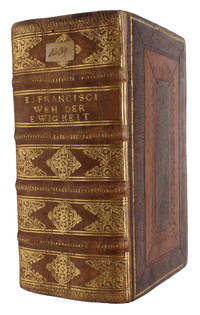
1682Best.-Nr. 60722Nürnberg W.M. Endters 1682 8vo. In a nice contemporary Cambridge-style mirror binding with four raised bands and richly gilt spine. Small paper-label pasted on to top of spine. A very nice copy. 28 1195 5 pp. frontispiece and 51 engraved plates. Rare first edition of Franciscus' extensive work richly illustrated with exotic depictions of the road to hell. A second edition was published in 1686. German Emblem Books 1531-1888: 290. hardcover
1682Best.-Nr. 60722Nurnberg, W.M. Endters, 1682 8vo. In a nice contemporary Cambridge-style mirror binding with four raised bands and richly gilt spine. Small paper-label pasted on to top of spine. A very nice copy. (28), 1195, (5) pp. + frontispiece and 51 engraved plates.
1531Best.-Nr. 94471531 Parisiis in via Iacobaea, apud Ludouicum Cyaneu sub duobus Gallis & Ionnem Roigninum sub Basilisco, 1531. Un volume in-12 (12 x 16,5 cm), [16]-746-[36] pp. (epistola nuncupatoria + lib. I-VI + index). Signatures: aii-cciiiib. Colophon: « Parisiis ex officina ludovici Cyanei sub duobus gallis in via Iacobea, Anno M.D.XXXI, mense Augusto». Livre bien complet de tous ses feuillets. Dans une reliure dépoque en cuir marron foncé, les plats estampés à froid, dos à cinq nerfs, tranches rouges. La couverture, notamment le dos, ont été habilement restaurés au XXe siècle, tout comme la page de titre et la dernière garde. Pages salies en début et fin d'ouvrage, écritures anciennes à la plume au verso de la page de titre, quelques soulignages dans le corps du texte, sinon ouvrage en bon état et parfaitement lisible.
1535Best.-Nr. 92971535 Basileae, in officina Frobeniana [per Hieronymum Frobenium et Nicolaum Episcopium], 1535. Un volume in-8° (122 x 181 mm) de [16]+864+[56] pages, marques dimprimeur au titre et en dernière page. Reliure de lépoque en plein en plein veau glacé marron estampé à froid et portant sur le plat supérieur le nom de son propriétaire, Hupert Heymer, fermoirs de laiton, dos à nerfs orné à froid. Charnières fendues, mais les doubles ficelles des nerfs sont intactes! Ex-libris manuscrit au haut de la page de titre: «Colleg[ii] Soc[i eta]tis Jesu, Silvae Duc[is] (biffé et remplacé par ) Alosti, 1621» (Hertogenbosch, Pays-Bas, et Alost, Belgique).
1671Best.-Nr. Pv5b111a"Prince of Christian Humanists" Desiderius Erasmus 1466 1536 was undoubtedly the most widely read author of the 16th Century. His books were best sellers; his writings accounted for 10-20% of all book sales in Europe by the 1530's. Presented here is the first Printing in the English language of his Colloquies A Work of very great Use to such as desire to attain an exact knowledge of the Latin Tongue. First published in 1518 and expanded by Erasmus over the next fifteen years Erasmus' Colloquies deliver a collection of lively dialogues which delighted readers far beyond the Renaissance schoolroom for whom these were originally intended. They cover a wide range of topics including religion education morality and social issues. The dialogues often satirical and critical address the issues of Erasmus' time and offer sharp commentary on contemporary society. The Colloquies were intended to teach Latin and moral lessons to students but they also serve as a window into the intellectual and cultural landscape of the Renaissance. The English translation of the Erasmus' Colloquies introduced English-speaking audiences to Erasmus' ideas and philosophy creating a profound impact on European intellectual thought during the Renaissance. The Colloquies also played a key role in the development of English prose and language as they were widely read and studied by both students and scholars. This highly enticing very scarce first printing is in excellent condition professionally rebound in full leather with five compartments and four ribs to spine with bright gilt details and title. Binding and hinges are firm new end papers and paste downs no loose or missing pages. Completely free of writings or markings of any kind light scattered foxing some mild damp staining to early and last pages see photos. 555 pages. A desirable example of this most significant Erasmus first appearance in English. Book #Pv5b111. $1895. We specialize in Rare Ayn Rand and other legends and landmarks. Brome, Tooke, Sawbridge hardcover
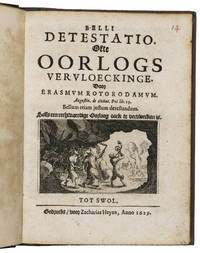
1629Best.-Nr. 2941Zwolle 1629. 4to. for Zacharias Heyns colophon: printed by Frans Jorrijaensz 19th century half brown morocco with the author title and imprint lettered in gold on the spine brown cloth sides. With a large engraved emblem on the title page 5 decorated woodcut initials a woodcut headpiece 2 headpieces built up from typographical ornaments a woodcut tailpiece and a tailpiece built up from typographical ornaments. 28 ll. First edition of Zacharias Heyns' new Dutch translation of Erasmus' famous anti-war essay Dulce bellum inexpertis. This essay was originally part of the 1515 edition of the Adagia but was first published as an independent work by Johann Froben in 1517 with the title Bellum. The present Dutch edition is quite rare as we have not been able to find any other copies in sales records of the past hundred years.The Adagia was first published in 1500 but Erasmus continued to edit the work until his death. The 1515 edition published by Froben was greatly expanded but the essay for the proverb Dulce bellum inexpertis war is sweet to the inexperienced was the longest and most remarkable addition. In the essay Erasmus argues that war is senseless unchristian and contrary to human nature. He also critiques the militaristic culture of his time which glorified violence and aggression and advocates instead for diplomacy and negotiation. The essay became so popular that Froben published it separately. Within ten years it had been reissued at Louvain twice at Strasbourg twice at Mainz at Leipzig twice at Paris twice at Cologne at Antwerp and at Venice. German translations of it were published at Basel and at Strasbourg in 1519 and 1520 and an English translation followed in 1533. The first Dutch translation was made in 1622. The present second Dutch translation made during the Eighty Years' War shows how the work continued to inspire more than a hundred years after it was first written.The spine has been slightly rubbed. The end paper are browned the work is lightly browned throughout. Otherwise in good condition.l Knuttel 3921; Bibl. Belgica E 247; Erasmus Bibl. Rotterdam p. 29; Erasmus Online 465; STCN 831153881; USTC 1026760; Vander Haeghen I p. 22. hardcover
1800Best.-Nr. 142097London: Printed for J. Johnson 1800. viii 612pp. Quarto 220 x 270mm. Contemporary calf with gold gilt decorations to the spine and gilt lettering stamped to a black moroccoo spine label. Illustrated with 12 engraved plates 2 folding 9 with an accompanying non-paginated text leaf. Some rubbing and wear to the boards with the top corners a bit bumped. Previous owner's inscription: "REVD. WILLIAM. RUSH. CHURCHILL 1775-1847 of Colliton Dorchester". Ex-libris of Darwin bibliographer Richard Freeman. Some offsetting and light foxing to the plates otherwise a tight and clean copy. A very good copy of this work by the grandfather of Charles Darwin with an interesting provenance. Erasmus Darwin was a well known English physician having turned down the opportunity to be a physician to the King at one point as well as a natural philosopher physiologist slave-trade abolitionist inventor and poet. 1800 Printed for J. Johnson hardcover